
In Q2 2026, TrendPower partnered with Emeishan Longqi Power to develop an interconnected heavy-duty truck charging platform designed to connect charging stations, electric truck fleets, vehicle data and payment operations in one network. The project aims to transform fragmented charging sites into coordinated energy nodes, helping operators improve station utilization while enabling fleets to plan faster and more predictable charging along major logistics routes.
The project is built around the same commercial fleet requirements addressed by TrendPower’s Heavy-Duty Truck Charging Fleet Management System: connecting vehicles, chargers, battery status, fleet accounts, charging transactions and operational data through one digital platform.
As electric heavy-duty trucks expand from closed industrial scenarios into medium- and long-haul logistics, the challenge is changing. The question is no longer simply how to deploy more chargers. It is how to connect charging infrastructure, vehicle demand and operational data so that the entire network can work more efficiently.
Case Study at a Glance
- Client: Emeishan Longqi Power
- Industry: Heavy-duty electric truck charging and logistics energy services
- Project: Heavy-duty truck charging traffic aggregation platform
- Region: Sichuan, China
- Core capabilities: Charging network interoperability, VIN-based charging, dual-connector charging, vehicle telematics integration, SOC monitoring, charging route planning, enterprise fleet management and centralized payment
- Project objective: Connect self-operated and third-party charging stations into a scalable charging service network for electric heavy-duty trucks
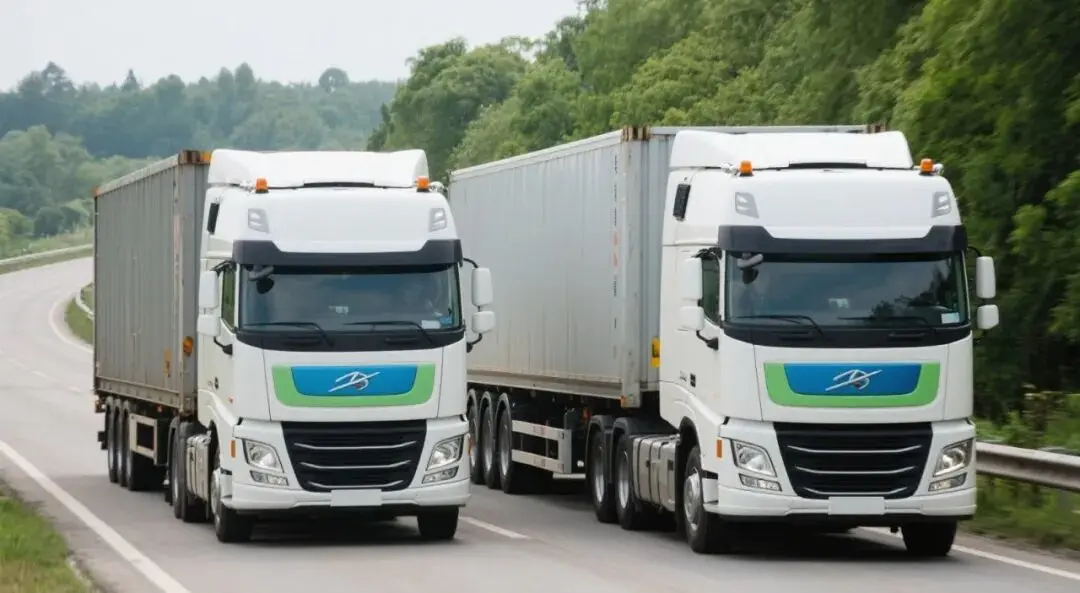
The Industry Shift: Heavy-Duty EV Charging Is Moving Beyond Closed-Loop Operations
China’s electric heavy-duty truck market has entered a period of rapid expansion. Market penetration has moved from below 1% during the industry’s early development stage to much higher levels in recent periods, with electric trucks becoming increasingly visible in commercial logistics operations.
More importantly, the operating environment itself is changing.
In the early stage of heavy-duty truck electrification, electric trucks were mainly deployed in relatively closed scenarios such as ports, mines, industrial parks and short-haul transport routes. A charging station typically served a fixed fleet operating on predictable routes, which made station operation and energy planning comparatively straightforward.
Today, electrification is increasingly extending toward regional and trunk-line logistics. Trucks are no longer restricted to a single closed route, while a growing number of vehicles need charging services while traveling between cities and logistics hubs.
This creates a fundamentally different charging requirement: mobile charging demand must be matched with distributed charging capacity in real time.
For businesses evaluating this transition in more detail, TrendPower’s guide to heavy-duty EV charging management software explains how fleet charging software can connect vehicle identification, charging operations, enterprise accounts and billing workflows for commercial truck fleets.
Why Isolated Heavy-Duty Truck Charging Stations Struggle
The opportunity is significant, but both charging station operators and logistics fleets face operational friction when charging resources remain fragmented.
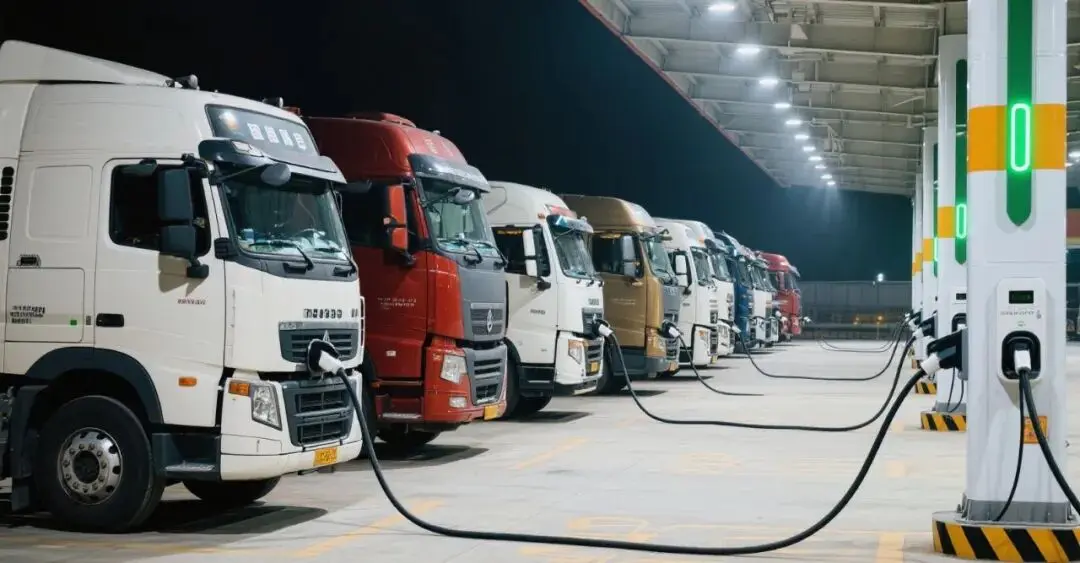
Challenges for Charging Station Operators
Heavy-duty truck charging demand often has a strong peak-and-valley pattern. A station may experience long queues during busy transportation periods but remain significantly underutilized during off-peak hours.
- Limited local customer reach: A standalone charging station often depends heavily on nearby fleets and passing vehicles already familiar with the site.
- Fragmented traffic: Independent stations have limited ability to attract and redirect cross-regional truck traffic.
- Low visibility of future demand: A single station sees only a small portion of the total vehicle flow along a logistics corridor.
- High infrastructure investment: Land, grid capacity expansion, charging equipment and construction all increase the pressure to improve charger utilization.
- Demand imbalance: High utilization at one location can coexist with idle chargers at another nearby station.
The result is a structural mismatch between available charging capacity and actual vehicle demand. Centralized EV charging point management software provides the digital foundation for managing chargers, sessions, users, tariffs and operational data across multiple charging locations.
Challenges for Electric Truck Fleets
For trunk-line logistics fleets, charging time directly affects vehicle utilization and freight turnover.
When charging information is fragmented across different station operators and applications, drivers may spend considerable time searching for a suitable charging site. Even after arriving, they may encounter queues or discover that available charging capacity is insufficient.
Additional empty driving to locate a charger creates further energy consumption, vehicle downtime and scheduling uncertainty.
For fleet operators, the real question is therefore not simply “Where is the nearest charger?” It is:
- Which station is compatible with the vehicle?
- How much energy should the truck receive at this stop?
- How many chargers are currently available?
- What is the expected charging or waiting time?
- Which charging stop best fits the truck’s route, load and remaining battery level?
For a deeper explanation of the operational software layer behind these decisions, see TrendPower’s Heavy-Duty Truck Charging Fleet Management System Guide.
From Fragmented Stations to One Connected Heavy-Duty Truck Charging Platform
To address this problem, Longqi Power and TrendPower are building a traffic aggregation platform based on a simple principle: connect fragmented charging supply and mobile fleet demand through one interoperable digital network.
The concept is similar to the aggregation model used by online travel platforms. Instead of every charging station operating as an isolated digital island, multiple charging operators can make their station resources available through a common platform, while fleets gain access to a broader charging service network.
This creates a transition from station-based operations to network-based operations.
Unlike a fixed single-site deployment, this type of project requires a software architecture that can support multiple station operators, charging equipment integrations, enterprise fleet accounts, vehicle data and commercial settlement. TrendPower develops these scenarios through its custom EV charging software solutions, adapting the platform architecture to the operator’s actual business model and integration requirements.
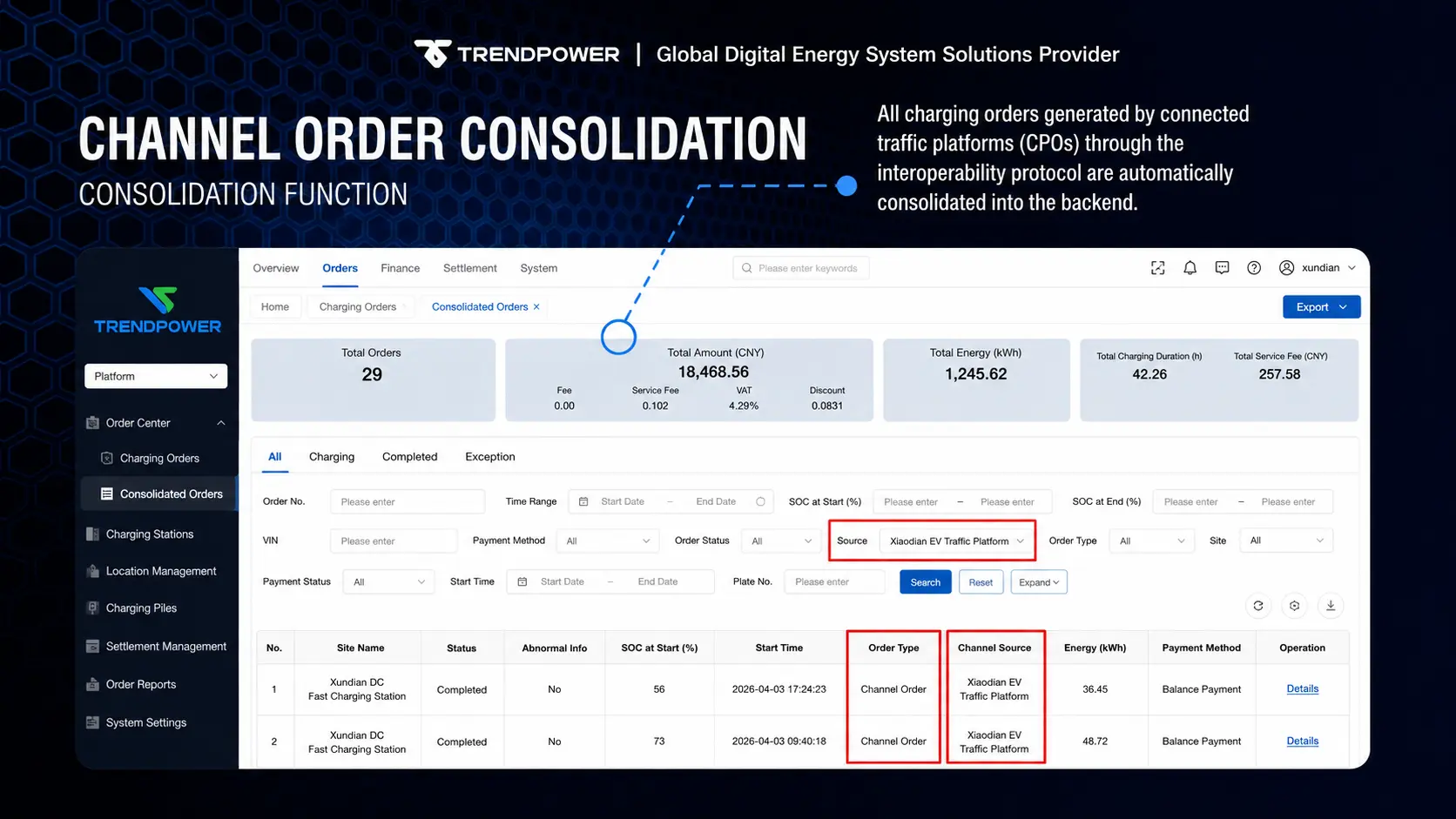
What Does the Platform Mean for Charging Station Operators?
For station operators, interoperability allows each charging site to become part of a larger logistics energy network rather than relying entirely on its own customer acquisition capability.
When fleets travel between Point A and Point B, the platform can match their charging requirements with suitable stations along the route. A participating charging site can therefore receive demand from vehicles that might otherwise never have discovered or selected that station.
The potential benefits include:
- Higher charger utilization
- Access to more cross-regional fleet traffic
- Better visibility of charging demand
- More effective use of existing charging assets
- New transaction-based service revenue opportunities
What Does the Platform Mean for Fleet Operators?
For electric truck fleets, the platform is designed to provide cross-operator and cross-region charging planning.
Instead of waiting until the battery reaches a low level before searching for a charger, a fleet can use vehicle status and route information to identify suitable charging opportunities in advance.
The system can support decisions such as:
- where the truck should charge;
- how much energy should be added;
- which available station best fits the planned route;
- whether available chargers can meet the vehicle’s charging requirements; and
- how the charging stop may affect the overall transportation schedule.
The objective is to make truck charging part of the logistics plan rather than an unpredictable interruption to it.
A similar fleet-oriented operating challenge can be seen in TrendPower’s Fleet EV Charging Software for Logistics Parks case study, where charging software connects commercial vehicles, enterprise accounts, charging infrastructure and operational workflows within logistics park environments.
Building a Connected Charging Corridor Across Sichuan
Longqi Power focuses on charging services for electric heavy-duty truck fleets and has developed charging infrastructure along multiple logistics corridors in Sichuan, including areas such as Emeishan, Chengdu, Deyang, Suining, Luzhou, Yibin, Hanyuan and Ganzi.

These charging sites form the foundation for the next stage of development: moving from a collection of individual charging assets toward an interconnected charging service network.
Based on Longqi Power’s strategic requirements, TrendPower is developing the platform around Longqi’s existing charging stations while enabling connections with additional charging operators along major transportation routes.
The goal is to demonstrate how a regional heavy-duty EV charging corridor can be built through software interoperability and ecosystem collaboration, rather than depending exclusively on the construction of self-owned charging infrastructure.
This route-based operating model is also relevant to port and container logistics. TrendPower’s Port Drayage EV Charging Software case study shows another commercial electric-truck scenario involving vehicle charging, route operations, fleet payments and battery information.
VIN-Based Charging and High-Power Dual-Connector Support
Heavy-duty commercial vehicles have very different operational priorities from passenger EVs. Every additional step in the charging process can translate into fleet downtime when multiplied across hundreds or thousands of charging sessions.
For this reason, the Longqi platform supports VIN-based vehicle identification and charging authorization.
Instead of repeatedly scanning a QR code, opening an application and completing multiple confirmation steps, an authorized vehicle can be identified through its VIN information and associated fleet account.
The platform is designed to support a simplified charging experience:
Connect the charger, start charging, complete the session and continue the journey.
It also supports dual-connector simultaneous charging for compatible heavy-duty truck charging scenarios, helping high-capacity commercial vehicles receive high-power energy replenishment more efficiently.
These capabilities form part of TrendPower’s broader heavy-duty truck fleet charging solution, which is designed around commercial vehicle readiness, charging management, vehicle data and fleet operations.
Charging Station Interoperability: Connecting Multiple Operators Through One Platform
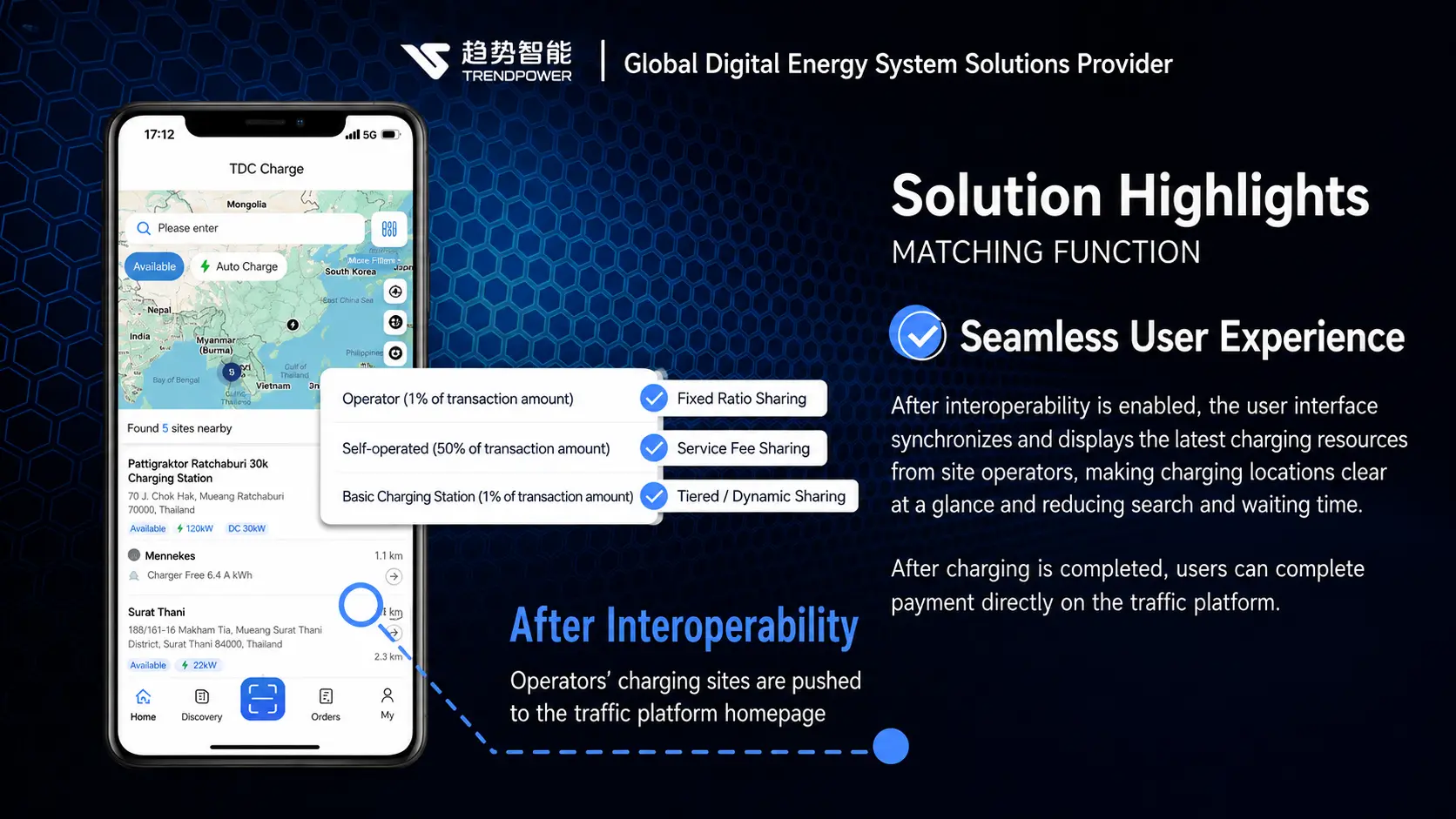
A traffic aggregation platform cannot scale if every charging operator remains technically isolated. Interoperability is therefore one of the core architectural components of the project.
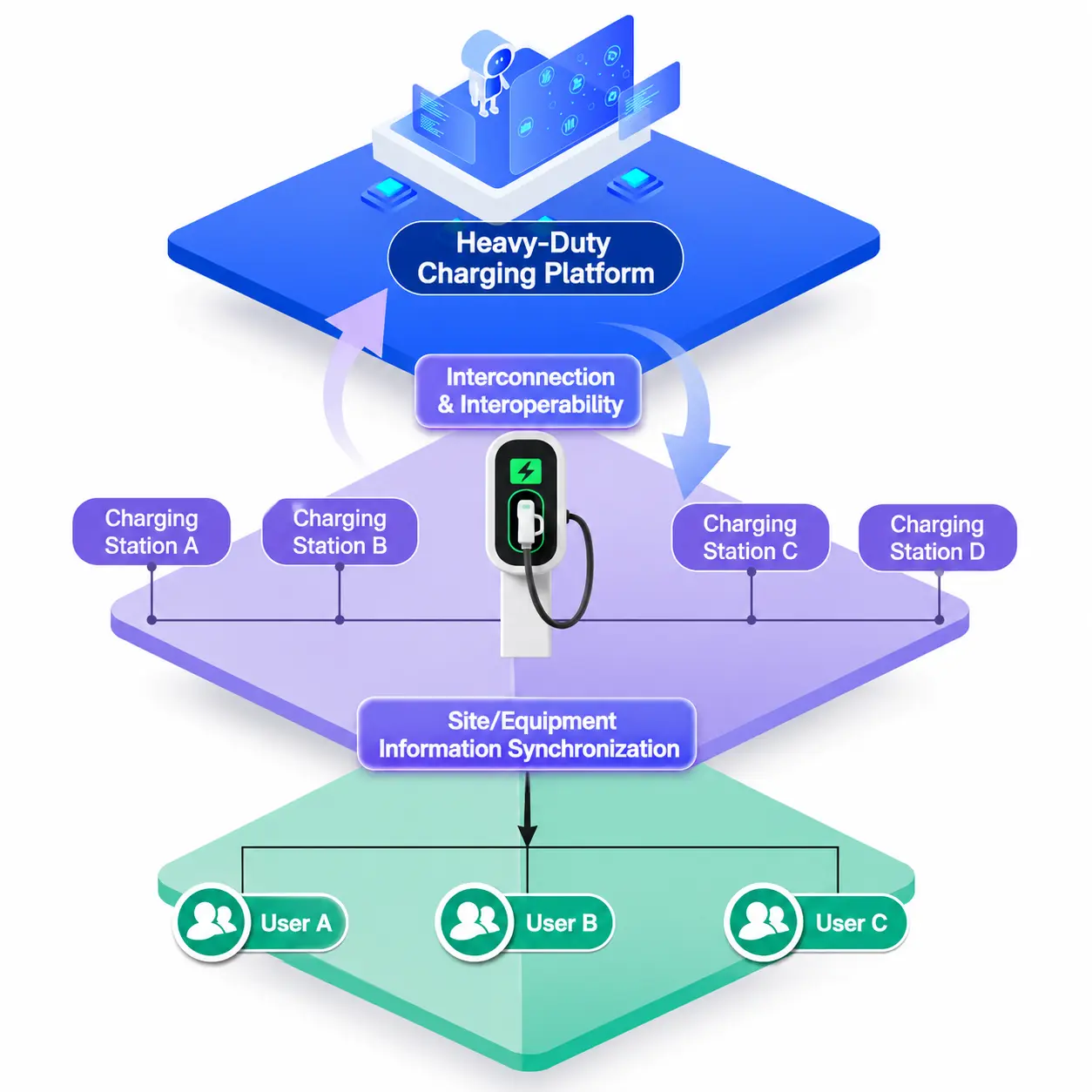
The TrendPower platform supports integration based on the China Electricity Council interoperability protocol, enabling the platform to connect with third-party charging equipment and charging operation systems.
The integration architecture covers the charging equipment connection lifecycle from initial configuration to ongoing data synchronization and operational monitoring.
For international charging networks, open charging protocols play a similar role in helping software communicate with chargers from multiple manufacturers. TrendPower’s OCPP EV Charging Software Guide explains how standards-based charger connectivity can support more flexible, hardware-agnostic charging networks.
1. Integration Parameter Configuration
Administrators can dynamically configure connection parameters for third-party charging operation platforms, including items such as APPKey, security credentials and API endpoint addresses.
Integration status can be enabled or disabled according to operational requirements, giving platform administrators greater flexibility when onboarding different charging partners.
2. Station and Charger Synchronization
The platform supports full synchronization of charging station and charger information returned by connected equipment operators.
After the initial synchronization, scheduled API calls can be used to retrieve incremental updates, helping the platform maintain accurate information as chargers are added, modified or removed.
3. Real-Time Data Push
Third-party equipment platforms can push station or charger status changes to the traffic platform.
During an active charging session, charging data can also be synchronized so that users and operators can view relevant charging information through the unified platform.
4. Charging Session and Transaction Records
When a charging session ends, the platform can receive and exchange detailed charging records and automatically generate the corresponding charging order based on data returned by the connected charging operator.
This creates a digital foundation for cross-operator transaction reconciliation and platform settlement. For operators that require more advanced wallet, billing, reconciliation and settlement workflows, TrendPower also provides a dedicated EV Charging Payment Solution.
5. Integration Health Monitoring
The system can periodically check communication status between the platform and connected systems, helping operations teams identify connection abnormalities and maintain continuous platform availability.
For larger distributed charging networks, this monitoring layer can be extended with intelligent EV charging operations management, including centralized device monitoring, fault alerts, remote diagnostics and maintenance workflows.
Connecting the Charging Network With Heavy-Duty Truck Telematics
Knowing where chargers are located is only one part of an intelligent fleet charging system. To make better charging decisions, the platform also needs to understand the status of the vehicle.
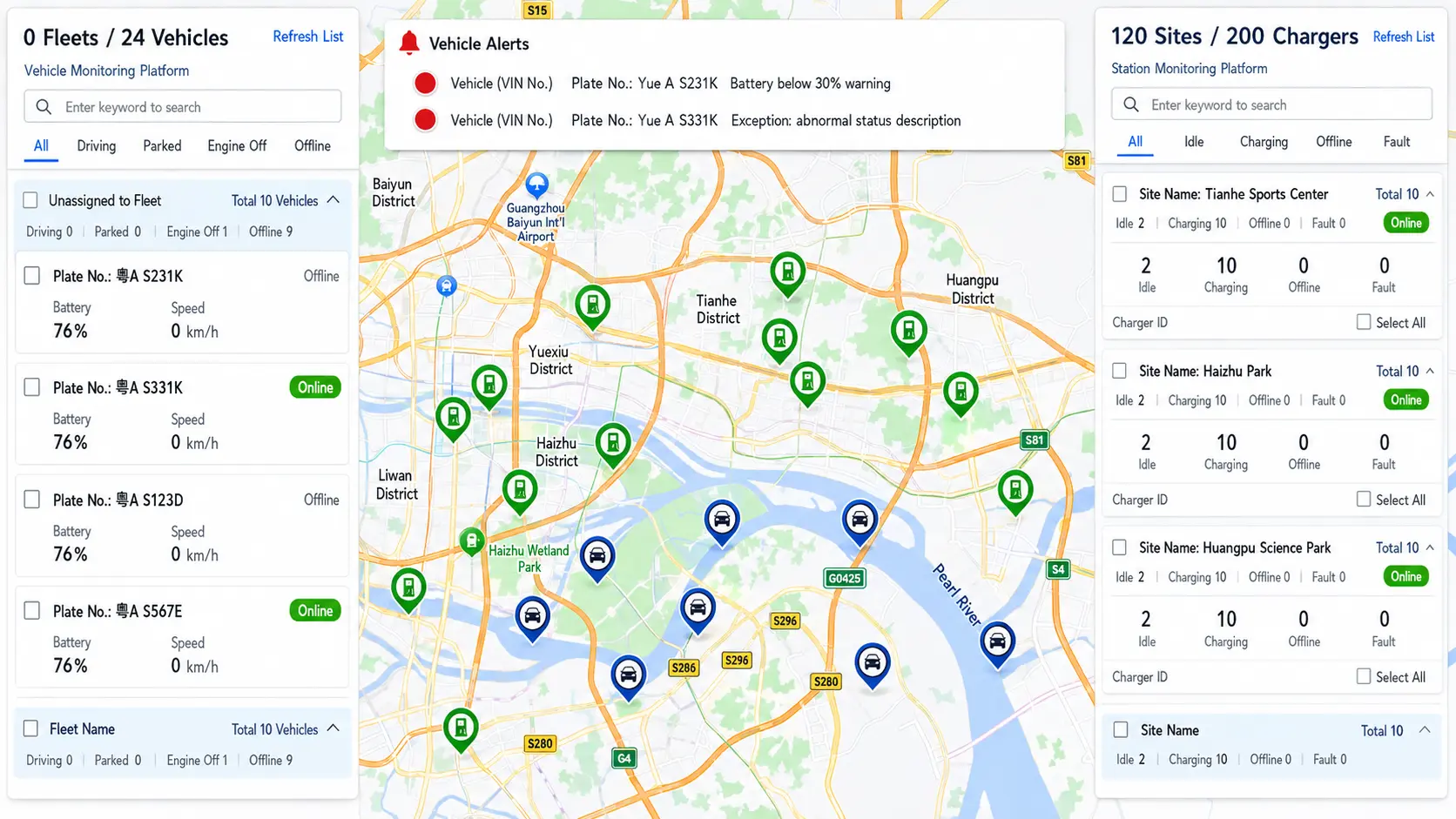
TrendPower therefore integrates the platform with third-party heavy-duty truck telematics systems through APIs, enabling the system to obtain data such as:
- real-time vehicle location;
- State of Charge (SOC);
- State of Health (SOH); and
- vehicle operating information required for charging decisions.
Combining vehicle data with charging network data creates a more complete decision loop for trunk-line fleet energy management.
1. Low-SOC Vehicle Alerts
Fleet administrators can configure a low-battery threshold for vehicles. For example, when a truck’s SOC falls below 30%, the system can automatically trigger an alert so that the driver or fleet operator can begin planning the next charging stop.
This helps reduce the risk of a driver overlooking battery status during a logistics journey.
2. Intelligent Charging Route Planning
After receiving a low-SOC or vehicle status alert, the system can combine the planned transportation route, current SOC and real-time vehicle position to identify suitable charging stations along the journey.
Instead of treating charging as a separate activity, the platform integrates charging decisions into the vehicle’s operating route.
3. Nearby Charging Station Recommendations
Fleet operators can select a vehicle in the management platform and retrieve charging station recommendations based on its current position.
Stations can be evaluated according to operational factors such as:
- distance from the current route;
- number of available charging connectors;
- charging price; and
- current station availability.
This allows drivers and dispatchers to identify a more appropriate charging location instead of simply navigating to the nearest station.
Multi-Level Account Management for Commercial Fleets
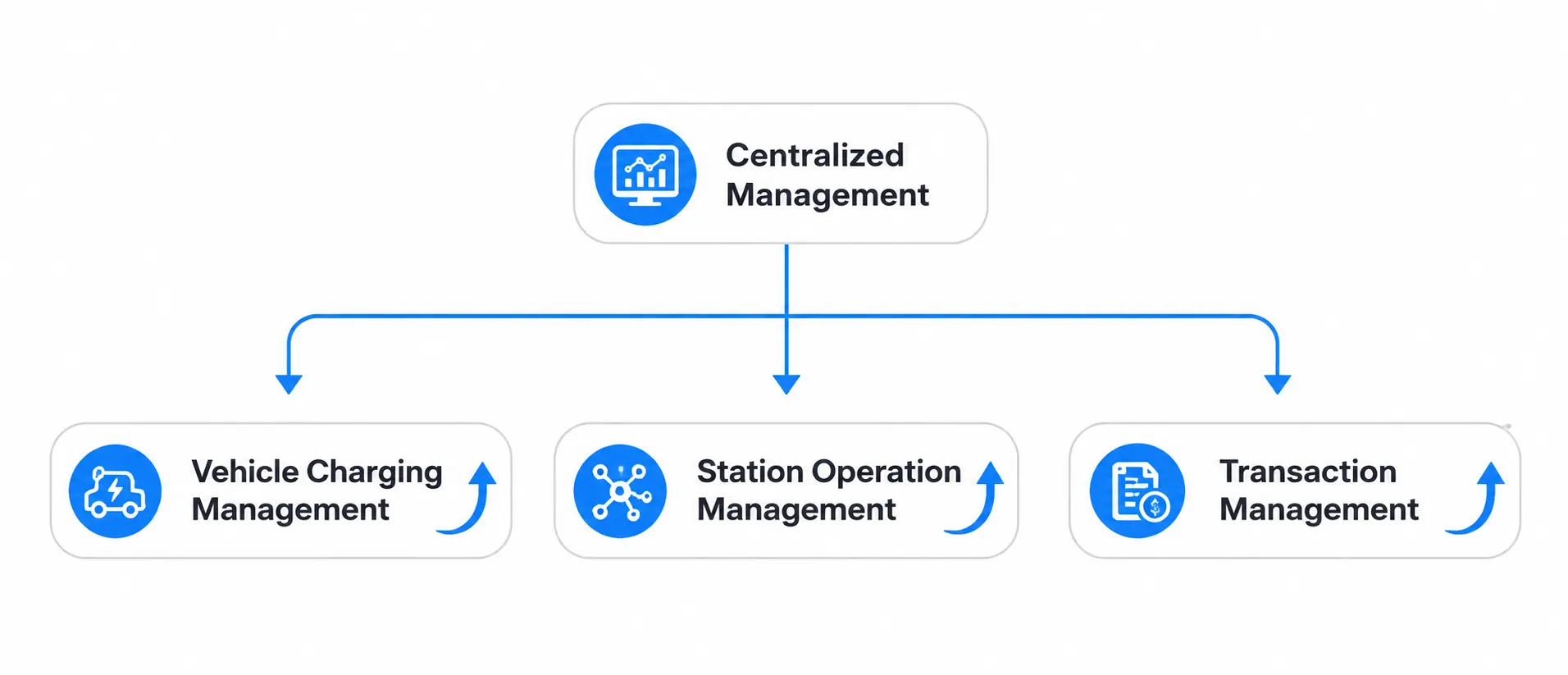
A professional heavy-duty EV charging platform must support more than drivers and chargers. It must also reflect the organizational structure of commercial fleet operations.
The Longqi platform therefore includes an enterprise management center with a hierarchical account architecture:
Platform → Fleet → Vehicle / Driver
Different management levels can be assigned appropriate permissions, helping fleet administrators maintain centralized visibility while controlling access to operational information.
Through the enterprise management center, authorized users can manage:
- fleet accounts;
- drivers;
- vehicles;
- charging permissions;
- fleet assets;
- charging activity; and
- transaction records.
This reduces management blind spots when a fleet operates many vehicles, drivers and charging locations.
Fleet operators comparing different platform architectures can also review TrendPower’s Top 10 Heavy-Duty Truck Charging and Fleet Management Systems for a broader view of the software capabilities becoming important in commercial fleet electrification.
Enterprise Wallet: From Post-Charging Reimbursement to Pre-Charging Control
Traditional driver reimbursement creates additional administrative work for commercial fleets. Drivers may need to pay first, retain transaction records and submit expenses later, while finance teams must determine which vehicle charged, where it charged and whether the amount is correct.
The platform’s enterprise wallet changes this process.
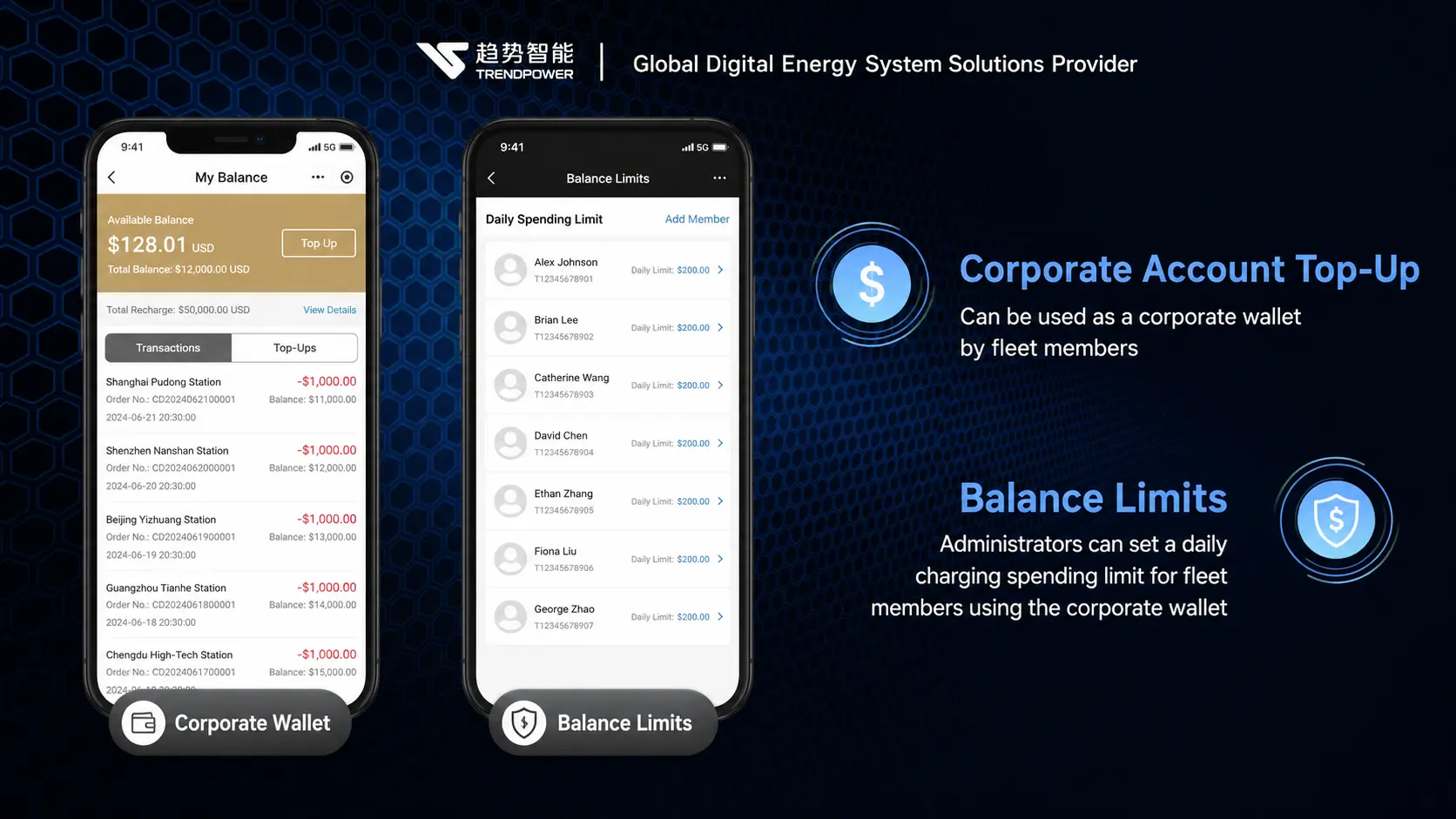
The fleet can recharge a centralized corporate account, and authorized vehicle charging transactions can be deducted directly from that account. Drivers do not need to use personal payment accounts or advance charging expenses themselves.
This shifts fleet charging management from post-event reimbursement toward pre-event authorization and centralized control.
Each charging transaction can be associated with relevant vehicle, account and charging session information, helping enterprises answer three important questions:
- Who charged?
- How much energy was charged?
- How should the transaction be reconciled?
For large fleets, this creates a clearer and more traceable charging management process. Businesses requiring centralized wallets, transaction records and financial reconciliation can learn more about TrendPower’s EV charging payment and settlement architecture.
The Business Value: From Charging Assets to Network Economics
The value of a heavy-duty truck charging traffic platform goes beyond connecting software systems. Its strategic importance lies in changing how charging infrastructure is operated.
Higher Utilization of Existing Charging Assets
By exposing charging capacity to a broader pool of fleet demand, participating stations have the opportunity to attract vehicles beyond their traditional local customer base.
More Predictable Fleet Charging
Vehicle SOC, location and charging station data can be combined to support proactive charging decisions, reducing dependence on last-minute charger searches.
Lower Dependence on Fully Self-Owned Infrastructure
Rather than building every charging site itself, a platform operator can connect compatible third-party charging networks and expand service coverage through interoperability.
Network-Level Operational Visibility
When more stations and fleets connect to the same platform, charging transactions generate a broader operational dataset.
This can help operators better understand vehicle flow, charging demand and station utilization across logistics corridors. Compared with data generated only by self-operated stations, an interconnected network can provide a more complete picture of commercial charging activity.
A Scalable Transaction Model
When charging sessions are processed and settled through the platform, the network can support transaction-based platform services in addition to traditional charging station revenue.
This allows the business model to evolve from simply operating physical charging assets toward operating a digital charging service network.
Why Network Effects Matter in Heavy-Duty EV Charging
For commercial EV charging, the value of a network can increase as more charging stations and fleets participate.
More connected stations provide fleets with greater charging coverage. More connected fleets provide charging stations with a larger potential demand pool. More charging transactions provide the platform with a richer operational dataset for future optimization.
This creates a positive cycle:
More stations → broader coverage → more fleet participation → more charging transactions → better operational data → stronger network value.
For heavy-duty logistics, where vehicles travel continuously between regions, this network model is particularly important. A fleet does not need an isolated charger. It needs a reliable charging network that follows the route of the vehicle.
From “Where Can I Charge?” to “How Should My Fleet Charge?”
The Longqi Power project illustrates an important evolution in the heavy-duty EV charging industry.
The first stage of electrification focuses on installing charging infrastructure.
The next stage focuses on connecting infrastructure, vehicles, energy data, fleet operations and transactions.
Once these elements are connected, charging management can move from a reactive model to a more intelligent model:
- from searching for chargers to planning charging in advance;
- from isolated charging stations to an interoperable network;
- from individual driver payments to enterprise-level settlement;
- from local station marketing to network-based traffic aggregation; and
- from fragmented data to integrated fleet and charging intelligence.
That transition is the foundation for more scalable heavy-duty electric logistics.
Explore More Heavy-Duty EV Charging Resources
If you are planning an electric truck charging network, logistics fleet platform or commercial charging project, the following TrendPower resources provide deeper technical and commercial guidance:
- Heavy-Duty Truck Charging Fleet Management System – Explore TrendPower’s dedicated solution for electric truck charging, vehicle monitoring, fleet operations and energy management.
- Heavy-Duty EV Charging Management Software for Smarter Fleet Operations – Learn how software connects vehicle identification, charging, enterprise accounts and fleet workflows.
- Heavy-Duty Truck Charging Fleet Management System Guide – Understand the core software architecture and operational functions behind electric truck charging networks.
- Top 10 Heavy-Duty Truck Charging and Fleet Management Systems – Compare major approaches to heavy-duty EV charging and fleet management.
- Fleet EV Charging Software for Logistics Parks: Songdiantu x TrendPower Case Study – Explore another TrendPower commercial fleet charging project.
- Port Drayage EV Charging Software Case Study – See how software supports electric container trucks, route charging and centralized fleet operations.
Frequently Asked Questions About Heavy-Duty Truck Charging Platforms
What is a heavy-duty truck charging platform?
A heavy-duty truck charging platform is a digital system that connects commercial electric vehicles, charging stations, fleet operators, charging data and payment processes. It can help fleets discover and plan charging while allowing charging operators to manage and distribute charging capacity through a broader network. TrendPower’s heavy-duty truck charging solution is designed specifically for these commercial fleet scenarios.
Why is charging station interoperability important for electric truck fleets?
Interoperability allows fleets to access charging resources operated by different companies through a more unified service experience. For charging operators, it also enables individual stations to participate in a larger charging network instead of functioning as isolated sites. International operators can also review TrendPower’s OCPP charging software guide for more information about standards-based charger interoperability.
How can vehicle SOC data improve fleet charging operations?
Real-time SOC data helps the platform understand how much usable battery capacity remains. When SOC is combined with vehicle location, route information and charging station availability, the system can recommend when and where a truck should charge before battery level becomes critical.
What is VIN-based charging?
VIN-based charging uses the vehicle identification number as part of the charging authorization process. For registered commercial vehicles, it can reduce repetitive driver operations such as scanning QR codes or completing manual payment steps before every charging session.
How does an enterprise wallet simplify fleet charging payments?
An enterprise wallet allows a fleet to centrally fund and manage charging transactions. Authorized vehicles or drivers can charge using the corporate account, reducing the need for drivers to make personal payments and submit reimbursement claims afterward. Learn more about TrendPower’s EV Charging Payment Solution.
Can a charging platform connect third-party charging stations?
Yes. With suitable interoperability protocols and API integration, a charging management platform can connect charging resources from multiple operators. This is one of the key technologies required to build a scalable regional or cross-regional commercial EV charging network.
TrendPower: Building the Digital Infrastructure Behind Smarter Heavy-Duty EV Charging Networks
As a digital energy software developer serving the global EV charging industry, TrendPower focuses on the interaction between people, vehicles, chargers and charging sites.
Our software solutions are designed to help charging equipment manufacturers, charging point operators, energy service providers and commercial fleets move from basic charger connectivity toward intelligent, data-driven charging operations.
For heavy-duty transport businesses, TrendPower provides a dedicated Heavy-Duty Truck Charging Fleet Management System covering vehicle and charger visibility, fleet charging workflows, energy management, enterprise accounts and third-party system integrations.
The Longqi Power project represents this philosophy in practice: connect fragmented resources, make vehicle and charging data actionable, simplify fleet operations and turn individual charging nodes into part of a more intelligent energy network.
Planning a heavy-duty EV charging network, logistics fleet charging platform or cross-operator charging ecosystem? Explore TrendPower’s heavy-duty truck charging software solution or review our custom EV charging software development capabilities to discuss a platform designed around your chargers, fleets and business model.

 EN_GB
EN_GB  EN
EN  ZH
ZH  AR
AR  DE
DE  ES
ES  KO
KO  JA
JA  IT
IT  FR
FR  VI
VI  MS
MS  ID
ID  FR_CA
FR_CA  NL
NL  SV
SV  TH
TH 