
Payment is one of the most important parts of the EV charging experience. For drivers, it determines whether charging feels fast, convenient, and trustworthy. For operators, it affects cash flow, billing accuracy, settlement efficiency, partner relationships, and long-term business scalability. A reliable EV charging payment solution is not just a tool for collecting money; it is the financial engine behind a modern charging network.
As charging businesses grow across cities, properties, fleets, and international markets, operators need more than a basic payment gateway. They need a payment system built specifically for charging scenarios, real-time billing, multi-party settlement, wallet payments, RFID access, tax invoicing, and financial reporting.
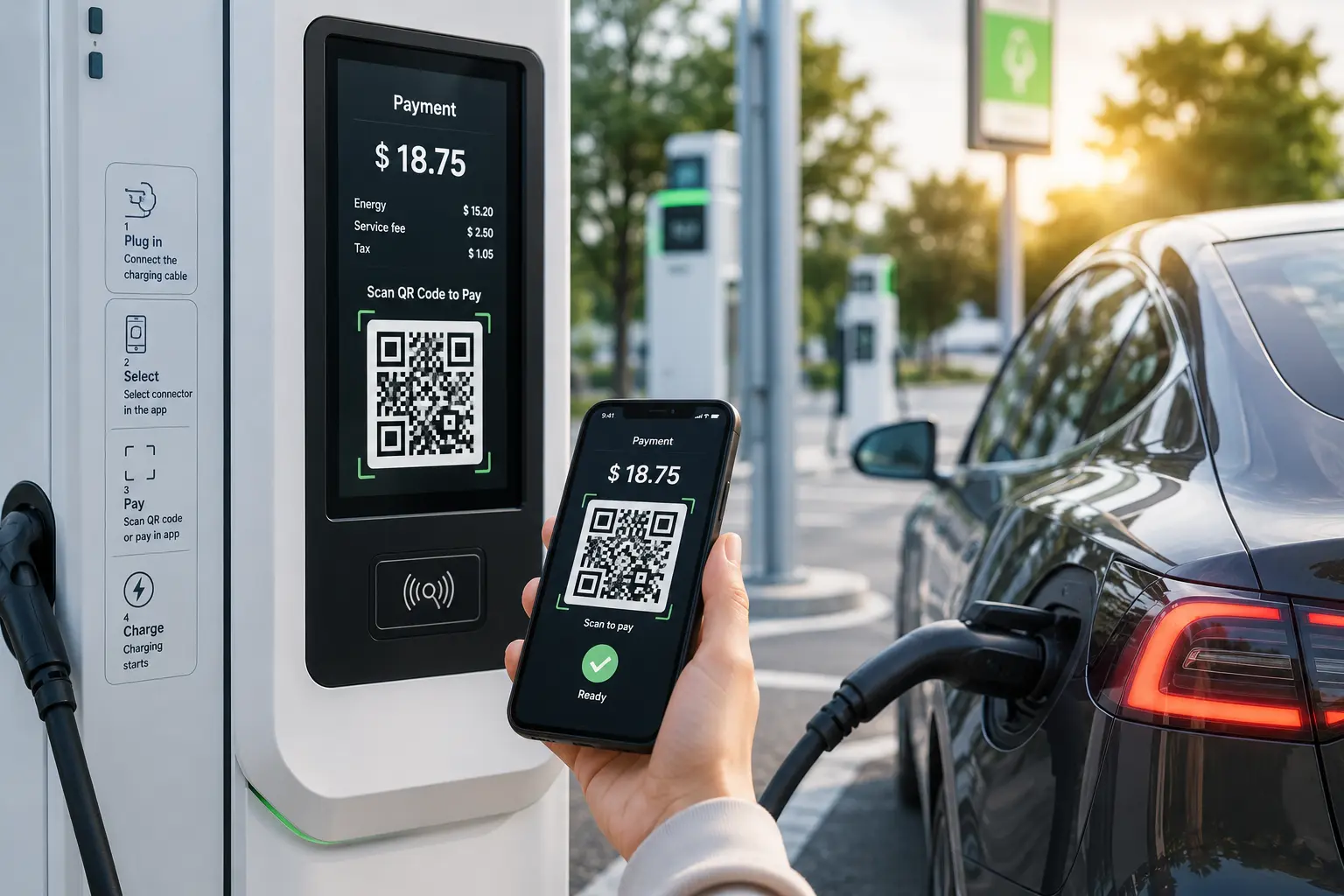 What Is an EV Charging Payment Solution?
An EV charging payment solution is a software system that enables drivers to pay for charging sessions through multiple payment methods while helping operators manage billing, reconciliation, settlement, and revenue distribution.
In simple terms, it connects charging stations, users, payment gateways, wallets, RFID or IC cards, billing rules, and backend operator systems. When a driver starts a charging session, the platform calculates usage, applies the correct pricing rule, processes payment, records the transaction, and sends the data to the operator’s financial system.
Why Charging Operators Need a Dedicated EV Charging Payment System
Generic payment tools are designed for standard online or retail transactions. EV charging is different. A charging session may involve variable energy consumption, time-based fees, parking fees, idle fees, service fees, prepaid balances, refunds, and revenue sharing among several stakeholders.
A dedicated EV charging payment system helps operators manage these charging-specific requirements. It supports real-time session billing, automatic transaction records, flexible pricing models, and accurate settlement between operators, agents, site owners, and investors.
For growing networks, the benefits are clear:
- More payment options for drivers
- Better charging experience and conversion rate
- Lower manual finance workload
- More accurate transaction reconciliation
- Faster settlement with business partners
- Clearer financial reporting
- Easier expansion into new regions
Without a specialized EV charging payment platform, operators may face delayed settlements, inconsistent transaction records, poor user experience, and difficulty scaling across multiple sites.
Common Payment Methods for EV Charging Platforms
A strong EV charging payment solution should support different user habits and regional payment preferences. The right mix of payment methods can directly improve charging accessibility and customer satisfaction.
QR Code Payment
QR code payment is widely used in app-based and web-based charging scenarios. Drivers scan a code on the charger or parking site, select a connector, start charging, and complete payment through a mobile interface. It is simple, fast, and suitable for public charging stations.
Credit and Debit Card Payment
Card payment remains essential for public charging, especially in international markets. Many drivers expect to pay with Visa, Mastercard, or other card networks without downloading an app. For operators, card support helps serve visitors, tourists, and one-time users.
Mobile Wallet Payment
Mobile wallets are important in markets where users prefer digital payment apps. Depending on the region, this may include PayPal, Alipay, WeChat Pay, ZaloPay, MoMo, or local wallet providers. A flexible EV charging payment gateway integration allows operators to localize payment experiences.
Wallet Balance Payment
With EV charging wallet payment, users can top up a prepaid balance and use it for future charging sessions. This is useful for membership-based charging networks, fleets, residential communities, and commercial operators that want to improve repeat usage and reduce transaction friction.
RFID or IC Card Payment
RFID EV charging payment and IC card access are common for fleet depots, workplaces, residential sites, and closed user groups. Drivers can tap a card to start charging, and the backend system records usage and deducts payment or assigns the cost to an account.
Whitelist-Based Access
Whitelist payment or access control is useful for private communities, employee charging, fleet vehicles, and VIP users. It allows approved users to charge based on preset rules, account permissions, or postpaid billing arrangements.
Key Features of a Reliable EV Charging Payment Platform
Choosing the right EV charging payment solution requires looking beyond the payment interface. Operators should evaluate how the system manages the full financial workflow behind every charging session.
Payment Gateway Integration
The platform should integrate with global and local payment gateways, including card processors, online wallets, and regional payment channels. This gives operators the flexibility to serve different markets and user groups.
Automated Billing
A charging-specific billing system should calculate fees based on electricity usage, charging duration, service fees, parking fees, idle fees, discounts, and user group rules. Accurate billing reduces disputes and protects operator revenue.
Wallet Balance Management
For prepaid charging models, the platform should support wallet top-ups, balance deductions, refunds, transaction records, and account-level fund management.
Transaction Reconciliation
EV charging transaction reconciliation is essential for financial accuracy. The system should compare charging orders, payment gateway records, wallet deductions, refunds, and settlement data automatically.
Clearing and Settlement
An advanced EV charging settlement system should support different settlement methods and cycles. Operators may need daily, weekly, monthly, or custom settlement rules depending on contracts and local business models.
Multi-Party Revenue Sharing
Charging networks often involve operators, agents, landlords, property owners, site hosts, investors, and platform owners. The payment platform should automatically split income according to predefined rules.
Merchant Hierarchy Management
As a charging business grows, it may need to manage multiple merchants, regions, stations, operators, and sub-accounts. A structured account system helps simplify complex business relationships.
Tax Invoicing
EV charging tax invoicing helps operators generate compliant invoices based on transaction records. This is especially important for enterprise users, fleets, and regulated markets.
Reporting and Analytics
Financial dashboards should help operators understand revenue, transaction volume, payment method usage, settlement status, site performance, and user behavior.
EV Charging Revenue Sharing and Settlement
EV charging revenue sharing is a key requirement for commercial charging networks. A single charging session may generate income that needs to be divided between several parties. For example, the operator may manage the platform, the site owner may provide parking space, an investor may own the charging hardware, and an agent may handle local business development.
A modern EV charging payment solution can automatically calculate each party’s share based on agreed rules. This reduces manual accounting, improves transparency, and helps partners trust the platform.
Automated settlement also makes business growth easier. Instead of manually checking spreadsheets and payment records, operators can use predefined settlement cycles, virtual fund splitting, and financial reports to distribute revenue more efficiently.
Supporting International EV Charging Payment Operations
Operators expanding into overseas markets need payment flexibility. Payment preferences vary by country, and a method that works well in one region may not be enough in another.
A scalable EV charging station payment solution should support international payment gateways, local wallets, card payment, wallet balances, and region-specific settlement workflows. It should also allow operators to adapt pricing, invoices, settlement cycles, and account structures to local business needs.
International expansion also requires strong integration capability. Operators may need to connect with local payment service providers, tax systems, fleet platforms, or existing business management systems. The more flexible the payment platform is, the easier it becomes to enter new markets.
How TrendPower Helps Operators Build a Smarter EV Charging Payment System
TrendPower’s EV Charging Payment Solution is designed for charging operators that need flexible, secure, and scalable payment operations. It supports core payments, international payments, wallet balance payment, IC card transactions, QR code payment scenarios, and card-based charging access.
For operators managing complex business structures, TrendPower helps build merchant hierarchies, manage account relationships, and support different settlement models. Its system supports automated reconciliation and accounting, reducing manual finance work and improving transaction accuracy.
TrendPower also supports clearing and settlement management, revenue sharing for platforms, agents, charging sites, and investors, tax invoicing, and multi-dimensional financial reporting. For companies expanding internationally, localized deployment and payment integration support can help operators build charging businesses across different markets.
How to Choose the Right EV Charging Payment Solution
Before choosing an EV charging payment solution, operators should ask practical questions:
- Does it support the payment methods my users prefer?
- Can it integrate with both international and local payment gateways?
- Does it support QR code, card, wallet balance, and RFID/IC card payment?
- Can it automate billing, reconciliation, and settlement?
- Does it support multi-party revenue sharing?
- Can it manage merchants, agents, site owners, and investors?
- Does it provide tax invoicing and financial reports?
- Can it support different pricing rules and user groups?
- Is it flexible enough for international expansion?
- Can it integrate with my existing EV charging operator software?
The best platform should not only process payments. It should help operators improve user experience, reduce financial risk, and support scalable business growth.
Conclusion
Payment infrastructure is a critical foundation for scalable EV charging operations. A reliable EV charging payment solution helps operators support more payment methods, improve driver convenience, automate billing, manage revenue sharing, simplify settlement, and expand across regions.
For charging businesses that want to move from basic payment collection to efficient financial operations, TrendPower provides a flexible and commercially scalable platform built for real-world EV charging scenarios. Explore TrendPower’s EV Charging Payment Solution to build a smarter, more reliable payment system for your charging network.
Contact Us
Don’t take our word for it.
Try it now for free.

EV Charging Payment Solution FAQs
Find answers to common questions about EV charging payment solutions, including supported payment methods, payment gateway integration, wallet balance, RFID/IC card payments, automated reconciliation, settlement, revenue sharing, tax invoicing, and international payment support.
An EV charging payment solution is a software system that allows drivers to pay for charging sessions and helps operators manage billing, transaction records, reconciliation, settlement, revenue sharing, and invoices. It connects chargers, users, payment gateways, wallets, cards, and backend management systems.
EV charging payment integration connects the charging platform with payment gateways, wallets, RFID or IC cards, and operator systems. When a charging session starts and ends, the platform calculates the fee, processes payment, records the transaction, and sends financial data for reconciliation and settlement.
Charging stations can support QR code payment, credit and debit cards, mobile wallets, prepaid wallet balances, RFID or IC cards, and whitelist-based access. The best payment mix depends on the market, user group, charging location, and operator business model.
Revenue sharing automatically divides charging income among stakeholders such as operators, site owners, agents, investors, and platform owners. The system calculates each party’s share based on predefined rules, then supports settlement according to agreed cycles and methods.
Automated reconciliation helps operators compare charging orders, payment records, wallet deductions, refunds, and settlement data. It reduces manual accounting work, improves financial accuracy, lowers operational risk, and gives operators clearer visibility into revenue and transaction performance.

 EN_GB
EN_GB  EN
EN  ZH
ZH  AR
AR  DE
DE  ES
ES  KO
KO  JA
JA  IT
IT  FR
FR  VI
VI  MS
MS  ID
ID  FR_CA
FR_CA  NL
NL  SV
SV  TH
TH 