
A practical guide for CPOs, charger manufacturers, fleet operators, property groups, energy companies and businesses building or replacing an EV charging platform.
What is EV charging management software?
EV charging management software is a central platform used to connect, monitor, operate and monetise electric vehicle charging stations. The industry also uses terms such as CPMS (Charge Point Management System), CSMS (Charging Station Management System), charging backend, charging network software and EV charger management software.
The software receives charger status and session data, applies operational and commercial rules, and gives different users the interfaces they need. Drivers may use an app, QR code or RFID card. Operators work from an administration portal. Site hosts, finance teams, service partners and investors may have separate permissions and reports.
The charger delivers electricity; the management platform coordinates everything around that transaction.
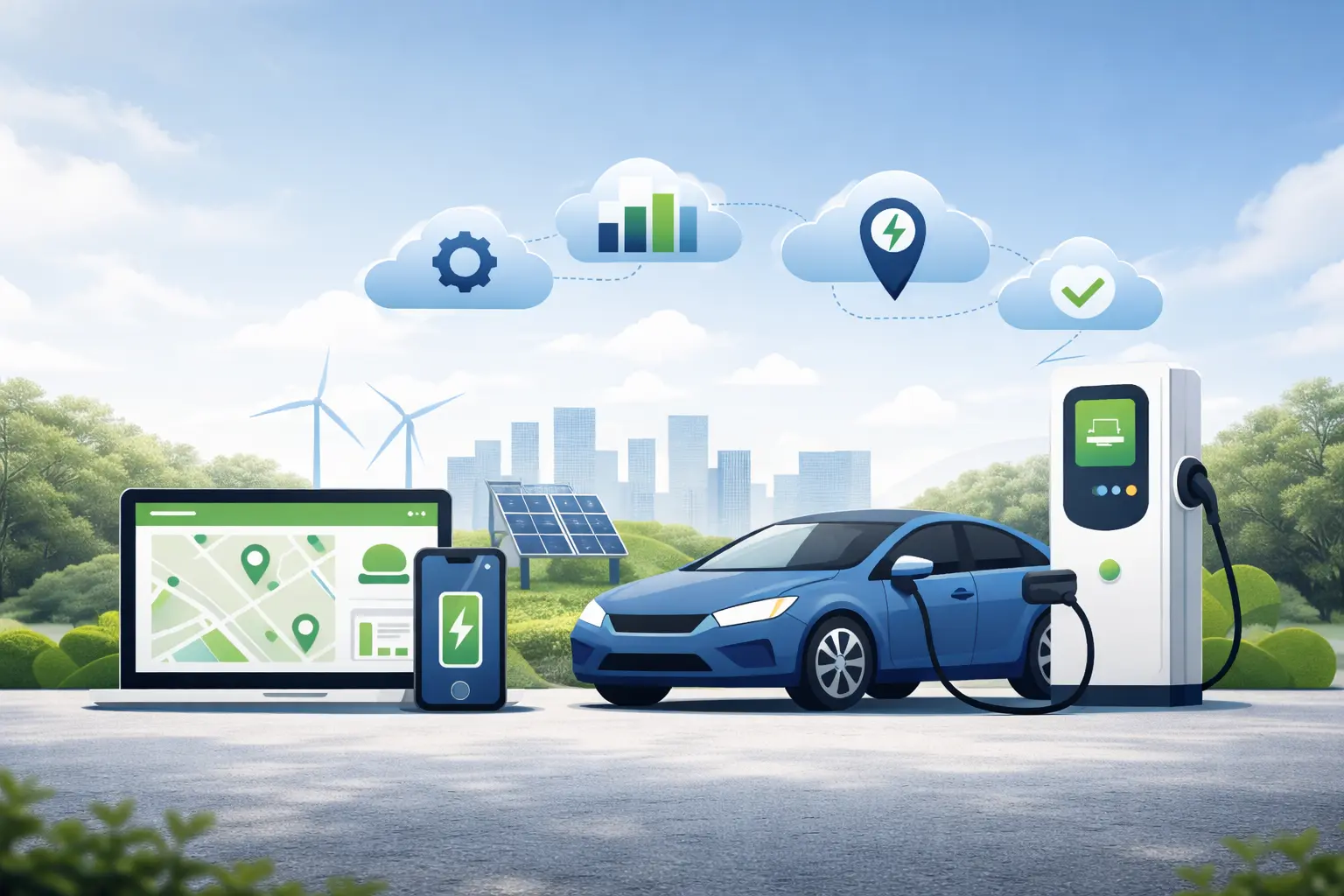
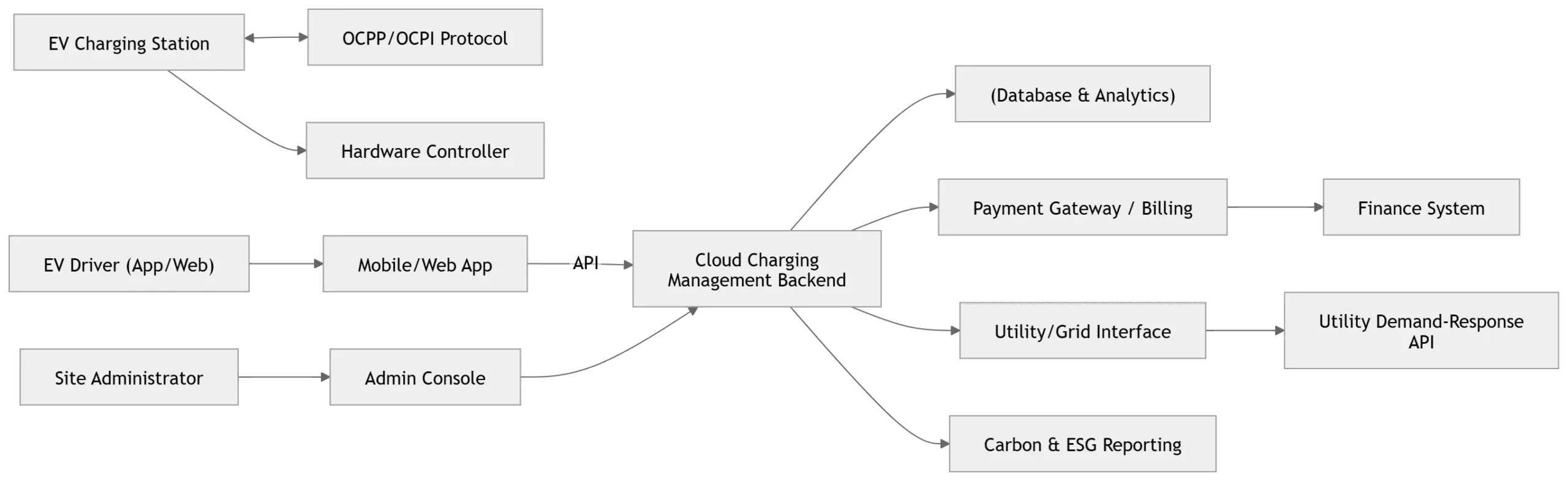
The charger communicates with the backend through OCPP or another supported interface.
The platform checks the app, RFID, account, QR or other permitted access method.
Charging starts under site, tariff, power and user rules defined by the operator.
Session data connects with payment, invoicing, refunds and partner settlement workflows.
Teams use alerts, reports and energy data to improve uptime, cost and utilisation.
Who needs an EV charging platform?
The required software changes with the business model. Start by identifying who owns the chargers, who serves the drivers and who receives the charging revenue.
Charging point operators and public networks
- Multi-site charger monitoring and remote operations
- Tariffs, payments, refunds and financial reconciliation
- Driver applications, QR, RFID and guest charging
- Partner commissions and site-host revenue sharing
- Fault alerts, service workflows and network reporting
- Roaming, API and third-party system integrations
Commercial fleets, buses and charging depots
- Vehicle readiness based on route and departure time
- Power scheduling within the depot's electrical limit
- Vehicle, telematics, SOC and charger integrations
- Energy cost, utilisation and exception reporting
- Priority charging and queue management
- Remote fault triage and service coordination
Residential, workplace, retail and hospitality sites
- Resident, employee, visitor and public access groups
- Site-specific tariffs and electricity cost allocation
- Load management across multiple charge points
- Monthly billing and reports for property teams
- Parking, access-control and tenant-system integrations
- Clear division between site host and operator duties
EV charger manufacturers, resellers and regional brands
- OCPP integration and model-specific validation
- White-label driver app and administration portal
- Firmware, commissioning and remote diagnostic tools
- Multi-tenant accounts for dealers and customers
- Local language, currency and payment integration
- APIs and custom workflows for target markets
Essential EV charging management software features
A strong CPMS must support technical operations and the commercial business around every charging session. Check how each feature works with your actual chargers, payment provider and user journey.
Charger monitoring
Live charger and connector status, session data, telemetry, communication logs, alerts and equipment inventory across all sites.
Remote operations
Remote start, stop, reset, configuration and firmware workflows where supported by the charger and protocol implementation.
Users and access
Accounts, groups, permissions, RFID, app, QR and guest access with different rules for drivers, staff, tenants and partners.
Tariffs and billing
Pricing by energy, time, session, user group or configured rules, connected to invoices, receipts, refunds and reconciliation.
Payments
Integration with selected gateways, wallets or terminals, including payment status, transaction records and operator settlement requirements.
Smart charging
Power limits, charging profiles, time schedules and dynamic allocation designed around the electrical capacity and operating priorities of each site.
Multi-site roles
Central oversight with controlled access for regional teams, site hosts, investors, service providers, agents and customer organisations.
Reports and analytics
Operational, energy and financial reports that help teams compare sites, find failed sessions and understand utilisation and revenue.
APIs and integrations
Interfaces for payments, navigation, roaming, parking, ERP, CRM, telematics, energy management and other project systems.

OCPP, OCPI and ISO 15118: what each standard does
These terms describe different connections in the charging ecosystem. They are complementary—not interchangeable.
OCPP 1.6
Still widely deployed. It supports core charging operations and smart-charging profiles, but actual functions depend on the charger's implementation and firmware.
OCPP 2.0.1
Adds stronger device management, security, transaction handling, smart charging and ISO 15118 support. It is not backwards-compatible with OCPP 1.6.
OCPI
Supports information exchange between charging operators and mobility service providers, commonly used for roaming, tariffs, locations and session records.
ISO 15118
Covers communication between the EV and charging station, including capabilities associated with Plug & Charge and advanced energy interactions.
Cloud, private deployment or custom platform?
Deployment architecture affects control, responsibility, integration effort and long-term cost. There is no correct model for every operator.
Swipe horizontally to view the full comparison.
| Model | Best suited to | Advantages | Questions to verify |
|---|---|---|---|
| Shared SaaS cloud | Operators seeking a faster, managed launch | Lower infrastructure burden, central updates and straightforward scaling | Data location, platform limits, feature roadmap, recurring fees and exit process |
| Dedicated or private cloud | Enterprises needing stronger isolation or architecture control | More control over environment, integration and data arrangements | Cloud ownership, security responsibilities, upgrades, monitoring and support boundaries |
| On-premises | Projects with strict internal hosting or network requirements | Direct infrastructure control within the customer's environment | Hardware, DevOps, security updates, disaster recovery and operational ownership |
| White-label platform | CPOs and charger brands launching under their own identity | Branded apps and portals without building the full charging backend from zero | Branding depth, app-store ownership, data rights, customisation and release control |
| Custom development | Unique business models or integration-heavy operations | Workflows and interfaces designed around the target operation | Scope control, maintenance, source-code terms, roadmap ownership and total lifecycle cost |
Should you build your own EV charging software?
Buy SaaS
Best when: standard charging workflows cover most requirements and speed matters.
Trade-off: the vendor controls more of the feature roadmap, hosting model and commercial structure.
Configure or white-label
Best when: you need your own brand, markets, roles, tariffs and integrations on an existing CPMS foundation.
Trade-off: you must clearly separate standard configuration, integration and custom development.
Build from scratch
Best when: software itself is a core strategic product and you can fund an experienced long-term engineering and operations team.
Trade-off: OCPP edge cases, payments, apps, security, operations and continuous maintenance are often underestimated.
How much does EV charging management software cost?
There is no reliable universal price per charger. Cost depends on network scale, enabled modules, deployment model, integrations, branding, payment architecture and support scope.
One-time costs
- Discovery and solution design
- Platform configuration
- Charger integration and validation
- Payment and third-party integrations
- White-label applications and branding
- Migration, testing and training
Recurring costs
- Software licence or platform subscription
- Cloud hosting and data services
- Support and maintenance
- Payment-provider charges
- Optional modules and API services
- Application-store and communication services
Usage-based costs
- Per charger, connector, site or active account
- Per charging session or transaction
- Percentage of charging revenue
- Roaming or settlement fees
- SMS, maps or external API usage
Exit and change costs
- Data export and historical records
- Charger endpoint reconfiguration
- New platform migration
- App transition and customer communication
- Custom integration replacement
Ask every vendor for the same cost breakdown. Separate mandatory platform fees from optional work and third-party charges. A low per-port price can become expensive if the system also takes transaction revenue or requires paid integrations for core workflows.
How EV charging software improves ROI
The platform creates value when it improves completed charging sessions, controls energy demand, reduces avoidable service work or supports a stronger commercial model.
Availability
Track online status, fault duration, failed sessions, incident response and recurring hardware or communications problems.
Utilisation
Measure sessions, energy delivered, active hours and use by site, connector, time period and customer group.
Energy cost
Compare peak demand, load profiles and charging schedules against available site capacity and tariff periods.
Revenue quality
Monitor successful payments, revenue per site, refunds, unpaid sessions, partner shares and settlement accuracy.
Define the baseline before implementation. Without “before” data—manual work hours, failed sessions, technician dispatches, peak energy use or payment loss—it is difficult to prove the platform's value after launch.
15 questions to ask an EV charging software provider
Use the same questions for every vendor and request written answers. A comparable response is more useful than several unrelated product demos.
Which charger models, firmware versions and OCPP profiles have you tested?
How do you prove remote commands, offline behaviour and smart-charging functions?
Which user journeys are standard: app, QR, RFID, card terminal and guest charging?
Which local payment, tax, invoicing and refund workflows are supported?
Who owns the merchant account, customer relationship, app accounts and operating data?
What roles, permissions and multi-tenant structures can the platform support?
Which APIs, webhooks and pre-built integrations are available?
Where is data hosted and which organisations can access it?
What are the backup, recovery, security-update and incident-response processes?
What service levels, support hours and escalation paths are included?
Which functions are standard, configurable, customised or third-party?
What are the complete setup, recurring, usage and payment-related fees?
How are new releases tested and deployed without disrupting charging operations?
How can we export data and migrate chargers if the contract ends?
Which acceptance tests must pass before production launch?
Five steps from requirements to production
The schedule depends on charger readiness, integrations, apps, approvals and custom scope. Use stage gates instead of promising a generic number of weeks.
Discover
Define sites, chargers, user groups, operating model, payments, data, integrations and success metrics.
Design
Confirm architecture, roles, workflows, interfaces, responsibilities and acceptance criteria.
Integrate
Connect representative chargers and third-party systems using production firmware and realistic data.
Pilot
Test successful and failed sessions, payments, faults, offline behaviour, reports and support escalation.
Scale
Train teams, launch controlled groups, review KPIs and expand only after the agreed criteria are met.

What to verify before connecting production chargers
Identity and access
- Role-based permissions and least-privilege access
- Strong administrator authentication
- Joiner, mover and leaver processes
- Audit trails for sensitive actions
Data protection
- Encryption in transit and at rest
- Retention, deletion and export policies
- Data location and sub-processor review
- Privacy requirements in target markets
Service resilience
- Monitoring, backups and tested recovery
- Documented incident severity and escalation
- Charger behaviour during network outages
- Capacity and performance testing
Payment boundaries
- Payment provider and merchant responsibilities
- Tokenisation and sensitive-data handling
- Refund, dispute and failed-payment workflows
- Reconciliation and financial audit records
Certifications and compliance needs differ by country and project. Ask for evidence relevant to the proposed service; do not assume that a badge covers your complete architecture or operating responsibility.
EV charging software built around your hardware, brand and operating model
TrendPower combines an established charging management platform with project-specific integration and delivery. The platform is designed for CPOs, charger manufacturers, fleet operators, property groups, energy companies and regional charging businesses that need more control than a fixed charging SaaS package.
Operate the network
- Charger, connector, site and session management
- Remote monitoring, control and fault workflows
- Users, roles, accounts and access methods
- Tariffs, orders, billing and payment integration
Build the business
- Partner permissions, commissions and settlement records
- Multi-site reporting and commercial analytics
- White-label app, H5 and administration interfaces
- APIs and project-specific third-party integrations
Choose functions around the charging scenario
Public networks, residential charging, depots and zero-carbon parks do not use identical operating flows. The platform should adapt pricing, users, energy logic, integrations and reporting without turning every new site into a software rebuild.

Send this eight-point project brief
Give every shortlisted provider the same information and ask them to demonstrate the required workflow using representative chargers.
2. Number of sites, chargers and connectors: ____
3. Charger brands, models, firmware and OCPP versions: ____
4. Charging scenario and user groups: ____
5. Required access, tariff and payment flows: ____
6. Required apps, branding, languages and currencies: ____
7. Third-party systems, reports and APIs: ____
8. Preferred cloud, private or on-premises deployment: ____
EV charging management software FAQ
What is the difference between CPMS, CSMS and EV charging software?
CPMS and CSMS are commonly used for the central platform that connects and manages charging stations. EV charging software is a broader term that can also include driver apps, payment tools, fleet scheduling, roaming, energy management and analytics.
Can one platform manage chargers from different manufacturers?
Yes, when the hardware and software use compatible open protocols and the required functions have been integrated. OCPP improves interoperability, but every charger model, firmware version and message set should still be tested.
Is OCPP 1.6 still suitable in 2026?
OCPP 1.6 remains widely deployed. OCPP 2.0.1 provides stronger device management, security and smart-charging capabilities, but the right choice depends on your hardware estate and required features. OCPP 1.6 and 2.0.1 are not directly compatible.
Does OCPP support guarantee charger compatibility?
No. The protocol version is only the starting point. Compatibility also depends on firmware, implemented profiles, vendor extensions, remote commands, charging profiles and offline behaviour. Require a pilot with production equipment.
How does EV charging software handle payments?
The platform connects charging sessions with tariffs, payment providers and financial records. Depending on the project, users may pay through an app, QR journey, digital wallet, RFID-linked account, invoice or card terminal. Confirm who owns the merchant account and handles refunds and disputes.
What is white-label EV charging software?
White-label software provides charging applications and operator tools under the buyer's brand. Clarify the depth of branding, app-store ownership, domain and account control, data rights, supported customisation and the process for future releases.
How does smart charging reduce energy costs?
Smart charging controls when and how much power chargers use within site limits and operational priorities. It can schedule charging, distribute capacity among connectors and respond to time-based energy rules. Savings depend on the site's load profile, electricity tariff and operating constraints.
How long does CPMS implementation take?
Timing varies with charger readiness, integrations, payment setup, branding, apps, data migration, testing and custom development. Ask for a staged plan with acceptance criteria instead of relying on a generic launch promise.
Can an existing charging network migrate to a new backend?
Often yes, if the operator can access charger backend settings, credentials and manufacturer controls. Historical data, payment arrangements and customer accounts may need separate migration work. Test a controlled charger group first and retain a rollback plan.
What should I provide before requesting a CPMS demo?
Provide target markets, site and connector count, charger models and protocols, user groups, payment methods, languages, branding, integrations, reports, expected scale and deployment preference. This allows the vendor to demonstrate your operating flow rather than a generic dashboard.
Validate the software against your real chargers and workflows
TrendPower can review your charger models, operating roles, payment needs, integrations, deployment preference and rollout plan, then scope a demonstration around your project.

 EN_GB
EN_GB  EN
EN  ZH
ZH  AR
AR  DE
DE  ES
ES  KO
KO  JA
JA  IT
IT  FR
FR  VI
VI  MS
MS  ID
ID  FR_CA
FR_CA  NL
NL  SV
SV  TH
TH 