
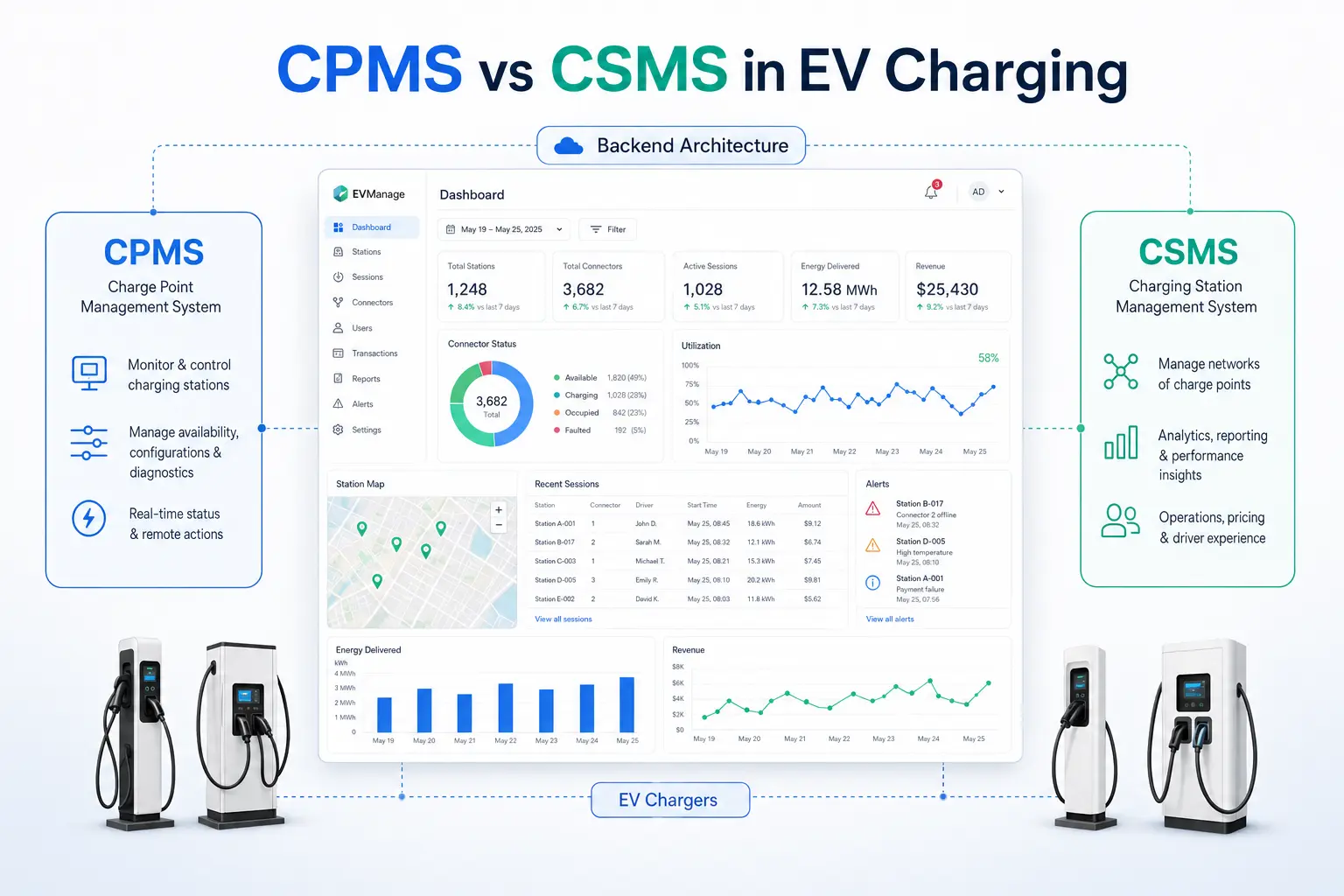
CPMS vs CSMS is mostly a terminology difference, not a choice between two completely different types of EV charging software. CPMS usually stands for Charge Point Management System, while CSMS stands for Charging Station Management System. In commercial EV charging, the terms are often used interchangeably for the backend platform that connects, monitors and controls charging infrastructure. However, there is one important distinction: CSMS is the terminology formally used in modern OCPP specifications, while CPMS is widely used by software vendors, charge point operators and buyers.
So if one EV charging software provider calls its platform a CPMS and another calls it a CSMS, that alone does not mean the two systems have different capabilities.
The real comparison should be based on OCPP compatibility, charger management, remote operations, billing, payments, APIs, energy management, scalability and deployment architecture.
CPMS vs CSMS: What Is the Short Answer?
The short answer is:
CPMS = Charge Point Management System
CSMS = Charging Station Management System
In most commercial EV charging projects, they describe the same core category of backend management software.
The difference is mainly about terminology and context.
CSMS is the term used by the Open Charge Alliance in modern OCPP specifications when describing the backend system that communicates with charging stations.
CPMS, meanwhile, has become a common commercial term for the platform used by charge point operators, charger manufacturers, fleets, property businesses and energy companies to manage charging networks.
There is no universal industry rule saying that every CPMS must have one set of features and every CSMS another.
In fact, the same software platform can reasonably be described as both a CPMS and a CSMS depending on whether the conversation is about commercial operations or OCPP architecture.
What Does CPMS Mean in EV Charging?
CPMS stands for Charge Point Management System.
In practical commercial use, a CPMS is the centralized software platform an operator uses to manage EV chargers and the business processes around them.
A modern CPMS may bring together functions such as:
- Real-time charger and connector monitoring
- Remote start, stop, reset and control
- Charging session management
- User and RFID management
- Tariff configuration
- Billing and transaction records
- Payment integrations
- Fault alerts and remote diagnostics
- Revenue and operational reporting
- Multi-site management
- Role-based access control
- Load balancing and smart charging
- API and third-party system integration
This is why the term CPMS appears frequently in EV charging software procurement.
For a CPO, the CPMS is not simply the server receiving charger messages. It is usually the operational workspace where the charging business is managed.
If you want a deeper overview of these functions, see our CPMS Software Guide for EV Charging Operators.
What Does CSMS Mean in EV Charging?
CSMS stands for Charging Station Management System.
The term is particularly important when discussing OCPP architecture.
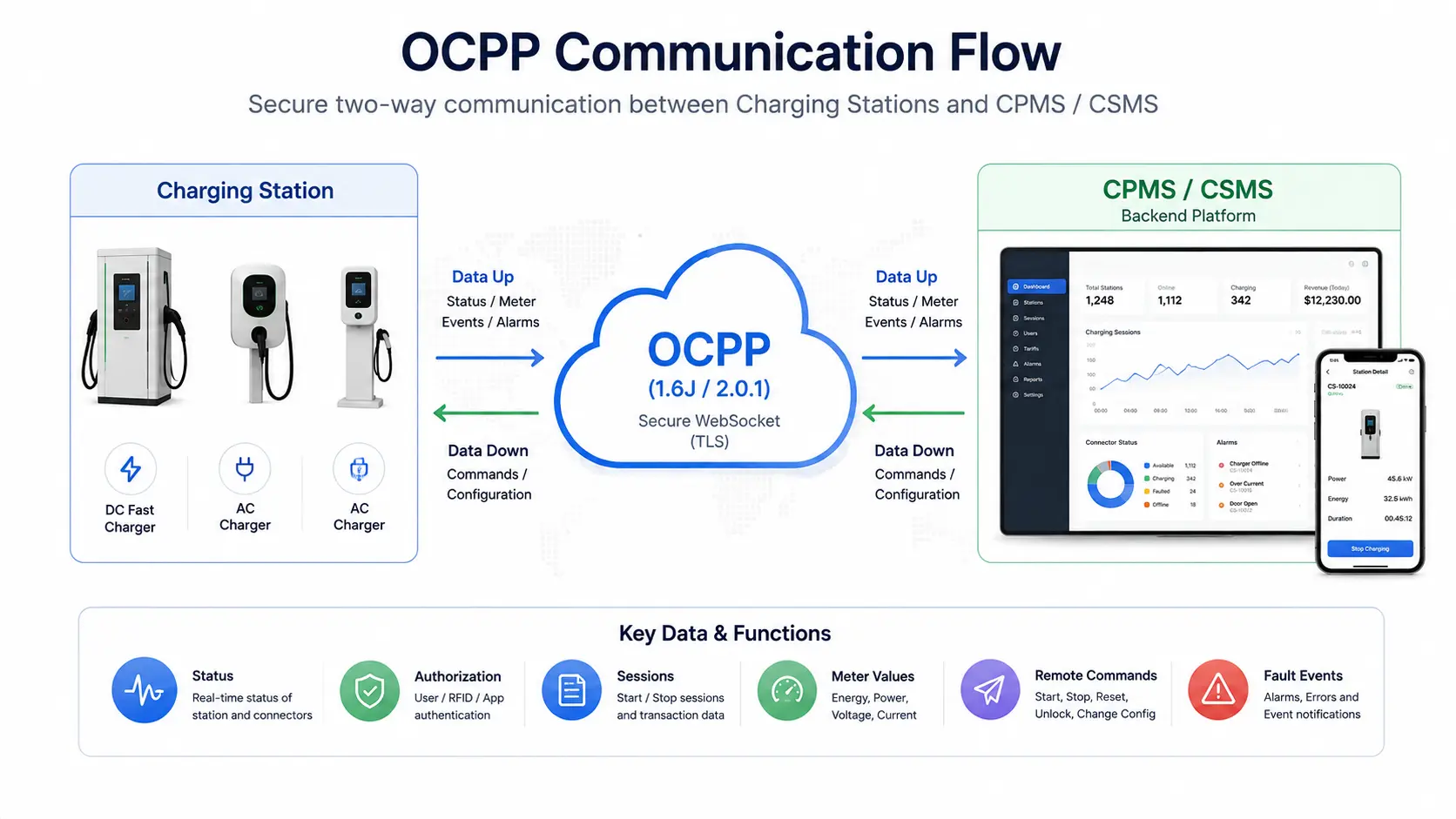
The Open Charge Point Protocol defines communication between a charging station and the backend management system. In OCPP 2.0.1 terminology, that backend is called the Charging Station Management System, or CSMS.
The CSMS can receive information from charging stations and send commands back to them. Depending on the OCPP version, charger capabilities and platform implementation, this can include functions related to:
- Authorization
- Charging transactions
- Charger availability
- Connector and EVSE status
- Meter values
- Remote commands
- Configuration
- Device management
- Smart charging
- Security events
- Firmware-related operations
The Open Charge Alliance describes OCPP as the communication standard between the Charging Station and the Charging Station Management System.
That makes CSMS the more precise standards-oriented term when engineers are discussing the backend role within an OCPP architecture.
For a deeper explanation of this communication layer, read our OCPP EV Charging Software Guide.
Why Do CPMS and CSMS Both Exist as Terms?
Part of the confusion comes from the evolution of EV charging terminology itself.
Earlier OCPP implementations, especially around OCPP 1.6, commonly used the terms Charge Point for the charger and Central System for the backend.
As the OCPP standard evolved, its terminology also changed.
OCPP 2.0.1 uses Charging Station for the charging infrastructure and Charging Station Management System for the backend system.
Meanwhile, the commercial EV charging software market had already widely adopted terms such as:
- Charge Point Management System
- CPMS software
- EV charging management software
- Charging station management software
- EV charger management software
- EV charging backend software
As a result, several overlapping terms now coexist.
This does not necessarily indicate conflicting technologies. In many cases, it reflects the difference between standards terminology, product terminology and buyer search behavior.
CPMS vs CSMS Comparison Table
| Comparison | CPMS | CSMS |
|---|---|---|
| Full name | Charge Point Management System | Charging Station Management System |
| Typical context | Commercial software, CPO operations and procurement | OCPP standards, architecture and technical documentation |
| Core purpose | Manage connected EV charging infrastructure and related operations | Manage charging stations and communicate with them through OCPP |
| Can it communicate through OCPP? | Yes, if the platform supports the required OCPP implementation | Yes; CSMS is the backend role identified in modern OCPP terminology |
| Can it manage chargers remotely? | Typically yes, depending on platform and charger capability | Typically yes, depending on protocol and implementation |
| Billing and payments | Frequently included in commercial CPMS platforms | May be part of the wider platform, but the acronym itself does not guarantee these functions |
| Is the scope formally standardized? | No universal commercial feature definition | The CSMS role is defined in OCPP, but a commercial product may include many functions beyond OCPP |
| Can the same platform be called both? | Yes | Yes |
Are CPMS and CSMS the Same Thing?
For most buyers, yes—they refer to substantially the same category of EV charging backend platform.
But saying they are exactly identical in every context would also be an oversimplification.
There are two useful ways to think about the terminology.
From an OCPP Architecture Perspective
CSMS is the more precise term.
It describes the backend system communicating with the Charging Station through OCPP.
From a Commercial EV Charging Software Perspective
CPMS is one of the most commonly used product-category terms.
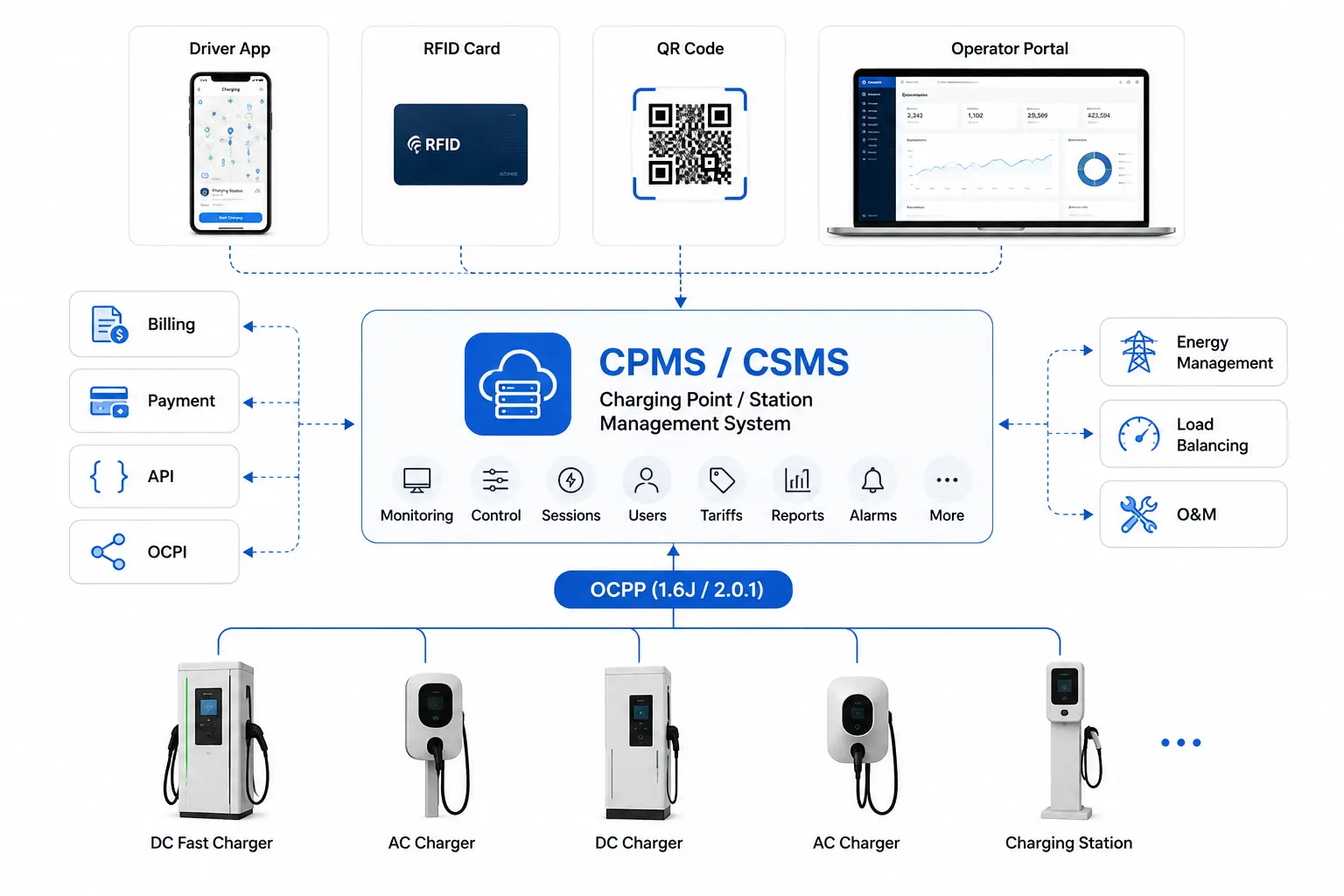
A commercial CPMS may include the CSMS communication layer plus a much wider set of applications and business modules, such as:
- Driver apps
- Payment gateways
- Billing engines
- Customer accounts
- Station maps
- Revenue settlement
- Operator portals
- Partner management
- APIs
- Analytics
- Energy-management functions
However, this broader scope comes from the way an individual software product is designed—not from a formal rule that says “CPMS must always be broader than CSMS.”
That distinction matters.
Is a CPMS Always Broader Than a CSMS?
No.
This is one of the most common mistakes when comparing CPMS vs CSMS.
It may be tempting to define CPMS as the complete commercial platform and CSMS as only the technical OCPP backend. In real projects, however, software vendors use the terms differently.
One provider may call its entire end-to-end platform a CSMS and include apps, billing and payments.
Another may call essentially the same architecture a CPMS.
A third provider may use the broader phrase EV charging management system.
Therefore, buyers should never assume software functionality from the acronym alone.
Buyer takeaway
Do not select an EV charging platform because it is called a CPMS or a CSMS. Select it because its architecture, protocol support and operational capabilities match your charging business.
How Does OCPP Fit Into CPMS and CSMS?
OCPP is one of the most important technologies behind this discussion.
OCPP does not replace a CPMS or CSMS. It is the communication protocol that allows compatible charging stations and backend systems to exchange information.
A simplified architecture looks like this:
↓
CPMS / CSMS Backend Platform
↓ OCPP ↓
EV Charging Stations
The backend may then connect with other systems through separate interfaces or APIs:
- Payment gateways
- Billing platforms
- ERP systems
- CRM systems
- Parking systems
- Fleet platforms
- Roaming services
- Energy management systems
This is why we recommend separating two questions during software evaluation:
- Can the backend communicate reliably with the charging hardware?
- Can the wider software platform support the business processes around those chargers?
OCPP primarily helps answer the first question. A complete charging management platform must address both.
Does OCPP Compatibility Mean Every CPMS or CSMS Is the Same?
No.
Two platforms may both advertise OCPP 1.6J or OCPP 2.0.1 support and still provide very different operational capabilities.
For example, buyers should investigate:
- Which OCPP versions are actually supported?
- Which functions have been implemented?
- Which charger brands and firmware versions have been tested?
- How are charger faults and connectivity events handled?
- Can operators access detailed OCPP logs?
- How does the system handle remote commands?
- Does the platform support multi-brand charger networks?
- What happens when chargers lose network connectivity?
- How is charger migration handled?
The Open Charge Alliance itself maintains OCPP certification processes for Charging Stations and Charging Station Management Systems, reinforcing the importance of implementation and interoperability rather than simply using the acronym OCPP in marketing materials.
What Should Buyers Compare Instead of CPMS vs CSMS Terminology?
If you are evaluating EV charging software, the acronym should be one of the least important parts of the purchasing decision.
The questions below are much more useful.
1. Charger and OCPP Compatibility
Confirm the protocol versions, charger manufacturers, firmware versions and functions that need to work together.
Do not stop at a simple “OCPP supported” statement. Ask how interoperability testing is performed.
2. Real-Time Monitoring and Remote Operations
Your operations team should be able to see charging-station and connector status, session activity, faults and relevant telemetry without waiting for driver complaints.
Remote operational functions can also help teams investigate problems before dispatching technicians.
3. Charging Session Management
The platform should provide clear records of charging activity, including the user, charger, connector, start and end times, energy delivered, session status and transaction relationship.
4. Tariffs, Billing and Payments
A charging network eventually has to connect energy delivery with commercial logic.
That may involve energy-based pricing, time-based fees, idle fees, membership rates, fleet accounts, local payment gateways, invoices or partner revenue sharing.
Our EV Charging Billing Software guide explains why payment collection and billing logic should be evaluated separately.
5. Multi-Site and Multi-Role Operations
A platform suitable for five chargers may not remain suitable for 500 or 5,000.
Operators should evaluate whether the system can organize multiple stations, regions, operator accounts, site owners, agents and user roles without creating unnecessary manual work.
6. API and Third-Party Integration
A CPMS or CSMS rarely operates as an isolated system.
As charging businesses scale, they may need to exchange data with payment platforms, parking systems, ERP software, CRM platforms, fleet management systems or financial tools.
See our EV Charging API Integration Guide for the technical and operational questions buyers should ask.
7. Smart Charging and Energy Management
Where multiple chargers share limited site capacity, charging management software may need to control how available electrical power is distributed.
This becomes particularly important for fleet depots, apartments, workplaces, parking facilities and other high-density charging sites.
Learn more in our guide to EV Charging Load Balancing Software.
8. Deployment, Security and Data Ownership
Ask where the platform will be hosted, how data is protected, who owns the operational data and what happens if the network later needs to migrate.
Depending on the project, businesses may evaluate managed cloud, dedicated cloud, private-cloud or on-premise deployment models.
A Better CPMS / CSMS Buyer Checklist
| Question | Why It Matters |
|---|---|
| Which OCPP versions are supported? | Determines compatibility with your present and future charging hardware. |
| Which charger brands have been integrated? | Real interoperability experience matters more than protocol claims alone. |
| Can chargers be monitored and controlled remotely? | Supports network uptime and reduces unnecessary site visits. |
| How are tariffs, billing and payments handled? | Determines whether the platform supports your commercial model. |
| Can the system manage multiple sites and operator roles? | Important when scaling beyond a small pilot network. |
| Which APIs and external systems can be integrated? | Charging operations often need to connect with existing business software. |
| Is load balancing or smart charging available? | Helps manage electrical capacity as charger density increases. |
| Who owns the charging and customer data? | Data ownership affects governance, integration and future migration. |
| Can the platform scale to future markets and business models? | A platform should not become a bottleneck when the charging business expands. |
Evaluating CPMS or CSMS software?
Instead of starting with the acronym, start with your charging network: charger brands, OCPP version, station quantity, operating countries, payment methods, user roles, integrations and expected scale.
Explore the TRENDPOWER EV charging station management system to see how these capabilities can be brought together in one operating platform.
Which Term Does TRENDPOWER Use: CPMS or CSMS?
At TRENDPOWER, we use both terms when the context requires them.
When we discuss commercial charging operations, product capabilities and software procurement, we frequently use CPMS or EV charging management system because these terms are widely used by CPOs, charger manufacturers and buyers.
When we discuss OCPP architecture and technical communication between the backend and charging stations, CSMS is the more standards-aligned term.
Behind those terms, however, our objective is the same:
Give charging businesses one digital platform to connect chargers, manage operations and build scalable charging services.
Depending on the project, TRENDPOWER’s EV charging software capabilities can include:
- OCPP-based charger integration
- Multi-brand charger management
- Real-time charger and connector monitoring
- Remote operational control
- User and charging session management
- Tariff and billing management
- Payment integration
- Fault and O&M workflows
- Revenue and business reporting
- APIs and external integrations
- Load balancing and smart charging
- Multi-site and multi-role operations
- White-label applications and portals
- Localized international deployments
The exact scope should always be defined around the charger environment and the business model rather than around an acronym.
CPMS vs CSMS: Which One Do You Need?
For most EV charging businesses, this is the wrong question.
You normally do not need to choose between a CPMS and a CSMS as though they were competing technology categories.
Instead, you need to determine whether the software can support your actual operating model.
For example:
- A public CPO may prioritize charger uptime, payments, tariffs, roaming and driver applications.
- A charger manufacturer may prioritize multi-brand integration, white-label software, distributor accounts and international localization.
- A fleet operator may prioritize charger reliability, vehicle readiness, energy management and depot operations.
- A property operator may prioritize resident access, billing, revenue sharing and load balancing.
- An energy company may prioritize APIs, smart charging, energy integration and large-scale network management.
The right EV charging management system is the one whose software architecture fits these workflows and can continue supporting them as the network grows.
For an example of how software requirements change in a high-utilization fleet scenario, see our fleet EV charging software case study.
Final Takeaway: Focus on Capability, Not the Acronym
The difference between CPMS and CSMS is much smaller than it may first appear.
CPMS is widely used as a commercial term for a Charge Point Management System.
CSMS is the formal Charging Station Management System terminology used in modern OCPP architecture.
In many real-world EV charging projects, both terms refer to the same core backend software category.
What matters is not what the vendor calls the platform.
What matters is whether it can:
- Connect your charging hardware reliably
- Support the required OCPP functionality
- Monitor and control chargers remotely
- Manage users and charging sessions
- Handle tariffs, billing and payments
- Integrate with other business systems
- Support your energy-management requirements
- Scale across sites, charger brands and markets
When evaluating CPMS vs CSMS, compare the architecture and operating capabilities—not just the terminology.
Planning an EV Charging Management Platform?
If you are a charge point operator, charger manufacturer, fleet operator, property group or energy company, tell our team about your chargers, OCPP version, target market, payment requirements, integrations and expected network scale.
We can help you define a practical CPMS / CSMS architecture for launch and future expansion.
Frequently Asked Questions About CPMS vs CSMS
What is the difference between CPMS and CSMS?
CPMS usually means Charge Point Management System, while CSMS means Charging Station Management System. In commercial EV charging, the terms often describe the same type of backend management platform. CSMS is the terminology used in modern OCPP specifications, while CPMS is widely used as a commercial software term.
Are CPMS and CSMS the same software?
They can be. A software platform may be described as a CPMS in commercial materials and perform the CSMS role in an OCPP architecture. Buyers should compare actual functionality rather than assuming the acronym defines the software scope.
Which term does OCPP use, CPMS or CSMS?
Modern OCPP specifications use the term Charging Station Management System (CSMS) for the backend system that communicates with a charging station.
Does every CPMS support OCPP?
Not necessarily. OCPP compatibility should be confirmed based on the software platform, protocol version, charger model, firmware and required functions. Buyers should also ask about actual interoperability testing.
Is CPMS broader than CSMS?
Not by definition. Some vendors use CPMS for a broader commercial platform containing apps, billing, payments and analytics, but there is no universal rule that CPMS must always include more functions than a CSMS.
What should I check when choosing CPMS or CSMS software?
Focus on OCPP compatibility, multi-brand charger integration, real-time monitoring, remote control, session management, billing, payments, APIs, load balancing, security, data ownership, deployment options and scalability.

 EN_GB
EN_GB  EN
EN  ZH
ZH  AR
AR  DE
DE  ES
ES  KO
KO  JA
JA  IT
IT  FR
FR  VI
VI  MS
MS  ID
ID  FR_CA
FR_CA  NL
NL  SV
SV  TH
TH