
Last updated: August 2026
Quick answer: EV charging management software is the digital system that connects EV chargers, drivers, operators, payment services, and energy systems. When a driver plugs in, the software can authenticate the user, authorize the session, communicate with the charger, monitor energy consumption, apply pricing rules, process payment, detect faults, and store charging records. For larger networks, it can also manage multiple charger brands, balance site power, support roaming, and control thousands of charging points from one platform.
Installing EV chargers is only one part of building a charging network. Once chargers are deployed across different sites, someone still needs to know whether they are online, who is using them, how much energy each session consumes, what the driver should pay, and what should happen when a charger reports a fault.
That is the role of EV charging management software.
For charge point operators, fleet managers, property owners, charger manufacturers, and energy companies, the software acts as the operational layer between physical charging equipment and the business processes behind the charging service.
In this guide, we explain how EV charging management software works step by step, what happens after an EV is plugged in, which systems communicate with each other, and what businesses should evaluate when selecting a charging management platform.
If you are comparing different types of platforms first, see our
complete guide to EV charging management software.
What Is EV Charging Management Software?
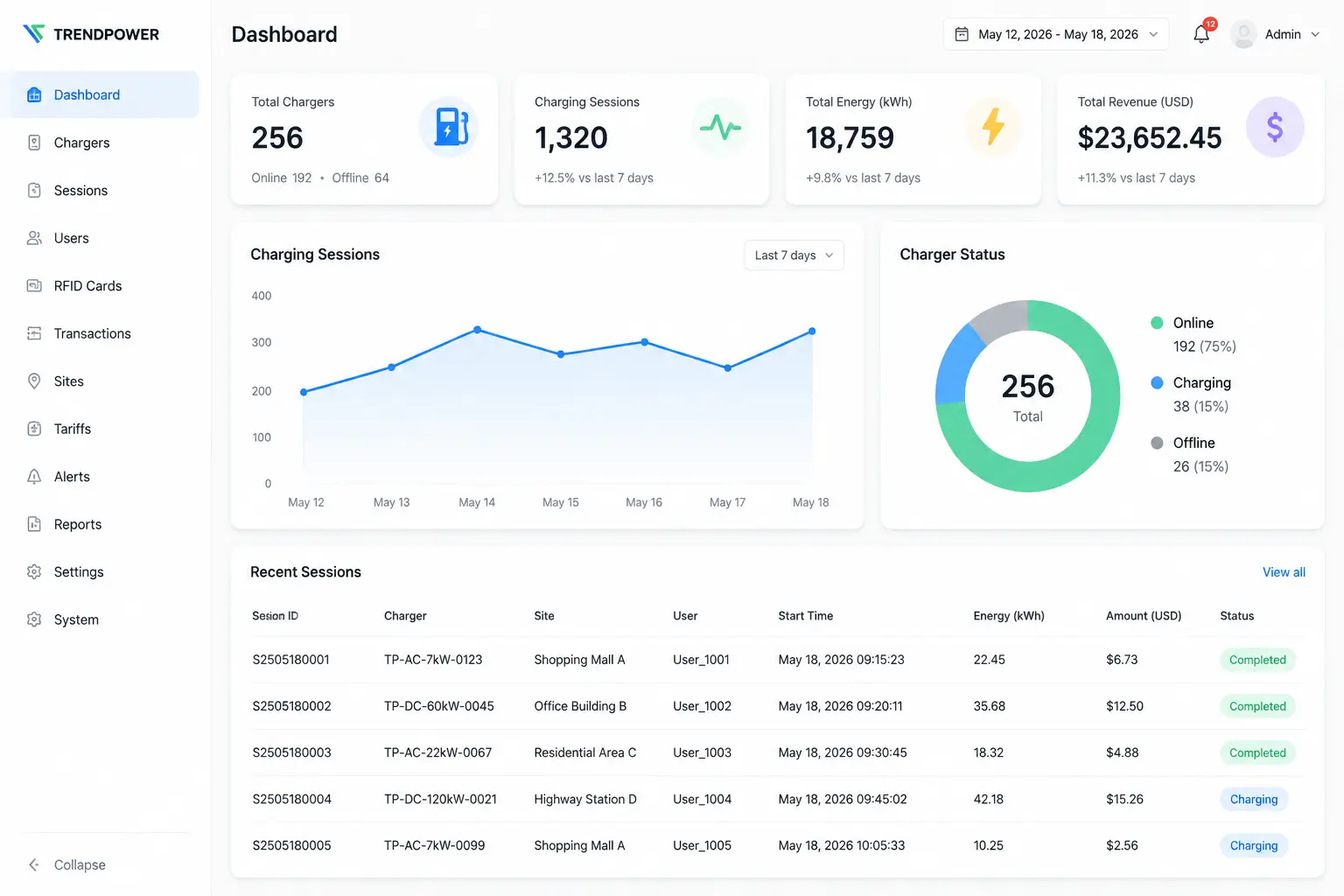
EV charging management software is a centralized platform used to connect, monitor, control, and operate electric vehicle charging stations.
It is often described as a Charging Station Management System (CSMS) or Charge Point Management System (CPMS). Terminology varies between providers, but the core purpose is similar: give an operator one digital environment for managing charging infrastructure and the services around it.
Depending on the business model, the platform may manage:
- EV chargers and connectors
- Charging station status
- Driver authentication
- Charging sessions
- Energy consumption
- Tariffs and pricing
- Payments and billing
- RFID cards and user accounts
- Remote start and stop commands
- Faults and operational alerts
- Smart charging and load management
- Charging locations and site hosts
- Roaming connections
- Reports and revenue data
The software does not physically deliver electricity to the vehicle. Instead, it coordinates the digital decisions and data flows that allow charging infrastructure to operate as a reliable commercial or private service.
For an example of the operator-facing platform layer, explore TrendPower’s
EV Charging Point Management System.
How Does EV Charging Management Software Work?
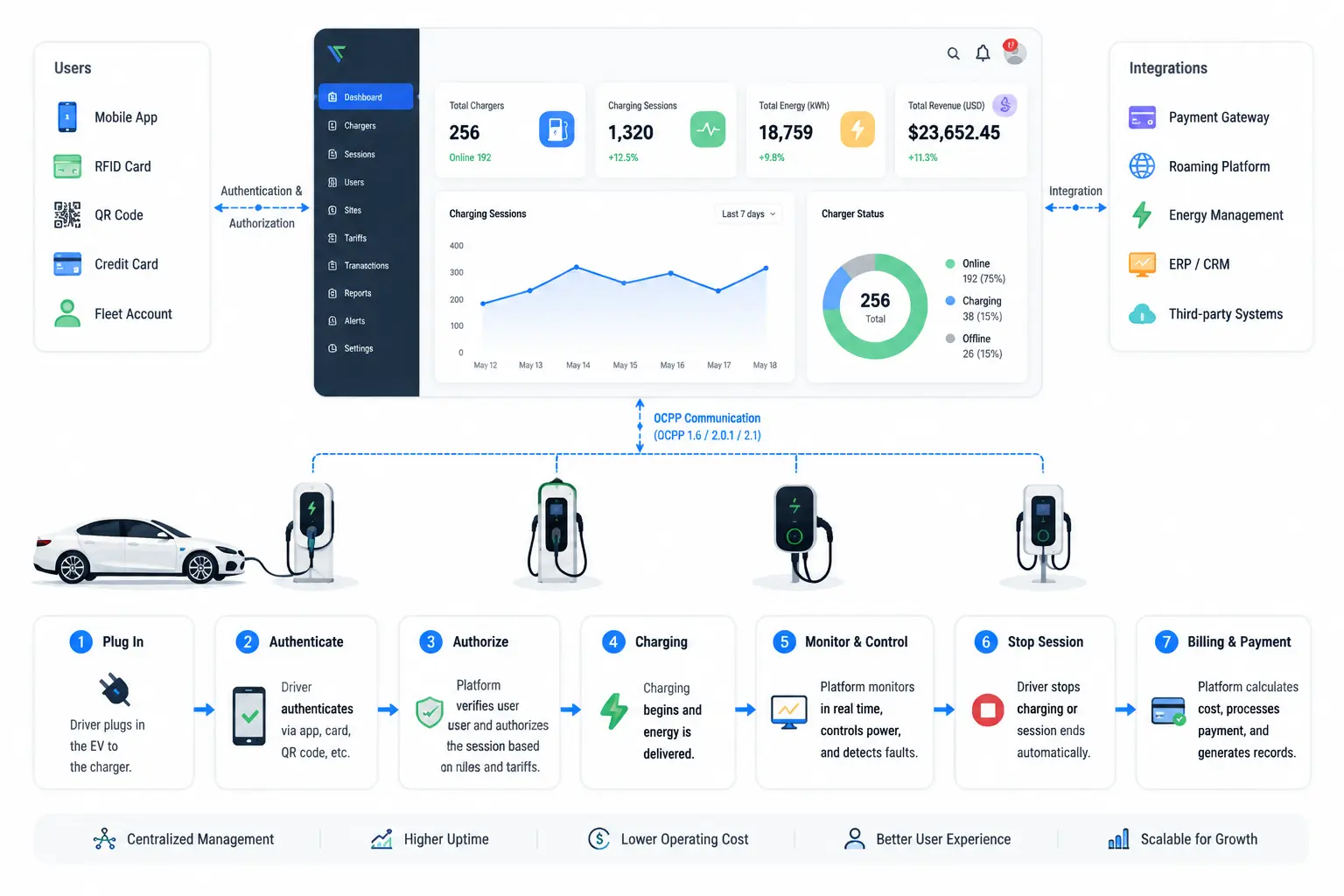
To understand the software, it is useful to follow a charging session from beginning to end.
Although exact workflows vary according to the charger, protocol, payment model, and operator configuration, a typical network follows the stages below.
Step 1: The EV Charger Connects to the Management Platform
Before drivers can use a charger, the charging station normally needs to establish communication with the backend management system.
In many commercial charging networks, this communication takes place through the Open Charge Point Protocol (OCPP).
OCPP provides a standardized communication layer between a charging station and a Charging Station Management System. This allows compatible chargers and software platforms to exchange operational messages without requiring both products to come from the same manufacturer.
Once connected, the backend can receive information such as:
- Charger availability
- Connector status
- Charging session events
- Meter values
- Error and fault information
- Configuration information
The backend can also send supported commands to the charging station, such as remote start, remote stop, configuration changes, charging profiles, or other operational instructions.
This interoperability is one reason OCPP support has become an important consideration when selecting EV charging software.
The Open Charge Alliance currently supports OCPP 1.6, OCPP 2.0.1, and OCPP 2.1. Businesses should evaluate not only which version a platform supports, but also whether the required workflows have been tested with the charger models they intend to deploy.
For a deeper technical explanation, read our guide to
OCPP EV charging software and hardware-agnostic charging networks.
Official reference:
Open Charge Alliance – Open Charge Point Protocol.
Step 2: The Driver Identifies or Authenticates
When a driver arrives at a charging station, the charging network usually needs to determine whether the person or vehicle is allowed to charge.
Depending on the charging service, authentication may take place through:
- A mobile app
- An RFID charging card
- A QR code
- A web-based payment page
- A credit or debit card terminal
- A fleet account
- A private access list
- Plug & Charge
The management software receives or participates in this authorization workflow and determines how the user should be treated.
For example, a public driver may need to pay a commercial tariff, while an employee, apartment resident, fleet vehicle, or VIP user may have a different price or access rule.
Step 3: The Platform Checks Authorization and Pricing Rules
Before charging starts, the platform may check several conditions.
These can include:
- Whether the user account is active
- Whether the RFID card or token is valid
- Whether the charger is available
- Whether the user is allowed to use the location
- Which tariff applies
- Whether payment authorization is required
- Whether a reservation exists
- Whether the site has specific charging restrictions
This is an important distinction between a simple charger and a commercial charging network.
The charger supplies power, but the management platform applies the operator’s business rules.
Step 4: The Charging Session Starts
Once authorization is approved, the charging station can begin the charging transaction.
The backend records the session and associates it with relevant data such as:
- User or account
- Charging station
- Connector
- Site or location
- Start time
- Meter reading
- Applicable tariff
- Payment method
- Operator or site host
From this point, the charging session becomes a digital transaction that can be monitored by the management software.
Step 5: The Software Monitors the Session in Real Time
During charging, the platform can receive ongoing operational information from the charging station.
Depending on the charger and protocol implementation, operators may be able to monitor:
- Charging status
- Energy delivered
- Session duration
- Power level
- Meter values
- Connector state
- Error conditions
- Communication status
This data can appear in the operator dashboard and, where appropriate, in the driver’s charging app.
Instead of physically visiting every station, operations teams can monitor a distributed charging network from one centralized system.
Step 6: Smart Charging Can Control Power Allocation
A charging management platform can do more than record charging sessions. It can also help control when and how much power chargers use.
This becomes especially important when many chargers share the same electrical connection.
Imagine a parking facility with 30 chargers. If every vehicle requests maximum power at the same time, total charging demand may exceed the site’s available electrical capacity.
A smart charging or load-management system can allocate available capacity according to defined rules.
The software may consider factors such as:
- Total site power capacity
- Number of active vehicles
- Charger power limits
- Charging priorities
- Time-of-use electricity prices
- Fleet departure schedules
- Energy storage availability
- Solar generation
For example, instead of allowing ten chargers to draw maximum power simultaneously, the platform may dynamically distribute available capacity across active sessions.
For a broader explanation of these strategies, see our
Smart EV Charging Solutions Guide.
Step 7: The Platform Detects Operational Problems
One of the most valuable functions of EV charging software happens when charging does not work as expected.
A charging platform can collect charger status information and fault events so operators can identify problems without waiting for a driver complaint.
Depending on the equipment and integration, operations teams may be able to:
- See offline chargers
- Identify fault codes
- Receive operational alerts
- Restart equipment remotely
- Change supported configurations
- Review charging session logs
- Track recurring faults
- Coordinate maintenance work
This remote visibility becomes increasingly important as the charging network expands across cities, regions, or countries.
Step 8: The Charging Session Ends
A session may end when the driver stops charging, disconnects the vehicle, reaches a configured condition, or when an authorized remote command is sent.
The management system then records the final transaction information.
Typical data can include:
- Session start and stop time
- Total charging duration
- Energy consumed
- Final meter information
- User information
- Tariff calculation
- Transaction amount
- Payment status
These records can later support customer receipts, operator reporting, financial reconciliation, site-host settlements, fleet reporting, and business analytics.
Step 9: Billing and Payment Are Processed
For commercial charging networks, charging data eventually needs to become a financial transaction.
The software can connect the charging session with the operator’s pricing and payment workflow.
Depending on the market, pricing may be based on:
- Energy consumed
- Charging duration
- Parking duration
- Session fees
- Time-of-day tariffs
- Membership pricing
- Different user groups
- Combinations of multiple pricing rules
The charging software may integrate with external payment gateways rather than directly handling the complete payment infrastructure itself.
For multi-party businesses, the backend may also support reconciliation or revenue-sharing workflows between the charging operator, location owner, reseller, or other commercial partners.
A Simple Example: What Happens After a Driver Plugs In?
Consider a driver arriving at a public charging station.
- The charger is already connected to the charging management platform.
- The driver scans a QR code or authenticates through an app or RFID card.
- The platform verifies the user and determines the applicable tariff.
- The backend authorizes the charging session.
- The charging station begins delivering energy.
- The charger sends session and meter information to the backend.
- The operator monitors the charger and session remotely.
- If necessary, smart charging rules control the charger’s power allocation.
- The driver stops charging.
- The software calculates the charging transaction according to the configured tariff.
- The payment workflow is completed.
- The session becomes part of the operator’s reports, revenue records, and analytics.
What feels like a simple charging experience to the driver can therefore involve communication between several different systems in the background.
What Systems Make Up an EV Charging Software Architecture?
A complete charging ecosystem usually contains more than one application.
1. EV Charging Stations
These are the physical AC or DC charging devices installed at charging locations.
They provide electricity to vehicles and exchange operational data with the backend.
2. Charging Station Management System
The CSMS or CPMS is the central operational platform.
It typically handles charger connectivity, sessions, users, tariffs, monitoring, remote operations, data, and administrative workflows.
3. Operator Dashboard
The operator dashboard provides charging businesses with visibility and control.
Operators may use it to manage chargers, users, locations, pricing, payments, alerts, reports, and different organizational roles.
4. Driver App or Web Application
A driver-facing application can enable users to:
- Find charging stations
- View charger availability
- Start or stop charging
- View tariffs
- Make payments
- Review charging history
- Manage an account
Some charging businesses choose a white-label EV charging app so the user experience can operate under their own brand.
5. Payment Gateway
The payment system connects charging transactions with financial processing.
The exact architecture depends on the country, payment provider, business model, and regulatory requirements.
6. Roaming Platform or eMobility Service Provider
Charging networks may also connect with external mobility platforms so drivers from another network can access their chargers.
One protocol used for this type of interoperability is OCPI, or Open Charge Point Interface.
While OCPP primarily connects charging stations with management systems, OCPI is commonly used for communication between Charge Point Operators and eMobility Service Providers.
OCPI can support functions such as location information, charger availability, tariffs, authorization, sessions, remote commands, and Charge Detail Records.
Official reference:
EVRoaming Foundation – OCPI.
7. Energy Management Systems
For smart charging environments, the EV charging platform may integrate with building energy management systems, solar generation, battery energy storage, or utility programs.
This allows charging decisions to consider more than driver demand alone.
8. External Business Systems and APIs
Larger operators may need the charging platform to communicate with other business software.
Common integrations can include:
- ERP systems
- CRM systems
- Accounting software
- Fleet platforms
- Parking systems
- Property management systems
- Energy platforms
- Data warehouses
APIs are therefore an important consideration for businesses that want EV charging to become part of a larger digital ecosystem.
OCPP vs. OCPI vs. ISO 15118: What Is the Difference?
These standards are often mentioned together, but they solve different communication problems.
OCPP: Charger to Management Platform
OCPP focuses primarily on communication between an EV charging station and a Charging Station Management System.
It enables functions such as charger status communication, transaction management, remote commands, configuration, monitoring, and smart charging depending on the protocol version and implementation.
OCPI: Charging Network to Mobility Services
OCPI helps connect Charge Point Operators with eMobility Service Providers and roaming ecosystems.
It can exchange information such as locations, real-time availability, tariffs, sessions, authorization, and charging records.
ISO 15118: Vehicle to Charging Infrastructure
ISO 15118 addresses communication between the electric vehicle and charging infrastructure and is particularly important for capabilities such as Plug & Charge.
With Plug & Charge, compatible vehicles and charging systems can automate identification and charging authorization without requiring the driver to manually authenticate with an RFID card or charging app.
Official reference:
CharIN – Plug & Charge.
OpenADR: Charging and the Energy System
OpenADR is associated with automated demand-response communication between utilities, energy systems, and connected loads.
In EV charging applications, this can help support charging strategies that respond to electricity pricing, grid conditions, or demand-response programs where applicable.
Official reference:
OpenADR Alliance – Demand Response Program Guide.
What Is Different About OCPP 1.6, OCPP 2.0.1 and OCPP 2.1?
As of 2026, the Open Charge Alliance lists OCPP 1.6, OCPP 2.0.1, and OCPP 2.1 among its supported versions.
OCPP 1.6 remains widely deployed in existing charging networks.
OCPP 2.0.1 introduced a different architecture with capabilities including an improved device model, enhanced transaction handling, stronger security features, smart charging improvements, and ISO 15118 support. OCPP 2.0.1 is not backward compatible with OCPP 1.6.
OCPP 2.1, released in 2025, builds on OCPP 2.0.1 and adds capabilities including ISO 15118-20 support and functionality related to bidirectional charging and distributed energy resources.
For buyers, however, choosing a protocol should not be reduced to selecting the largest version number.
A more practical question is:
Does the software reliably support the charger models and operational workflows that our charging business actually needs?
A provider may advertise OCPP compatibility, but a real deployment still requires interoperability testing across charger firmware, charging scenarios, remote commands, payment workflows, smart charging functions, and fault conditions.
What Happens If an EV Charger Loses Its Internet Connection?
Because most modern charging management platforms depend on network communication, operators should understand how the system behaves when connectivity is interrupted.
The exact behavior depends on the charging station, protocol configuration, local authorization capabilities, firmware, and backend architecture.
Possible scenarios include:
- The charger continues an active session and synchronizes information later.
- Previously authorized users may still be able to charge through local authorization rules.
- New online payment sessions may be unavailable until communication returns.
- The charger may temporarily appear offline in the management dashboard.
- Stored transaction data may be uploaded after the connection is restored.
For business-critical charging environments, buyers should test offline behavior instead of assuming every charger reacts in the same way.
How Does Smart Charging Software Reduce Site Power Demand?
One of the biggest challenges in large charging installations is that the theoretical maximum demand of all chargers may be much higher than the power actually available at the site.
Smart charging software can respond by distributing available capacity dynamically.
For example, imagine a site with:
- 20 connected vehicles
- 20 chargers capable of significant combined demand
- A limited amount of power available for EV charging
Instead of allowing every charger to request maximum power, the charging management platform can apply charging profiles or site-level rules to keep total demand within the configured limit.
More sophisticated systems can also prioritize vehicles.
A fleet vehicle that must leave in one hour may receive more power than a vehicle parked overnight.
This is especially useful for:
- Electric bus depots
- Commercial fleets
- Apartment buildings
- Office charging
- Large parking facilities
- Logistics centers
- Charging hubs
Who Uses EV Charging Management Software?
Different organizations use the same underlying technology for different purposes.
Charge Point Operators
CPOs use charging management software to operate networks, monitor stations, manage users, configure tariffs, process charging transactions, and understand network performance.
EV Charger Manufacturers
Hardware manufacturers may use a charging software platform to provide customers with a complete hardware-and-software solution instead of selling standalone equipment only.
Fleet Operators
Fleet and depot operators use charging software to coordinate vehicles, chargers, energy constraints, and operational schedules.
Property Owners and Apartment Operators
Property businesses can use the software to control access, allocate charging costs, manage residents or tenants, and monitor shared charging infrastructure.
Workplaces and Commercial Properties
Businesses may provide different charging rules for employees, visitors, tenants, customers, or other user groups.
Energy Companies and Utilities
Charging platforms can become part of a wider energy ecosystem involving load management, tariffs, renewable energy, battery storage, and demand-response programs.
What Are the Main Benefits of EV Charging Management Software?
Centralized Network Visibility
Operators can see chargers across multiple sites without managing each device separately.
Remote Operations
Supported charger functions can be controlled remotely, reducing the number of situations that require an immediate site visit.
Automated Charging Transactions
The platform connects users, charging sessions, pricing, and payment workflows in one operational system.
Improved Charger Availability
Fault monitoring and operational alerts can help teams identify problems earlier and respond more efficiently.
Scalable Operations
A centralized platform makes it easier to expand from a small number of chargers to a larger multi-site network.
Better Business Data
Operators can analyze energy usage, charging sessions, user behavior, revenue, charger utilization, and network performance.
More Flexible Hardware Strategy
With well-implemented open-protocol support, businesses may be able to operate compatible chargers from multiple manufacturers instead of tying the entire network to one hardware vendor.
What Should You Look for in EV Charging Management Software?
Feature lists can look similar across different software providers. The more useful approach is to evaluate whether a platform can support your real operating model.
1. Proven Charger Interoperability
Do not ask only whether the system “supports OCPP.”
Ask which protocol versions are supported, which charger models have been tested, and whether your required workflows can be demonstrated.
2. Real-Time Monitoring and Remote Operations
The platform should give operations teams clear visibility into charger health, sessions, errors, and network status.
3. Flexible Tariffs and Payment Integration
Make sure pricing and payment workflows fit the countries and business models where you plan to operate.
4. Smart Charging and Load Management
For sites with many chargers or limited electrical capacity, energy-management capability can become a critical requirement rather than an optional feature.
5. APIs and Third-Party Integration
Check whether the system can integrate with existing business, fleet, parking, energy, accounting, or customer platforms.
6. Data Ownership and Export
Businesses should understand how operational data can be accessed, exported, migrated, and integrated with other systems.
7. Security and Access Control
Evaluate authentication, role-based access, encrypted communications, audit capabilities, software update processes, and security responsibilities across the complete system.
8. Localization
Global charging businesses may require different languages, currencies, payment providers, taxes, tariffs, and local operating processes.
9. Scalability
The architecture should support future growth without requiring the charging business to redesign its entire software environment each time the network expands.
10. Deployment and Support Model
Understand whether the platform is delivered as SaaS, private cloud, on-premises, or another architecture, and determine what level of technical integration and support is available.
10 Workflows to Ask an EV Charging Software Provider to Demonstrate
A practical software evaluation should go beyond screenshots and feature lists.
Ask potential providers to demonstrate workflows such as:
- Adding and provisioning a new charger.
- Connecting a real charger through OCPP.
- Starting a session through RFID.
- Starting a session through an app or QR-code workflow.
- Changing a charging tariff.
- Monitoring a live charging session.
- Handling an offline or faulted charger.
- Remotely starting, stopping, or restarting supported equipment.
- Generating charging and revenue reports.
- Applying a site-level smart charging or load-management rule.
If roaming, Plug & Charge, fleet scheduling, revenue sharing, or energy integration matters to your project, those workflows should also be tested before deployment.
For more procurement questions, visit our
EV Charging Software FAQ knowledge base.
Does Every EV Charging Business Need the Same Software?
No.
The right software architecture depends heavily on the operating model.
A public charging network may prioritize payments, roaming, driver applications, and charger availability.
A bus depot may care more about vehicle readiness, departure schedules, power limits, and charger reliability.
An apartment charging business may focus on resident access, shared chargers, automated billing, and revenue allocation.
A charger manufacturer may prioritize white-label software, multi-tenant dealer management, hardware integration, localization, and after-sales visibility.
That is why software selection should begin with the required operating workflows rather than with the longest feature checklist.
How TrendPower Approaches EV Charging Management Software
TrendPower develops EV charging software for charging operators, charger manufacturers, fleets, property businesses, and other organizations building connected charging services.
Our published platform capabilities include OCPP 1.6J and OCPP 2.0.1 architectures, charger management, payment integration, user management, monitoring, white-label applications, multi-role operations, smart charging, and integration with external systems.
TrendPower’s EV charging business is built on the software engineering experience of Guangzhou Trend Information Technology Co., Ltd., founded in 2005. Our company information currently reports more than 150 projects and experience across more than 30 countries and regions.
You can learn more about our engineering background and delivery experience on the
TrendPower About page.
For businesses evaluating software architecture, hardware integration, customized workflows, payment requirements, or charging-network deployment, explore our
EV charging software solutions.
You can also compare different market participants in our guide to
leading EV charging solution companies in 2026.
Frequently Asked Questions
What does EV charging management software do?
EV charging management software connects charging stations with the systems used to manage users, charging sessions, tariffs, payments, energy usage, faults, reports, and remote operations. It allows an operator to manage multiple charging points from a centralized platform.
How does EV charging software communicate with charging stations?
Many commercial charging platforms communicate with compatible charging stations using OCPP. The protocol allows chargers and management systems to exchange messages related to status, transactions, meter values, configuration, remote commands, and other supported functions.
Can one EV charging platform manage chargers from different manufacturers?
Potentially, yes. Open-protocol platforms can support chargers from multiple manufacturers, but interoperability should be tested with the specific charger models, firmware versions, protocol versions, and workflows required for the project.
What is the difference between an EV charging app and charging management software?
A charging app is normally the driver-facing interface used for functions such as finding chargers, starting sessions, making payments, and viewing charging history. The charging management platform is the larger backend system responsible for operating chargers, sessions, users, tariffs, payments, monitoring, and network data.
Is OCPP the same as EV charging management software?
No. OCPP is a communication protocol. EV charging management software is the actual operational platform. The software may use OCPP to communicate with compatible charging stations.
How does EV charging software handle payments?
The platform links charging-session data with configured tariffs and payment workflows. Depending on the system architecture, it may integrate with external payment gateways, wallets, card terminals, or other payment providers to complete the financial transaction.
What happens if a charger goes offline?
The result depends on the charger, firmware, protocol configuration, and backend setup. Some chargers can continue existing sessions or use local authorization capabilities and synchronize data when connectivity returns. Operators should test offline behavior as part of charger-software interoperability testing.
What is smart EV charging?
Smart EV charging uses software to control charging behavior according to factors such as site capacity, charger demand, vehicle priorities, energy prices, solar production, battery storage, or fleet schedules. It can help avoid unnecessary power peaks and use available electrical capacity more efficiently.
Final Thoughts: The Software Is the Operational Layer Behind the Charger
For the driver, EV charging can look simple: plug in, authenticate, charge, and leave.
Behind that experience, however, a charging management platform may be coordinating chargers, users, authorization, pricing, payment, energy consumption, network monitoring, maintenance information, roaming, and external business systems at the same time.
That is why EV charging management software becomes increasingly important as a network grows.
The most important question is not simply whether a platform has a long list of features. Businesses should determine whether the software can reliably support their chargers, operating model, payment environment, energy constraints, integrations, and future expansion.
If you are planning a new charging network or evaluating an existing platform, start by mapping the complete charging workflow from charger connection to final billing. That process will usually reveal which software capabilities genuinely matter to your business.
Explore TrendPower EV Charging Management Software to learn how charging stations, users, payments, monitoring, and operational data can be managed through one platform.
Technical References
This article references open industry standards and technical organizations involved in EV charging interoperability:

 EN_GB
EN_GB  EN
EN  ZH
ZH  AR
AR  DE
DE  ES
ES  KO
KO  JA
JA  IT
IT  FR
FR  VI
VI  MS
MS  ID
ID  FR_CA
FR_CA  NL
NL  SV
SV  TH
TH 