
Choosing charge point management software is not only about a clean dashboard. For a CPO, OEM, property operator or fleet business, the real decision comes down to compatibility, billing, operations, data ownership and future scalability.
A platform may look modern during a demo, but the real test begins after chargers go online. Can it connect different charger brands? Can it support your pricing model? Can your team troubleshoot a failed session remotely? Can you migrate data if the business expands into another region? Can the system keep operating when a site has unstable network conditions?
This guide is designed as a practical selection checklist for buyers who already understand the basic concept of CPMS software and now need to compare real platforms. If you are still learning the fundamentals, you can first read TrendPower’s CPMS Software Guide for EV Charging Operators and then return to this selection guide.
When You Need Real Software, Not Just a CPMS Concept Page
Many EV charging businesses start by searching “what is CPMS” or “what is EV charging management software.” That is useful at the beginning. But once you are preparing to launch chargers, enter a new market, build a branded platform, or migrate from another backend, the question changes.
You no longer need a definition. You need a reliable commercial system.
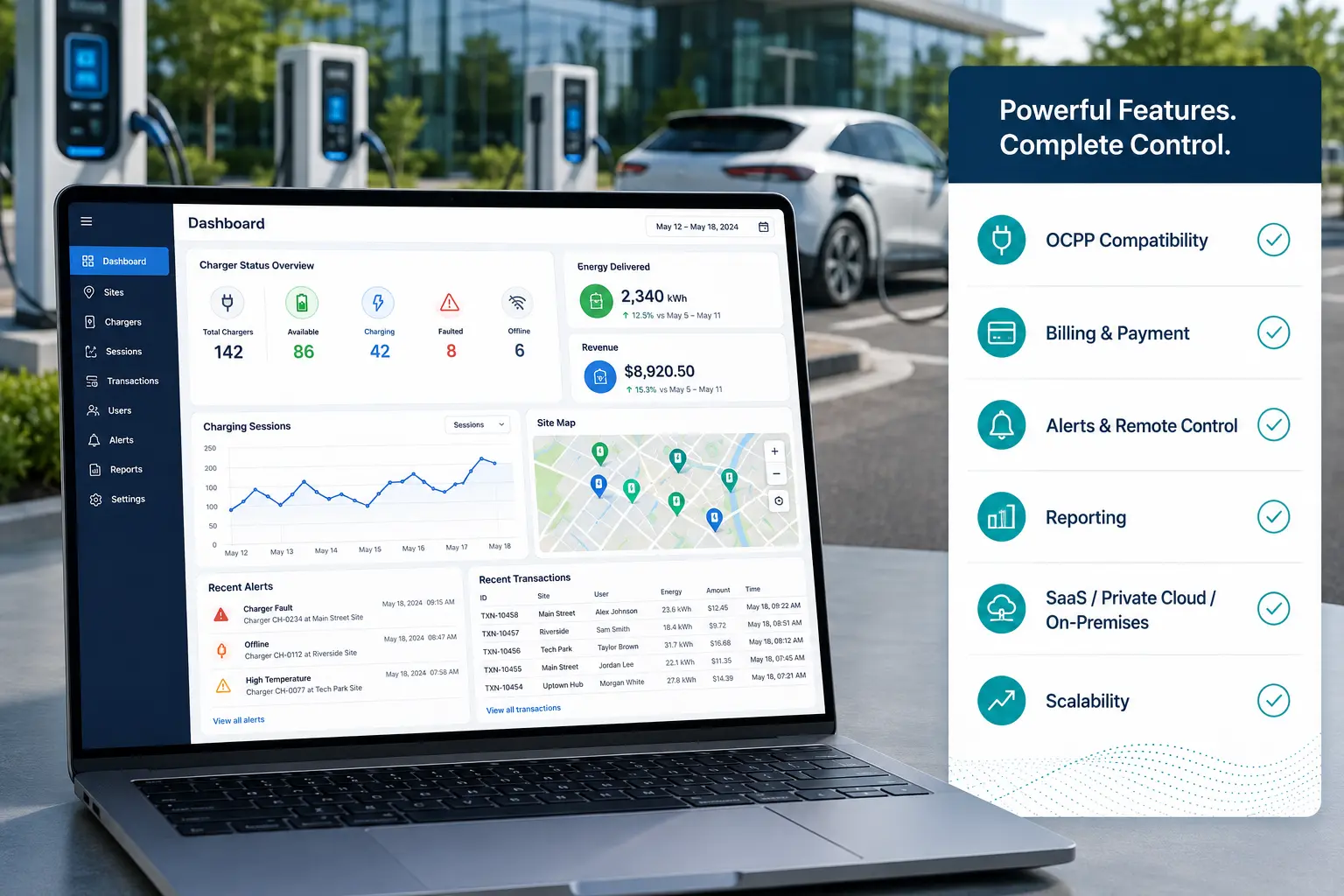
A real charge point management software platform should help your team manage chargers, users, charging sessions, billing, payments, fault alerts, maintenance workflows, reports, permissions and integrations from one connected backend. It should also support your business model instead of forcing you to operate in a fixed way.
For example, a public CPO may care most about uptime, roaming, payment success rate and multi-site reporting. A charger OEM may need OCPP testing, white-label deployment and fast localization for overseas customers. A property operator may focus on access control, resident billing and revenue sharing. A fleet operator may need vehicle-level records, scheduled charging and internal cost allocation.
That is why the best charge point management software is not always the one with the longest feature list. It is the one that matches your charger hardware, market, operating model and growth plan.
CPOs, OEMs, Properties and Fleets Have Different Priorities
Before comparing platforms, define who will use the software and what success looks like.
CPOs
Charge point operators need charging station management software that keeps stations online, reduces manual work and turns every session into trackable revenue. Core priorities usually include real-time monitoring, remote control, flexible pricing, payment integration, user support, maintenance workflows and financial reporting.
CPOs also need scalability. A system that works for 20 chargers should not collapse when the network expands to 2,000 chargers across different cities or countries.
Charger OEMs
EV charger manufacturers often need cpms software to support hardware sales. Overseas buyers increasingly ask whether chargers can connect to a local platform, support OCPP, process local payments and provide a branded user experience.
TrendPower’s cooperation with JSOWELL New Energy is a strong example. JSOWELL needed an overseas EV charging operation platform to support its global hardware expansion. TrendPower helped provide a platform foundation with protocol integration, multilingual support and payment method adaptation for international markets.
Property Operators
Residential communities, office buildings, hotels, malls and parking facilities usually need access control and settlement logic. The software should support tenants, visitors, members, property managers and maintenance teams with different permissions.
For this scenario, integration between charging access, billing and reporting is more important than a complex roaming network. You can also review TrendPower’s Shared Residential EV Charging Solution for property-based charging models.
Fleet Operators
Fleets need predictable operations. Their priority is not only public payment collection but also charger availability, power scheduling, driver records, vehicle-level charging history and internal reports.
For electric buses, logistics vehicles, service fleets or heavy-duty trucks, the platform should support high charging reliability, planned charging windows and energy usage analysis. TrendPower’s Heavy-Duty Truck Charging Fleet Management System is relevant for this type of operational environment.
Must-Check Features Before Choosing Charge Point Management Software
OCPP Compatibility
OCPP compatibility is one of the most important selection criteria. The Open Charge Point Protocol is the open communication protocol between charging stations and charging management systems. It helps operators build infrastructure that is interoperable, scalable and less dependent on proprietary systems. You can refer to the official Open Charge Alliance OCPP page for protocol background.
When evaluating ev charging management software, do not only ask, “Do you support OCPP?” Ask more detailed questions:
Does the platform support OCPP 1.6?
Is it ready for OCPP 2.0.1 or 2.x migration?
Can it connect chargers from multiple manufacturers?
Can your team test BootNotification, StatusNotification, MeterValues, StartTransaction, StopTransaction and remote commands?
How are charger logs, fault codes and firmware updates handled?
Can the vendor support hardware debugging before mass deployment?
TrendPower has supported overseas OCPP platform projects for companies such as Max Power New Energy and JSOWELL New Energy. These cases show why protocol readiness matters: charger manufacturers expanding globally need more than hardware. They need a backend that can help them connect, test and operate chargers in different market environments.

Billing and Payment
Billing is where charging sessions become business revenue. A weak billing module creates disputes, manual reconciliation and poor user experience.
Good charging station management software should support common pricing rules such as kWh-based pricing, time-based pricing, session fees, idle fees, member pricing, peak and off-peak tariffs, site-based pricing, fleet billing and revenue sharing.
Payment is equally important. In some markets, users prefer credit cards. In others, QR payment, app wallets, local aggregators or account balance models are more common. Your CPMS should not force one payment method across all countries or site types.
TrendPower’s Hong Kong project with Guangzhou Puri Power shows the importance of local payment adaptation. The platform was designed for the Hong Kong market with OCPP integration, multilingual access and SoéPay payment support. It also supported flexible billing rules, including time-based pricing, idle fees, minimum balance and peak/off-peak configuration.
If payment is a major requirement, connect this article internally to TrendPower’s EV Charging Payment Solution.
Alerts and Remote Control
A charger that is offline, blocked or unable to process payment is not only a technical issue. It is lost revenue and a damaged customer experience.
Your charge point management software should provide real-time charger status, connector status, session progress, energy output, network status, fault alerts and maintenance records. It should also allow authorized teams to perform remote start, remote stop, reset, configuration updates, diagnostics and troubleshooting.
For multi-site operators, remote control reduces unnecessary site visits. For OEMs, it helps support customers faster. For fleet operators, it reduces disruption when drivers depend on charger availability.
The key question is whether the system helps your team act quickly. A dashboard that only displays problems is not enough. A strong backend should help identify, assign, troubleshoot and resolve them.
Reporting and Permission Management
Reporting is often underestimated during software selection. In the early stage, basic session data may seem enough. As the network grows, different stakeholders need different reports.
A CPO may need revenue by site. A landlord may need settlement by parking area. A fleet manager may need charging records by vehicle or driver. A finance team may need monthly statements. A maintenance team may need fault history. A regional partner may need access only to its own chargers.
The platform should support role-based permissions, multi-site data separation, partner accounts, exportable reports and visual dashboards. Data should be easy to understand and reliable enough for operational decisions.
For a deeper explanation of backend architecture, charger communication, payments and multi-site operations, link to TrendPower’s EV Charging Backend Software Guide.
How to Choose the Right Deployment Model
Deployment model affects cost, speed, control, compliance and long-term flexibility. The best option depends on your business stage and data requirements.
SaaS
SaaS is suitable for operators that want fast launch, lower upfront cost and continuous platform updates. The vendor hosts and maintains the system, while your team uses it through a browser, mobile app or admin portal.
Choose SaaS if you are launching quickly, testing a new market or operating a standard charging business model. It is usually the easiest path for small and mid-sized CPOs.
However, you should still ask about data export, API access, system uptime, payment gateway ownership and migration options. SaaS should not mean losing control of your business data.
Private Cloud
Private cloud is suitable for companies that need more control, branded operations, regional data separation or deeper customization. It gives operators more flexibility than standard SaaS while avoiding the full maintenance burden of on-premises systems.
This model is often attractive to charger OEMs, regional operators and international companies entering new markets. TrendPower’s overseas platform cases show how private or customized deployment can help companies adapt to different languages, payment habits and protocol requirements.
On-Premises
On-premises deployment is usually chosen by enterprises with strict data security, compliance or internal IT requirements. It gives the highest level of control but also requires stronger technical resources.
Before choosing on-premises, confirm who handles updates, monitoring, backups, security patches, server capacity, disaster recovery and support. Full control also means more responsibility.
For many commercial charging businesses, private cloud or hybrid deployment can provide a better balance between control and operational efficiency.
Migration and Vendor Lock-In Risks
Vendor lock-in is one of the biggest hidden risks in CPMS software selection. It may not appear during the first demo, but it becomes painful when you want to change hardware, expand to another market or move to a different backend.
To reduce lock-in risk, ask these questions before signing:
Can charger data, user data, transaction data and billing records be exported?
Can the platform connect to chargers from different brands?
Are APIs available for third-party integrations?
Who owns the driver accounts and payment relationship?
Can the platform support your own domain, brand and app?
What happens if you migrate from another CPMS?
What happens if a charger is offline or the network is unstable?
OCPP reduces hardware lock-in, but it does not automatically remove software lock-in. You still need clear data ownership, export tools, integration documentation and contract terms.
TrendPower emphasizes data sovereignty, flexible deployment and multi-protocol support. For growing operators, this matters because your charging platform should become a long-term asset, not a closed system that limits future business decisions.
A Practical Five-Step Selection Checklist
Use this five-step checklist when comparing charge point management software vendors.
Step 1: Map Your Business Model
List your site types, charger types, user groups, payment requirements, pricing models, operating countries and growth plan. A public fast-charging network, residential charging platform and fleet depot will not need the same configuration.
Step 2: Test Charger Compatibility
Do not rely only on a sales claim. Test your charger models with the platform. Confirm OCPP version support, remote commands, transaction records, meter values, error codes, firmware updates and recovery behavior after network interruption.
Step 3: Validate Billing and Payment Workflows
Create test sessions for your real pricing models. Check taxes, refunds, idle fees, prepaid balance, card payment, wallet payment, invoices, settlement reports and revenue sharing. Payment failure handling should also be tested.
Step 4: Review Operations and Support
Ask how alerts are generated, who receives them, how tickets are handled, whether remote troubleshooting is available and what service response process the vendor provides. Operations support is especially important after launch.
Step 5: Confirm Scalability and Exit Options
Check whether the system can support more chargers, more countries, more languages, more payment gateways and more partners. Also confirm data export, API availability and migration support before the contract is signed.

 EN_GB
EN_GB  EN
EN  ZH
ZH  AR
AR  DE
DE  ES
ES  KO
KO  JA
JA  IT
IT  FR
FR  VI
VI  MS
MS  ID
ID  FR_CA
FR_CA  NL
NL  SV
SV  TH
TH 