
Introduction
When drivers ask how to pay for EV charging, charging operators should also ask how to make payment smooth, reliable, and easy to reconcile.
That is because EV charging payment is not the same as paying for fuel. A gasoline transaction is usually a single retail event. An EV charging session is often a digital workflow that starts with user authorization, continues with charger communication and tariff calculation, and ends with payment capture, receipt or invoice generation, reconciliation, settlement, and sometimes refund handling. The U.S. Department of Energy describes plug-in EVs as vehicles that charge by connecting to charging equipment, which is a useful reminder that the “payment moment” is tied to a live charging session rather than a simple pump transaction.
This guide is written from the perspective of EV charging software operation, where payment is closely connected with authorization, billing, reconciliation, and site-level settlement. TrendPower positions its platform around EV charging management, payment support, billing integration, user management, real-time monitoring, and multi-scenario operation for operators, manufacturers, and property-related use cases.
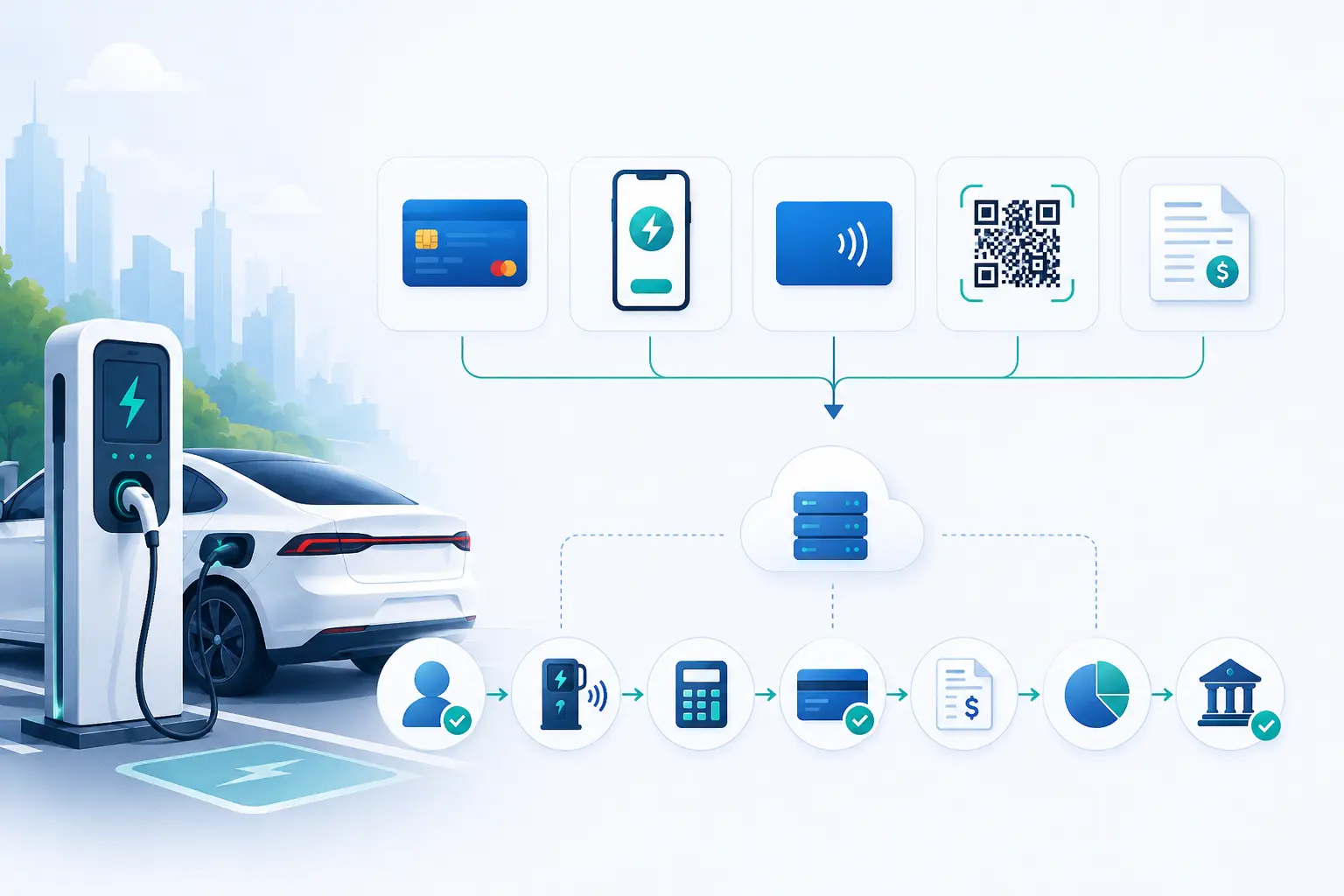
Common EV Charging Payment Methods
Credit Card and Ad Hoc Payment
For many first-time or occasional drivers, the simplest answer to how to pay for EV charging is still the most familiar one: tap or insert a credit or debit card, or open a one-time payment page and pay without registering.
This is usually called ad hoc payment. It matters most at public charging stations, where requiring every driver to create an account can create friction, failed conversions, and abandoned sessions. On the driver side, ad hoc payment feels simple. On the operator side, it requires much more: payment gateway connectivity, charger-to-terminal coordination, tariff display, transaction logging, failed-payment rules, and customer support for interrupted sessions.
From a protocol perspective, the Open Charge Alliance states that OCPP 2.1 adds support for ad hoc payment through built-in or stand-alone card terminals and also introduces secure dynamic QR codes for ad hoc payment. That makes payment a charger-platform workflow, not just a checkout widget. See the Open Charge Alliance’s OCPP documentation for the protocol-side reference.
In Europe, this topic is no longer only about convenience. Regulation (EU) 2023/1804 requires publicly accessible recharging points deployed from April 13, 2024 to offer ad hoc charging with widely used payment instruments, including card readers or contactless payment-capable devices, and it requires transparent pricing before the session begins. The regulation also says ad hoc payment must remain available even when contract-based options exist. The broader policy context is summarized in the European Commission guidance on alternative fuels infrastructure and in Regulation (EU) 2023/1804 on EUR-Lex.
Operator insight: Card acceptance solves only part of the problem. If the charger fails to start after authorization, the operator still has to match the payment attempt to charger logs, session records, and refund rules.
Mobile App and Wallet
App-based payment is often the best answer for repeat users asking how to pay for electric car charging across a familiar network. A driver registers once, stores a card, tops up a wallet or links a payment method, then starts and stops sessions through the app. Receipts, charging history, promotions, and support all live in one place.
Behind the scenes, the app is usually the visible front end of a bigger account and billing system. The operator needs user identity, location and connector selection, tariff assignment, session-state monitoring, payment authorization, wallet deduction or card capture, and receipt generation to stay synchronized. TrendPower’s payment-solution page describes EV charging payment as a system that connects chargers, users, gateways, wallets, RFID or IC cards, billing rules, and backend systems while supporting billing, reconciliation, settlement, and revenue distribution.
Apps are also especially useful for membership pricing, repeat-user retention, subscription models, and multi-site charging networks. From an operator perspective, app payment supports wallet balances, user groups, tariff control, account-level reporting, and refund handling with more flexibility than one-time payment alone.
TrendPower perspective: In practice, app payment is not only a UX choice. It is often the account layer that makes pricing rules, coupons, monthly statements, and operational reporting manageable at scale.
RFID Card
RFID is fast, familiar, and still highly practical. A driver taps a card, the charger checks authorization, and the session begins. But in many deployments, RFID is not really the payment method by itself. It is the identity token that tells the charging platform which account, fleet, tenant, employee, or membership group should be billed.
That is why RFID is common in workplaces, apartment buildings, depots, and fleet environments. It reduces session-start friction, helps control access, and can support local authorization logic when connectivity is imperfect. TrendPower’s payment and CPMS materials both position RFID or IC cards as part of a broader payment-and-management workflow rather than a standalone tool.
The operational limits are equally important. Lost cards, card issuance, account binding, permissions, deactivation, and reconciliation all become platform responsibilities. If finance teams later need to allocate costs by driver, department, or property unit, RFID data must already be tied to a clean account structure.
Operator insight: RFID works best when access control and billing identity are designed together. If the card database and billing database drift apart, support tickets rise quickly.
QR Code Payment
QR code payment can look simple on-site, but it is only reliable when it is tightly connected to charger and session data.
In a basic model, the driver scans a code, lands on a payment page or mobile web app, selects the connector, confirms payment, and starts charging. For low-cost deployments, static QR codes can be attractive. But static codes can be misapplied, tampered with, or disconnected from the actual session context. OCPP 2.1’s support for secure dynamic QR codes shows why the industry increasingly treats QR as an integrated charging interaction instead of a generic payment redirect.
For operators, QR payment requires secure session matching, price confirmation before start, payment confirmation logic, charger start/stop messaging, timeout handling, and refund rules if charging never begins or ends prematurely.
TrendPower perspective: QR payment should never sit outside the charging workflow. If the payment page and charger session are not linked in real time, operators can end up with paid orders but failed starts, or started sessions with incomplete payment records.
Corporate Monthly Billing
For fleets, workplaces, residential communities, commercial parks, hotels, and logistics operators, the best answer to ev charging payment is often not instant card payment at all. It is structured monthly billing.
In these environments, operators may group charging sessions by company, vehicle, driver, department, tenant, site, or cost center. The billing engine may then calculate energy fees, time-based fees, idle fees, discounts, service fees, and tax treatment before producing statements and invoices. TrendPower’s CPMS and payment materials emphasize automated billing, transaction tracking, flexible billing methods, and backend reporting for these kinds of operational use cases.
Monthly billing matters because many B2B customers do not want each charging session settled like a consumer retail event. They want account control, approvals, invoice accuracy, and predictable finance operations.
Operator insight: If a site serves employees, residents, or fleet vehicles, the payment question usually becomes “Who should be charged, how often, and under which tariff?” That is a billing-software question, not just a payment-gateway question.
Which Payment Method Fits Different Charging Scenarios
Public Charging Stations
Public charging should usually support more than one option: ad hoc card payment, QR payment, and app payment. Public users need low-friction access, clear pricing, dependable payment confirmation, and fast support if something goes wrong. EU policy has also pushed the market further toward user-friendly ad hoc access and visible pricing.
Operators should avoid relying on only one channel. A driver who does not want to download an app may still expect to pay immediately. Another may prefer app-based receipts and saved payment details. Supporting multiple methods improves conversion and reduces customer-service pressure.
Operator insight: At public sites, payment failure often becomes a customer-service issue before it becomes a finance issue. The charger may be online and technically available, but from the driver’s perspective the station still “doesn’t work” if the payment flow breaks.
Shopping Malls, Hotels and Destination Charging
Destination charging is different because the business goal is not always charging revenue alone. It may also include dwell time, hospitality, loyalty, tenant experience, or retail traffic.
That is why QR payment, app payment, RFID for staff or VIP users, and discount or free-charging rules can all make sense together. For example, in a hotel or retail charging project, TrendPower can help the operator combine QR payment for visitors, RFID authorization for staff vehicles, and backend reporting for monthly revenue review. This is a practical scenario, not a named customer case. TrendPower’s broader platform messaging highlights user management, payment integration, multilingual operation, and flexible deployment for varied network models.
Apartments and Shared Residential Charging
Shared residential charging needs more than a payment button. It needs access control.
Property managers and residential operators must prevent unauthorized use, apply tenant-specific rules, manage charger availability, and generate dependable statements. TrendPower’s Shared Residential EV Charging Solution describes smart access control, automated billing, real-time monitoring, and configurable idle time slots for charger sharing, which is highly relevant for apartments and condos.
In this scenario, app accounts, RFID credentials, tenant-based billing, and monthly statements usually fit better than one-off retail payment alone. A resident may use the charger frequently, but the property manager still needs a clean monthly record of who used what, when, and under which pricing rule.
Fleet Charging
Fleet charging is usually best served by RFID, account-based billing, monthly invoicing, and centralized reporting. Fleet managers care less about retail checkout and more about cost allocation, vehicle identity, depot performance, and settlement accuracy.
A practical example is a logistics fleet that wants to separate charging costs by vehicle, driver, or depot. One truck may charge overnight at Depot A, another during the day at Depot B, and a supervisor may need a month-end report by route or business unit. That requires user management, charging records, tariff rules, and structured reports. TrendPower’s platform and CPMS materials highlight these kinds of billing, payment, reporting, and operational controls for operators managing multiple stations and commercial charging workflows.
What Operators Must Handle Beyond Payment
Invoices
Invoices are where charging data becomes finance data.
For B2B users, fleets, tenants, and commercial properties, invoice accuracy matters as much as payment acceptance. A useful invoice may need session date and time, charger or site, driver or account identity, energy consumed, time-based fees, idle fees, discounts, taxes, and statement-level totals. TrendPower’s payment and CPMS pages both emphasize billing management, payment processing, transaction tracking, and automated billing because operators need more than successful payment collection.
Accurate invoicing reduces disputes and cuts manual finance work. Poor invoicing creates distrust even when the charging session itself completed correctly.
Revenue Sharing
Many charging businesses do not keep all revenue inside one entity. Revenue may need to be split across site owners, equipment owners, operators, property managers, agents, or platform partners.
This is why revenue sharing should be configured inside charging billing software rather than managed later in spreadsheets. TrendPower’s CPMS page explicitly refers to operational commission management, automated revenue sharing, and five-party operational frameworks, which reflects the reality that payment and settlement often involve multiple commercial parties.
Reconciliation and Refunds
Reconciliation is where many EV charging payment problems finally become visible.
A successful payment does not always mean a successful charging outcome. The charger may fail to start after authorization. A session may end early because of a hardware fault. A gateway may show capture while the charger never delivered energy. Some cases need full refunds, others partial refunds, and some require dispute review against charger logs and tariff rules.
TrendPower’s payment-solution positioning around reconciliation, settlement, and transaction linking mirrors this operational reality. The real requirement is simple to state and difficult to implement: payment records must stay connected to charger session data from start to finish.
Operator insight: When finance, support, and operations teams all see different versions of the same charging event, refund handling becomes slow and expensive.
Common Mistakes When Choosing an EV Charging Payment Solution
The first mistake is looking only at the driver payment screen and ignoring backend reconciliation. A clean checkout page means very little if finance teams cannot match orders, sessions, refunds, and settlements later.
The second mistake is forcing one payment method into every scenario. Public charging, residential charging, and fleet charging often need different mixes of ad hoc payment, wallet payment, RFID authorization, and postpaid billing.
The third mistake is ignoring invoices and monthly billing. Many operators discover too late that B2B users, landlords, business parks, and fleet accounts care more about statements and finance controls than about the payment button itself.
The fourth mistake is treating RFID, QR, and app payment as separate systems instead of connected user identities. When those channels are disconnected, operators lose reporting clarity and customers lose continuity.
The fifth mistake is choosing a setup that cannot scale across sites, tariffs, taxes, currencies, or partners. TrendPower’s own platform messaging stresses scalable architecture, flexible billing, multilingual support, payment integration, and multi-party operational support for exactly this reason.
Recommended Next Step
The best answer to how to pay for EV charging depends on user type, site model, and business objective.
Public users usually need simple ad hoc payment. Repeat users often prefer an app, wallet, or RFID-linked account. Fleets, property managers, and commercial operators usually need monthly billing, invoices, and structured settlement logic. In other words, the real question is not only how to pay for electric car charging. It is how to turn charging payments into a reliable operating workflow.
For charging businesses, that means choosing a complete backend, not only a payment button. TrendPower’s EV Charging Payment Solution, EV Charging Point Management System, Shared Residential EV Charging Solution, and main TrendPower platform are positioned around that broader operational need: payments, billing support, user access control, reporting, and multi-scenario charging operations.
If you are evaluating an EV charging payment setup for a public network, property portfolio, or fleet environment, the most practical next step is to contact TrendPower or request a demo to review how payment methods, billing rules, reporting, and settlement workflows fit your specific charging model.

 EN_GB
EN_GB  EN
EN  ZH
ZH  AR
AR  DE
DE  ES
ES  KO
KO  JA
JA  IT
IT  FR
FR  VI
VI  MS
MS  ID
ID  FR_CA
FR_CA  NL
NL  SV
SV  TH
TH 