
Managing an EV charging network becomes increasingly complex as the number of chargers, locations, users and transactions grows. Operators need more than connected charging hardware. They need a digital platform that can monitor chargers, control charging sessions, manage users, automate billing, process payments, identify faults and turn operational data into useful business decisions.
This is where EV Charging Management Software becomes essential.
Also known as a Charging Point Management System (CPMS) or charging station management software, it acts as the central operating layer between EV chargers, drivers, operators and external business systems. For charge point operators (CPOs), charger manufacturers, fleets, property companies and energy businesses, selecting the right platform can directly affect network scalability, operational efficiency, charger availability and customer experience.
This guide explains how EV Charging Management Software works, the capabilities operators should prioritize, how OCPP affects hardware interoperability, and what to evaluate before choosing a software provider.
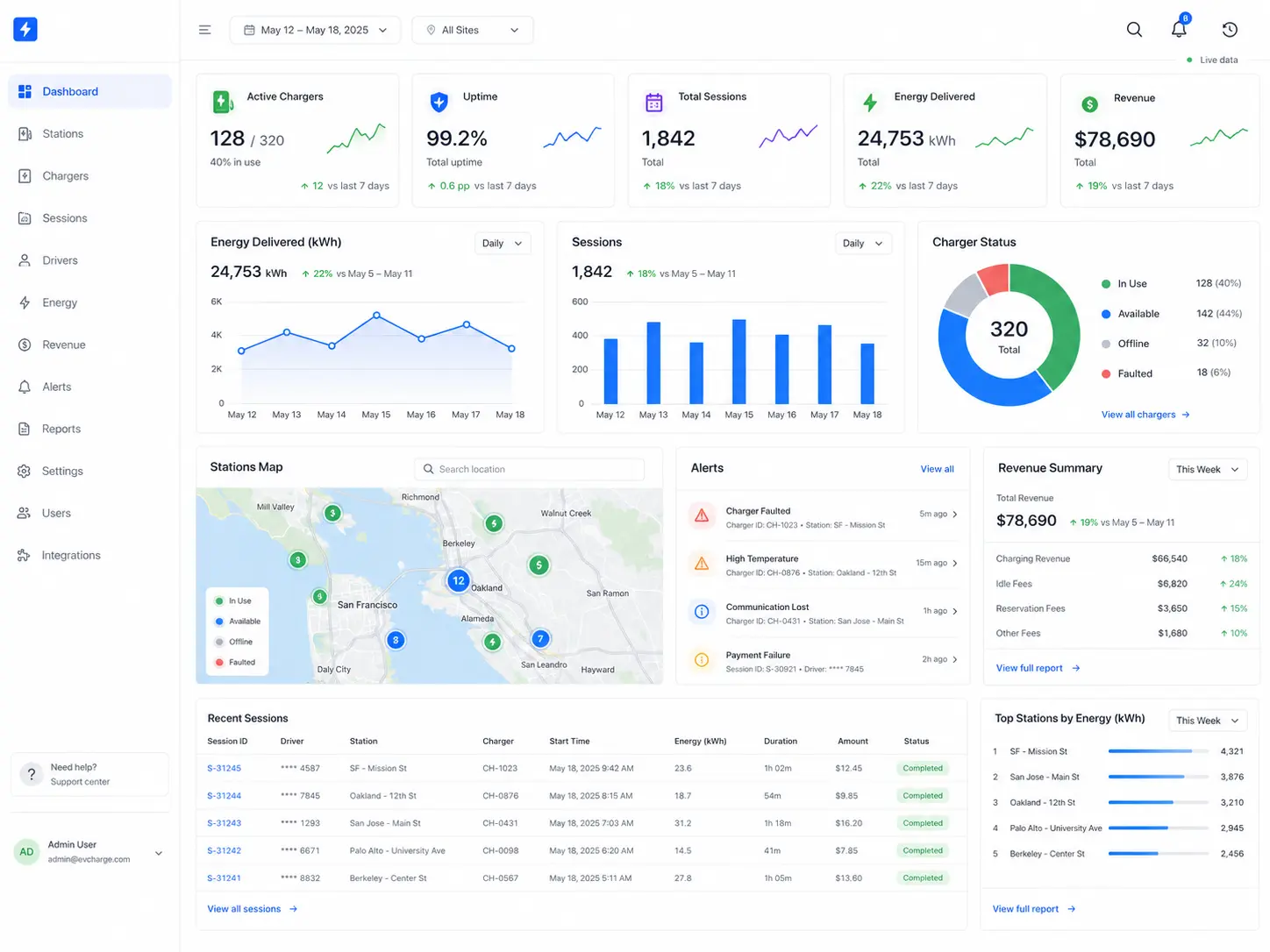
What Is EV Charging Management Software?
EV Charging Management Software is a centralized software platform used to connect, monitor, control and operate EV charging stations. Instead of managing individual chargers independently, operators can manage an entire charging network through one backend system.
A typical platform connects chargers with operator dashboards, driver-facing services, user accounts, pricing rules, payment systems and operational workflows. Depending on the project, it may also integrate with mobile apps, payment gateways, fleet systems, CRM platforms, ERP systems, roaming networks and energy-management solutions.
For a small charging site, basic charger monitoring may be enough. For a commercial charging network, however, software must coordinate thousands or potentially more charger events, user activities, payment transactions and maintenance tasks across multiple locations.
TrendPower’s EV Charging Point Management System is designed around this centralized approach, helping charging businesses connect chargers, users, sessions, transactions and operational data within one management environment.
How Does EV Charging Management Software Work?
The basic architecture contains three layers: EV chargers in the field, a communication layer and the central charging management platform.
When a charger connects to the backend, the platform can receive information such as charger availability, connector status, active charging sessions, energy consumption, meter values, alarms and fault information. Operators can then use the management portal to monitor devices and perform supported remote actions.
When a driver initiates a charging session, the platform may authenticate the user through an app, RFID card, QR code, account or another supported method. It then records the charging session, applies the configured tariff, calculates the transaction and connects the result with the relevant payment or billing process.
Communication standards are especially important when chargers from multiple manufacturers are involved. The Open Charge Alliance defines OCPP as an open communication protocol between charging stations and charging management systems. Using OCPP-compatible equipment can give operators greater flexibility when building multi-vendor charging networks.
However, buyers should not assume that an “OCPP-compatible” label guarantees every charger function will work automatically. Actual integration can depend on the charger model, firmware, OCPP version, configuration and functions implemented by both sides. Compatibility testing remains an important part of deployment.
Core Features of EV Charging Management Software
Not every charging platform offers the same depth of functionality. The most useful way to evaluate software is to connect each feature with the business problem it is supposed to solve.
| Core Capability | What It Does | Business Value |
|---|---|---|
| Real-Time Monitoring | Tracks charger, connector, session and fault status | Improves network visibility and fault response |
| Remote Control | Supports remote start, stop, reset and other compatible commands | Reduces unnecessary site visits |
| User Management | Manages accounts, RFID cards, permissions and access | Supports public, private and fleet charging |
| Tariffs & Billing | Configures pricing and calculates charging transactions | Supports commercial monetization |
| Payment Integration | Connects charging transactions with payment services | Creates a smoother customer payment journey |
| Analytics | Analyzes utilization, energy, sessions and revenue | Supports better operating decisions |
| O&M Management | Connects alarms, diagnostics and work orders | Improves maintenance efficiency |
| API Integration | Connects external apps and enterprise systems | Supports future expansion |
Real-Time Charger Monitoring
Operators need a clear view of what is happening across the charging network. EV Charging Management Software can provide centralized visibility into charger connectivity, connector status, ongoing sessions, alarms and other available operational data.
This becomes increasingly valuable when chargers are spread across multiple cities or countries. Instead of checking individual sites, an operations team can identify abnormal chargers from a central dashboard and prioritize the issues that require attention.
Remote Operations and Diagnostics
Many charger issues do not immediately require an engineer to visit the site. Depending on hardware capability and integration, software may support remote restart, configuration, log retrieval, fault analysis and other diagnostic actions.
A more advanced O&M workflow can connect detection, diagnosis, remediation and field-service processes. TrendPower’s Intelligent Operations Management solution combines real-time monitoring, remote diagnostics, supported remote remediation and work-order management for distributed charging infrastructure.
The U.S. Department of Energy’s Alternative Fuels Data Center also identifies the collection and analysis of charging infrastructure uptime and utilization data as an important part of successful charging station management.
User, Vehicle and Access Management
Different charging businesses require different access models. A public CPO may support app users, QR-code charging and payment accounts, while a private fleet may need driver, vehicle, RFID or organizational permissions.
A flexible platform should allow operators to define who can use specific chargers, locations or services and connect each charging session with the relevant user or business account.
Tariffs, Billing and EV Charging Payments
Charging infrastructure becomes a commercial business only when operators can convert charging activity into accurate transactions.
EV charging software may support energy-based pricing, time-based pricing, parking or service fees, member pricing, location-specific tariffs and other business rules. The system should also retain clear transaction records and support billing, settlement, refunds and financial reporting according to project requirements.
For companies entering different countries, payments deserve particular attention because payment methods, currencies, tax requirements and customer expectations vary by market. TrendPower’s EV Charging Payment Solution can be used to connect charging transactions with project-specific payment and settlement workflows.
Revenue Sharing and Multi-Party Settlement
Many charging networks involve more than one commercial stakeholder. A CPO may operate chargers located at hotels, shopping centers, parking facilities, residential properties or franchise locations.
In these scenarios, charging income may need to be distributed between the operator and site partners according to different commercial agreements. Software that supports configurable revenue sharing and settlement can reduce manual reconciliation and make partner relationships easier to scale.
Reporting and Charging Network Analytics
Raw charger data becomes more valuable when it can answer business questions.
Operators should be able to analyze metrics such as charging sessions, energy delivered, charger utilization, revenue, failure patterns, user activity and site performance. These insights can help determine where chargers are underused, which sites deserve additional capacity and where maintenance resources should be prioritized.
Why EV Charging Management Software Matters as a Network Grows
The difference between operating 10 chargers and operating 10,000 chargers is not simply scale. It is operational complexity.
Manual processes that appear acceptable in a pilot project become difficult to maintain when the business expands across multiple sites, hardware brands and customer groups. A centralized platform creates standardized processes for monitoring, billing, customer access, maintenance and reporting.
| Without Centralized Management | With EV Charging Management Software |
|---|---|
| Charger status checked individually | Network monitored from one dashboard |
| Faults discovered through customer reports | Alerts can identify issues earlier |
| Pricing handled through disconnected systems | Tariffs and transactions managed centrally |
| Manual financial reconciliation | Charging and payment data can be connected |
| Separate workflows for each site | Standardized multi-site operations |
| Limited operational insight | Utilization and performance analytics |
The goal is not automation for its own sake. The goal is to give operations teams enough visibility and control to manage more infrastructure without increasing manual workload at the same rate.
Who Uses EV Charging Management Software?
Although the underlying technology may be similar, the actual software requirements vary significantly by business model.
Charge Point Operators
CPOs typically require the broadest functionality: charger monitoring, user management, tariffs, payment integration, customer services, settlement, analytics and maintenance workflows. For multi-country operators, localization and regional payment support may also become essential.
EV Charger Manufacturers
Hardware manufacturers increasingly need a software layer to provide customers with a complete charging solution. Instead of developing every backend capability internally, manufacturers may use a customizable or white-label CPMS that connects with their chargers.
TrendPower’s White-Label EV Charging Software allows charging businesses to build branded driver and operator experiences on top of a charging management foundation.
Fleet and Depot Operators
Fleet charging focuses less on public customer acquisition and more on operational reliability. Businesses may need vehicle or driver identification, charging schedules, energy records, charger availability and integration with fleet-management systems.
Property and Parking Operators
Commercial buildings, residential communities, hotels and parking groups may need tenant or visitor access, site-specific pricing, revenue sharing and centralized management across multiple properties.
Utilities and Energy Companies
Energy businesses may require charging management to work alongside existing customer platforms, energy-management systems or distributed energy infrastructure. API flexibility and deployment architecture can therefore become major selection criteria.
OCPP and Multi-Brand Charger Compatibility
For many buyers, OCPP support is one of the most important requirements in EV Charging Management Software.
OCPP provides a standardized way for charge points and central management systems to communicate. According to the Open Charge Alliance, OCPP 1.6 continues to be widely used, while newer OCPP 2.x versions provide more advanced capabilities for modern charging infrastructure.
The strategic advantage of an open protocol is flexibility. A CPO can potentially manage compatible chargers from different manufacturers through a single backend rather than building an entirely separate operating system around each hardware brand.
But protocol support should be evaluated carefully. Before deployment, ask:
- Which OCPP versions does the platform support?
- Which charger brands and models have already been integrated?
- Has the required charger firmware been tested?
- Which OCPP functions are supported by both sides?
- How are vendor-specific extensions handled?
- Who is responsible for integration testing and troubleshooting?
A successful multi-brand deployment depends on real technical interoperability, not only protocol labels.
How to Choose the Right EV Charging Management Software
Choosing a CPMS should be treated as a long-term infrastructure decision. Migrating thousands of chargers, users and transaction records later can be far more difficult than evaluating the software architecture properly at the beginning.
| Evaluation Area | Key Question to Ask |
|---|---|
| Hardware | Can it integrate with the charger brands and OCPP versions we use? |
| Scale | Can the platform support our future charger and site volume? |
| Payments | Can it support payment methods required in our target markets? |
| Localization | Does it support required languages, currencies and regional workflows? |
| APIs | Can it integrate with our existing business systems? |
| Deployment | Are cloud, private-cloud or on-premise options available if needed? |
| Branding | Can the driver app and operator platform use our brand? |
| Operations | How are alerts, diagnostics and maintenance cases managed? |
| Data | Who owns the operational data and how can it be exported? |
Evaluate Scalability Before You Need It
A system that works for an early-stage pilot should also have a realistic path to larger deployments. Ask how chargers are provisioned, how data is separated across countries or business units, and how platform performance is managed as concurrent charging activity increases.
Evaluate APIs and Integration Capability
An EV charging platform rarely remains isolated. Over time it may need to communicate with mobile apps, payment providers, CRM software, fleet platforms, accounting tools, energy systems or roaming partners.
A documented API and clear integration model can be more valuable in the long term than a long list of features that cannot communicate with your existing technology stack.
Evaluate Deployment and Data Control
Different organizations have different IT and data requirements. A public cloud model may provide fast deployment and simpler maintenance, while certain enterprises or government-related projects may require private-cloud or on-premise architecture.
Before choosing a vendor, understand where data is hosted, how backups work, what data can be exported and how system access is controlled.
Cybersecurity Should Be Part of the CPMS Decision
EV charging infrastructure connects physical chargers, cloud services, user accounts, operational systems and potentially payment services. That creates a broader cybersecurity surface than a standalone charger.
The U.S. National Institute of Standards and Technology has published a Cybersecurity Framework Profile for EV Extreme Fast Charging Infrastructure, highlighting the connected nature of charging stations, networks, cloud or third-party operators and utility-related systems.
When evaluating EV Charging Management Software, buyers should discuss areas such as user permissions, authentication, encryption, operational logging, backups, vulnerability management and incident-response procedures.
Payment architecture requires additional attention. Where payment account data is stored, processed or transmitted, businesses should consider the applicable requirements of the PCI Security Standards Council and work with appropriate payment providers to reduce unnecessary exposure to sensitive payment data.
White-Label vs. Custom EV Charging Software
Companies entering the EV charging market often face a strategic choice: build software from the ground up, use a standard SaaS platform, or customize an existing charging software foundation.
Developing everything internally gives maximum architectural control but requires substantial development, protocol integration, testing and ongoing maintenance resources. A standard SaaS product can be faster to deploy but may provide less flexibility for unique commercial models.
A white-label or configurable platform sits between these approaches. It can allow businesses to launch under their own brand while customizing customer journeys, charger integrations, payments and operational workflows around an established CPMS foundation.
For projects that need deeper business-specific functions, TrendPower also provides custom EV charging software solutions for project-defined integrations and workflows.
Why Choose TrendPower for EV Charging Management Software?
TrendPower focuses on software and digital operating systems for the EV charging industry. Its EV Charging Management Software is designed for CPOs, charger manufacturers, fleets, property groups, automotive companies and energy businesses that need to launch, operate and scale charging services.
The platform connects key charging business workflows, including charger management, user management, charging sessions, tariffs, transaction data, payments, reporting and remote operations.
TrendPower also supports OCPP-based charger integration and provides software options for white-label deployment, custom projects, payment integration and intelligent charging network O&M. This allows businesses to select the modules and deployment scope that match their operating model rather than forcing every project into the same configuration.
For international charging projects, software requirements may also include multiple languages, payment methods, charger brands, currencies and regional operating rules. These requirements are best defined at the architecture stage, before large-scale charger deployment begins.
EV Charging Management Software FAQs
What does EV Charging Management Software do?
EV Charging Management Software connects EV chargers to a centralized backend so operators can monitor charger status, manage users and charging sessions, configure tariffs, process transaction data, integrate payments, analyze performance and coordinate charging network operations.
What is the difference between a CPMS and EV charging software?
EV charging software is a broad term that may include driver apps, payment systems, energy-management tools and other applications. A Charging Point Management System, or CPMS, specifically focuses on centrally managing charging stations, users, sessions, pricing, operations and related data. In commercial projects, these functions are often integrated within the same platform.
Can one CPMS manage different EV charger brands?
Yes, a charging management system can potentially manage chargers from multiple manufacturers when compatible communication protocols such as OCPP are supported. However, charger model, firmware, protocol version and required features should be tested before deployment.
Can EV charging software reduce maintenance costs?
It can help reduce avoidable maintenance work by providing centralized monitoring, alarms, remote diagnostics and supported remote actions. When an issue requires a site visit, integrated work-order management can also improve service coordination and fault traceability.
Does EV Charging Management Software handle payments?
Many commercial platforms provide tariff, billing and transaction functions and integrate with external payment gateways or payment service providers. Actual payment methods and settlement models depend on the target country, payment provider and project requirements.
What information should I prepare before requesting an EV charging software demo?
Prepare your charger brands and models, OCPP versions, expected charger volume, target countries, user types, payment methods, pricing model, deployment requirements and any third-party systems that need to be integrated. A demo based on real operating requirements is much more useful than a generic software walkthrough.
Build an EV Charging Platform That Can Scale With Your Business
The right EV Charging Management Software is not simply a tool for displaying chargers on a dashboard. It becomes the digital foundation behind charging operations, customer access, payments, maintenance, data analysis and future network expansion.
For operators planning long-term growth, the most important questions are not only “What features does the software have today?” but also “Can this platform work with our hardware, business model and expansion strategy three or five years from now?”
Open protocol support, scalable architecture, payment flexibility, API integration, reliable O&M workflows and clear data control can significantly reduce the risk of rebuilding the technology stack as the charging business grows.
If you are launching a charging network, replacing an existing CPMS, building software around your own EV chargers or expanding into new markets, TrendPower can help evaluate the required platform architecture, charger integration and commercial workflows.

 EN_GB
EN_GB  EN
EN  ZH
ZH  AR
AR  DE
DE  ES
ES  KO
KO  JA
JA  IT
IT  FR
FR  VI
VI  MS
MS  ID
ID  FR_CA
FR_CA  NL
NL  SV
SV  TH
TH 