
In Q2 2026, EV Tech partnered with TrendPower to build an integrated U.S. home EV charging platform that supports both private household charging and controlled peer-to-peer charger sharing. The platform connects homeowners, family members, nearby EV drivers, chargers, household power capacity, reservations, payments and revenue settlement through one digital system.
Quick answer:
TrendPower’s solution helps EV Tech manage residential chargers through Wi-Fi and 4G remote control, Bluetooth offline access, adjustable charging current, recurring schedules, family permissions and smart load management. Homeowners can also open idle charging periods to other drivers, define availability and pricing, accept reservations and receive charging revenue.
Key Takeaways
- One platform, two use cases: everyday home charging and private charger sharing.
- Reliable access: remote operation through Wi-Fi or 4G, with Bluetooth-based local access for compatible offline scenarios.
- Safer household charging: current adjustment and smart load management help keep charging demand within available electrical capacity.
- Owner-controlled sharing: homeowners decide when a charger is available, who can use it and how charging is priced.
- Commercially scalable: reservations, billing, payment integration and settlement create a foundation for a branded residential charging service.
Project Overview
| Customer | EV Tech |
|---|---|
| Market | United States |
| Project period | Q2 2026 |
| Primary use cases | Private home charging, family access and peer-to-peer residential charger sharing |
| Connectivity | Wi-Fi, 4G and Bluetooth for compatible charger configurations |
| Core capabilities | Remote control, current adjustment, charging schedules, user permissions, load management, reservations, payments and owner settlement |
| Software model | Customized residential charging platform and branded user application |
About EV Tech
EV Tech is a U.S. engineering and design company specializing in EV charging equipment and infrastructure development. According to the company, its corporate history spans more than 20 years, with experience serving municipalities, commercial enterprises and residential developments.
For this project, EV Tech needed more than a basic charger-monitoring application. It required a flexible shared residential EV charging solution that could support daily household charging while enabling homeowners to share underused charging capacity in a controlled way.
Why Home EV Charging Matters in the United States
Public fast charging is essential for long-distance travel and urgent energy needs. For routine commuting, however, home charging is often the more convenient option. Drivers can plug in after returning home, schedule charging during suitable hours and begin the next day with the range they need.
The U.S. Bureau of Transportation Statistics reports in its National Household Travel Survey quick facts that the average driver travels about 29 miles per day. This pattern makes overnight Level 2 or lower-power residential charging practical for many daily driving needs.
The International Energy Agency’s Global EV Outlook 2025 states that home charging is expected to remain the preferred charging method where it is available because of its affordability and convenience. Under the IEA’s Stated Policies Scenario, almost two-thirds of the charging points added worldwide from 2025 through 2030 are expected to be home chargers.
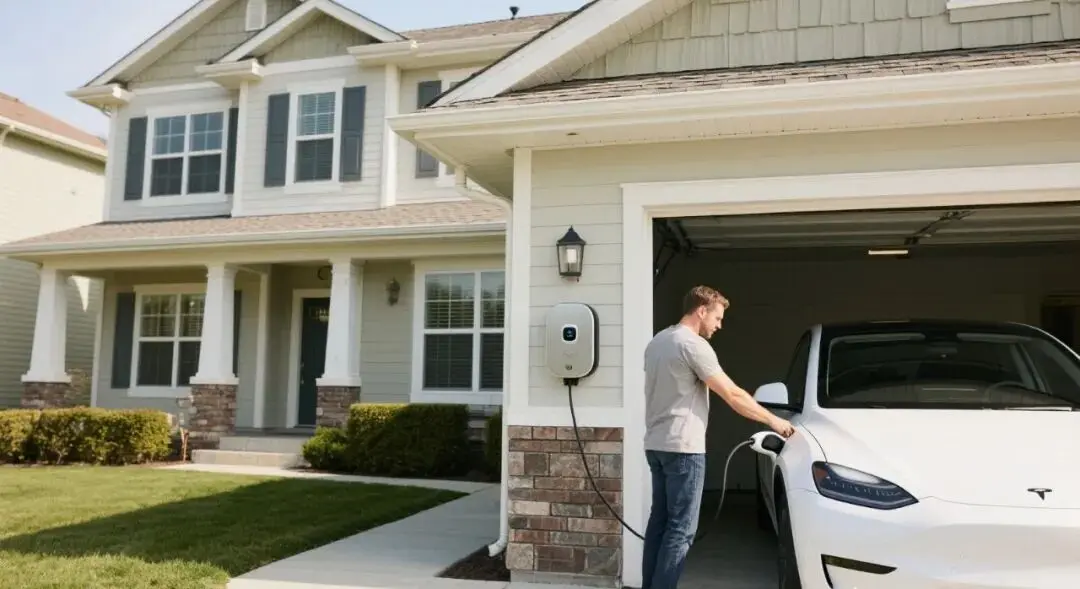
Policy is gradually reducing installation friction
California’s 2025 Title 24 building code, effective January 1, 2026, revised EV charging requirements for multifamily parking facilities, including certain additions and alterations. Separately, California SB 770 amended Civil Code Section 4745. The law provides that restrictions which effectively prohibit or unreasonably restrict the installation or use of an EV charging station in an owner’s unit or designated parking space are void and unenforceable.
Requirements vary by property type, local jurisdiction, electrical design and project scope. Charging businesses and property owners should obtain local legal, permitting and electrical guidance before deployment.
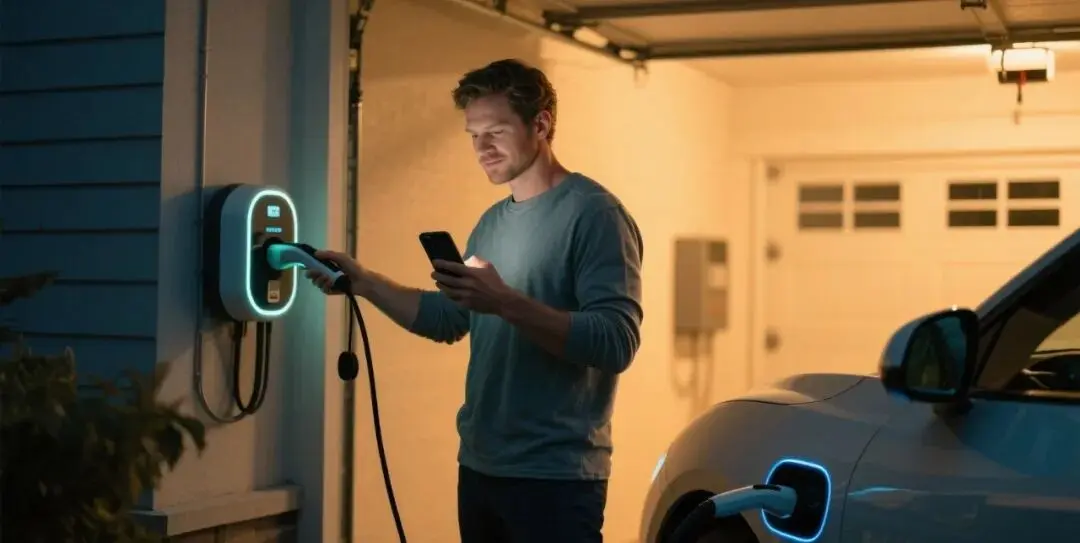
Market shift:
As more homes and multifamily properties become charging-ready, the competitive question changes from “Can a charger be installed?” to “Can the charger be managed reliably, safely and profitably?”
The Residential Charging Challenge: Hardware Is Only Half of the Experience
A residential charger may rely on a household Wi-Fi router located far from the garage, driveway or outdoor parking space. Unlike a professionally managed public site, a home charging installation may not have dedicated networking equipment or onsite technical support.
“Charger hardware quality is only one part of the user experience. Stable connectivity and usable offline workflows are critical variables in residential charging.”
— TrendPower project team
During project assessment, TrendPower identified several common residential charging risks:
- Weak Wi-Fi signals preventing charging schedules from synchronizing
- Temporary cloud or internet interruptions affecting remote commands
- Failed firmware updates or incomplete device communication
- Chargers appearing offline in the mobile application
- Users being unable to start a session during a network outage
- EV charging demand exceeding the household’s available electrical capacity
- Unclear access rules when family members, guests and paying users share one charger
The EV Tech project therefore required a software design that combined cloud-based management with practical local fallback, flexible user permissions and household power control.
How the TrendPower Home EV Charging Platform Works
The platform connects five operating layers:
- Charger connection layer: compatible chargers communicate through Wi-Fi, 4G, Bluetooth and project-specific device protocols.
- Homeowner and driver application: users can view charger status, start or stop sessions, schedule charging, manage permissions, reserve shared chargers and complete payment.
- Operator backend: EV Tech can manage chargers, users, charging records, pricing, faults, firmware, permissions and shared-charging operations from a centralized interface.
- Energy-management layer: current control and load-management logic coordinate EV charging with available household or site capacity.
- Commercial layer: reservation, billing, payment and settlement workflows support a scalable charger-sharing business model.
For companies that need broader network control, TrendPower also provides an EV Charging Point Management System with centralized charger monitoring, remote control, billing, reporting and operational management. OCPP compatibility and feature support are confirmed during charger-model testing and project integration.
Smart Home Charging Functions
1. Wi-Fi and 4G Remote Authorization
Authorized users can remotely start or stop a charging session when the charger is connected through Wi-Fi or 4G. A homeowner can grant access to a family member, support a guest or authorize a reserved charging user without being physically present beside the charger.
2. Bluetooth Access During Network Interruptions
For compatible project configurations, Bluetooth provides a local access path when the charger cannot connect to the cloud. This helps preserve essential charging functions during temporary internet interruptions or in garages and parking areas with weak Wi-Fi coverage.
Offline capability does not remove the need for synchronization. Once connectivity returns, relevant charging records and device status can be synchronized according to the charger and software configuration.
3. Adjustable Charging Current
The application allows authorized users to adjust charging current within the limits supported by the charger, vehicle and electrical installation. A homeowner can reduce EV charging demand while air conditioning, electric water heating or other high-power appliances are operating.
This gives users more control over charging speed and household demand while helping reduce the risk of overload or nuisance tripping.
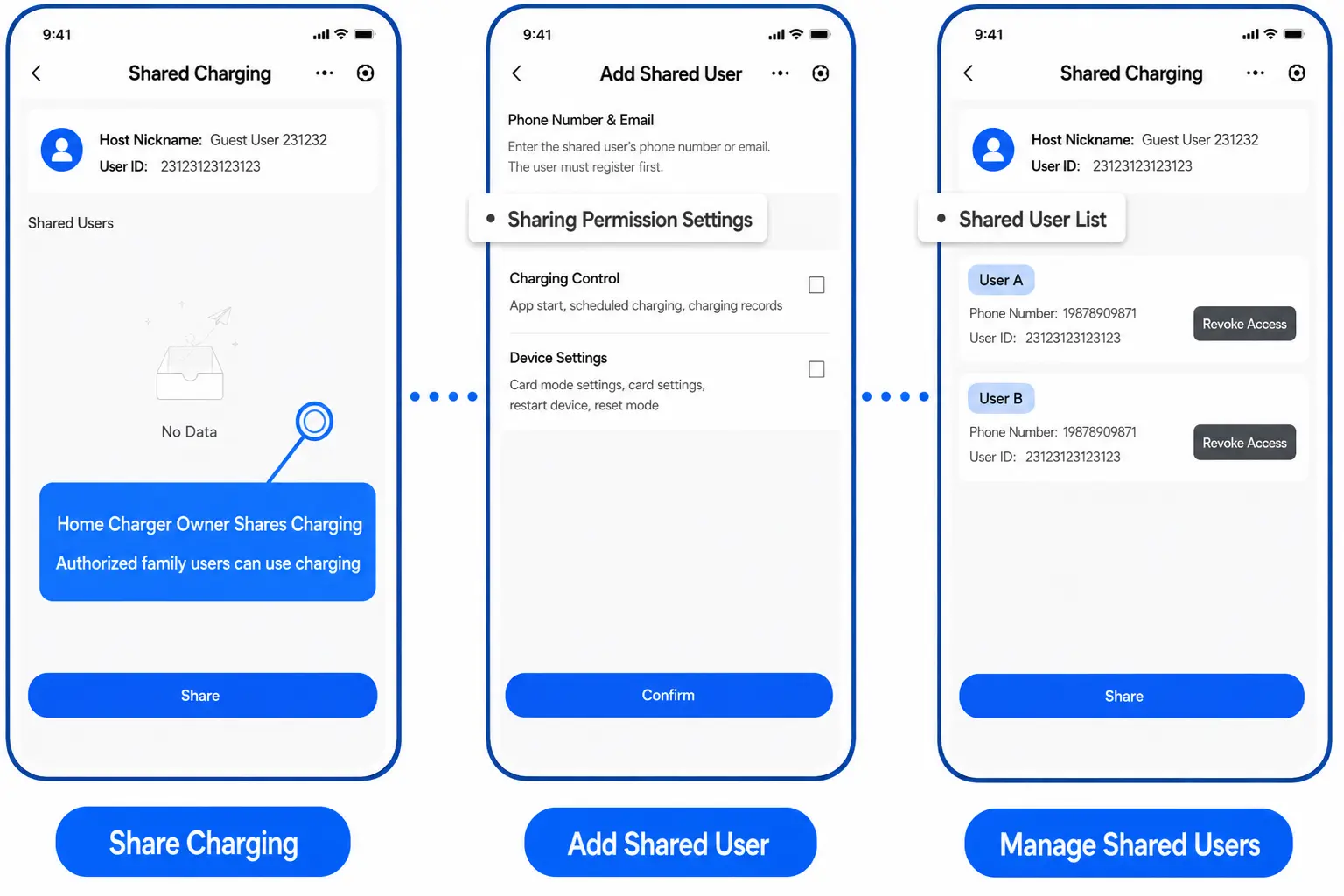
4. Family Member and Multi-User Permissions
The charger owner can invite household members and assign access permissions instead of sharing one username and password. This creates clearer control over who may view the charger, initiate charging and access session information.
Family access remains separate from external commercial sharing. The owner can retain priority use of the charger while opening selected time periods to other drivers.
5. Smart Load Management and Ordered Charging
When household or property electricity demand approaches a configured limit, the platform can reduce charger output. When additional capacity becomes available, charging power can be restored within the permitted range.
For properties with more than one EV or charger, power can be distributed across active sessions instead of allowing every charger to draw maximum power simultaneously. This approach can help:
- Keep total demand within available electrical capacity
- Reduce the risk of interrupted charging or site overload
- Coordinate simultaneous charging for multiple vehicles
- Use existing panels and connections more efficiently
- Delay or reduce unnecessary electrical upgrades in suitable projects
Learn more in TrendPower’s guide to EV charging load balancing software.
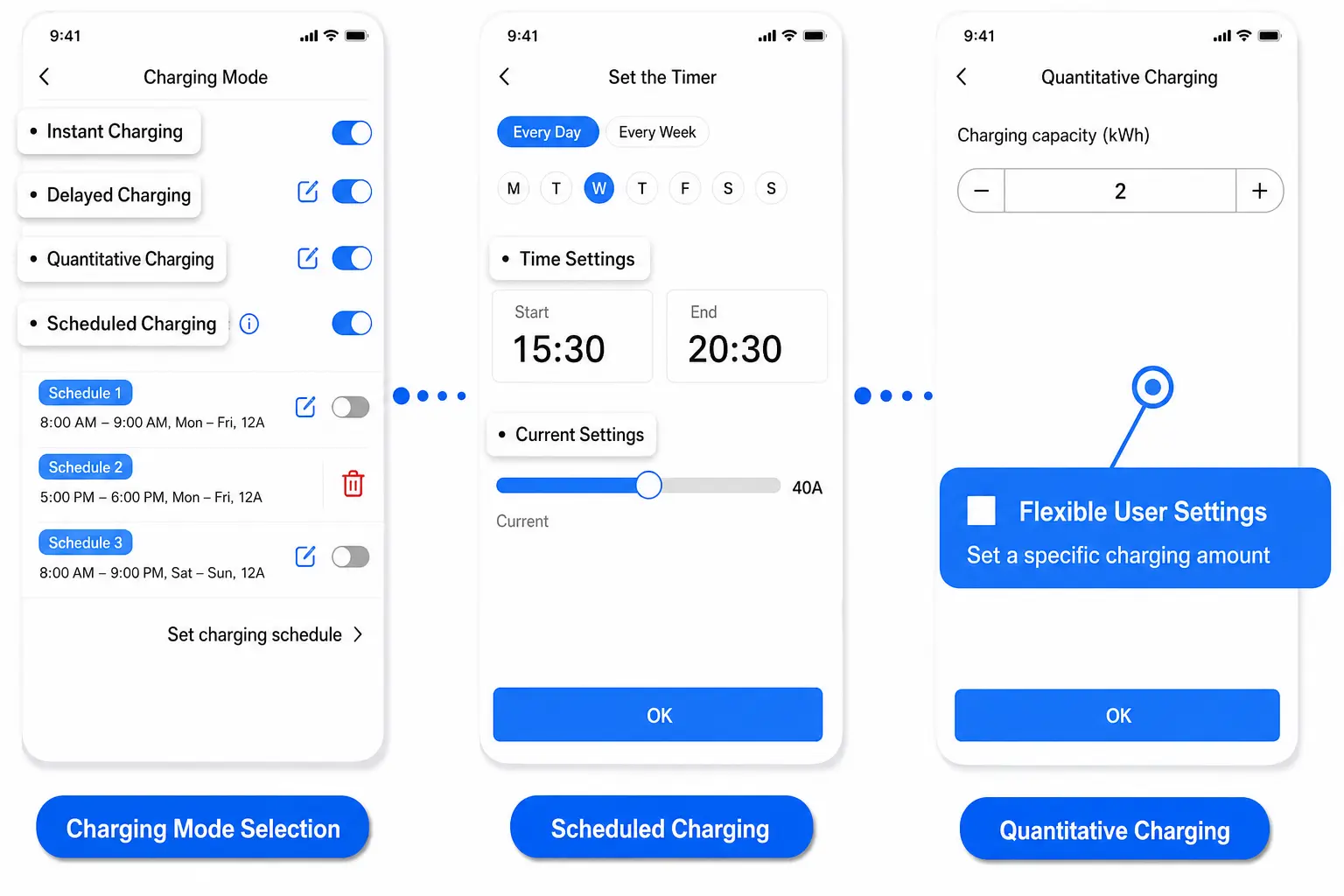
6. Flexible Charging Modes
Plug-In Auto-Start
For authorized configurations, charging can begin after the connector is plugged into the vehicle without repeated app confirmation. This simplifies everyday charging for approved users.
Energy-Limited Charging
Users can define an energy target for a charging session. Charging stops after the configured kilowatt-hour amount is delivered, subject to charger and vehicle behavior. This is useful for household energy control, guest allowances and fixed-energy charging products.
Scheduled Charging
Drivers can create daily or weekly charging schedules, including recurring days, time windows and supported current settings. Where time-of-use electricity pricing is available, scheduling can help shift charging away from higher-cost periods.
Private Charger Sharing: From Idle Equipment to a Managed Local Service
Residential chargers are frequently unused for many hours each day. Peer-to-peer charging allows a homeowner to offer selected idle periods to drivers who lack convenient charging at home.
A 2025 peer-reviewed study of 367 California EV households found that approximately 28% of respondents were willing to host charging and 31% were willing to rent access through a P2P residential charger platform. Hosts prioritized rental income, while renters valued convenience and cost savings. The study also identified liability as a major concern, highlighting the importance of identity checks, controlled access, transparent rules and appropriate insurance arrangements.
TrendPower’s private charger-sharing software gives EV Tech a structured workflow for managing this model.
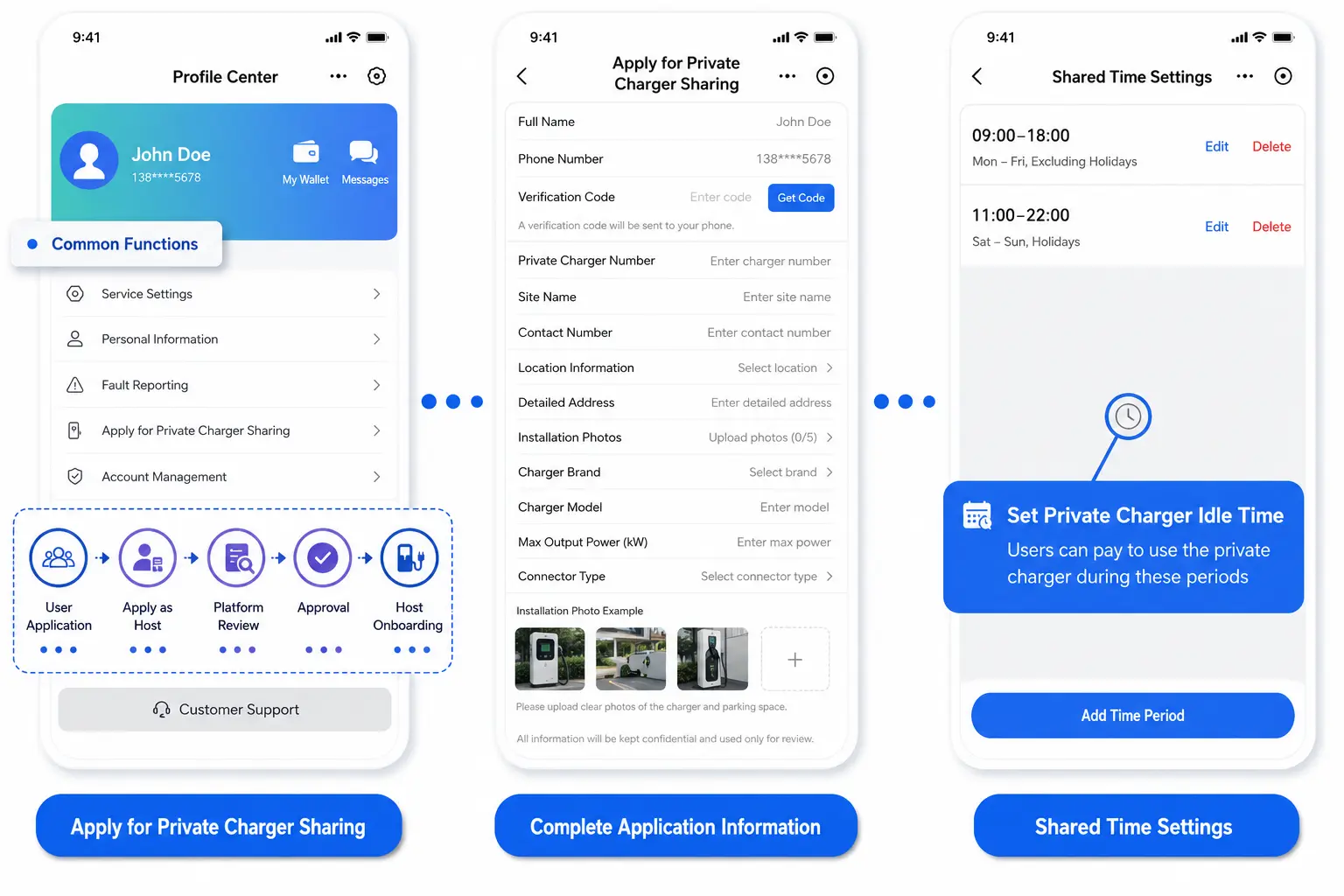
Step 1: Charger-Owner Registration and Review
A homeowner can apply to become a charging host through the mobile application. Depending on EV Tech’s operating policy, the application can collect identity information, charger details, parking-space information, installation records, property-access instructions and payout information.
The operator reviews the submitted information before activating commercial sharing.
Step 2: Owner-Defined Availability and Pricing
Approved charger owners can decide when the charger is available. They may configure:
- Available dates and time slots
- Energy-based, time-based or service-fee rules
- Peak and off-peak pricing
- Reservation conditions and cancellation rules
- Temporary suspension of sharing
The owner remains in control: open the charger when it is idle and close sharing whenever private use takes priority.
Step 3: Nearby Charger Discovery
Drivers can search the application map for available residential chargers. A listing may show the approximate location, connector type, charging power, available reservation periods, price and access instructions.
Step 4: Reservation and Controlled Access
After selecting a suitable charger, the driver reserves an available period. The reservation is linked to charger-access permissions, helping reduce scheduling conflicts and unauthorized use.
Step 5: Charging Payment
After the session, the software calculates the charge according to the configured billing rules. International payment gateways such as PayPal or Stripe can be integrated according to the operator’s project scope, merchant setup and local compliance requirements.
TrendPower’s EV charging payment solution can support charging-specific billing, transaction records, revenue sharing, reconciliation and settlement workflows.
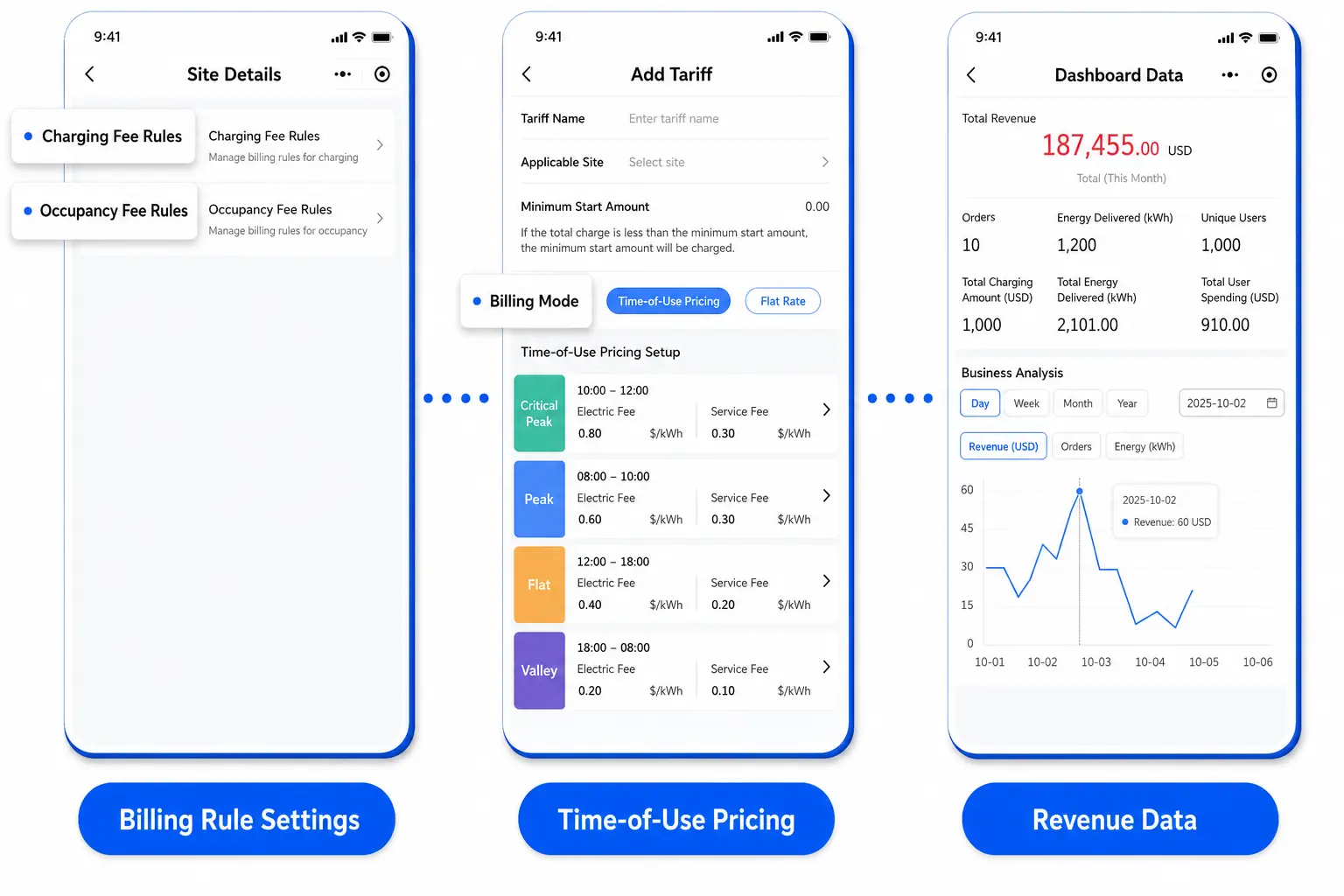
Step 6: Owner Revenue and Settlement
Charging income is recorded in the owner’s platform account. The owner can review sessions and earnings and request a payout according to EV Tech’s settlement rules, payment-provider requirements and applicable tax policies.
Business Value for EV Tech, Homeowners and Drivers
For EV Tech
- Expand from charger hardware and installation into recurring digital services
- Operate a branded residential charging experience
- Manage private and shared chargers through one backend
- Support payments, settlement and commercial charging products
- Build a scalable foundation for residential communities and property partnerships
- Use charger and session data to improve support and operations
For Homeowners
- Control charging remotely
- Schedule sessions around household routines or electricity tariffs
- Manage access for family members and guests
- Reduce charger idle time
- Create potential revenue from selected sharing periods
For Nearby EV Drivers
- Find charging closer to home or a destination
- View availability and pricing before arrival
- Reserve a charging period
- Use a controlled digital access process
- Pay through an integrated checkout workflow
For Residential Communities and Property Operators
- Improve the utilization of existing charging assets
- Coordinate limited electrical capacity
- Separate resident, guest and external-user permissions
- Create clearer charging and settlement records
- Support gradual expansion without treating every charger as an isolated device
For multifamily scenarios, explore TrendPower’s guide to EV charging software for apartments and condominiums.
Why the Combined Model Matters
Home charging and public charging do not have to operate as completely separate systems. A connected residential charger can serve several roles:
- A private energy device for the homeowner
- A shared household charger for authorized family members
- A reservable charger for neighbors or nearby drivers
- A distributed charging point within a local network
- A revenue-generating asset managed through a commercial platform
The key is owner control. The charger is not automatically transformed into an unrestricted public station. Availability, user access, pricing and settlement remain governed by the platform’s rules and the owner’s selected settings.
Why TrendPower
TrendPower develops EV charging management software for charge point operators, charger manufacturers, property groups, fleets and energy companies. Its platform supports charger management, remote monitoring, billing, payment settlement, analytics, smart charging and localized international deployment.
For EV Tech, TrendPower brings together the functions needed for a residential charging business:
- White-label EV charging apps and operator portals
- OCPP-oriented charger integration and device testing
- Remote operations and charging-session management
- Household and site load management
- Flexible pricing, payment and settlement
- User roles for owners, family members, drivers and operators
- Cloud, private-cloud and customized deployment options
Businesses with specialized hardware, workflows or regional requirements can also explore TrendPower’s custom EV charging software development.
Build a Smarter Home EV Charging Platform
Planning a residential charger brand, apartment charging service or peer-to-peer charger-sharing network? TrendPower can help you connect chargers, manage users, control power, integrate payments and launch a branded operating platform.
Frequently Asked Questions
What is a home EV charging platform?
A home EV charging platform is software that connects residential chargers with a mobile app and management backend. It can support remote start and stop, charging schedules, user permissions, current adjustment, load management, session records, fault alerts and, where required, charger-sharing and payment functions.
Can a home EV charger work without Wi-Fi?
That depends on the charger and software configuration. In the EV Tech project, compatible configurations can use Bluetooth for local access during temporary network interruptions. Core offline functions, data storage and later synchronization must be confirmed during charger integration and testing.
How does smart load management help a household?
Smart load management adjusts charger output according to the electrical capacity available in the home or property. When other appliances increase demand, charging power can be reduced. When capacity becomes available, charging can increase within configured limits.
Can several family members use the same residential charger?
Yes. The owner can authorize separate family users and assign appropriate permissions through the app. This is generally more secure and manageable than sharing one account and allows family access to remain separate from commercial charger sharing.
How does peer-to-peer residential EV charging work?
The owner selects availability and pricing. A nearby driver finds the charger in the app, reserves a time, receives controlled access, completes the charging session and pays through the platform. The software records the transaction and calculates the owner’s earnings according to the operator’s rules.
Can the charger owner set the sharing price and schedule?
Yes. The solution can allow the owner to define available time periods, pricing rules, service fees and temporary closures. The final options depend on the business model configured by the platform operator.
Which payment methods can be integrated?
TrendPower can integrate international and regional payment methods according to project requirements. Options may include PayPal, Stripe, card payments, digital wallets or other local gateways. Availability depends on the target country, merchant account and compliance requirements.
Is private charger sharing legal everywhere?
No single rule applies everywhere. Operators and owners should review local property rules, HOA or condominium requirements, electrical permits, utility tariffs, insurance, accessibility, consumer protection and tax obligations. Charging software supports operational control but does not replace legal or regulatory advice.
Can TrendPower provide a white-label residential charging app?
Yes. TrendPower can provide branded mobile apps, web interfaces and operator dashboards. Branding, payment integration, charger compatibility, workflow customization and deployment scope are defined during project planning.
Does TrendPower support OCPP chargers?
TrendPower supports OCPP-oriented EV charging management, including OCPP 1.6 and OCPP 2.0.1 capabilities. Actual compatibility depends on the charger model, implemented OCPP profiles, firmware behavior and required functions, so joint testing is recommended before commercial deployment.
Sources and Methodology
Project timing, workflow and feature descriptions are based on TrendPower’s EV Tech project documentation. Market and policy context was reviewed against the following sources:
- EV Tech — About Us
- U.S. Bureau of Transportation Statistics — NHTS Daily Travel Quick Facts
- International Energy Agency — Global EV Outlook 2025: Electric Vehicle Charging
- California Building Standards Commission — 2025 Title 24 Code Changes
- California SB 770 — Chaptered Bill Text
- Peer-to-Peer Residential Charger Sharing Study — Transportation Research Part D, 2025

 EN_GB
EN_GB  EN
EN  ZH
ZH  AR
AR  DE
DE  ES
ES  KO
KO  JA
JA  IT
IT  FR
FR  VI
VI  MS
MS  ID
ID  FR_CA
FR_CA  NL
NL  SV
SV  TH
TH 