
The EV charging industry is entering a new stage. As more electric vehicles hit the road, charging operators, property owners, fleet managers, and infrastructure investors are facing a common challenge: how to build charging networks that are powerful, cost-efficient, scalable, and sustainable.
Traditional grid-only charging stations can work well for small-scale projects, but they often face limitations when charging demand grows. High-power DC fast charging may increase peak electricity demand, require expensive grid upgrades, and put pressure on local power infrastructure. At the same time, more businesses are looking for ways to use renewable energy and reduce long-term operating costs.
That is why PV-ESS-Charging Solutions are becoming increasingly important. According to the International Energy Agency, more than 1.3 million public charging points were added worldwide in 2024, representing growth of more than 30% compared with the previous year. This rapid expansion makes smarter energy design more valuable for commercial and public charging projects.
For businesses planning the next generation of EV charging infrastructure, Trendpower provides integrated solutions that combine solar power, energy storage, EV charging, and smart energy management into one coordinated system. Trendpower describes its PV-ESS-Charging Solution as an intelligent ecosystem that integrates solar power, energy storage, and EV charging to help businesses optimize energy use, reduce operational costs, and improve efficiency.
What Are PV-ESS-Charging Solutions?
PV-ESS-Charging Solutions combine three core elements:
PV refers to photovoltaic solar power generation. Solar panels generate clean electricity during the day.
ESS refers to an energy storage system, usually based on battery storage. It stores excess solar power or lower-cost grid electricity for later use.
Charging refers to EV charging infrastructure, including AC chargers, DC fast chargers, smart charging systems, and management software.
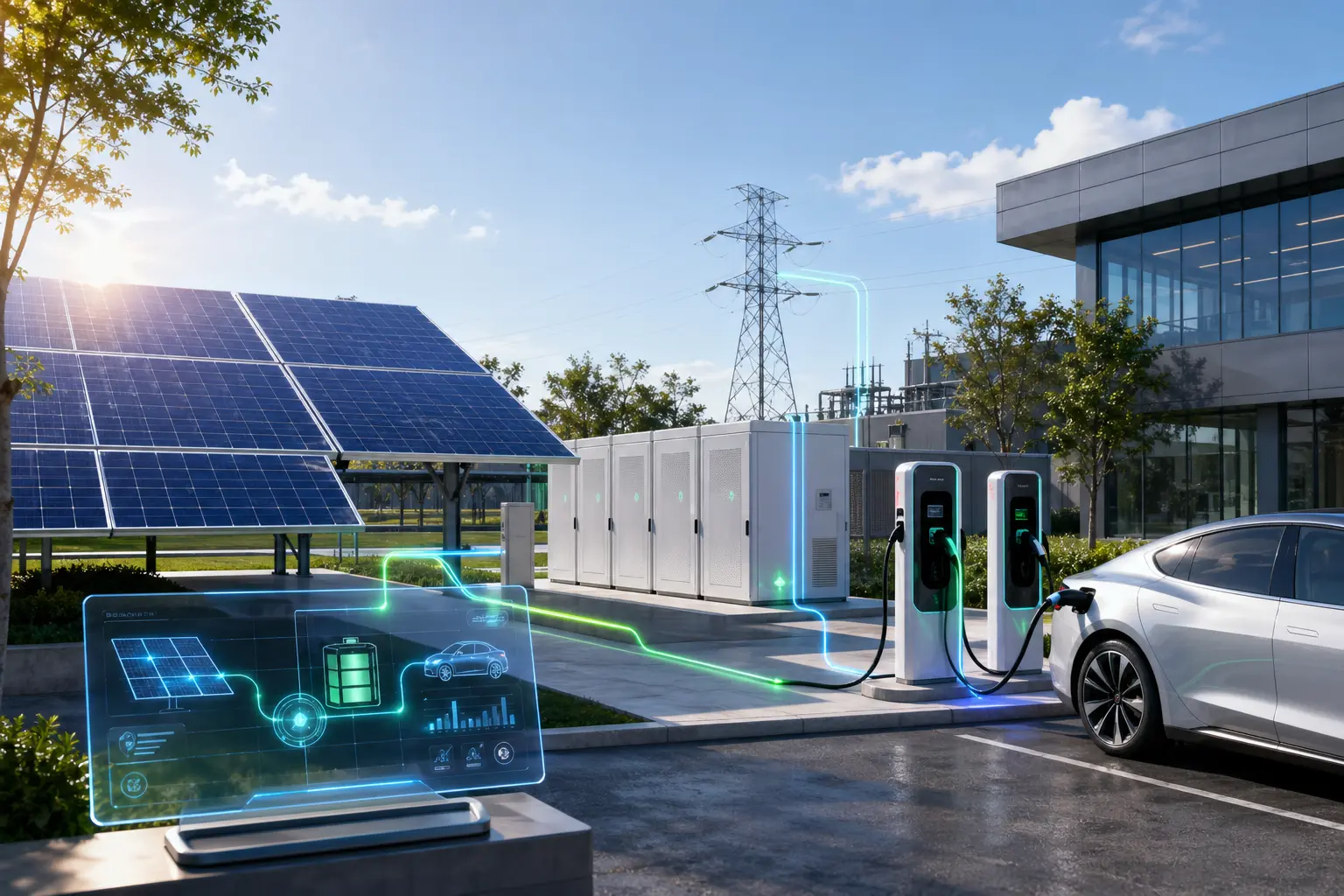
When these three parts work together, the system can generate energy, store energy, and distribute energy to EV chargers based on real-time demand. Instead of relying only on the utility grid, a charging site can use solar power during the day, battery storage during peak periods, and grid power when needed.
The key is not only hardware integration. A high-performing PV energy storage charging system also requires intelligent software. Trendpower’s smart energy monitoring solution provides real-time visibility across PV, ESS, and EV charging systems, while integrating with BMS and PCS to monitor battery status, power flow, and charge-discharge performance.
Why PV-ESS-Charging Solutions Matter for EV Charging Operators
For EV charging operators, energy cost is one of the most important factors affecting profitability. A charging station may attract more users as EV adoption grows, but higher utilization can also bring higher electricity costs and stronger pressure on grid capacity.
PV-ESS-Charging Solutions help solve this problem from several angles. Solar power can reduce daytime grid electricity consumption. Battery storage can support peak shaving by discharging during high-price periods. Smart energy management can coordinate solar generation, battery charging, grid power, and EV charging load.
For high-power sites, battery energy storage can also act as an energy buffer. This is especially useful for DC fast charging stations, where sudden charging demand may exceed the site’s grid capacity. In 2024, the global stock of fast chargers reached 2 million, while ultra-fast chargers above 150 kW grew by more than 50%, showing that high-power charging is becoming a major infrastructure trend.
For commercial buyers, the value is clear: lower operating costs, better energy control, improved charging reliability, and stronger sustainability positioning.
Top 10 PV-ESS-Charging Solutions
1. Commercial Solar EV Charging Solution
A commercial solar EV charging solution is designed for shopping malls, office buildings, hotels, retail centers, and public parking lots. Solar panels generate electricity during business hours, while EV chargers serve customers, employees, and visitors.
This solution helps property owners turn parking areas into energy-generating assets. It can also improve customer experience by offering convenient EV charging services. For brands that care about sustainability, a commercial solar EV charging station can also strengthen green brand value.
Trendpower can support commercial sites by integrating solar generation, energy storage, charging hardware, and smart management into a coordinated system.
2. PV-ESS DC Fast Charging Solution
A PV-ESS DC fast charging solution is built for high-demand charging locations. It combines photovoltaic power, battery storage, and DC fast chargers to support rapid charging while reducing stress on the grid.
Battery storage plays an important role here. During low-demand periods, the battery can store solar or grid electricity. During peak charging hours, it can discharge power to support fast chargers. This helps operators reduce peak demand and avoid unnecessary grid expansion when site conditions allow.
This solution is ideal for public charging stations, highway stations, commercial hubs, and busy urban charging sites.
3. Fleet PV-ESS-Charging Solution
Fleet operators need predictable, reliable, and cost-controlled charging. A fleet PV-ESS-Charging Solution is suitable for logistics companies, electric buses, taxis, delivery fleets, and corporate vehicles.
Fleet charging usually follows a schedule. Vehicles may return to the depot at night or during fixed operating windows. With solar power and battery storage, operators can plan energy use more efficiently. Smart charging software can prioritize charging time, vehicle demand, energy price, and battery storage status.
For fleet managers, this means better energy planning, lower charging costs, and smoother daily operations.
4. Industrial Park PV-ESS-Charging Solution
Industrial parks often have large rooftops, open parking areas, and significant electricity demand. A PV-ESS-Charging Solution can connect solar power generation, energy storage, employee charging, visitor charging, and logistics vehicle charging into one energy strategy.
This solution is especially useful for factories, warehouses, manufacturing campuses, and logistics parks. It can support workplace charging while helping the site improve renewable energy utilization.
For industrial users, the biggest advantage is system-level energy optimization. Instead of treating EV charging as a separate load, the site can manage charging as part of its broader energy infrastructure.
5. Highway Service Area PV-ESS Fast Charging Solution
Highway service areas need fast, reliable, and scalable EV charging. Drivers on long-distance trips expect charging stations to be available and efficient.
A highway PV-ESS fast charging station uses solar generation and battery storage to support high-power charging demand. It can reduce grid pressure during busy travel periods and provide additional energy flexibility for operators.
This solution is suitable for highway rest stops, transportation corridors, gas station upgrades, and intercity EV charging networks.
6. Off-Grid PV-ESS-Charging Solution
Not every charging site has strong grid access. Remote areas, islands, mining sites, rural locations, construction zones, and temporary operating bases may need independent power support.
An off-grid PV-ESS-Charging Solution uses solar panels and battery storage to provide EV charging without relying heavily on the utility grid. The system can be designed based on local sunlight conditions, charging demand, battery capacity, and backup requirements.
This solution is valuable where grid expansion is expensive, slow, or technically difficult.
7. Grid-Tied PV-ESS-Charging Solution
A grid-tied PV-ESS-Charging Solution combines solar, battery storage, EV charging, and utility grid power. Unlike an off-grid system, it still connects to the grid for backup and stability.
This is one of the most practical solutions for urban and commercial charging sites. During the day, solar power can serve EV charging loads or charge the battery. During peak periods, stored energy can help reduce grid demand. When solar and storage are not enough, grid power ensures continuous operation.
For many businesses, this offers a balanced approach between sustainability, reliability, and cost control.
8. Solar Carport PV-ESS-Charging Solution
A solar carport charging solution turns parking spaces into solar energy assets. Solar panels are installed above parking areas, creating shade for vehicles while generating electricity for EV charging.
This solution is ideal for malls, campuses, office parks, hotels, airports, hospitals, and public parking areas. It makes efficient use of existing land and creates a visible clean-energy experience for drivers.
When combined with energy storage and smart charging, a solar carport becomes more than a roof. It becomes a distributed energy station.
9. Microgrid PV-ESS-Charging Solution
A microgrid PV-ESS-Charging Solution is designed for sites that need higher energy independence and system resilience. It can integrate solar power, battery storage, EV charging, grid power, and sometimes other distributed energy resources.
This solution is suitable for smart communities, university campuses, industrial zones, public facilities, and energy-resilient projects. The microgrid can coordinate multiple energy sources and loads through an energy management system.
As renewable power expands, microgrid-style charging infrastructure will become more important. The IEA expects global renewable power capacity to double by 2030, with solar PV accounting for almost 80% of the increase.
10. Modular PV-ESS-Charging Solution
A modular PV-ESS-Charging Solution is designed for projects that need flexibility and future expansion. Operators can start with a smaller system and expand solar capacity, battery storage, or charging points as demand grows.
This approach is suitable for investors who want to control initial capital expenditure while keeping a clear upgrade path. It is also useful for multi-site charging networks, commercial properties, and phased infrastructure projects.
Trendpower supports scalable PV-ESS-Charging Solutions for different site sizes, energy needs, and business models.
| No. | Solution | Best For | Core Value |
|---|---|---|---|
| 01 | Commercial Solar EV Charging | Malls, hotels, offices, public parking lots | Turns parking areas into clean-energy charging assets |
| 02 | PV-ESS DC Fast Charging | High-demand public and urban charging sites | Supports fast charging while reducing grid pressure |
| 03 | Fleet PV-ESS-Charging | Logistics fleets, buses, taxis, delivery vehicles | Improves scheduled charging and lowers operating costs |
| 04 | Industrial Park PV-ESS-Charging | Factories, warehouses, logistics parks | Connects solar, storage, workplace and fleet charging |
| 05 | Highway PV-ESS Fast Charging | Highway service areas and transport corridors | Supports long-distance EV charging with better energy flexibility |
| 06 | Off-Grid PV-ESS-Charging | Remote areas, islands, mining sites, weak-grid locations | Provides independent charging where grid access is limited |
| 07 | Grid-Tied PV-ESS-Charging | Urban commercial charging stations | Balances solar, storage and grid power for stable operation |
| 08 | Solar Carport PV-ESS-Charging | Campuses, malls, airports, hospitals, parking areas | Combines shade, solar generation and EV charging |
| 09 | Microgrid PV-ESS-Charging | Smart communities, campuses, industrial zones | Creates a resilient energy ecosystem for charging sites |
| 10 | Modular PV-ESS-Charging | Scalable projects and phased charging networks | Allows flexible expansion of solar, storage and chargers |
How to Choose the Right PV-ESS-Charging Solution
There is no one-size-fits-all system. The right solution depends on the site, business model, power demand, and investment goals.
Before choosing a PV-ESS-Charging Solution, buyers should evaluate daily charging volume, AC or DC charging requirements, available solar installation area, grid capacity, battery storage needs, electricity tariff structure, peak demand charges, climate conditions, and expected ROI.
Software is also important. A charging project needs real-time monitoring, remote management, energy scheduling, billing, maintenance alerts, and performance analytics. Without smart management, even good hardware may not deliver the best long-term results.
A professional solution provider should design the system based on real site data, not assumptions.
Why Choose Trendpower for PV-ESS-Charging Solutions?
Trendpower provides a flexible approach for businesses that want to build smarter EV charging infrastructure. Its PV-ESS-Charging Solution integrates solar power, energy storage, and EV charging into one intelligent ecosystem supported by smart energy management and coordinated scheduling.
For charging operators, commercial property owners, fleet managers, and infrastructure investors, Trendpower helps connect energy generation, storage, charging, and software management in a more efficient way.
Trendpower is designed to support commercial and industrial charging scenarios with real-time monitoring, scalable system architecture, energy optimization, and smart EV charging management. This makes it suitable for projects that require not only charging equipment, but also long-term operational control.
Future Trends in PV-ESS-Charging Solutions
The future of EV charging will not be built on chargers alone. It will be built on smarter energy systems.
Several trends are shaping the market: higher-power DC fast charging, wider adoption of commercial solar EV charging stations, stronger demand for battery energy storage, AI-based energy management, bidirectional charging potential, microgrid integration, and smart city infrastructure.
As EV adoption grows, charging sites will need to become more energy-aware. Operators that combine solar, storage, charging, and software will be better prepared for future demand.
Conclusion
PV-ESS-Charging Solutions are more than a clean-energy upgrade. They are a strategic investment in the future of EV charging infrastructure.
By combining solar power, energy storage, EV charging, and smart energy management, businesses can reduce grid dependency, improve charging reliability, lower operating costs, and support sustainability goals.
For commercial properties, fleets, industrial parks, highway service areas, and public charging networks, the right PV-ESS-Charging Solution can create long-term value.
If you are planning a commercial, industrial, fleet, or public EV charging project, contact Trendpower to explore a customized PV-ESS-Charging Solution for your site.
Contact Us
Don’t take our word for it.
Try it now for free.

Frequently Asked Questions About PV-ESS-Charging Solutions
Explore common questions about PV-ESS-Charging Solutions, including how solar power, battery energy storage, EV charging infrastructure, and smart energy management work together to support more efficient and sustainable charging projects.
A PV-ESS-Charging Solution combines photovoltaic solar power, battery energy storage, and EV charging infrastructure into one coordinated energy system. It helps charging sites generate, store, and distribute electricity more efficiently.
It can reduce charging costs by using solar power, storing energy during low-cost periods, and discharging stored energy during peak-demand periods. This helps reduce grid electricity use and manage peak demand charges.
Yes. Battery energy storage can support DC fast charging by acting as an energy buffer. This helps reduce grid pressure and improve charging stability during high-demand periods.
PV-ESS-Charging Solutions are suitable for charging operators, commercial properties, shopping malls, fleet depots, industrial parks, hotels, highway service areas, parking operators, and energy infrastructure investors.
Trendpower helps businesses integrate solar power, energy storage, EV charging, and smart energy management into one coordinated solution. It is designed to support commercial and industrial charging projects with scalable, intelligent energy infrastructure.

 EN_GB
EN_GB  EN
EN  ZH
ZH  AR
AR  DE
DE  ES
ES  KO
KO  JA
JA  IT
IT  FR
FR  VI
VI  MS
MS  ID
ID  FR_CA
FR_CA  NL
NL  SV
SV  TH
TH 