
 English (UK)
 English (United States)
 Chinese
 Arabic
 German
 Spanish
 Korean
 Japanese
 Italian
 French (France)
 Vietnamese
 Malay
 Indonesian
 French (Canada)
 Dutch
 Swedish
 Thai
EV charging software for fleets and employees needs to do more than start a charging session. It must identify who is charging, apply the right access and cost rules, coordinate available power and help operational vehicles leave when required.
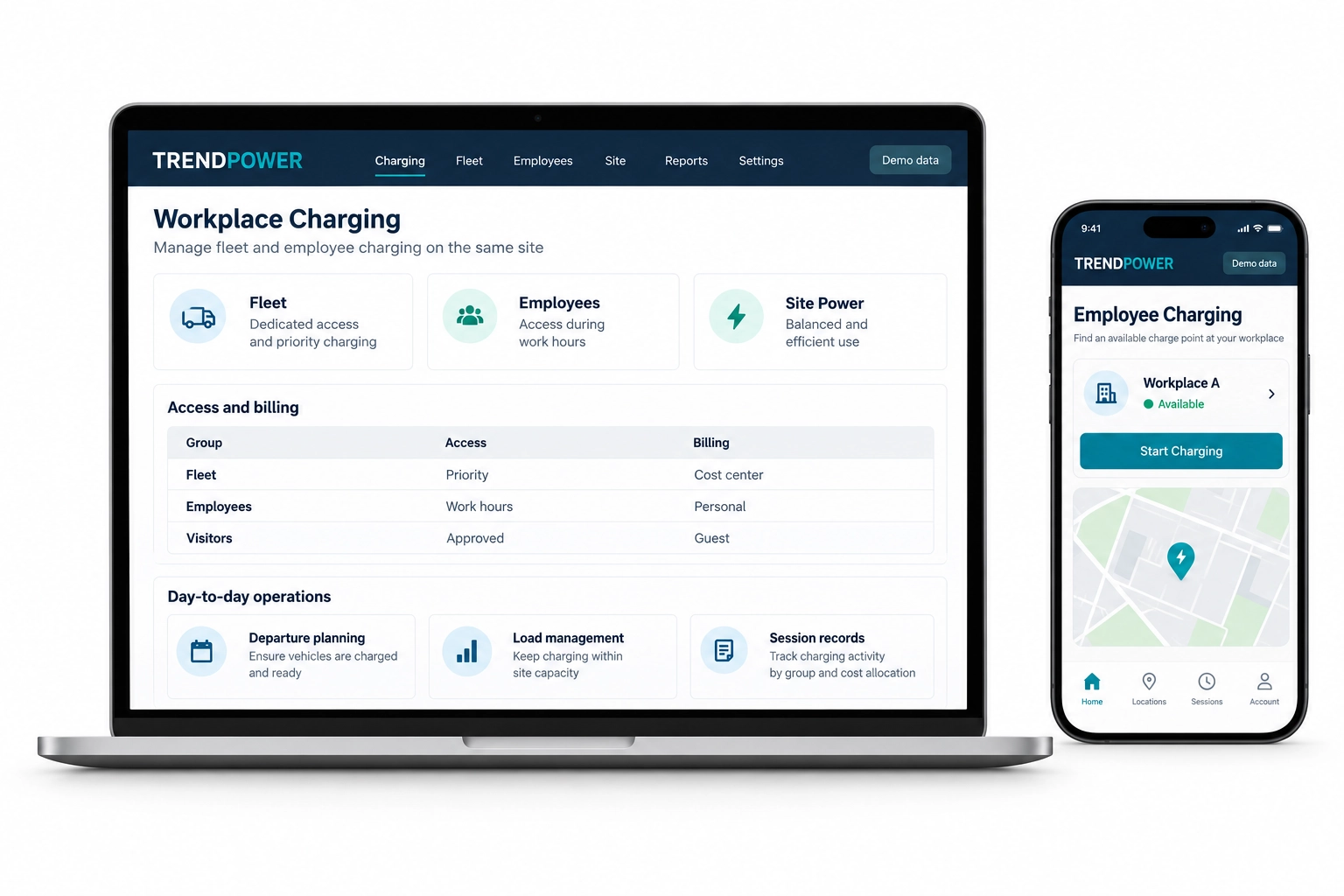
For an employee-only parking area, a manageable starting point may be authenticated access, clear pricing, sharing rules and reliable session records. A working fleet adds vehicle schedules, energy requirements, operational priorities and exception handling. When both groups share a site, the software must keep those requirements distinct while coordinating the same infrastructure.
The most useful buying question is therefore practical: can the proposed system operate your chargers, users and business rules under the conditions your site actually faces?
Fleet Charging and Employee Charging Have Different Priorities
A delivery van needed for an early route and an employee’s private car parked throughout the workday do not create the same charging requirement. Treating every connected vehicle as an identical session can leave an operational vehicle short of energy or make employee access unpredictable.
| Decision area | Operational fleet | Employee vehicles |
|---|---|---|
| Main objective | Readiness for the next duty or departure | Convenient, fair workplace access |
| Identity | Vehicle, driver, department and operating task | Employee or household account and permitted vehicle |
| Charging priority | Departure deadline and required energy | Published sharing, access and benefit rules |
| Financial treatment | Internal cost allocation or fleet account | Free benefit, subsidy or employee payment |
| Important exception | Vehicle may miss its next assignment | Driver cannot access a charger or disputes a charge |
Swipe across the table to view all columns.
A shared site needs an explicit policy for conflicts between these objectives. Reserving selected bays for fleet vehicles is one option; allowing different groups to use the same chargers during different hours is another. Software should make the chosen arrangement enforceable and visible.
The U.S. Department of Energy’s workplace charging guidance discusses administration, registration, sharing and pricing. These are useful planning categories, while the final policy must reflect your organization and location.
Define the Site Before Comparing Software Features
Prepare an inventory that connects charging demand to the actual facility. Count vehicles, chargers, connectors and parking spaces separately. A charger with two connectors does not necessarily deliver full rated power to both simultaneously, and two parking spaces do not automatically create two usable charging connections.
Document vehicle arrival and departure windows, typical charging energy, shift changes, employee attendance patterns and expected growth. Ask facilities staff to identify electrical limits, other building loads, metering availability and the utility tariff. Include ownership and access constraints where the property is leased.
Also identify who will operate the service. Fleet dispatch, facilities, HR, finance, IT and an external charging operator may each own part of the process. Name a decision-maker for priorities, payments, faults and changes before configuring the platform.
For a small pilot, this information can fit into a project brief. For several sites, use a structured inventory so the same questions are answered consistently. Accurate inputs make software demonstrations and quotations more useful than a generic request for a scalable charging solution.
Six Capabilities to Evaluate First
1. Separate access for fleets, employees and visitors
Require the platform to distinguish user groups, chargers, sites and permitted hours. A staff credential should not automatically authorize access to a restricted depot, and a visitor account should not inherit an employee subsidy.
Test registration, approval, credential replacement, suspension and removal. For pooled fleet vehicles, decide whether authorization follows the driver, vehicle or fleet account. If one employee charges both a company vehicle and a private car, the selected purpose must reach the appropriate billing record.
RFID and app access can serve different needs. The right choice depends on the hardware, user journey and project configuration; the important requirement is accountable authorization rather than a particular interface.
2. Visibility into chargers and real session outcomes
The operator needs to distinguish an available charger, an occupied connector, a communication problem and a session that failed after authorization. A green online indicator does not show whether a driver completed a successful charge.
Ask to inspect session timelines, reported energy, device events and payment status. The platform should help staff locate the affected station and connector quickly. Also establish the freshness of displayed information and how missing or delayed data appears.
For a fleet, connect the information to operational impact: which vehicle is affected, when it needs to leave and what alternative charger is available. For employees, provide a clear route to report problems without exposing other users’ information.
3. Scheduling and operational charging priorities
Fleet charging management software should be evaluated against departure requirements, charging windows and the energy each vehicle needs. Some sites can use a stable overnight schedule; others require adjustments when routes, vehicles or return times change.
Where available, vehicle state of charge and telematics can improve planning. Do not assume the charger reports a usable battery percentage for every vehicle, particularly across mixed AC equipment. Verify the actual data source, refresh interval and behavior when that input is missing.
The system should also explain exceptions. If a late arrival or equipment fault makes the requested target infeasible, staff need an alert and an alternative decision rather than an apparently successful schedule.
4. Load management around verified site limits
Differentiate scheduled charging from dynamic load management. A timetable says when charging may occur. Dynamic control adjusts allocation using the available inputs and limits as conditions change.
Confirm how the solution receives building-load information, which circuits or charger groups it controls and what happens when a meter, gateway or network connection fails. Establish the boundaries between the CPMS, local controller, energy management system and electrical protection.
Ask an appropriately qualified electrical professional to define the design limits. Software does not replace the physical protection and engineering required at the site. During commissioning, verify that the complete control chain behaves as specified.
5. Billing and internal cost allocation
Charging may be free to employees while still creating a cost for a department. Fleet sessions may require internal accounting rather than individual card payments. Contractor fleets or visitors can introduce separate commercial arrangements.
Require session records to retain the correct account, vehicle or cost center, tariff and any applicable adjustments. Finance should be able to distinguish employee-paid revenue, employer subsidy and internal fleet expenditure.
If the project collects payments, evaluate refunds, interrupted sessions and reconciliation. A completed charging record, successful payment and bank payout are separate events. Review the full workflow through the EV charging payment solution requirements relevant to your project.
6. Fault handling and a named operational owner
Determine who receives an alert, who investigates and who contacts the driver. Some software or communication problems may support approved remote actions; a damaged connector or electrical fault needs the appropriate physical response.
The useful record connects the symptom, diagnostic evidence, action, responsible person and verified outcome. Repeated resets should not conceal recurring failures. Define escalation and support coverage around the site’s operating hours.
TrendPower’s intelligent operations management page describes monitoring and service workflows to discuss during scoping. Available diagnostic data and remote commands depend on the actual equipment and integration.
Can Fleets and Employees Share the Same Chargers?
Yes, where parking, access, capacity and operating requirements make sharing practical. The software and site policy need to distinguish permission to connect, allocation of power and entitlement to a space. These are related but separate decisions.
Consider an illustrative business campus. Six fleet vans each require 24 kWh of additional energy over an eight-hour overnight window. Their combined battery-energy requirement is 144 kWh, equivalent to an average of 18 kW before charging losses. That arithmetic is only a starting estimate: actual requirements depend on vehicle acceptance, losses, arrival times, charger availability and the site load profile.
Employee vehicles arrive during the day. If the verified design allows it, the same infrastructure may serve staff after the fleet charging window. However, a van returning late, an early employee arrival or a failed charger creates an exception that the policy must address.
A useful demonstration should show the resulting decision. Does the system preserve a reserved fleet connection, reduce lower-priority allocations within the agreed rules or notify staff that manual intervention is required? No platform can guarantee a departure target when the available time, power and functioning equipment are insufficient.
The Department of Energy’s smart charge management implementation guidance emphasizes vehicle schedules, utility rates, building data and commissioning against defined objectives. Its federal-fleet context should not be mistaken for a universal operating standard.
Should Employees Pay for Workplace EV Charging?
That is a policy and financial decision for the employer. Options include free charging, a limited allowance, subsidized rates or full employee payment. Each model needs clear eligibility, usage records and an explanation of what happens when limits are reached.
Free charging removes a payment step, but it does not remove the need for access control or reporting. A subsidy requires the system to distinguish the employer contribution from employee liability. Paid charging needs a suitable collection method and a process for disputes or refunds.
Be precise about time-based charges. Charging duration, connection time and parking occupancy are not interchangeable. An idle fee should have a defined trigger, grace period and operating window, supported by the information the system can actually verify.
Check local rules on pricing, metering, employee benefits, payroll deductions, tax and privacy before implementing the chosen arrangement. Do not assume that a policy used at another company or in another country transfers unchanged.
What Does OCPP Compatibility Actually Prove?
OCPP provides a communication framework between charging stations and management systems. The Open Charge Alliance publishes protocol versions with different capabilities. A version label is useful information, but it does not establish that every charger and backend combination supports every required function.
Request a compatibility record covering manufacturer, model, firmware, protocol, tested functions and known limitations. Include authorization, sessions, meter values, remote controls, charging profiles and recovery where relevant to your project.
Test the representative equipment you plan to deploy. A successful connection using a simulator does not establish end-to-end behavior with the actual charger, vehicle, local controller and payment workflow.
If a supplier claims OCPP certification, verify the exact product, version and covered scope through the certification records. Certification and project acceptance answer related questions, but neither should be replaced by a generic logo on a presentation.
Which Integrations Are Worth Paying For?
An integration earns its place when it removes a defined operational gap. Telematics can supply vehicle data; a fleet system can provide departure schedules; an identity platform can support staff access; and finance software can receive cost-allocation records.
For each connection, specify the source, destination, required fields, update frequency and incident owner. Establish which system is authoritative when records disagree. Also decide how duplicate messages, delayed updates and unavailable services are handled.
| Integration | Business question it may answer | Evidence to request |
|---|---|---|
| Fleet or dispatch system | Which vehicles must leave next? | Schedule updates reaching the charging workflow |
| Vehicle telematics | What energy or readiness data is available? | Supported vehicle fields and their freshness |
| Building energy system | How much power can charging use now? | Meter inputs, control boundaries and fallback tests |
| Identity management | Who may use the workplace service? | User lifecycle and access-removal demonstration |
| Finance or ERP | Which entity or department bears the cost? | A traceable session-to-accounting export |
Swipe across the table to view all columns.
Avoid adding every available integration to the initial release. Select the ones required for a complete pilot, document the others and price future expansion separately.
How Much EV Charging Software Do You Need at Each Stage?
A small employee parking area may need only authenticated access, dependable monitoring, usage records and a sharing policy. It may not need route scheduling or transport-system integration. Keep the scope proportionate to the service being offered.
A working fleet depot needs stronger operational coordination, especially when departure times are fixed, spare vehicles are limited or charging windows are short. Add vehicle identification, exception handling, tested priorities and the interfaces required to support those decisions.
A multi-site business needs a consistent hierarchy for organizations, sites, chargers, users and cost centers. Regional staff should see the sites they manage, while central teams need comparable reports and controlled policy changes. Ask how new locations and equipment are onboarded without copying inconsistent settings manually.
At every stage, separate software functions from implementation services. Configuration, charger testing, training, hosting, maintenance and integration work may be priced differently. The CPMS cost guide can help structure a comparison of one-time, recurring and usage-based charges.
What Should You Ask a Supplier to Demonstrate?
Use a scenario that resembles your site rather than asking for a tour of every menu. Start with two user groups, representative chargers, a fleet departure requirement and a limited charging allocation.
Ask the supplier to demonstrate:
- An approved employee starts charging while an unauthorized credential is rejected.
- A fleet session is assigned to the correct vehicle or internal account.
- A change in available site capacity affects charging according to the agreed control design.
- A revised departure requirement reaches the relevant operator or scheduling workflow.
- A charger becomes unavailable and the affected users or fleet tasks are identified.
- An interrupted or delayed session produces traceable charging and billing records.
- An employee payment or internal cost export can be reconciled to the original session.
- An administrator removes a user’s access without deleting the records needed for reporting.
For every important capability, ask whether it is standard, configurable, dependent on an integration or requires custom development. Record any hardware limitation and additional cost. This turns a promising demonstration into evidence the procurement team can compare.
How Should You Run a Pilot Before Wider Deployment?
Choose representative operating conditions, including the shifts and charger types that are likely to expose problems. A quiet-day test with one vehicle does not show how the system behaves at a busy shift change.
Agree acceptance measures before starting. These can include correct authorization, complete session records, adherence to the tested control limits, successful billing allocation and a clear response to faults. Where vehicle readiness is measured, define the target, data source and permitted exclusions.
Include controlled tests of lost connectivity, unavailable vehicle data, delayed events and a failed charger. Confirm which functions continue locally and which require the backend. Also verify that reconnection does not create duplicate charges or silently discard transactions.
Name the people who sign off electrical behavior, IT access, operational readiness and financial reporting. Train drivers and support staff on the rules that affect them. After acceptance, roll out in controlled groups and repeat affected tests when firmware, integrations or policy change.
Which Metrics Matter After Launch?
Use measures that connect charging activity to the service objective. Total energy delivered is useful, but it does not reveal whether a van missed departure or whether employees repeatedly failed to start a session.
| Metric | Why it matters | Definition to agree |
|---|---|---|
| Fleet readiness | Connects charging to the next operating task | Vehicles meeting the agreed energy target by deadline |
| Successful session starts | Measures whether users can actually charge | Successful starts divided by recorded attempts |
| Charger availability | Helps prioritize equipment problems | Included assets, operating hours and exclusions |
| Cost allocation accuracy | Supports finance and internal reporting | Sessions correctly assigned and reconciled |
| Employee access experience | Reveals congestion and friction | Waits, failed bookings or complaints using a stated method |
| Fault restoration time | Shows service-response effectiveness | Start and end events used to measure restoration |
Swipe across the table to view all columns.
Review exceptions as well as averages. A high overall success rate can conceal one unreliable charger used by a critical vehicle. Use the results to adjust staffing, policies, integration quality or infrastructure where the evidence supports a change.
Frequently Asked Questions
Can one platform manage fleet and employee charging?
It can, if its account structure, access rules, charging controls and reporting support both workflows. Confirm how permissions and costs remain separate and test what happens when the groups compete for capacity.
Do employees need an app to charge at work?
Not always. Depending on the equipment and platform, an RFID credential or mobile web flow may be available. An app may add discovery, notifications and account functions. Choose the interface around the required user journey.
Can employee charging be free while fleet costs are tracked internally?
That arrangement can be specified as a project requirement. The system must retain the right user group and accounting records even where no driver payment is collected. Confirm implementation and reporting during the demonstration.
Does every fleet vehicle need telematics integration?
No. Some operations can begin with planned energy requirements and reliable schedules. More variable or time-critical operations may benefit from vehicle data. Establish which inputs are necessary and what happens if they are missing.
Will smart charging remove the need for an electrical upgrade?
It may help use available capacity more effectively, but it cannot create additional physical supply or guarantee every schedule. The answer depends on the electrical design, charging demand and operating windows assessed for the site.
Can existing chargers be kept when changing software?
Possibly, subject to equipment capability, configuration access, protocol implementation and commercial restrictions. Inventory the actual models and firmware, then validate a representative pilot before migrating the full site.
Discuss Your Fleet and Workplace Charging Requirements with TrendPower
TrendPower provides EV charging point management software and project-specific integration options. Its fleet charging solution describes capabilities for vehicle, charging, billing and operational workflows that can inform a more detailed scope discussion.
To prepare a useful conversation, share your site locations, fleet and employee vehicle counts, charger models, shifts, departure requirements, electricity constraints and payment or cost-allocation model. Include existing fleet, building and finance systems that the project needs to connect.
With that brief, the team can discuss standard platform functions, configuration, integration and testing requirements against your actual operating model.
Request a Fleet and Workplace Charging DemoSources and scope: Official resources were reviewed on October 18, 2026. U.S. Department of Energy material provides planning context; local electrical, employment, payment and tax requirements require separate confirmation. The shared-site calculation is illustrative. Images show illustrative scenes and demo interfaces, not verified customer installations or exact product screenshots. Product functions depend on the agreed equipment and integration scope.
