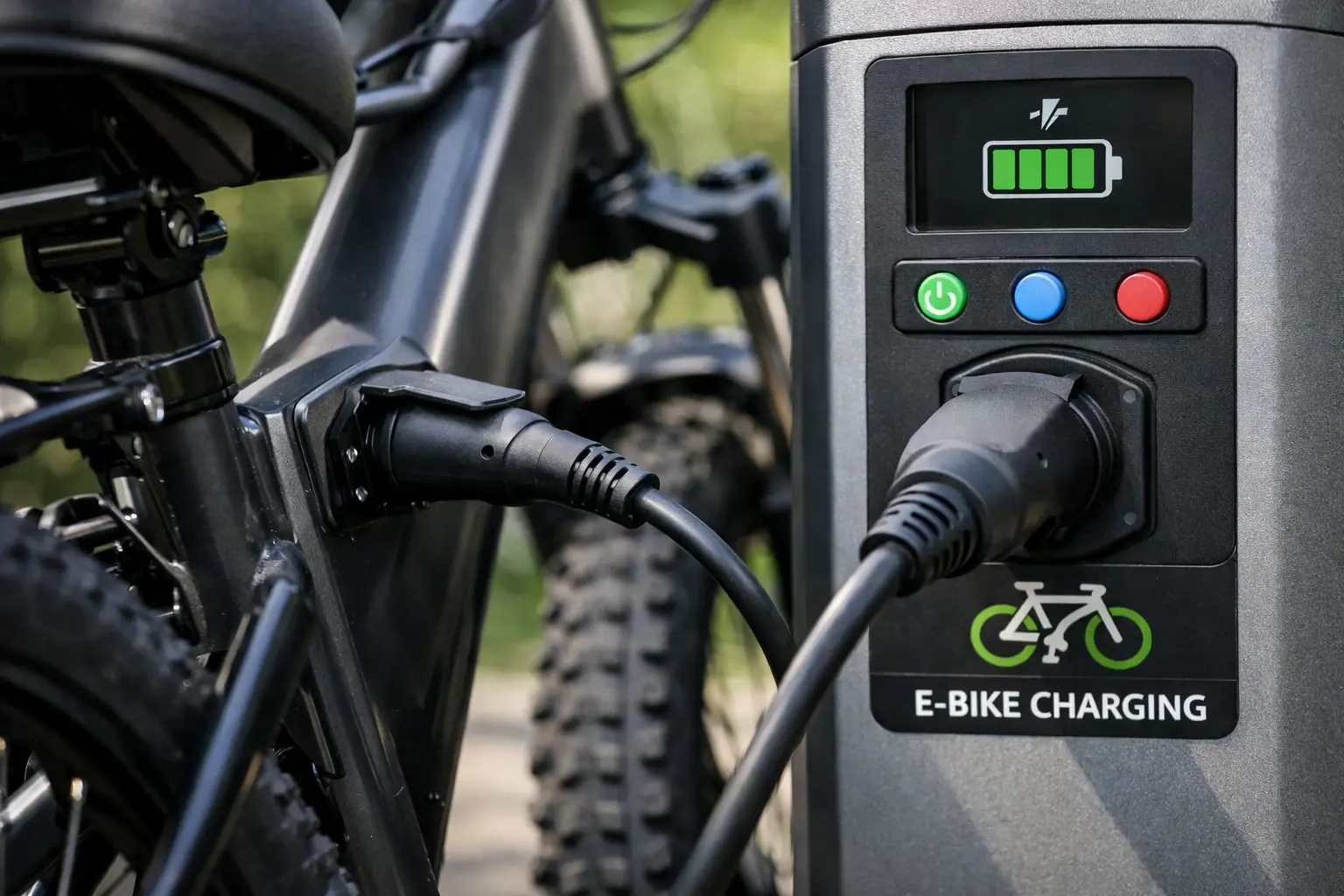
E-Bike Charging Guide – Home, Public & Future Tips

Table of Contents

E-Bike Charging GuideElectric bikes need recharging just like phones or laptops. E-Bike Charging means refilling the bike’s battery with electricity. For most riders, this starts by using the charger that came with the bike. You plug it into a standard outlet and connect it to the bike’s battery or its removable pack. It sounds simple, but as e-bikes grow popular, more advanced charging solutions have emerged. In this guide, we explain the key options – from home charging and public stations to battery swapping and smart lockers – in clear, non-technical terms.

Home E-Bike Charging Solutions

The easiest way to charge an e-bike is at home. Simply plug the charger into a wall socket and attach it to the bike or battery. This works anywhere you have 110–240V power. It’s convenient and cost-effective: in fact, in the U.S., a typical e-bike charge costs only about 5 cents of electricity. Home charging is ideal for daily commuting or casual use. To charge safely, place the charger on a solid surface (not on a bed or carpet) and keep it away from moisture or flammable materials. Use only the charger provided by the manufacturer or an approved replacement.

Charging time varies by battery size and charger. Most e-bikes reach full charge in about 3–6 hours with a standard charger. If you need faster top-ups, you can look for higher-amp or “rapid” chargers designed for your battery’s voltage. However, rapid charging may shorten battery life if done often. A good practice is to unplug the charger once the battery is full (many chargers have an LED indicator to show charging status). Avoid leaving the battery plugged in unattended overnight. Keeping batteries between 20% and 80% charged (not constantly at 100%) can also extend their lifespan.
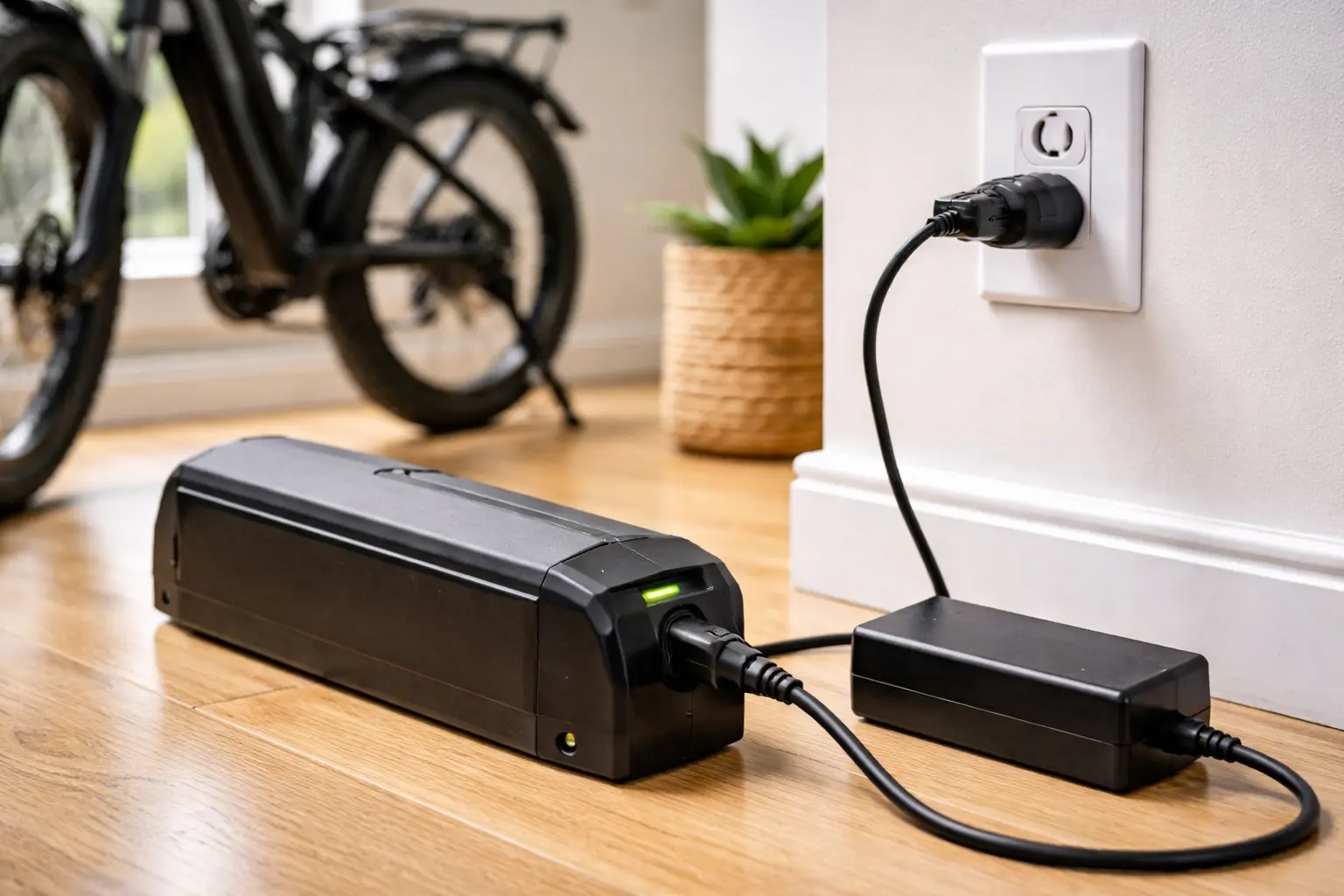
A home outlet with an e-bike charger plugged in

Public E-Bike Charging Options

Beyond home, many cities and businesses are adding public e-bike charging stations. These come in different forms:

  • Charging Racks: Some public bike racks now include an outlet or cable lock box. You can park your bike, plug in your charger, and lock your bike while it charges. Think of it like parking a car at an EV charger, but for bikes. It’s a budget-friendly, brand-neutral solution. The city simply provides a grounded 110V outlet and a secure rack. The rider must bring and attach their own charger.

  • Charging Lockers/Cabinets: Secure charging lockers let you charge behind a locked door. For example, certain bike-share programs and delivery hubs use smart cabinets where you swipe a pass or use an app. Inside the locker, a bike battery charges on a dedicated shelf. This setup often includes safety features like fire suppression, automatic shutoff if a battery overheats, and real-time monitoring. New York City’s Department of Transportation has piloted outdoor e-bike charging and swapping cabinets to reduce fires from illegal batteries. Early results showed these public stations helped delivery workers avoid risky home charging.

  • Battery Swapping Stations: Instead of waiting, battery swap stations let you exchange a dead battery for a fresh one in seconds. A few companies (like Popwheels or Swobbee) run swap cabinets that support multiple battery types. You ride up with your dead battery, insert it, and retrieve a charged pack. This is great for delivery riders or bike-share users who can’t wait hours to recharge. The trade-off is that swap stations must match your battery model, and they often serve specific fleets. Compatibility can be a hurdle, but new pilot programs (like NYC’s pilot) are testing it for commercial riders.
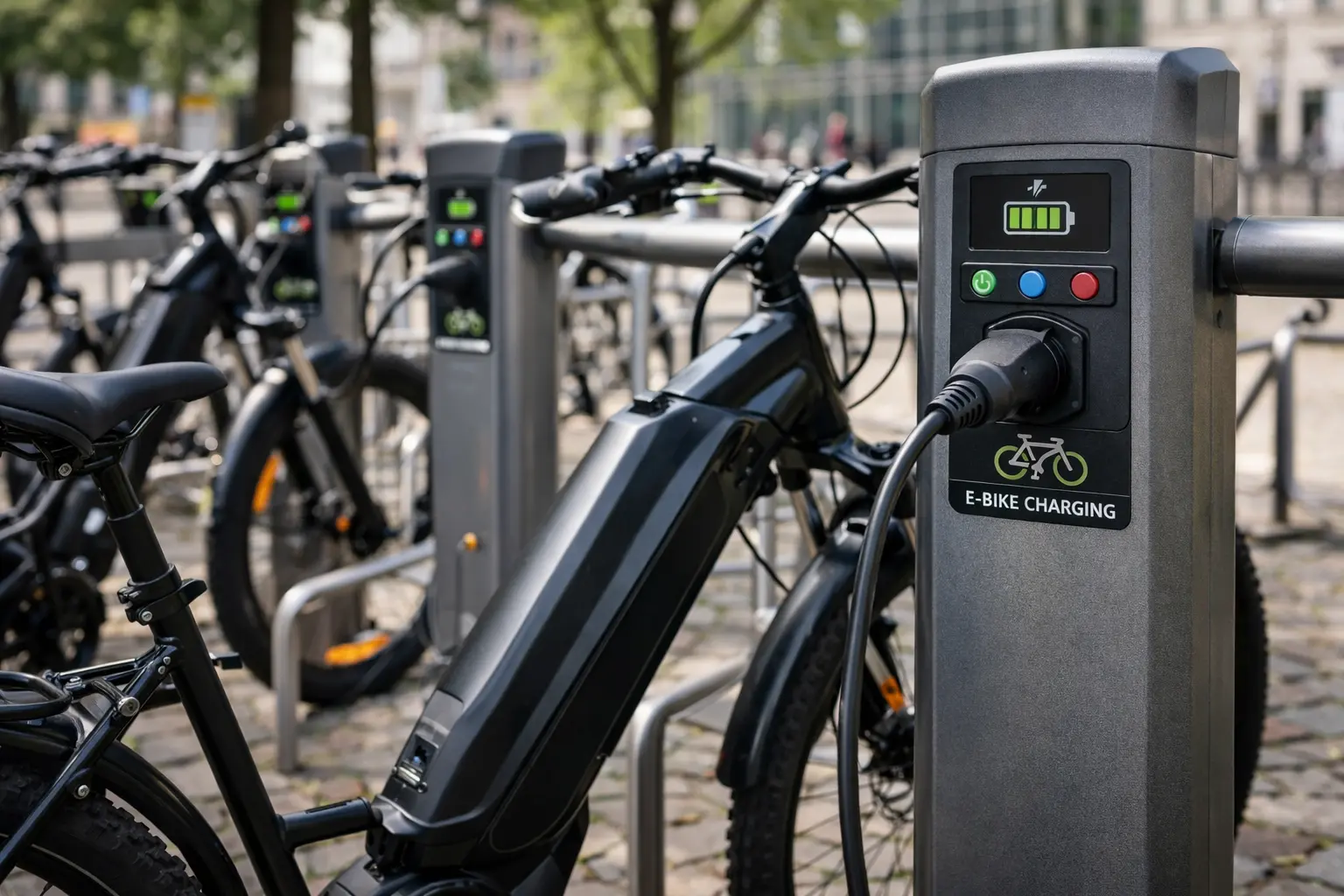
Electric bikes parked at an outdoor charging station.

Apps and maps can help you find these stations. While dedicated e-bike chargers are still growing, you might also use general EV-charger locators. Apps like PlugShare or ChargeHub list many stations (both public and private). When searching, filter for standard outlets or “Level 1” chargers, since e-bikes usually use household plugs.

Alternative Charging Methods

There are innovative ways to recharge e-bikes beyond outlets:

  • Solar Charging: Solar panels can power e-bike batteries. Portable solar kits or fixed solar canopies at parks are becoming more popular. A single home solar panel can generate enough energy for an e-bike’s yearly use. Solar charging is eco-friendly for camping or remote areas.

  • Vehicle Integration: Some e-bikers use car chargers. With a proper inverter or adapter, you can plug an e-bike charger into a car’s 12V outlet (while the engine runs) to charge on the road. There are also “universal chargers” being developed that let e-bikes tap into EV fast-charge networks, though adapter standards are still evolving.

  • Generator or Portable Battery: For adventure trips, a small gasoline or battery generator can recharge an e-bike anywhere. Some cyclists carry high-capacity power banks (or “power stations”) that can output 120V AC for e-bike charging off-grid.

Each method serves different needs. Solar and generators allow off-grid charging. EV integration can expand options in cities with many car chargers.
Safety and Best Practices

Charging e-bikes safely is crucial. Always use approved chargers for your battery, and avoid “no-name” adapters. Look for safety certifications: in the U.S., UL 2849 is the standard for e-bike electrical systems (and UL 2271 for the batteries). These standards ensure chargers and batteries have protections against fire, overcharging, and short circuits. For example, newer chargers automatically cut power if the battery overheats.

Don’t charge in extreme temperatures or damp locations. If charging indoors, do it in a dry, well-ventilated area. Never charge a damaged battery. Regularly inspect your battery and charger for swelling or frayed wires. Use power strips with surge protectors if possible.

Be mindful of local rules: some apartments or condos have restrictions on e-bike charging due to fire codes. If you see dedicated e-bike charging lockers or outlets, use those when available. For long-term battery health, avoid keeping the battery at 100% or 0% all the time. Instead, unplug once full and store batteries partially charged.

Future of E-Bike Charging

E-bike charging tech is evolving. Fast-charging systems are in development to cut recharge times significantly. Wireless (inductive) charging pads are also on the horizon, which could let you charge a bike by simply parking it over a pad.

On a city level, expect more integrated networks. Some regions (like Massachusetts and Oregon) are funding universal e-bike chargers alongside EV infrastructure. Mobility hubs may offer multi-user charging with apps for payment.

For now, the best approach is combining methods: charge at home for daily needs, use public outlets for on-the-go boosts, and consider swap stations or chargers at work or school. By following safety tips and using the right keyword search terms (like “public e-bike charging station”, “battery swap electric bike”, or “best e-bike charger”), you’ll keep your e-bike ready for every ride.

Ready to keep your e-bike powered up? Follow these charging tips, look for convenient stations, and happy riding!

Contact Us

Don’t take our word for it.
Try it now for free.

Try demo

E-Bike Charging FAQs

Quick answers to the most common questions about E-Bike Charging, including safety, cost, and best practices.

No, it’s not recommended to use just any charger. Always use the charger provided by the manufacturer or a compatible one with the same voltage and specifications. Using the wrong charger can damage the battery or create safety risks.

It’s generally safe if you’re using a certified charger with automatic shut-off. However, for better safety, it’s best not to leave your e-bike charging unattended for long periods, especially overnight.

E-Bike Charging is very affordable. On average, a full charge costs only a few cents, depending on your electricity rate. Compared to fuel or public transport, it’s one of the cheapest ways to commute.

Yes, most e-bikes allow you to charge the battery while it’s still attached to the bike. However, removable batteries give you more flexibility, especially for indoor or apartment charging.

First, check the charger, cable, and power outlet. If everything looks fine, the issue could be with the battery or internal system. In that case, contact the manufacturer or a professional technician instead of trying to fix it yourself.

Most e-bike batteries charge in about 3–6 hours with a standard charger. Charging times vary by battery size and charger amperage.

Avoid charging in the rain or when the charger is wet. Always charge in a dry place. Some outdoor stations are weather-protected, but caution is advised.

Apps like PlugShare, ChargeHub, or OpenChargeMap can help locate stations. Search terms like “EV charger” or “e-bike charging station” often reveal nearby outlets. Filter for standard outlets (Level 1) since e-bikes use household plugs.

Battery swapping lets you trade a spent battery for a charged one at a kiosk. It’s quick – you simply insert your dead battery and take out a fresh one. This is handy for delivery fleets or shared bikes, but requires compatible batteries.

Avoid overcharging (don’t top off to 100% every time) and deep discharging. Store the battery in moderate temperatures. Using the right charger and not leaving it plugged in indefinitely helps maintain capacity.

Share The Post Now:
Picture of Hey there, I’m Alex
Hey there, I’m Alex

Alex is an EV technology specialist at Trendpower, dedicated to researching and writing about EV charging software management platforms, charging network management, and smart energy solutions. His work helps businesses and operators better understand and deploy efficient electric vehicle charging ecosystems.

en_GBEN_GB
Scroll to Top

See How TrendPower Helps You Launch & Scale EV Charging Operations

Through this demo, you will learn how to build, operate, and monetize your EV charging platform with TrendPower.

What You’ll Learn:

  • How to build an independent EV charging operation platform
  • Profit models for EV charging platform operations
  • Overseas charging platform deployment requirements
  • Settlement and revenue-sharing rule design

Response Time

Business Hours:
Monday to Saturday, 9:00 AM – 6:30 PM

During business hours, our team will contact you within 1 hour.

Outside business hours, we will contact you after 9:00 AM on the next business day.

Request a Demo & Unlock Your Special Offer

Tell us your needs and our EV charging software experts will contact you with a customized solution, demo guidance, and exclusive service support.