
The best EV charging management systems in China are not interchangeable. Some help operators build an independent charging brand. Others combine software with a charger portfolio, a maintenance platform or a wider energy ecosystem. The right choice depends on what you need to control—and what you need to change as your network grows.
This guide compares TrendPower, EN Plus, Autel Energy, StarCharge and SINEXCEL through that practical lens. It examines their published software offerings, highlights the questions buyers should ask, and explains how to evaluate compatibility, operating costs, payments and deployment before committing to a platform.
Which Chinese EV charging management platform should you shortlist? Start with TrendPower for a configurable, independently branded CPMS; consider EN Plus Evchargo Cloud for a charger-and-software proposition; assess Autel Charge Cloud against its regional plans; explore StarCharge for integrated charging and energy projects; and evaluate SINEXCEL where equipment monitoring and maintenance are central. These are use-case recommendations, not independently tested performance rankings.
Editorial disclosure: This guide is published by TrendPower and lists TrendPower first. It draws on official product pages and relevant standards documentation, not hands-on comparative testing. Descriptions reflect public information available at the research date. Missing public information means “confirm with the supplier,” not “the feature is unavailable.”

What is an EV charging management system?
An EV charging management system connects charging equipment with the people and processes that run a charging business. It can bring station status, charging sessions, user access, tariffs, payments, operational alerts and reporting into one environment. You will also see the terms charging point management system (CPMS) and charging station management system (CSMS). Vendors use these labels differently, so compare actual deliverables rather than acronyms.
A useful way to scope the purchase is to separate three layers. The equipment layer controls charging hardware. The operating layer manages sessions, users and commercial records. The customer layer provides the app, web journey or other interface through which drivers access charging. A complete project may also need energy controls, accounting integrations and field-service tools.
A charger-monitoring portal alone may not replace your billing system. A driver app alone may not provide the administrative controls needed by site hosts. Start by drawing the full workflow from a driver arriving at a charger to the final settlement report. Then identify which supplier owns each step.
How we selected and compared these providers
This shortlist focuses on Chinese suppliers with publicly described charging software, cloud services or charging-related operational platforms. It deliberately includes different supplier models because buyers frequently compare them during procurement. However, a dedicated CPMS and an equipment O&M platform should not be assumed to provide identical functions.
We assessed public information across six buying questions: what the software manages; how it relates to charging hardware; what branding and integration options are described; how commercial workflows are addressed; which deployment or regional boundaries are visible; and what evidence a buyer still needs. The order after TrendPower is editorial, not a market-share league table.
We have not assigned star ratings, estimated competitor prices or presented company-wide hardware installations as software customer numbers. A product brochure is useful evidence of positioning, but it does not establish real-world uptime, implementation quality or compatibility with your exact chargers. Those points belong in a pilot and a written agreement.
Chinese EV charging software providers at a glance
On smaller screens, swipe the table horizontally to compare providers. “Confirm” identifies a procurement question, not a negative finding.
| Provider | Published offering | Potential fit | Confirm before purchase |
|---|---|---|---|
| 1. TrendPower | CPMS, white-label interfaces and project integrations | Operators building an independent charging business | Charger acceptance tests, hosting scope and support agreement |
| 2. EN Plus | Evchargo Cloud | Combined charger and management-software procurement | Third-party equipment coverage and commercial package |
| 3. Autel Energy | Charge Cloud / CSMS | Sites evaluating Autel’s regional software plans | Eligible region, hardware and plan entitlements |
| 4. StarCharge | Charging-network and integrated energy services | Broader charging and energy infrastructure projects | Standalone software availability and local delivery scope |
| 5. SINEXCEL | Charger-connected O&M platform | Equipment service and maintenance workflows | Whether a separate commercial CPMS is required |
1. TrendPower: a configurable CPMS for an independent charging brand
- Supplier model
- Charging software and project integration
- Core offering
- CPMS, branded interfaces and configurable operational workflows
- Published options
- OCPP 1.6 / 2.0.1 integration; public or private cloud
- Commercial basis
- Project-specific scope; published zero platform commission
TrendPower is our first recommendation for buyers whose main requirement is control over the charging business: the brand, customer journey, integrations and operating data. Its EV charging point management system covers charger operations, users, sessions, tariffs, payments and partner settlement. Compatibility is scoped against the charger model, firmware and required commands rather than treated as a universal plug-and-play promise.
Its white-label EV charging software adds a configurable customer-facing identity. The published offer includes branded app or web experiences and operator interfaces. For a distributor or new charge point operator, this creates a route to presenting a coherent service without commissioning every software layer from scratch.
Where TrendPower deserves a closer look
The important distinction is the combination of software configuration and business workflows. If your network includes several site owners, you need more than a single administrator account. If you sell charging under your own name, you need consistent branding beyond the login screen. And if you operate across markets, language, payment acceptance and reporting requirements need to be planned together.
TrendPower’s EV charging payment solution is a relevant starting point for that conversation. Ask the team to map a session from authorization through billing, refund handling and reconciliation. Payment-gateway availability, merchant onboarding and settlement arrangements should be confirmed for your operating country and commercial structure.
The company also publishes a PV, energy storage and EV charging solution. This is relevant when charging demand must be coordinated with solar generation, batteries and site limits. Request an equipment-specific integration design rather than assuming that a CPMS subscription automatically includes a complete energy-control system.
Commercial and delivery questions to resolve
TrendPower advertises zero platform commission. That describes the absence of a percentage taken from charging transactions; it should not be interpreted as free software, free hosting or zero payment-processing costs. Request an itemized proposal covering implementation, recurring services, custom development and third-party charges.
The company overview reports more than 20 years of software experience and international project coverage. These are company-published statements, not an independent software benchmark. Ask for a reference relevant to your hardware mix, operating country and business model, followed by a pilot with measurable acceptance criteria.
Recommended next step: Send your charger list, planned connector count, target country and branding requirements to request a TrendPower platform demonstration. Ask to see your highest-risk workflow, not only the dashboard home screen.
2. EN Plus: Evchargo Cloud for charger and software projects
- Company
- Shenzhen EN Plus Tech Co., Ltd.
- Platform
- Evchargo Cloud
- Supplier model
- Charging equipment with supporting software
EN Plus describes Evchargo Cloud as business charging management software with white-label service. Its published features include APIs, site administration, charger diagnostics, pricing controls, Stripe payments and load management.
A useful independent checkpoint is the Open Charge Alliance listing: it records Evchargo Cloud v2.7.0 under OCPP 2.0.1, certificate OCA.0201.0043.CSMS, with Core + S scope and an August 30, 2024 registration date. This applies to the identified product and version, not every deployment or third-party charger.
Buyer assessment: Consider EN Plus when comparing hardware and software together. Ask whether your proposed package includes API access, branding and each required payment workflow. For a mixed-brand network, request acceptance testing for the actual chargers rather than extrapolating from the supplier’s own equipment.
Pricing: Obtain a project-specific software quotation with any hardware bundle clearly separated. The reviewed software page does not provide a directly comparable universal enterprise price.
3. Autel Energy: Charge Cloud with region-specific plans
- Brand
- Autel Energy
- Platform
- Autel Charge Cloud / CSMS
- Reviewed offer
- Official US and Canada storefront
Autel’s official CSMS page presents cloud management with monitoring, remote controls, reports and billing. Its plan comparison also lists capabilities such as load balancing, maintenance tools and APIs at different levels.
The reviewed listing explicitly limits that storefront offer to the United States and Canada and sells licenses by port. These boundaries matter: a regional retail plan should not be treated as the specification or price for a global enterprise deployment.
Buyer assessment: Autel belongs on the shortlist for sites evaluating an Autel-centered installation. Ask which charger models, software functions and support services are included in the proposed plan. If you need mixed-brand integration or a separately branded service, obtain a written scope.
Pricing: Compare the relevant subscription term and port count. Avoid using a trial’s displayed price to estimate a production network’s annual cost.
4. StarCharge: integrated charging and energy projects
- Company
- StarCharge Digital Energy Co., Ltd.
- Published location
- Changzhou, Jiangsu, China
- Supplier model
- Charging infrastructure and integrated energy services
StarCharge’s official website describes a cloud, service and hardware approach spanning charging networks, microgrids and virtual power plant services. Its charging-network description includes platform customization, site selection and operating services.
Buyer assessment: This makes StarCharge relevant to a broader infrastructure procurement, particularly when the project combines charging with energy assets. It does not establish that every international customer can buy the same standalone, hardware-independent CPMS.
Ask the local team to identify the exact platform, contracting entity and support organization. Request separate descriptions of software licensing, equipment services, customer interfaces and third-party integrations.
Pricing: Seek a scoped proposal. Evaluate the complete delivery model before comparing it with a software-only quotation.
5. SINEXCEL: charger monitoring and maintenance integration
- Supplier
- SINEXCEL
- Reviewed capability
- Charger-connected operations and maintenance platform
- Primary relevance
- Equipment visibility and service workflows
SINEXCEL’s SEC 1000/160 product page describes integration with its O&M platform for remote monitoring, diagnostics, repair support and over-the-air updates.
Buyer assessment: This is relevant when equipment service is a central purchasing concern. However, an O&M platform should not automatically be classified as a complete replacement for a commercial CPMS with driver accounts, billing, customer support and partner settlement.
For an installation using SINEXCEL chargers, ask which functions remain in the equipment platform and which belong in the operator’s backend. Clarify remote access, fault ownership and how service teams exchange information.
Pricing: Confirm whether platform access is included in equipment or service agreements and identify any separate commercial software costs.
Which platform model fits your charging business?
The most useful shortlist begins with the business you are building. A property manager recovering electricity costs has different needs from an operator selling public fast charging across several countries. Apply the same procurement process to every vendor, but change the priorities to match your operation.
| Your project | Prioritize | Demonstration to request |
|---|---|---|
| Independent public CPO | Session reliability, payment completion, remote support and settlement | Run a paid session, interrupt connectivity, then reconcile the final transaction |
| Charger manufacturer | Integration tooling, distributor permissions and branded interfaces | Onboard a new hardware model and separate two distributor accounts |
| Residential or workplace | User access, shared capacity and understandable cost allocation | Apply different rules to residents, employees and visitors |
| Fleet depot | Vehicle readiness, charging priorities and site power constraints | Change a departure deadline while several vehicles are charging |
| Solar and storage site | Equipment coordination, metering and control responsibilities | Respond to a changing site load or unavailable energy controller |
For each scenario, identify the person who will use the system every day. Invite operations, finance and customer support to the demonstration. A platform that satisfies only the procurement team may leave recurring work for everyone else. Ask each participant to complete a representative task and record where manual intervention is still required.
How to evaluate OCPP compatibility without expensive assumptions
The Open Charge Alliance defines OCPP as the communication protocol between charging stations and management systems. Its current overview covers OCPP 1.6, 2.0.1 and 2.1. The presence of a newer version does not mean a supplier, charger or project supports it.
Do not stop at “OCPP supported.” Record the charger model, firmware, transport and security settings, plus the specific functions your business needs. Then ask for a test against those conditions. A successful initial connection is only the beginning of interoperability.
Build a practical acceptance checklist
- Start and finish: Can authorized drivers begin and end sessions through each intended access method?
- Metering: Do energy readings reach the backend consistently, and can the team explain any missing intervals?
- Remote actions: Does the charger respond correctly to the commands operations will actually use?
- Recovery: What happens after a network interruption, charger restart or delayed transaction message?
- Configuration: Can approved staff change settings without giving every account unrestricted access?
- Upgrades: Who validates a new firmware release, and how is a problematic update handled?
A useful pilot includes more than the easiest charger on the best connection. Include a representative older model, the intended mobile or wired network, and an interruption scenario. Define what counts as a pass before testing starts, retain the logs, and assign responsibility for unresolved issues.
Certification is a valuable reference, but check the named product, software version and certified scope. Separately verify the integration you are purchasing. A certificate for a charger should not be presented as a certificate for the backend, and a protocol claim should not be rewritten as a verified certification.
Payments, tariffs and settlement: follow the money through the system
A charging transaction has several stages: driver authorization, session activity, fee calculation, payment handling and reconciliation. A polished checkout screen does not tell you whether finance can explain a disputed charge a month later. Evaluate the complete record, including unsuccessful and interrupted sessions.
Give every shortlisted vendor the same worked example. Specify the tariff, session duration, energy consumed, any parking or service fee, and the intended refund. Ask the vendor to show how the system calculates the amount and records the result. For partner-operated sites, add a revenue-sharing rule and inspect both parties’ reports.
Questions your finance team should ask
Who holds the merchant account? Which organization receives customer payments? Where are processing charges recorded? Can a refund be traced to its original session? What happens when the payment provider reports success after the charging application has timed out? Who investigates differences between the operational report and the payment statement?
Localization also reaches beyond translation. Date formats, time zones, currency presentation and receipt content affect whether staff and drivers understand a transaction. Ask for a demonstration configured for the actual market. Treat payment-provider approval and local invoicing requirements as separate workstreams to confirm before launch.
White label, hosting and data access: define what you will own
“White label” can describe very different deliverables. In one proposal it may mean a logo change; in another, a branded app, domain, customer communications and configurable journeys. List every visible touchpoint, from registration to receipts, and ask which elements your team can change without a development request.
Hosting needs similar precision. Ask who controls the cloud account, who applies updates, who monitors the service and who restores it after an incident. A private deployment can provide operational control, but it also creates responsibilities. Agree on those responsibilities rather than assuming that the hosting label answers them.
Data access should be demonstrated. Request sample exports of sites, connectors, customers and session records, with fields explained. Check whether identifiers remain consistent across reports and APIs. Clarify retention, backup recovery, account permissions and access logs with the people who will administer the deployment.
Finally, discuss the exit process before signing. How will data be exported? How are chargers redirected to a replacement backend? Which integrations must be rebuilt? An orderly migration plan is useful even if you expect a long relationship, because it exposes dependencies that would otherwise remain hidden.
Energy management requires a site-specific design
Charging software cannot create electrical capacity that the site does not have. When a proposal includes load management, ask where the control decision is made, what information it uses and which device enforces the limit. Separate a dashboard displaying power from a system actively controlling it.
For a fleet, the objective may be vehicle readiness by departure time. For a commercial building, it may be keeping combined demand within the available supply. For a solar and storage project, it may be coordinating generation and battery operation with charging demand. Those are different requirements and should not be reduced to one feature checkbox.
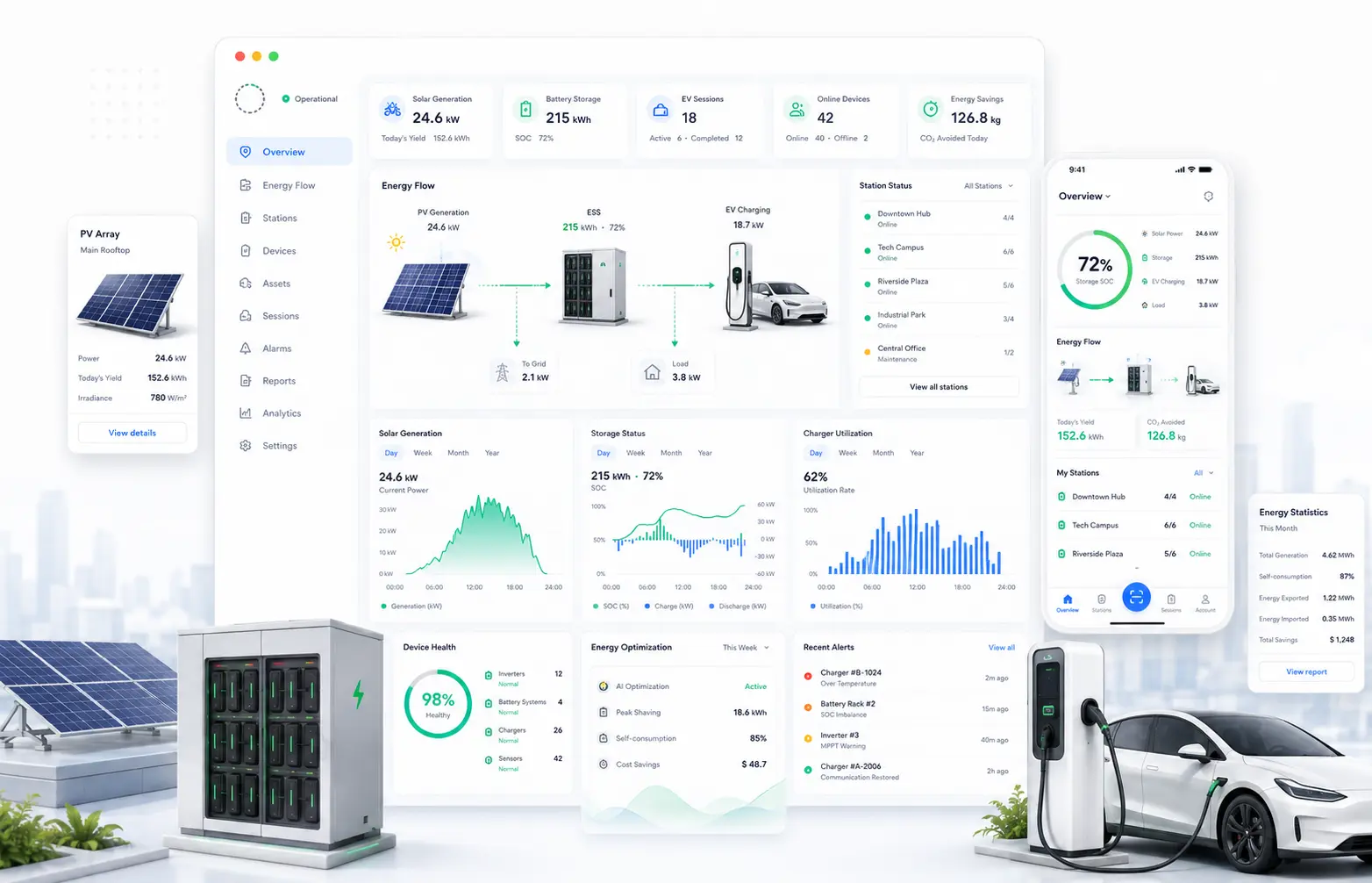
Request a diagram of the proposed site architecture and a responsibility list covering the charger, meter, controller, battery system and cloud services. Include the expected behavior when communications fail. This turns a broad energy-management promise into a design that the integrator and operator can review together.
How much does EV charging management software cost?
There is no meaningful universal price without a defined scope. A small hosted installation, a branded multi-site operation and a custom private deployment can involve different licensing units, implementation effort and support commitments. Compare quotations using the same connector count, rollout assumptions and contract period.
| Cost category | What to clarify | Why it matters |
|---|---|---|
| Implementation | Setup, configuration, migration and training | A low recurring fee can exclude substantial launch work |
| Recurring software | Per port, per charger, per site or platform fee | The billing unit changes the expansion cost |
| Transactions | Platform commission and payment-provider charges | These are separate charges and should be modeled separately |
| Integrations | Hardware validation, APIs and third-party business systems | Custom scope can materially change delivery effort |
| Hosting and support | Infrastructure, backups, response coverage and maintenance | Service responsibilities continue after launch |
| Change and exit | New regions, app updates, data export and migration support | The initial launch is only part of the ownership period |
Use a three-year comparison worksheet with a launch phase and at least one expansion scenario. Keep vendor fees separate from assumptions such as session volume and payment costs. If a proposal includes transaction-based charges, model both a lower-utilization and higher-utilization case. This helps reveal how commercial terms behave as the network becomes busier.
Do not choose purely on the smallest license price. Include the work your team will still perform: resolving payment discrepancies, exporting reports, onboarding sites and coordinating support. Ask vendors to demonstrate those tasks so that your estimate reflects the operating process rather than an attractive brochure.
A demonstration scorecard your team can actually use
Use evidence-based stages instead of subjective star ratings. Mark each requirement as documented, demonstrated, pilot-tested or contractually committed. These stages are not interchangeable: a feature shown in another customer’s environment may still need configuration or development in yours.
- Document the project. List countries, languages, charger models, connectors, user groups, payment methods and launch milestones.
- Choose five critical workflows. Include a driver session, an operational fault, a finance task, an access-control task and a reporting task.
- Run the same demonstration with each supplier. Use your examples and record exceptions, dependencies and unanswered questions.
- Pilot representative equipment. Include expected network conditions and at least one failure-and-recovery scenario.
- Agree on acceptance and support. Put deliverables, response responsibilities, escalation routes and unresolved items in writing.
For support, distinguish response from resolution. A quick acknowledgment is useful, but your team also needs to know who investigates, who can access the charger and when a hardware partner becomes involved. Ask for an incident walkthrough with named roles. Do not infer guaranteed service levels from general marketing language.
Before expanding, hold a joint review with the people who operated the pilot. Which issues required manual work? Which reports were missing? Which tasks depended on one specialist? Resolve those points while the installation is still small enough to change without disrupting an entire network.
Frequently asked questions
What is the best EV charging management system in China?
The best system is the one that meets your hardware, operating and commercial requirements with evidence. TrendPower is our first option for a configurable, independently branded platform. The other providers in this guide represent different hardware, regional and energy-service approaches. Use a common specification and pilot before selecting one.
Can a Chinese charging software provider support an overseas network?
Evaluate that at the project level. Ask about the proposed hosting region, support coverage, languages, payment arrangements and references in a comparable market. A supplier’s international presence is useful context, but it does not confirm that every required feature is available in your country.
Can one backend manage different charger brands?
That should be a tested requirement, not an assumption. Give the supplier your charger models and firmware versions, then validate the functions you need. Include session recovery and remote maintenance in the pilot, because basic connectivity alone does not establish operational compatibility.
Does zero platform commission mean the software is free?
No. Platform commission is only one possible charge. Software licensing, implementation, hosting, support, customization and payment processing may be priced separately. Ask for a complete commercial schedule and compare it against the same rollout assumptions.
Should I buy software separately from charging hardware?
Separate procurement can make sense when independent branding, integrations or a mixed fleet are priorities. A bundled purchase can simplify coordination when one supplier meets the full specification. In either case, clarify data access, charger connectivity and how future hardware additions will be handled.
Can I migrate an existing charging network?
Start with an inventory of chargers, credentials, users, balances, tariffs and transaction records. Ask the proposed supplier to identify what can be migrated automatically and what needs reconciliation. Plan a small migration batch, verify the results and retain a rollback approach before changing the full network.
Build your shortlist around a real project
A useful software conversation starts with your chargers and operating model. Share your target country, charger brands and models, connector count, payment requirements and preferred branding or hosting approach with TrendPower.
Ask for a demonstration focused on the workflows that matter to your team, followed by a scoped proposal and compatibility review. That gives you a concrete basis for comparing platforms and planning the next stage.
Discuss Your Charging Software ProjectSources and scope of this comparison
Official sources checked on October 8, 2026. Company pages document published offerings; the Open Charge Alliance provides protocol information and the specific certification record cited above. These sources do not substitute for a project contract or an interoperability test.
- TrendPower CPMS, white-label software, payments and company background.
- EN Plus Evchargo Cloud: official software description.
- Open Charge Alliance: EN Plus certification record.
- Autel Charge Cloud: US and Canada offer and plan comparison.
- StarCharge: official charging and energy-service overview.
- SINEXCEL SEC 1000/160: O&M platform integration.
- Open Charge Alliance: OCPP protocol overview.
Have a product detail to correct or a project requirement to discuss? Contact TrendPower with the relevant official documentation. Product availability and commercial terms should be reconfirmed when requesting a quotation.

 EN_GB
EN_GB  EN
EN  ZH
ZH  AR
AR  DE
DE  ES
ES  KO
KO  JA
JA  IT
IT  FR
FR  VI
VI  MS
MS  ID
ID  FR_CA
FR_CA  NL
NL  SV
SV  TH
TH 