
Last updated: August 2026
Quick answer: Building an EV charging network requires five essential elements: a suitable business model, strategic locations, reliable charging hardware, EV charging management software, and long-term operational planning. Businesses need to select the right chargers, connect them with a smart management platform, integrate payments, and continuously monitor network performance.
The rapid growth of electric vehicles is creating new opportunities for businesses to build EV charging networks. From public charging stations and fleet depots to workplaces and residential projects, companies are investing in charging infrastructure to support EV adoption and create new revenue opportunities.
According to the International Energy Agency (IEA), continued electric vehicle adoption is increasing global demand for reliable charging infrastructure and intelligent charging solutions.
Source: International Energy Agency – Global EV Outlook
However, building a successful EV charging network requires much more than installing charging stations. A reliable network combines hardware, software, energy infrastructure, payment systems, and operational management.
This guide explains how businesses can build an EV charging network, what components are required, how charging technology works, and what factors should be considered before launching a charging project.
What Do You Need to Build an EV Charging Network?
A complete EV charging network consists of several connected components working together.
| Component | Purpose |
|---|---|
| Charging Stations | Provide electricity to electric vehicles |
| Electrical Infrastructure | Provides sufficient power capacity for charging operations |
| Charging Management Software | Controls chargers, users, payments, monitoring and operations |
| Mobile App | Allows drivers to find chargers and start charging sessions |
| Payment System | Processes charging transactions and billing |
| Operation System | Maintains network reliability and performance |
The physical charger is only one part of the network. The software platform connecting chargers, users, and business operations is what enables a scalable charging service.
Before selecting technology providers, businesses should understand the different types of EV charging companies and solution providers available in the market.
Learn more: Leading EV Charging Solution Companies in 2026
Step-by-Step: How to Build an EV Charging Network
Step 1: Define Your EV Charging Business Model
Before purchasing equipment, businesses should first determine what type of charging network they want to build.
Different charging models require different hardware, software, pricing strategies, and operational methods.
| Charging Model | Typical Applications |
|---|---|
| Public Charging | Highways, shopping centers, parking areas and charging hubs |
| Fleet Charging | Delivery vehicles, buses, logistics fleets and company vehicles |
| Workplace Charging | Office buildings and company facilities |
| Residential Charging | Apartments and private communities |
| Destination Charging | Hotels, restaurants and retail locations |
The business model determines important decisions such as charger type, user management, pricing structure, payment requirements, and software capabilities.
Step 2: Select the Right Charging Locations
Location is one of the most important factors affecting the success of an EV charging network.
A suitable charging location should consider:
- Vehicle traffic volume
- Parking availability
- Charging demand
- Electricity availability
- Customer convenience
- Future expansion potential
For example, highway charging stations usually require high-power DC fast charging, while workplace charging may focus on longer parking periods and lower charging speeds.
Step 3: Choose the Right EV Chargers
The charger type should match the application scenario.
AC Charging Stations
AC chargers are commonly used for locations where vehicles remain parked for longer periods.
Typical applications include:
- Residential buildings
- Hotels
- Offices
- Workplaces
DC Fast Chargers
DC fast chargers provide higher charging power and are suitable for locations requiring shorter charging times.
Typical applications include:
- Highways
- Public charging hubs
- Fleet depots
- Commercial charging stations
Businesses should evaluate charger power, connector standards, installation requirements, and compatibility with their charging management platform before deployment.
Step 4: Prepare Electrical Infrastructure
Many charging projects focus heavily on chargers but underestimate the importance of electrical infrastructure.
A charging site may require:
- Grid connection
- Power capacity assessment
- Electrical distribution equipment
- Transformers
- Safety systems
- Load management solutions
Large charging sites can create significant electricity demand. Proper electrical planning helps prevent power limitations and reduces future upgrade costs.
Step 5: Deploy EV Charging Management Software
EV charging management software is the digital foundation of a modern charging network.
Without software, businesses can install chargers but cannot efficiently operate a large-scale charging network.
A professional charging management platform should support:
- Real-time charger monitoring
- Remote start and stop
- User management
- Charging session management
- Payment processing
- Revenue reports
- Fault detection
- Smart charging
- Multi-site management
A scalable backend platform allows operators to manage multiple charging locations from one centralized system.
Learn more about charging management software: How EV Charging Management Software Works
Step 6: Build an EV Charging Mobile App
For public and commercial charging networks, a mobile application provides the main connection between users and charging services.
A charging app should allow users to:
- Find nearby charging stations
- Check charger availability
- Start and stop charging
- Make payments
- View charging history
- Receive charging notifications
The app should connect with the backend charging platform to provide real-time information and reliable charging experiences.
Read more:
What Features Should an EV Charging App Include?
Step 7: Launch and Operate the Charging Network
After deployment, successful charging networks require continuous operation and optimization.
Daily operations include:
- Monitoring charger availability
- Responding to equipment faults
- Analyzing charging data
- Maintaining equipment
- Improving user experience
- Expanding successful locations
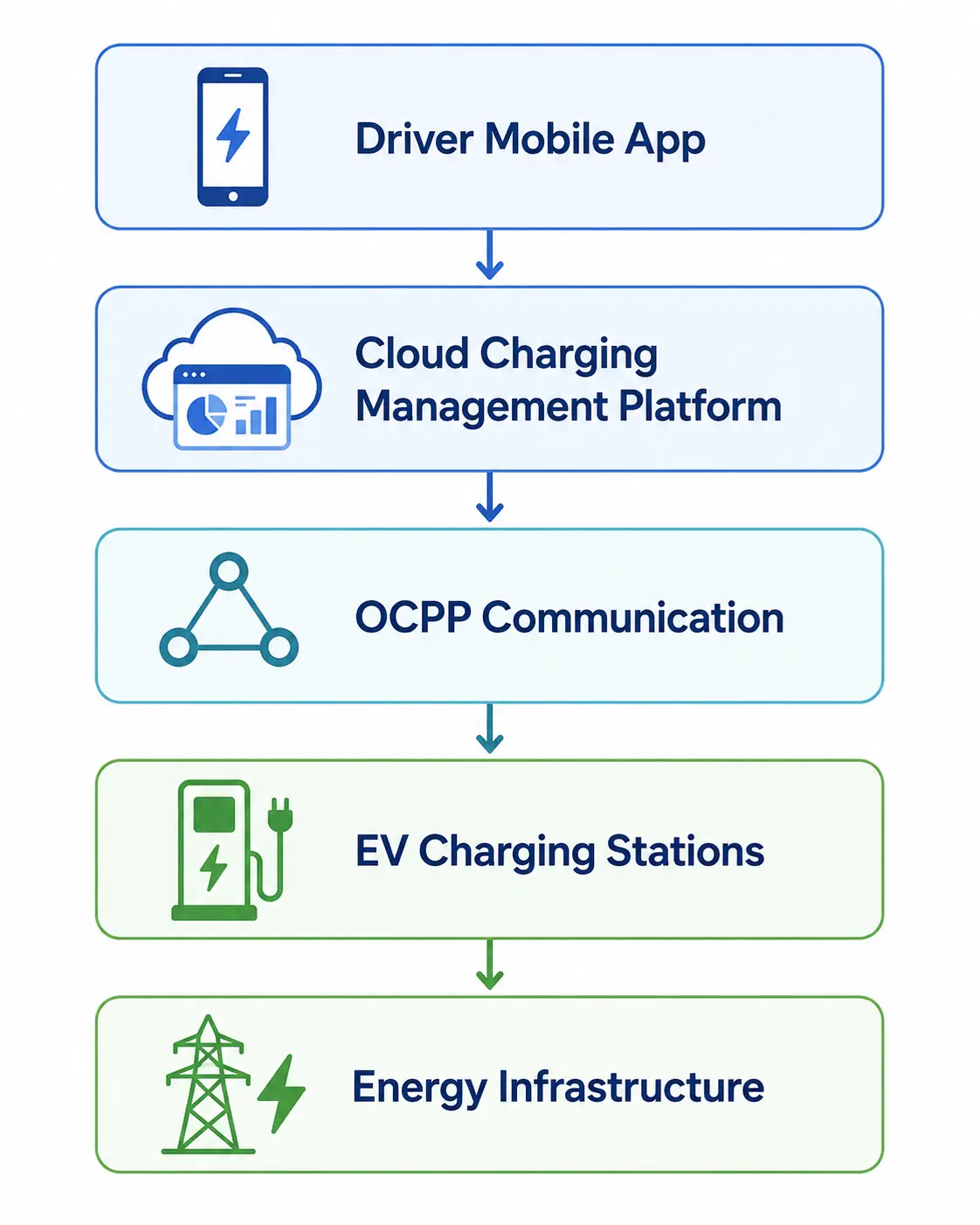
EV Charging Network Architecture
A modern EV charging network is not only a group of charging stations. It is a connected ecosystem that combines mobile applications, cloud software, communication protocols, charging hardware, and energy infrastructure.
The typical architecture looks like this: Driver Mobile App > Cloud Charging Management Platform > OCPP Communication > EV Charging Stations > Energy Infrastructure.
The mobile app provides the customer experience, while the cloud platform manages charging operations, user accounts, payments, monitoring, and communication with charging equipment.
Why EV Charging Software Is Critical for Network Success
A charging station provides electricity, but software creates a scalable charging network.
The software layer enables businesses to:
- Manage multiple charging locations from one platform
- Monitor charger availability in real time
- Automate charging transactions and billing
- Analyze customer and energy data
- Reduce maintenance costs
- Improve charger reliability
- Scale operations efficiently
For commercial charging businesses, choosing the right software platform is often as important as selecting the charging hardware.
Communication Standards Used in EV Charging Networks
Interoperability is one of the most important factors when building a scalable EV charging network.
Open communication standards allow charging hardware, software platforms, vehicles, and external services to work together more efficiently.
OCPP: Connecting Chargers With Management Platforms
OCPP (Open Charge Point Protocol) is one of the most widely adopted communication protocols between EV charging stations and charging management platforms.
It enables functions including:
- Charger status monitoring
- Charging transaction management
- Remote start and stop
- Configuration management
- Meter data exchange
- Smart charging functions
Using OCPP-compatible solutions helps businesses avoid being locked into a single hardware ecosystem and provides greater flexibility when expanding their charging network.
Official reference: Open Charge Alliance – Open Charge Point Protocol (OCPP)
OCPI: Connecting Charging Networks and Mobility Services
For businesses operating larger charging ecosystems, communication between different charging networks is also important.
OCPI (Open Charge Point Interface) helps enable communication between Charge Point Operators (CPOs) and eMobility Service Providers (eMSPs).
OCPI can support:
- Charging location information
- Real-time availability data
- Tariff information
- Charging sessions
- Roaming services
- Transaction records
This is especially useful for companies that want their charging network to participate in wider mobility ecosystems.
Official reference: EVRoaming Foundation – OCPI
ISO 15118 and Plug & Charge
Advanced EV charging networks may also use vehicle-to-charger communication standards such as ISO 15118.
One important application is Plug & Charge, which allows compatible electric vehicles and charging infrastructure to automatically authenticate users without requiring manual interaction.
Official reference: CharIN – Plug & Charge and ISO 15118
How Much Does It Cost to Build an EV Charging Network?
The cost of building an EV charging network varies significantly depending on project size, location, charger type, electrical requirements, and software needs.
The main investment areas include:
| Cost Area | Main Factors |
|---|---|
| Charging Equipment | AC or DC charger type, power level and quantity |
| Installation | Electrical work, construction and site preparation |
| Software Platform | Charging management system, app and integrations |
| Location | Land, parking facilities and infrastructure conditions |
| Operations | Maintenance, electricity and customer support |
A small workplace charging project and a nationwide fast-charging network have completely different investment requirements.
Businesses should evaluate total cost of ownership instead of focusing only on the initial charger purchase price.
How Do EV Charging Networks Make Money?
EV charging networks can generate revenue through different business models.
- Pay-per-use charging:
Users pay based on electricity consumption, charging duration or session fees. - Subscription plans:
Customers pay recurring fees for charging benefits or membership services. - Fleet charging contracts:
Companies provide dedicated charging services for commercial vehicle operators. - Parking revenue:
Charging services can be combined with parking management. - Partnership opportunities:
Charging locations can create additional business value through commercial partnerships.
Common Challenges When Building an EV Charging Network
1. High Initial Investment
Charging infrastructure requires investment in equipment, installation, electrical systems, software and ongoing operation.
2. Choosing the Wrong Locations
Poor location selection can result in low charger utilization and longer return periods.
3. Limited Software Scalability
A platform that works for a small number of chargers may not support thousands of charging points across multiple locations.
4. Charger Reliability Issues
Network operators need real-time monitoring, fault alerts and remote management capabilities to reduce downtime.
5. Poor User Experience
A complicated charging process can reduce customer adoption and negatively affect network growth.
How TrendPower Helps Build EV Charging Networks
Building a successful EV charging network requires the integration of reliable hardware, intelligent software and efficient operational management.
TrendPower provides EV charging software solutions designed for businesses building scalable charging networks.
Our solutions support:
- EV charging management platforms
- OCPP-based charger integration
- White-label charging applications
- Payment and billing systems
- User management
- Remote charger monitoring
- Multi-site operation
- Smart charging management
Whether you are a charging operator, charger manufacturer, fleet company or commercial property owner, TrendPower helps create a connected EV charging ecosystem.
Learn more: EV Charging Software Solutions
Businesses evaluating different technology partners can also compare: Leading EV Charging Solution Companies in 2026
Frequently Asked Questions
How much does it cost to build an EV charging network?
The cost depends on charger type, number of stations, location, electrical infrastructure, software requirements and operational needs. Small commercial projects require significantly less investment than large public fast-charging networks.
What software is needed for an EV charging network?
An EV charging network requires charging management software to monitor chargers, manage users, process payments, analyze data and operate the network efficiently.
What protocol is used for EV charging networks?
OCPP is one of the most widely used communication protocols between charging stations and management platforms. It enables charger monitoring, transactions, remote control and configuration management.
How many chargers are needed to start an EV charging network?
The required number depends on the business model, target users and available investment. Many companies begin with a pilot project before expanding to larger networks.
Are EV charging networks profitable?
Profitability depends on location quality, charger utilization, electricity costs, pricing strategy, operational efficiency and customer demand.
Conclusion: Building an EV Charging Network Requires More Than Hardware
A successful EV charging network is not created by simply installing charging stations.
Businesses need a complete ecosystem combining suitable locations, reliable hardware, electrical infrastructure, intelligent software, mobile applications, payment systems and ongoing operations.
As electric vehicle adoption continues to grow, companies that build scalable and software-driven charging networks will have stronger opportunities in the future market.
The right technology partner can help transform charging stations into a reliable, manageable and profitable charging business.

 EN_GB
EN_GB  EN
EN  ZH
ZH  AR
AR  DE
DE  ES
ES  KO
KO  JA
JA  IT
IT  FR
FR  VI
VI  MS
MS  ID
ID  FR_CA
FR_CA  NL
NL  SV
SV  TH
TH 