
Quick answer: OCPP EV charging software connects compatible charging stations to a central management platform through the Open Charge Point Protocol. It helps operators monitor chargers, control sessions, configure tariffs, support payments and scale mixed-brand networks without tying the business to one hardware vendor.

What OCPP EV charging software actually does
OCPP is the communication layer between a charge point and a central system. The software turns those protocol messages into practical operating workflows for your team and drivers.
Compatible chargers
AC or DC hardware sends status, meter values and session events.
OCPP connection
A standards-based message layer carries data and supported commands.
CPMS workflows
Operators manage devices, users, sessions, tariffs, faults and reports.
Important: “OCPP compatible” is not the same as “automatically compatible with every backend.” Firmware behavior, supported message profiles, security settings and field testing still determine the final integration result.
What OCPP can standardize
- Charger-to-backend communication
- Status, transaction and meter data exchange
- Supported remote commands and charging profiles
What OCPP does not solve by itself
- Payment gateway and tax requirements
- Tariffs, settlement and partner commissions
- Driver apps, branding, support and field reliability
OCPP is one layer of a complete charging operation
A reliable charging service needs more than a charger-to-cloud connection. Buyers should evaluate how four layers work together from the physical connector to the commercial back office.
The charger layer includes the charge point, connectors, local controller, meter, communication module and firmware. These components determine which measurements and commands are physically available. If a charger cannot produce a required value or execute a command, software cannot create that capability on its own.
The protocol layer carries supported messages between the charger and the charging station management system. It covers events such as registration, status changes, authorization, transaction start and stop, meter values, availability changes, resets and selected configuration or charging-profile functions.
The management layer turns those messages into usable workflows. This is where operators view station health, search sessions, configure tariffs, manage accounts, investigate faults, export reports and coordinate support.
The business layer connects charging activity to payments, customer service, partner settlement, branding, analytics and local operating rules. Two platforms can support the same OCPP version yet deliver very different results at this layer.
Charging hardware
Connectors, meter, controller, modem, firmware and local behavior.
OCPP communication
Supported messages, security configuration and connection behavior.
CPMS operations
Devices, sessions, users, tariffs, alerts, remote actions and reports.
Commercial services
Payments, apps, partner roles, settlement, branding and integrations.
Why hardware independence matters as a network grows
The real value of OCPP is not the protocol label. It is the flexibility it can create across procurement, operations and future expansion.
Reduce vendor lock-in
Evaluate hardware by site needs, certification, power level, service coverage and total cost instead of staying inside one closed stack.
Manage mixed networks
Bring supported AC chargers, DC fast chargers and multiple manufacturers into a more consistent operating environment.
Keep migration options open
A standards-based architecture makes future backend migration more realistic, provided credentials, contracts and data access are planned early.
Centralize operations
Give teams one view of charger status, sessions, alerts, remote actions, tariffs, transactions and site performance.
Adapt to local markets
Connect the protocol layer to local payments, languages, tax rules, account structures and customer journeys.
Scale with less rework
Use documented onboarding and acceptance tests so each new charger model does not become an improvised integration project.
Who benefits from hardware-agnostic OCPP software?
The platform requirement changes with the business model. A public charging operator, hardware manufacturer, fleet and property group may use the same protocol but need very different permissions, tariffs and reporting.
Charging point operators
CPOs need a consistent way to operate chargers across sites while maintaining visibility over availability, sessions and revenue.
- Multi-site charger and connector monitoring
- Tariffs, payments, refunds and customer accounts
- Partner permissions, commissions and settlement
- Fault review and remote operations workflows
EV charger manufacturers
Manufacturers can pair compatible hardware with a branded software experience instead of requiring every customer to source a separate backend.
- White-label driver and operator interfaces
- Model-specific onboarding and commissioning
- Firmware and configuration workflows where supported
- Localized software for distributors and regional projects
Fleet and depot operators
Fleet projects care less about public discovery and more about vehicle readiness, access control, energy limits and operational accountability.
- Driver, vehicle or RFID authorization
- Charging windows and depot power coordination
- Session records by vehicle, charger or route
- Alerts and escalation for failed charging events
Property and destination charging
Residential, workplace, hotel, retail and parking projects need charging rules that match tenants, visitors, members and site owners.
- Different user groups and access rights
- Site-specific pricing or free-charging rules
- Host reporting and revenue-sharing records
- Branded customer journeys and local payments
OCPP 1.6 vs OCPP 2.0.1
Neither version should be selected by feature count alone. Match the protocol to the charger fleet, deployment timeline, security requirements and operating roadmap.
Established and widely deployed
- Large installed base and broad market familiarity
- Practical for charger monitoring and session operations
- Often suitable for projects prioritizing proven deployment
Richer architecture for newer projects
- Expanded security and device-management capabilities
- Richer transaction and smart-charging foundations
- Longer-term path for supported modern charger fleets
What about OCPP 2.1?
The Open Charge Alliance released OCPP 2.1 in 2025. It builds on OCPP 2.0.1 and adds areas such as bidirectional charging, distributed energy resource control, further smart-charging functions, additional transaction options and battery-swapping support. That does not make every current project an OCPP 2.1 project. Hardware readiness, backend support, certification needs and the actual business case still matter.
Also note that OCPP 1.6 and OCPP 2.0.1 are not directly compatible versions. A mixed fleet may therefore require the backend to maintain separate protocol implementations and model-specific test records. TrendPower project compatibility should be confirmed against the charger and required version rather than assumed from a roadmap label.
A production network must be designed for unreliable conditions
Chargers operate in car parks, depots, roadsides and buildings where mobile coverage, routers, power quality and local IT policies vary. The platform should handle these conditions without turning every temporary interruption into lost operational data.
Review how the charger behaves when the connection drops, how queued messages are handled, whether a transaction can continue safely, and what the operator sees after reconnection. Confirm time synchronization, duplicate-message handling and how incomplete sessions are reconciled.
Security is also a system responsibility rather than a checkbox. Charger credentials, endpoint configuration, transport encryption, certificate handling, role permissions, audit records and software updates should form one controlled process. The exact controls depend on the protocol version, charger implementation and deployment architecture.
Evaluate the charger and backend as one operating system
A charger can exchange OCPP messages and still require model-specific validation. Before rollout, confirm firmware, WebSocket security, authorization methods, meter values, remote commands, charging profiles, offline behavior and error handling.
For example, a buyer evaluating an XYDF OCPP EV charger should verify the exact model, firmware and required OCPP functions against the selected backend before commissioning. That validation step is more reliable than assuming compatibility from the protocol label alone.

What a serious charger integration test should cover
A useful pilot tests complete operating scenarios, not only whether the charger appears online. Agree the required functions before testing so both sides know what constitutes acceptance.
Connection and device state
Verify initial registration, heartbeat behavior, connector status, time synchronization, meter reporting, availability changes and reconnection after an interrupted network.
Authorization and sessions
Test every required authorization route, remote and local session start, normal stop, user cancellation, cable disconnection, power interruption and abnormal termination.
Tariffs and transaction data
Confirm that timestamps, energy values, identifiers, fees and payment references remain consistent from charger event to customer receipt and operator report.
Remote operations
Validate only the commands the project will use, such as remote start, remote stop, reset, availability settings, configuration or charging profiles where supported.
Fault and recovery behavior
Simulate communication loss, rejected authorization, failed starts, emergency states and charger reboot. Confirm alerts, event records and the recovery workflow.
Change regression
Keep a repeatable test set for future charger firmware and backend releases. A previously integrated model can behave differently after an uncontrolled update.
Acceptance output: record the charger model, firmware, OCPP version, tested functions, known limitations, security configuration and responsible contacts. This creates an integration record that can be reused during rollout and support.
How to evaluate an OCPP software platform
Use evidence and operating fit—not a long feature list—to compare providers.
| Evaluation area | What to ask | Evidence to request |
|---|---|---|
| Charger integration | Which charger models, firmware versions and OCPP functions are supported? | Integration list, test scope and pilot acceptance record |
| Operations | Can teams monitor connectors, sessions, faults and supported remote commands? | Live workflow demonstration using representative devices |
| Billing & payments | Do tariffs, taxes, gateways, refunds and settlement fit the target market? | Country-specific process map and integration scope |
| Data & deployment | Who owns the data, where is it hosted and how can it be exported? | Architecture, access controls, backups and exit plan |
| Customization | Can branding, APIs, user roles and workflows evolve later? | Clear separation of configuration, integration and custom work |
| Support | Who owns incidents across charger, network, platform and payment layers? | Escalation path, service scope and release process |
A published brand name does not confirm that your exact charger model and firmware support every workflow you need.
A successful connection is only the start. Test complete charging, billing, failure and reconnect scenarios.
Confirm charger credentials, data exports, contracts and migration responsibilities before the network becomes difficult to move.
Is your project ready for an OCPP platform discussion?
Select the information you already have. This quick check identifies what to prepare before a technical demo.
Choose the operating model before comparing quotations
Cloud, private cloud and on-premises delivery create different responsibilities for infrastructure, security, updates, integrations and support. The lowest setup price is not always the lowest operating cost.
Managed cloud
The software provider operates the shared or dedicated cloud environment according to the agreed service model.
- Faster initial deployment for many projects
- Less infrastructure work for the operator
- Clarify data location, backups and service boundaries
- Confirm recurring fees and exit arrangements
Private cloud
A dedicated environment can provide more control over architecture, access and integrations while retaining cloud infrastructure benefits.
- Useful for enterprise or regional platforms
- Supports project-specific network and access design
- Requires clearer infrastructure ownership
- Define monitoring, updates and incident responsibilities
On-premises
The platform runs within infrastructure controlled by the customer or its appointed technology partner.
- Greater control over the operating environment
- May fit strict data or integration requirements
- Requires internal infrastructure and security capability
- Plan upgrades, capacity, backups and disaster recovery
Before choosing: identify the expected charger count, transaction volume, countries, payment providers, data-retention rules, enterprise integrations and internal IT capability. Ask every supplier to separate one-time implementation, recurring software, infrastructure, payment, messaging, map, app-store and custom-development costs.
Also define what happens if you change suppliers later. Charger endpoint access, credentials, data exports, mobile-app ownership, domain names, cloud accounts and source-code rights may sit with different parties. A clear exit plan is part of sound architecture, even when migration is not expected.
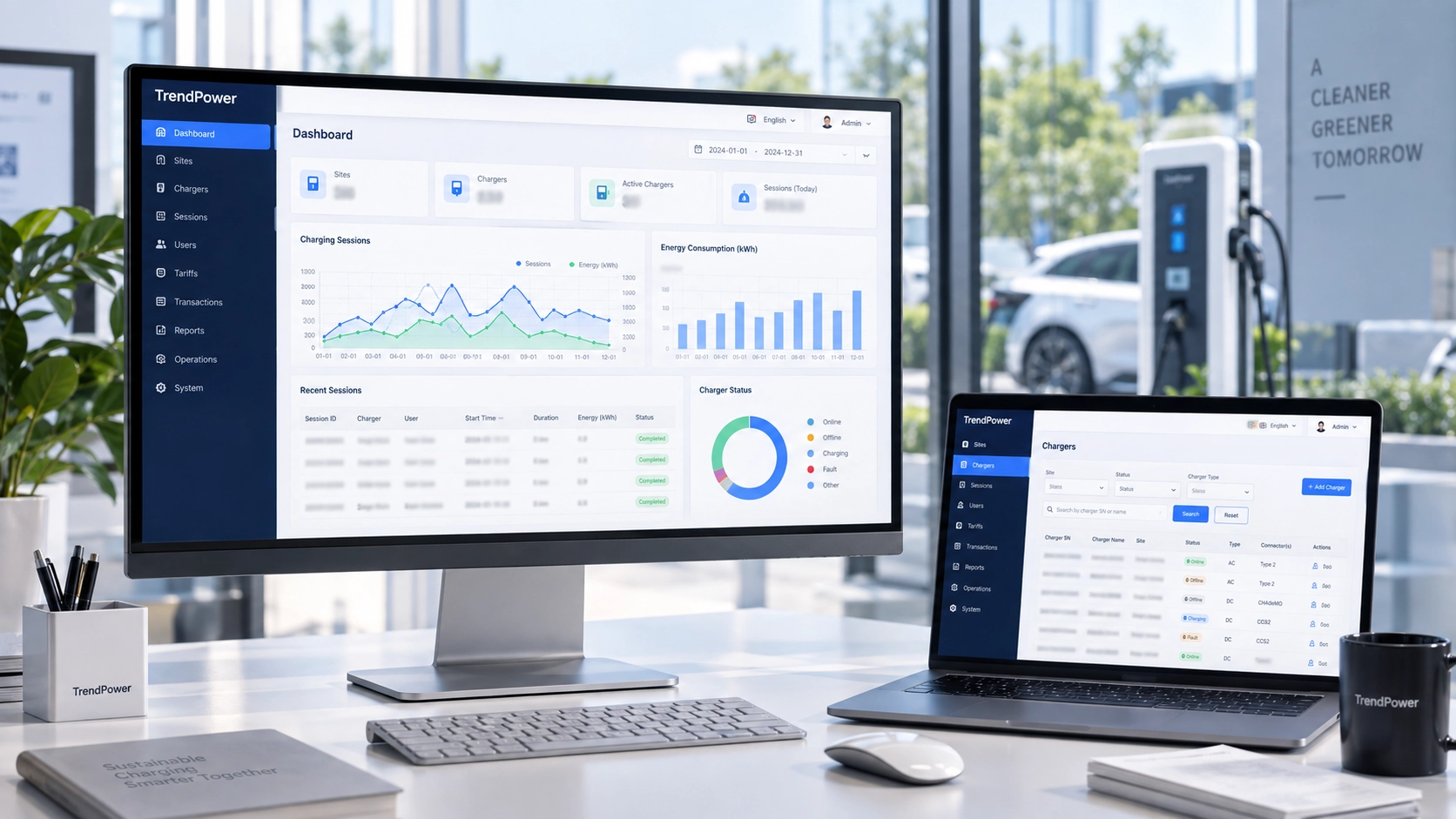
From OCPP connectivity to commercial operation
TrendPower supports OCPP-aligned charger integration together with the workflows required to operate a charging business: device monitoring, users, sessions, flexible tariffs, payments, reporting, partner roles and remote operations.
- OCPP 1.6 and OCPP 2.0.1 integration by project scope
- Mixed-brand and multi-site charger management
- White-label apps and operator portals
- Cloud, private and project-specific deployment paths
- Localization, payment and third-party API integration
Measure whether the charging network is becoming easier to operate
Protocol connectivity is not the final outcome. Once the network is live, track a small set of operational and commercial indicators that reveal reliability, customer friction and support workload.
Define every KPI before using it in supplier reviews. For example, “availability” can produce misleading comparisons if one report excludes communication faults while another includes them. Segment results by charger model, firmware, site and network provider so recurring patterns remain visible.
The best dashboard is not the one with the most charts. It is the one that helps an operator move from an abnormal signal to a responsible owner and a practical next action.
A safer path from charger list to live network
Use a staged process with documented responsibilities and acceptance criteria.
Discover
Map chargers, firmware, sites, users, tariffs, payments, integrations and deployment constraints.
Validate
Connect representative hardware and test the required OCPP messages and business workflows.
Pilot
Run a controlled group under real network conditions, then document supported behavior and exceptions.
Scale
Roll out in batches, monitor operational KPIs and retest after firmware or platform changes.
Already using another backend? Review TrendPower’s EV charging software migration guide before changing endpoints or credentials.
OCPP EV charging software FAQ
What is OCPP EV charging software?
It is a charging management platform that communicates with compatible charge points through the Open Charge Point Protocol. It converts charger messages into operating workflows for device status, sessions, users, tariffs, transactions, diagnostics and reporting.
Does OCPP guarantee compatibility with every charger?
No. OCPP defines a communication standard, but real compatibility depends on the charger model, firmware, implemented message profiles, security configuration and the functions required by the project. Representative hardware should be tested before scale deployment.
Can one platform manage chargers from different manufacturers?
Yes, when the chargers use compatible protocol implementations and pass integration testing. A hardware-agnostic CPMS is designed to create a consistent operating layer across supported brands and sites.
Should a new project use OCPP 1.6 or OCPP 2.0.1?
OCPP 1.6 remains widely deployed and can suit established hardware fleets. OCPP 2.0.1 provides a richer foundation for security, device management and newer capabilities. The right choice depends on charger readiness, required workflows and the project roadmap.
Does the release of OCPP 2.1 make OCPP 2.0.1 obsolete?
No. OCPP 2.1 was released in 2025 and extends OCPP 2.0.1 with additional functionality. Many projects will continue using OCPP 1.6 or 2.0.1 according to charger readiness, certification, required functions and deployment timing. Confirm actual support with both the charger and backend provider.
What should be tested during an OCPP charger pilot?
Test connection stability, authorization, start and stop flows, meter values, status notifications, remote commands, tariffs, offline behavior, reconnect behavior, faults and any charging-profile or firmware workflow required by the project.
Which deployment model is best for an OCPP platform?
There is no universal best model. Managed cloud can reduce infrastructure work, while private-cloud or on-premises deployment can provide additional control for certain enterprise, data or integration requirements. Compare responsibilities, security, recurring cost, upgrade processes and exit arrangements.
Can TrendPower support white-label or private deployment?
TrendPower can support branded customer and operator interfaces, localization, integrations, and cloud or private deployment paths according to project scope. Final architecture and features should be confirmed during requirements review.
Build an OCPP platform around your real charger network
Share your charger models, target market, operating roles and payment requirements. TrendPower can prepare a focused compatibility and platform discussion.
Technical references: Open Charge Alliance — OCPP. Protocol support and feature availability depend on charger capability, firmware, implementation and agreed project scope.

 EN_GB
EN_GB  EN
EN  ZH
ZH  AR
AR  DE
DE  ES
ES  KO
KO  JA
JA  IT
IT  FR
FR  VI
VI  MS
MS  ID
ID  FR_CA
FR_CA  NL
NL  SV
SV  TH
TH 