
EV charging software is the digital layer that connects EV chargers (EVSE) to a centralized platform so an operator can monitor uptime, control access, set prices, process payments, manage energy usage (e.g., load balancing), and generate operational/financial reports—across one site or an entire network. It is commonly described using industry terms such as a charging station management system (CSMS) or charge point management system (CPMS), and it typically sits “above” the charger’s embedded firmware (which runs the hardware locally).
In practice, the category includes (a) EV charging station management software for single-site operators, (b) EV charging network software for multi-site operators and roaming ecosystems, and (c) EV fleet charging software for depots where schedules, vehicle readiness, and power constraints drive most requirements. The most important “must understand” integration is the role of open protocols: OCPP for charger-to-platform communication, and OCPI for roaming/data exchange between operators and mobility providers.
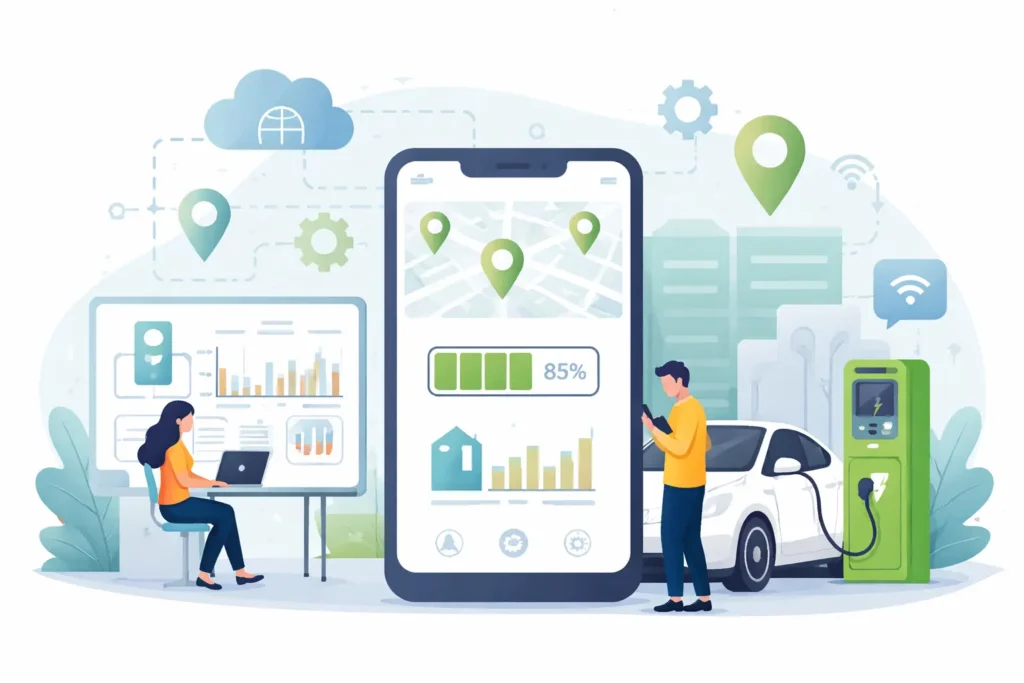
Definition and where it fits in the EV ecosystem
Definition in plain English
“EV charging software” (also written as electric vehicle charging software) is a software system that enables the management, maintenance, and monetization of EV chargers—usually through a back office/operations console, a web portal, and an EV-driver-facing app experience. As one practical definition puts it, EV charging software is a cloud-based management platform that monitors, controls, and optimizes chargers across one or many locations.
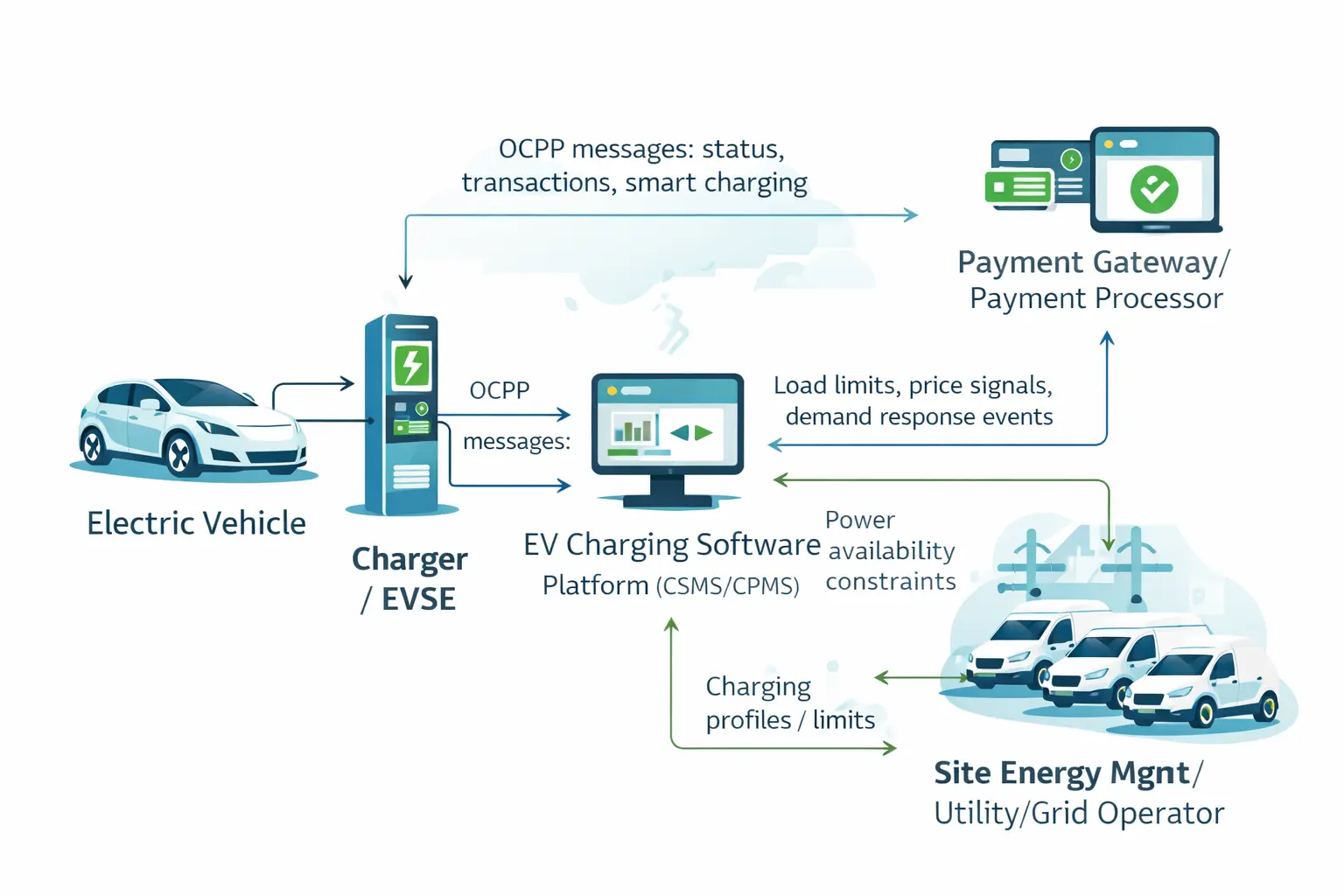
In standards language, the Open Charge Point Protocol (OCPP) describes communication between a charging station and a Charging Station Management System (CSMS)—which is essentially the core operational component of EV charging management software. This is why “EV charging station software” is often used interchangeably with CSMS/CPMS, even though broader “EV charging software and platforms” may also include driver apps, roaming hubs, energy services, and enterprise integrations.
Who uses EV charging management software
EV charging software is used by site hosts (workplaces, retail, parking operators, multifamily), charge point operators (CPOs), fleets, municipalities, and utilities—anyone who must run charging reliably, control access, manage costs, and report on usage. The reason is straightforward: once chargers are networked, operations shift from “install and forget” to continuous EV charging station management (uptime, pricing rules, support, and energy constraints).
Firmware vs platform software
A charger’s firmware is embedded software from the hardware manufacturer that controls the station’s core operation locally. By contrast, a CPMS/CSMS is an overarching platform that connects many chargers and adds operational/commercial functions such as monitoring, pricing, access management, reporting, and optimization—without being the firmware itself. This distinction matters for implementation: software can often be swapped (especially with OCPP), while firmware constraints can limit which protocol versions and features a charger can actually support.
Key modules and features of an EV charging management system
Operations and reliability
At minimum, an EV charging management platform provides provisioning (bringing chargers online), status monitoring, alerts, and remote actions (e.g., resets) to reduce downtime. Modern platforms increasingly lean on OCPP 2.0.1 capabilities such as device management and improved transaction handling, paired with “added security” and smart charging functions—because those features reduce operational blind spots and enable richer remote diagnostics.
From an infrastructure-planning standpoint, authoritative guidance notes that Level 2 EVSE can benefit from “networked charging management solutions” to minimize coincident charging peaks and avoid electrical service upgrades—making reliable, networked operations part of cost control, not just convenience.
Access control and driver authentication
Access control tools determine who can charge, when, and under which rules (employees vs public vs residents vs fleet drivers). Common mechanisms include mobile-app authentication, RFID cards, and guest access flows; driver-facing interfaces are typically integrated into the platform’s operations model and reporting.
Pricing, billing, payments, and settlement
A core monetization module supports tariff configuration (e.g., per kWh, per time, or time-of-day variants), billing/invoicing, and revenue reporting—often with different price books per user group (public vs fleet vs private). A well-known government reference on networked EVSE also describes charging networks as offering payment models such as monthly subscriptions and pay-as-you-go, with benefits including automated payments, access control, station usage analysis, diagnostics, and customer support.
To keep implementation flexible, some platforms explicitly recommend integrating with a payment processor of the operator’s choice so the operator controls “money flow” and can accept payments directly.
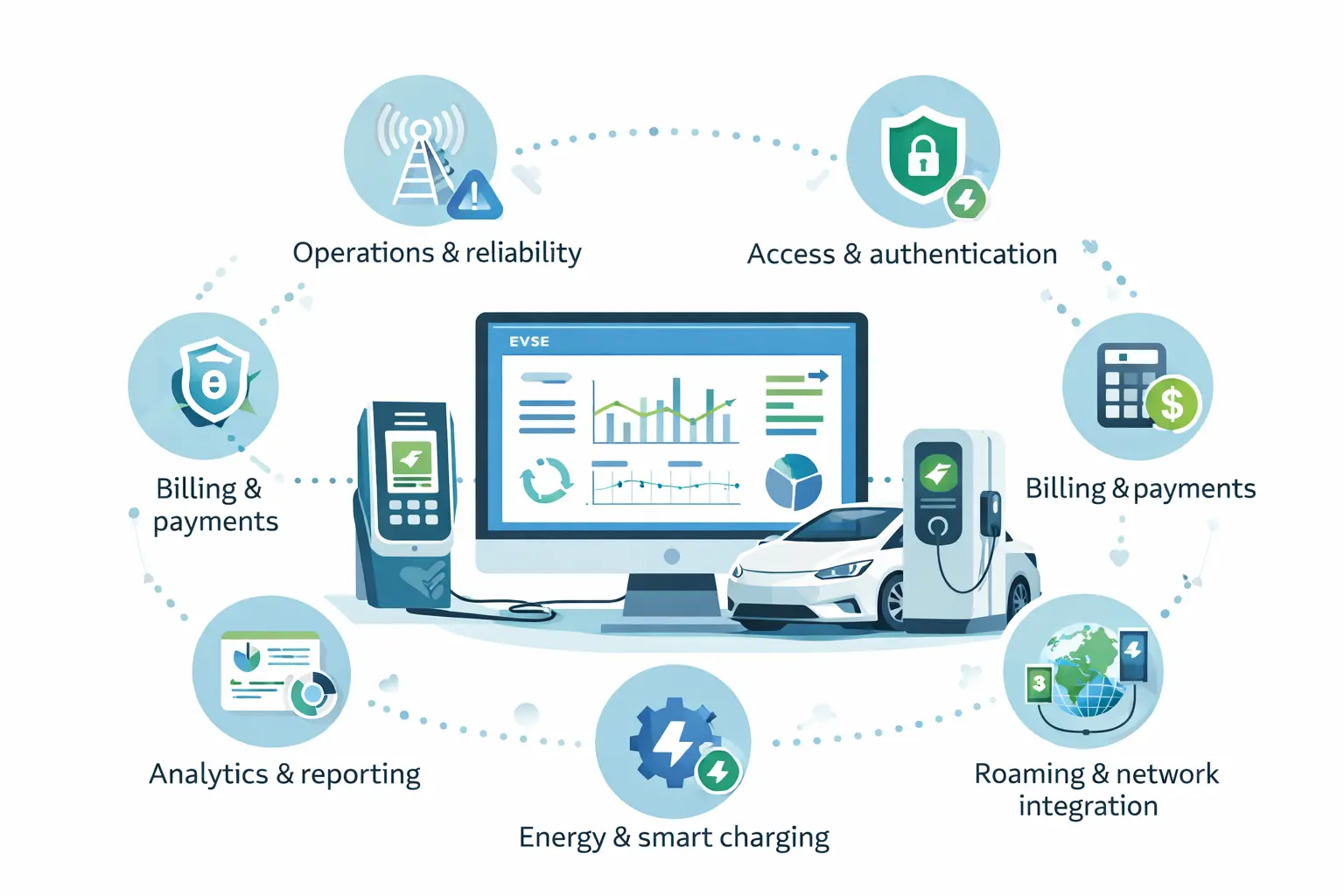
Energy management and smart charging
“Smart charging” generally means controlling when and how power is delivered to EVs to respect site limits, reduce peak costs, and respond to grid/price signals—commonly implemented as dynamic load management/load balancing at a site. Multiple sources emphasize that load management can reduce or avoid expensive electrical upgrades by making better use of existing capacity.
A practical architecture nuance is that not every control loop should live in the cloud: industry reporting highlights that some functions require cloud connectivity (e.g., payment/authentication), while some are best handled on-site (e.g., certain load management decisions).
Roaming and ecosystem connectivity
For public networks, “roaming” is a commercial and technical requirement: EV drivers expect to charge across multiple networks with fewer apps/accounts, while platforms must exchange session/tariff/billing data behind the scenes. This is where OCPI commonly appears—bridging CPOs and eMobility Service Providers (eMSPs) for authorization, session data exchange, and billing via charge detail records (CDRs).
Analytics, reporting, and automation
Reporting typically covers charger availability/health, utilization, energy consumption, and financial outcomes—often delivered as dashboards plus exportable reports that feed BI or finance workflows. Platform vendors also position analytics as a way to automate processes and provide actionable operational insights (including AI-assisted querying in some offerings).
Comparison of station vs network vs fleet solutions
EV charging station management software
EV charging station management is typically “site-first”: a workplace, retail site, parking operator, or multifamily property wants to control access, set pricing, understand utilization, and avoid panel upgrades by sharing available capacity intelligently. In this context, EV charging station software is often judged on day-to-day operability: remote monitoring/alerts, straightforward access policies, and load management that keeps installations within current electrical constraints.
EV charging network software
EV charging network software expands the scope from “one site” to “many sites + partners.” Besides core operations, it typically emphasizes interoperability (hardware flexibility via OCPP), roaming/partner integrations (often via OCPI), centralized pricing strategy, and standardized reporting across regions and business models. Because networks are multi-stakeholder, “system-to-system” reliability (authorization speed, accurate billing, consistent CDRs) becomes a major KPI; the ChargeX OCPI recommendations report explicitly highlights data consistency issues (e.g., CDR variations) as real reliability/scalability challenges for roaming ecosystems.
EV fleet charging software
Fleet electrification changes the optimization target: the goal is “vehicles ready when needed,” under constrained site power and time windows (overnight depot charging, shift handoffs, dispatch schedules). As a result, an EV fleet charging management system usually prioritizes automated charging schedules, energy management to reduce demand charges, and integrations with fleet tools/telematics to align charging with operations.
A useful selection heuristic: if the operator mainly needs “tenant/employee fairness + cost control,” start with station management; if the operator needs “multi-site + roaming + partner settlement,” evaluate network-grade platforms; if the operator needs “vehicle readiness + dispatch constraints,” prioritize fleet-focused scheduling and integrations (even if the same platform can also serve public use).
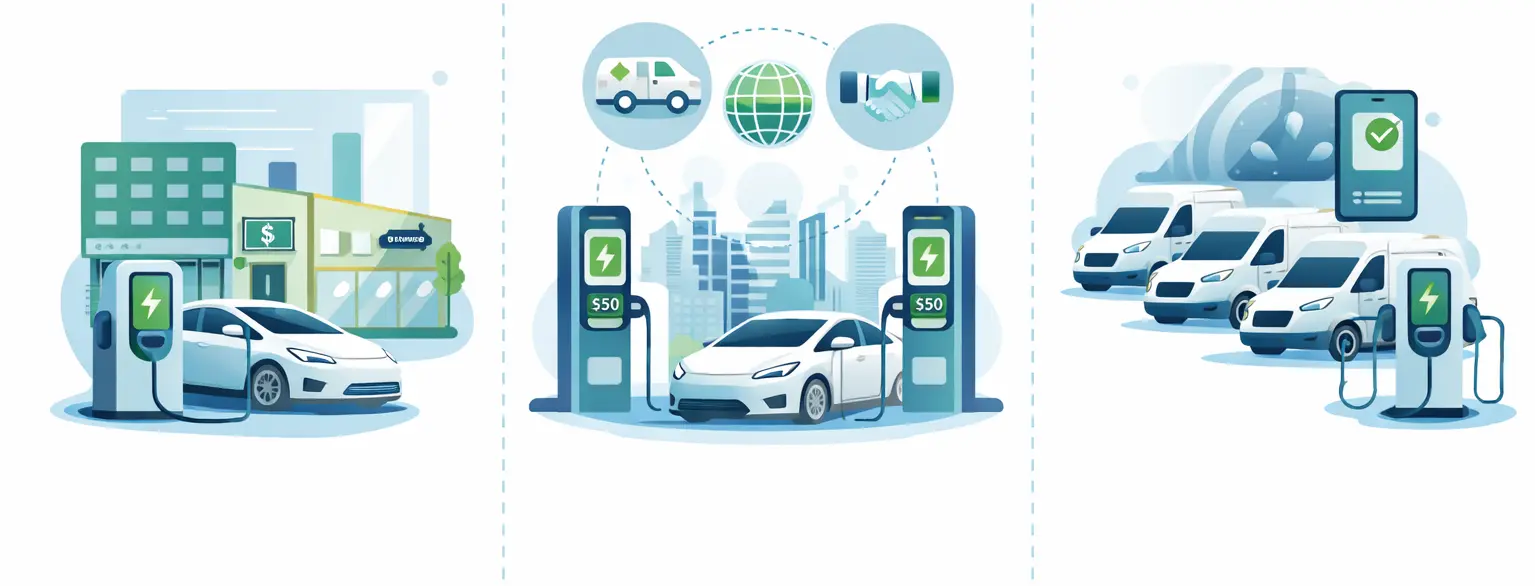
Common integrations, standards, and data flow
OCPP for charger-to-platform communication
OCPP’s goal is to provide a uniform method of communication between charge points and central systems so any central system can connect to any charge point regardless of vendor—reducing vendor lock-in and simplifying multi-hardware deployments. OCPP 2.0.1 is positioned by the standard body as adding/improving device management, transaction handling, security, smart charging functionalities, and support for ISO 15118—features that map directly to modern operational and future “plug-and-charge” requirements.
OCPI for roaming, settlement, and interoperability between market actors
OCPI is described by its standards organization as supporting connections between eMSPs (who serve EV drivers) and CPOs (who operate stations), and it can be implemented bilaterally or through roaming hubs. The ChargeX OCPI recommendations report further explains OCPI’s role in authorization, session data exchange, and billing through CDRs—and notes ongoing version evolution targeting improved compliance and ecosystem needs.
ISO 15118 and Plug & Charge
Plug & Charge relies on ISO 15118 authentication and a certificate ecosystem; CharIN’s implementation guide describes ISO 15118 as the technical basis for Plug & Charge authentication and discusses certificate management/provisioning processes. In payments contexts, EMVCo describes a model where a driver links a payment card to the EV to create an ISO 15118 mobility operator charging contract certificate that is stored in the vehicle and used for Plug and Charge.
Payments, enterprise systems, and grid/utility interfaces
Practical deployments commonly integrate with payment rails (card readers, digital wallets, kiosks), and may export data or connect APIs to parking systems, fleet systems, billing/CRM, and reporting tools. On the energy side, platforms increasingly describe interfaces for demand response and grid/operator coordination—for example, participating in demand response programs and exchanging data with utilities/grid operators (often via standards such as OpenADR).

 EN
EN  ZH
ZH  AR
AR  DE
DE  ES
ES  KO
KO  JA
JA  IT
IT  FR
FR  VI
VI  MS
MS  ID
ID  FR_CA
FR_CA  NL
NL  SV
SV  EN_GB
EN_GB  TH
TH