
คำตอบด่วน
Charging point management systems are software platforms that help EV charging operators monitor, control, bill, maintain, and optimize charging stations from one centralized dashboard. A modern system connects chargers, users, payments, mobile apps, energy management tools, and revenue analytics so operators can run scalable, reliable, and profitable EV charging networks.
ระบบจัดการจุดชาร์จไฟคืออะไร?
Charging point management systems are the digital control centers behind modern EV charging networks. They connect physical charging stations to a cloud-based or locally deployed software platform, allowing operators to monitor charger status, manage users, configure pricing, process payments, track revenue, troubleshoot devices, and optimize power usage across multiple sites.
In simple terms, chargers deliver energy, but charging point management systems make the business work.
Without a reliable management platform, an EV charging network can quickly become difficult to operate. Operators may struggle with offline chargers, unclear billing records, slow maintenance response, inconsistent pricing, poor user experience, and limited visibility into revenue performance. With the right system, every charging point becomes a connected, measurable, and revenue-generating asset.
The need for intelligent management is growing quickly. According to the International Energy Agency, public chargers worldwide have doubled since 2022 and reached more than 5 million, making software-based monitoring, billing, and energy optimization increasingly important for large-scale EV infrastructure.
เหตุใดระบบจัดการจุดชาร์จจึงมีความสำคัญ
EV charging is no longer just about installing hardware. For charge point operators, property owners, fleet managers, equipment manufacturers, and energy companies, success depends on how well the network is managed after deployment.
A charging point management system helps operators answer critical daily questions:
| Operator Question | How the System Helps |
|---|---|
| Which chargers are online, offline, or faulty? | การตรวจสอบและการแจ้งเตือนแบบเรียลไทม์ |
| Who is using each charger? | User authentication and account management |
| How much revenue is each site generating? | Revenue reports and order analytics |
| How should pricing be adjusted? | Flexible billing and tariff rules |
| Can power be distributed more efficiently? | การชาร์จอัจฉริยะและการจัดการโหลด |
| Can partners, agents, and site owners share revenue automatically? | Commission and revenue-sharing tools |
| Can users find, reserve, and pay for charging easily? | Mobile app, QR code, wallet, and payment integration |
| Can the platform scale to multiple regions or business models? | Multi-site, multi-role, and localized deployment |
This is why a modern EV charging business needs more than a charger. It needs a connected operations platform.
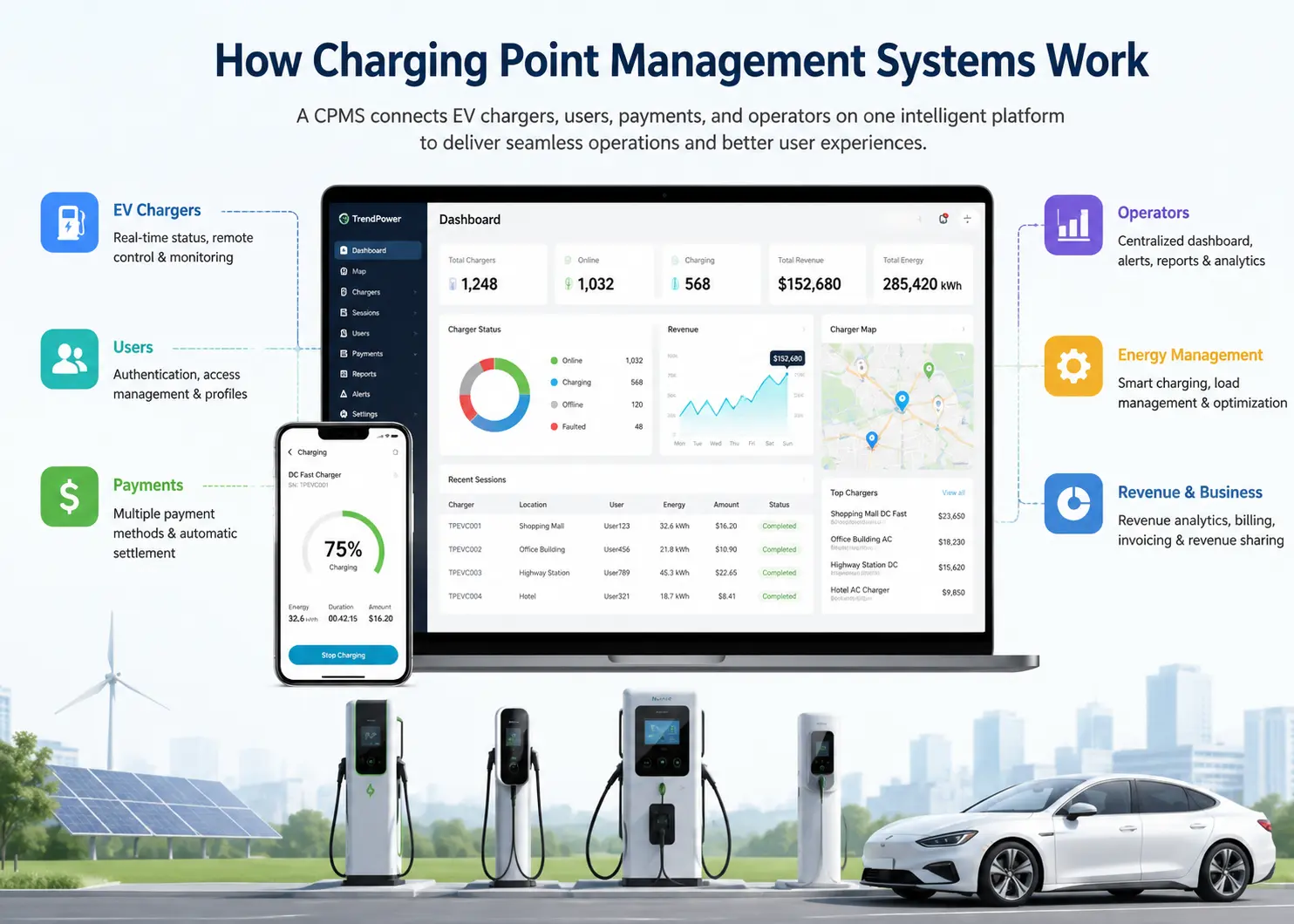 How Charging Point Management Systems Work
A charging point management system works by connecting EV chargers, user apps, payment systems, operator dashboards, and energy management tools into one coordinated platform.
The typical workflow looks like this:
- The EV charger connects to the platform through a communication protocol such as OCPP.
- The driver starts a charging session using a mobile app, RFID card, QR code, plug-and-charge function, or another authentication method.
- The system verifies the user, checks pricing rules, and authorizes the session.
- Charging data is transmitted in real time, including power output, energy consumption, session duration, port status, and error codes.
- Billing is calculated automatically based on time, energy, power, service fees, membership plans, or custom tariff rules.
- Operators monitor performance through dashboards, alerts, reports, and analytics.
- Maintenance teams troubleshoot remotely, update firmware, adjust parameters, and restart devices when needed.
- Revenue is tracked and distributed among operators, agents, site owners, or business partners based on predefined rules.
The result is a fully connected charging operation where both the technical side and the commercial side are managed from one platform.
Core Features of a Modern Charging Point Management System
1. การตรวจสอบสถานะการชาร์จแบบเรียลไทม์
Real-time monitoring gives operators instant visibility into every charging station, connector, and session. Instead of waiting for user complaints, operators can see whether a charger is available, occupied, offline, faulted, or under maintenance.
A strong monitoring dashboard should show charger status, port-level data, current power output, voltage, charging duration, energy delivered, fault codes, connectivity logs, and station utilization.
This improves uptime, reduces maintenance delays, and helps operators build a more reliable charging network.
2. Device Management and Remote Debugging
Device management is one of the most important features of charging point management systems. Operators need to add chargers, bind QR codes, configure parameters, update firmware, view communication packets, manage pricing rules, and remove or replace devices across different locations.
TrendPower’s platform highlights batch operations, QR code binding, firmware upgrades, remote debugging, communication logs, connectivity records, and real-time pricing rule management as part of its EV charging point management capabilities.
Remote debugging is especially valuable because it reduces on-site maintenance costs. When a charger has a communication issue, port error, or configuration problem, the operations team can often diagnose and resolve it from the management platform instead of sending technicians immediately.
3. Flexible Billing and Pricing Management
A charging business must support different pricing models for different sites, users, and operating strategies. A good charging point management system should support flexible billing methods such as:
| รูปแบบการเรียกเก็บเงิน | Common Use Case |
|---|---|
| การกำหนดราคาตามพลังงาน | Charging by kWh |
| การกำหนดราคาตามเวลา | Parking lots, destination charging, idle fee control |
| Power-based pricing | High-power charging and commercial sites |
| Service fee pricing | Operator margin and platform fee |
| การคิดราคาตามช่วงเวลาการใช้งาน | Peak and off-peak electricity optimization |
| ราคาค่าสมาชิก | Monthly users, residents, fleets, and VIP customers |
| ราคาโปรโมชั่น | Coupons, rewards, and marketing campaigns |
TrendPower’s current page emphasizes customizable time-of-use tariffs, service fees, and multiple billing methods, including charging by time, energy, or power.
This flexibility allows operators to adapt pricing by location, electricity cost, customer segment, charger type, and business goal.
4. Automated Payment Processing
Payment convenience directly affects user adoption. A charging point management system should support secure and localized payment options such as credit cards, debit cards, mobile wallets, RFID cards, QR code payments, stored balances, subscriptions, and third-party payment gateways.
Automated payment processing reduces manual reconciliation, improves cash flow, and creates a better driver experience. Operators can track every transaction, refund, invoice, recharge amount, and payment channel from the backend.
For global operators, localized payment integration is especially important because user payment habits vary by country and region.
5. User Management and Access Control
Not every charging station should be available to every user. A residential charger may be limited to residents. A workplace charger may be available only to employees. A fleet charger may be restricted to approved vehicles. A public charger may support open access but apply different pricing rules for members and guests.
Charging point management systems solve this with user management and access control.
Operators can create user groups, assign permissions, manage accounts, issue RFID cards, approve partners, define private or public access, and track user behavior. This is essential for apartments, office buildings, hotels, commercial parking lots, fleets, and semi-public charging networks.
6. Smart Charging and Load Management
As charging networks grow, electricity capacity becomes a major challenge. Installing more chargers does not always mean a site has enough power to run all of them at full capacity at the same time.
Smart charging and load management help distribute available power intelligently. The system can reduce output during peak demand, prioritize certain users or vehicles, balance power across chargers, schedule charging during off-peak hours, and integrate with solar, battery storage, or building energy systems.
This reduces grid pressure, helps avoid costly electrical upgrades, and improves site-level energy efficiency.
OpenADR is one relevant standard in this area. The OpenADR Alliance describes OpenADR as an open, secure, two-way information exchange model and smart grid standard designed to standardize and simplify demand response and distributed energy resource management.
7. Revenue Reports and Business Analytics
A charging network is a business asset, and operators need clear financial data. A strong charging point management system should include revenue analytics such as daily, weekly, monthly, quarterly, and annual turnover, revenue ranking, order statistics, recharge amount analysis, payment type analysis, utilization rate, and site-level performance.
TrendPower’s platform already positions revenue reports as a core feature, including turnover statistics, revenue ranking, order count statistics, recharge amount analysis, and payment type insights.
These insights help operators answer important business questions:
- Which locations generate the most revenue?
- ที่ชาร์จแบบไหนบ้างที่ใช้งานน้อย?
- Which payment methods are most popular?
- Which pricing strategy performs best?
- Which partners or agents contribute the most transactions?
- When should the operator expand capacity?
Data turns charging operations from guesswork into measurable growth.
8. Marketing and User Retention Tools
Many charging point operators focus on deployment but overlook user retention. A modern platform should help operators attract, activate, and retain users through marketing tools.
Useful features include welcome vouchers, recharge rewards, monthly subscription plans, membership levels, referral campaigns, group charging offers, coupons, and merchant promotions.
TrendPower’s current page highlights marketing management tools such as welcome vouchers, group charging campaigns, recharge rewards, monthly subscription plans, and tiered membership programs.
This is especially powerful for commercial charging sites near shopping centers, restaurants, hotels, offices, and business districts. Charging becomes more than an energy service—it becomes a traffic engine.
9. Commission and Revenue Sharing
Many EV charging networks involve multiple stakeholders: operators, agents, site owners, property managers, installers, service providers, and sales partners. Manually calculating each party’s share can become complicated as the network grows.
A charging point management system can automate commission management and revenue sharing. The platform calculates earnings based on predefined ratios, displays real-time income, and supports transparent settlement among different parties.
TrendPower’s page describes a five-party operational framework connecting operators, agents, site hosts, service providers, and EV users, as well as automated commission calculation and revenue sharing.
This is a major advantage for operators building channel-based, franchise-based, or multi-partner EV charging businesses.
10. Mobile App Experience for EV Drivers
The driver-facing mobile app is where the charging experience happens. A good app should help users find chargers, view availability, navigate to stations, scan QR codes, start and stop sessions, schedule charging, pay quickly, check charging progress, receive notifications, and access customer support.
TrendPower’s mobile-end feature showcase includes quick charger finding, scheduled charging, quick payment, and owner service functions.
For operators, the mobile app is also a data channel. It helps analyze user behavior, charging habits, location preferences, retention patterns, and promotional performance.
Key Protocols and Standards for Charging Point Management Systems
Interoperability is one of the most important topics in EV charging. Operators should avoid being locked into a single hardware brand or closed ecosystem. This is why open standards matter.
| มาตรฐาน | มันทำอะไรได้บ้าง | เหตุใดจึงสำคัญ |
|---|---|---|
| โอซีพีพี | Connects chargers with central management systems | Enables hardware-software interoperability |
| ไอโอเอส 15118 | Supports communication between EVs and charging equipment | Enables Plug & Charge, smart charging, and vehicle-to-grid functions |
| โอซีพีไอ | Connects charge point operators and e-mobility service providers | Supports roaming, authorization, tariffs, and billing between networks |
| OpenADR | Connects energy systems for demand response | Helps charging networks respond to grid and energy signals |
| Cybersecurity frameworks | Guide secure deployment and risk management | Protects users, payments, data, and infrastructure |
The Open Charge Alliance describes OCPP as a protocol designed to provide a uniform method of communication between charge points and central systems, making it possible to connect central systems with charge points regardless of vendor.
OCPP 2.0.1 adds or improves functionality such as device management, transaction handling, security, smart charging, ISO 15118 support, and display messaging support.
ISO 15118 focuses on communication between the electric vehicle communication controller and the supply equipment communication controller, enabling IP-based communication between the EV and the charging equipment.
OCPI supports connections between mobility service providers and charge point operators, enabling roaming and data exchange across networks.
For cybersecurity, NIST has published a cybersecurity framework profile for EV extreme fast charging infrastructure to help industry members apply risk-based controls across EVs, charging systems, cloud operations, and utility or building networks.
ใครบ้างที่ต้องการระบบจัดการจุดชาร์จไฟ?
ผู้ให้บริการจุดชาร์จ
CPOs need charging point management systems to operate networks at scale. The platform helps them control pricing, monitor uptime, manage users, process payments, analyze revenue, and expand across multiple locations.
Charging Equipment Manufacturers
Manufacturers can use a management platform to offer a complete hardware-plus-software solution. This increases product value and helps customers deploy chargers faster.
Property Owners and Commercial Real Estate Operators
Shopping malls, parking lots, hotels, office buildings, and mixed-use developments can use charging software to manage access, billing, user experience, and revenue from charging services.
Apartment and Shared Residential Communities
Residential charging requires user permissions, fair billing, private access, load management, and transparent settlement. A management platform makes shared charging easier for residents and property managers.
ผู้ประกอบการขนส่ง
Fleet charging requires scheduling, vehicle prioritization, energy tracking, charging history, cost allocation, and charger reliability. A CPMS helps fleets reduce downtime and improve operational efficiency.
Municipalities and Public Charging Networks
Public sector charging projects need transparency, reporting, uptime monitoring, payment accessibility, and long-term scalability.
Energy Companies and PV-ESS-Charging Projects
For sites combining solar PV, energy storage, and EV charging, the management system becomes the bridge between charging demand, electricity cost, renewable generation, and energy optimization.
Main Benefits of Charging Point Management Systems
Higher Charger Uptime
Real-time monitoring, alerts, remote diagnostics, and firmware management help operators detect issues early and reduce downtime.
Lower Operating Costs
Remote troubleshooting, automated billing, digital reporting, and batch device management reduce manual work and on-site maintenance.
Better User Experience
Mobile apps, quick payments, charger availability, scheduled charging, and transparent pricing make EV charging more convenient for drivers.
More Revenue Opportunities
Dynamic pricing, subscriptions, loyalty programs, merchant integration, and commission structures help operators create multiple revenue streams.
Smarter Energy Use
Load management and smart charging help operators reduce peak demand, avoid grid constraints, and make better use of available capacity.
Easier Network Expansion
A scalable platform allows operators to manage more chargers, more locations, more users, and more partners without rebuilding the entire system.
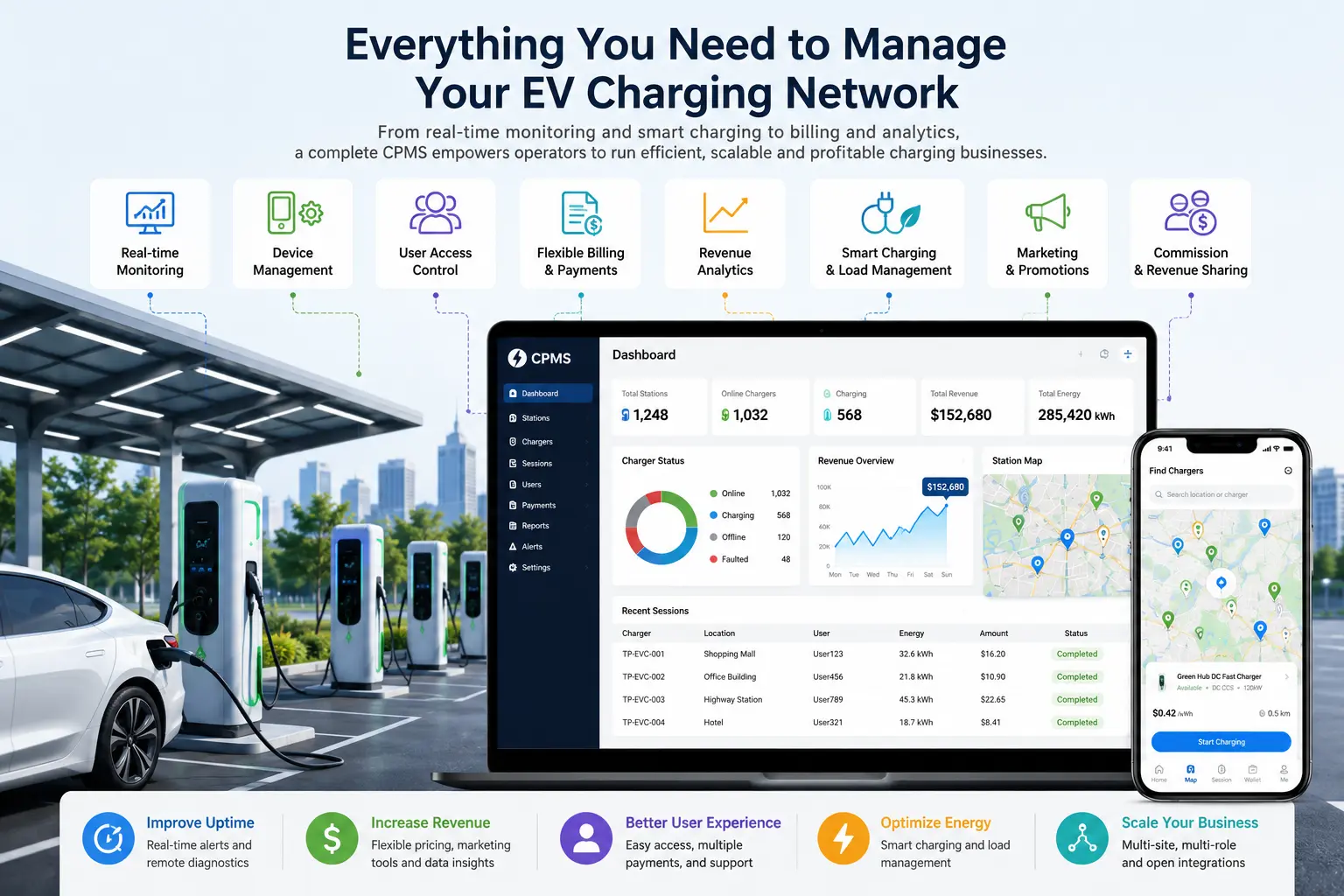 วิธีเลือกใช้ระบบจัดการจุดชาร์จที่เหมาะสม
When selecting a charging point management system, operators should evaluate both technical and commercial requirements.
A strong platform should offer:
- ความเข้ากันได้กับ OCPP
- การตรวจสอบการชาร์จแบบเรียลไทม์
- Remote start, stop, restart, and diagnostics
- Flexible billing and pricing rules
- Multiple payment integrations
- User, role, and permission management
- การชาร์จอัจฉริยะและการจัดการโหลด
- Revenue reporting and analytics
- Marketing and membership tools
- Commission and revenue-sharing automation
- Mobile app or H5 app support
- การผสานรวม API
- Third-party hardware compatibility
- Localized payment, language, and deployment options
- Cybersecurity controls
- สถาปัตยกรรมที่ปรับขนาดได้
- Professional deployment and maintenance support
Operators should also consider whether the system supports cloud deployment, private deployment, or on-premises deployment. TrendPower highlights on-premises deployment, third-party device integration, joint debugging, deployment and maintenance services, and upstream/downstream partnership matching as part of its technology and service offering.
Why TrendPower for EV Charging Point Management Systems?
เทรนด์พาวเวอร์ provides a commercially scalable and localized EV charging management platform for charging equipment manufacturers, operators, and related enterprises worldwide. Its EV Charging Point Management System is designed to help businesses move from basic charger operation to intelligent, data-driven, and revenue-focused network management.
With TrendPower, operators can manage multiple charging stations from one platform, monitor real-time performance, configure flexible billing, automate revenue sharing, support mobile users, integrate third-party devices, and scale across different business models.
The platform is especially suitable for:
- EV charging operators
- Charging equipment manufacturers
- ผู้ให้บริการที่จอดรถ
- เจ้าของอสังหาริมทรัพย์เชิงพาณิชย์
- Shared residential charging projects
- Fleet charging networks
- Localized EV charging businesses
- PV-ESS-charging integrated projects
- Multi-partner charging ecosystems
From charging to revenue, a strong management system helps turn EV infrastructure into a sustainable business.
บทสรุป
Charging point management systems are the foundation of modern EV charging operations. As charging networks grow, operators need more than hardware—they need software that connects chargers, users, payments, energy, maintenance, analytics, and business partners into one intelligent platform.
A well-designed system improves uptime, simplifies billing, reduces operating costs, enhances user experience, enables smart energy management, and creates new revenue opportunities.
For businesses planning to build, upgrade, or scale an EV charging network, choosing the right charging point management system is one of the most important decisions. With a flexible, scalable, and commercially focused platform, TrendPower helps operators manage charging infrastructure more efficiently and grow with confidence.
เอกสารอ้างอิง
- Open Charge Alliance — Open Charge Point Protocol (OCPP)
- Open Charge Alliance — OCPP Protocol Versions
- EVRoaming Foundation — Open Charge Point Interface (OCPI)
- OpenADR Alliance — Demand Response and Distributed Energy Resource Standard
- สำนักงานพลังงานระหว่างประเทศ — แนวโน้มรถยนต์ไฟฟ้าทั่วโลกปี 2025: การชาร์จรถยนต์ไฟฟ้า
- NIST — Cybersecurity Framework Profile for EV Extreme Fast Charging Infrastructure
- Joint Office of Energy and Transportation — Cybersecurity for EV Charging Infrastructure
- Joint Office of Energy and Transportation — SAE J3400 Charging Connector
ติดต่อเรา
อย่าเพิ่งเชื่อคำพูดของเรา
ลองใช้ฟรีได้เลยตอนนี้
FAQs About Charging Point Management Systems
Find answers to common questions about charging point management systems, from real-time charger monitoring and flexible billing to OCPP compatibility, remote control, user management, and revenue optimization for EV charging operators.
A charging point management system is a software platform that helps operators monitor, control, bill, maintain, and optimize EV charging stations from a centralized dashboard.
It connects EV chargers to a backend platform through communication protocols such as OCPP. Operators can then manage charging sessions, users, payments, pricing, devices, energy usage, and reports in real time.
Important features include real-time monitoring, device management, remote debugging, user management, flexible billing, payment integration, smart charging, revenue reports, mobile apps, API integration, and cybersecurity controls.
OCPP enables communication between charging stations and central management systems. It helps operators avoid vendor lock-in and integrate chargers from different manufacturers.
Yes. A modern system can support billing by energy, time, power, service fees, memberships, subscriptions, dynamic pricing, and time-of-use tariffs.
Yes. Operators can remotely start, stop, restart, configure, monitor, update, and troubleshoot chargers through the management platform.
Yes. Fleet operators can use the system to schedule charging, prioritize vehicles, monitor energy use, reduce downtime, and track charging costs across vehicles and locations
They help increase revenue through dynamic pricing, automated payments, subscriptions, marketing campaigns, membership programs, merchant partnerships, analytics, and automated commission sharing.
Yes. A strong system should support third-party device integration, especially through open standards such as OCPP.
Yes. TrendPower’s system is designed for scalable EV charging operations, supporting multi-role access, multi-site management, flexible billing, mobile apps, revenue analytics, device management, and partner-based operating models.

 TH
TH  EN
EN  ZH
ZH  AR
AR  DE
DE  ES
ES  KO
KO  JA
JA  IT
IT  FR
FR  VI
VI  MS
MS  ID
ID  FR_CA
FR_CA  NL
NL  SV
SV  EN_GB
EN_GB