
 Arabic
 English (United States)
 Chinese
 German
 Spanish
 Korean
 Japanese
 Italian
 French (France)
 Vietnamese
 Malay
 Indonesian
 French (Canada)
 Dutch
 Swedish
 English (UK)
 Thai
Fleet charging billing should connect every charging session to an authorized vehicle, the correct enterprise account, and a reproducible price calculation. For electric truck operators, that means linking vehicle identity, metered energy, tariffs, and settlement before a driver reaches the charger—not reconstructing those relationships from receipts at month-end.
A fleet may have reliable chargers yet still struggle with expenses. Drivers advance payments, finance teams chase invoices, and managers cannot explain why two trucks on similar routes have different charging costs. The solution starts with the account model and transaction records behind each session.
This guide explains how to organize VIN-linked accounts, enterprise wallets, charging cost allocation, and reconciliation. It draws on TrendPower’s Licanghang logistics project and turns those operating requirements into practical questions for fleet managers and software buyers.
What the Licanghang Project Reveals About Fleet Billing
In Q3 2026, TrendPower partnered with Licanghang, a Shenzhen logistics company and strategic supplier to Fortune Global 500 businesses, to develop an electric truck charging operations platform. Licanghang had introduced 75 battery-electric tractor units during its green transition and subsequently operated nearly 100 electric heavy-duty trucks.
The project’s central requirement was a three-level enterprise–fleet–VIN account structure. Drivers needed a straightforward charging experience, while managers needed centralized payments and visibility into individual vehicles’ energy use. The software therefore had to connect charging authorization with financial ownership.
Read the Licanghang electric truck charging platform case study for the project background. The broader lesson is useful beyond that installation: define who may charge, who pays, and which record proves the transaction before scaling a fleet.
Build Enterprise, Fleet, and Vehicle Accounts First
Vehicle accounts and driver accounts solve different problems. A driver may change trucks during a shift; a truck may serve several drivers during a week. Using the driver’s login as the only cost reference can make vehicle-level reporting unreliable.
Start with an enterprise account that owns the commercial agreement and funding arrangement. Place fleet groups beneath it for departments, depots, or operating businesses. Link each vehicle’s VIN and internal asset number to the appropriate fleet, with a recorded effective date for transfers.
| Level | Primary responsibility | Typical record |
|---|---|---|
| Enterprise | Commercial terms, funding, consolidated settlement | Paying entity and account owner |
| أسطول | Operational grouping and cost allocation | Depot, business unit, or fleet manager |
| عربة | Authorization and session attribution | VIN, asset ID, assigned fleet |
| السائق | Access permissions and operational actions | User identity and current assignment |
Keep historical ownership intact when a truck moves between fleets. Reassigning today’s vehicle profile should not silently move last month’s expenses into a different department. Ask vendors to demonstrate an account transfer and then regenerate the earlier report.
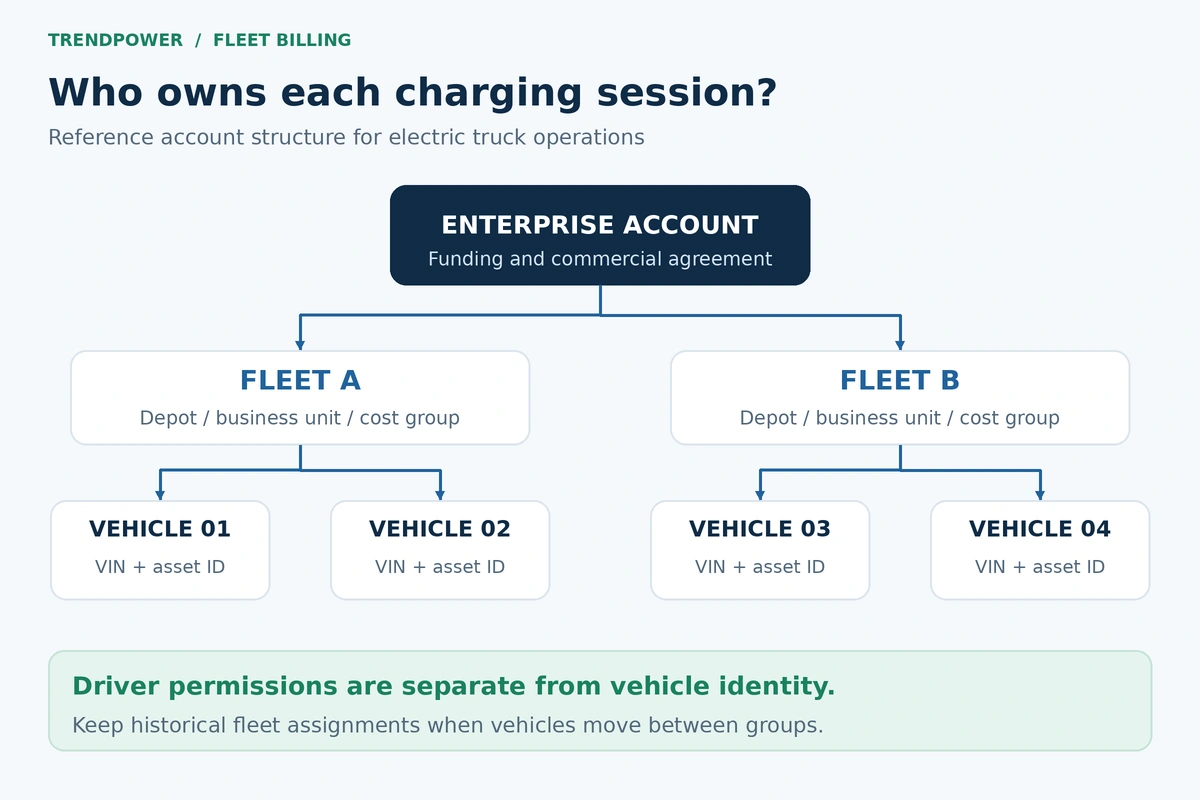
This structure is a useful starting point when evaluating a نظام إدارة أسطول شحن الشاحنات الثقيلة. The requirement is clear financial and operational responsibility, rather than simply having more levels in a dashboard.
Connect VIN-Based Authorization to the Paying Account
A VIN identifies a vehicle in the fleet database. Whether the charger can recognize that vehicle automatically depends on the truck, charger, firmware, and implemented integration. A VIN field in software alone does not establish automatic authentication.
For an approved combination, the workflow should identify the vehicle, locate its active fleet account, check authorization, apply the agreed tariff, and record the session against the correct account. Decide what happens when identification fails: deny the session, request an approved fallback credential, or route the issue to support.

Also distinguish VIN-linked fleet workflows from certificate-based ISO 15118 Plug & Charge. The Open Charge Alliance’s ISO 15118 guidance explains that OCPP 1.6 does not natively support ISO 15118 messages and describes an intermediate implementation approach. Similar driver experiences can therefore involve different technical arrangements.
During acceptance testing, use an authorized truck, a suspended truck, and an unregistered vehicle. Confirm that every successful session reaches the intended payer and that rejected attempts generate a useful reason. Test authorization again after a vehicle changes fleet or its account is suspended.
Choose an Enterprise Wallet or Credit Arrangement
An enterprise fleet wallet replaces scattered driver payments with centrally managed funds. Finance tops up the agreed account, and charging expenses are assigned to the relevant vehicles and fleets. This can remove routine reimbursement work without requiring every fleet group to maintain a separate external payment relationship.
Credit-based monthly settlement serves a different commercial arrangement. Charging is accumulated against an approved account and settled later under agreed terms. The software should reflect that agreement, including credit limits, due dates, and the behavior when an account exceeds its limit.
Clarify whether fleet balances represent actual separate funds or internal spending allocations. Otherwise, transfers between subaccounts may be mistaken for new revenue or additional charging expenditure. Top-ups, charging charges, refunds, and allocation changes should remain distinguishable in the ledger.
Set responsibilities for limit changes and exceptional approvals. A dispatcher may need to resolve a charging access problem without permission to alter company funding. These controls belong in the platform’s charging payment and settlement workflow, with a record of who changed what and when.
Make Every Charging Price Reproducible
Fleet agreements may include energy charges, service fees, time-based charges, or site-specific pricing. Record each component separately so finance can explain the final amount. Define whether a price includes tax and how rounding is applied under the commercial arrangement.
Store the tariff version used for the session. If a contract changes next month, the earlier order should still reproduce its original price. Where tariffs change during a session, specify whether the start-time rate applies throughout or usage is allocated across pricing periods.
Consider a simplified example: a truck receives 180 kWh at $0.20 per kWh, plus a $3 session fee. The pre-tax total is $39, and the effective billed cost is approximately $0.217 per kWh. These are illustrative values, not Licanghang prices or projected savings.
A report showing only the $0.20 energy rate would miss the session fee. Conversely, combining all charges into one unexplained number makes comparisons difficult. Display both component charges and the total attributable to the vehicle.
Reconcile the Session, Order, and Payment Records
Fleet charging reconciliation works best when three records remain linked: the charger’s session record, the platform’s priced order, and the associated ledger or payment transaction. Each should have a stable identifier, and the links should remain available in exported reports.
At minimum, retain the charging point and connector, transaction ID, vehicle identity, fleet account, start and end times, metered energy, tariff version, amount, and settlement status. Use consistent time-zone handling so a session near midnight does not fall into different accounting periods across systems.

A useful month-end workflow has four steps:
- Gather completed sessions: separate ongoing and incomplete transactions from the period being closed.
- Match and price: connect each session to its account and reproduce the applicable tariff calculation.
- Resolve exceptions: review missing meter values, duplicate records, unknown vehicles, and unmatched deductions.
- Close and export: approve the statement, retain its version, and pass the agreed fields to finance.
Network interruptions deserve explicit testing. A charger may resend a transaction after reconnecting; the platform should recognize the existing record instead of creating a second charge. Likewise, a late session update should follow a defined correction process after a statement has closed.
Refunds should reference the original order and preserve the reason, approval, and amount. Deleting an incorrect transaction removes the evidence finance needs to explain the adjustment. Ask to see an exported exception report, not only a dashboard total.
Handle Shared Sites and External Charging Separately
A logistics company may charge its own trucks at a depot, use a partner’s station along a route, and admit another fleet to spare charging capacity. These arrangements can share infrastructure while requiring different commercial records.
For an owned depot, internal cost allocation is not necessarily a sale to an external customer. For a partner station, the fleet may receive a supplier invoice whose session references need to match its own vehicle records. For an external fleet using the depot, the operator needs the correct customer agreement and billing responsibility.
Keep those relationships explicit rather than applying one wallet rule to every session. Ask whether the platform can distinguish the infrastructure owner, station operator, fleet account, and paying entity. The same vehicle identifier can remain useful across sites, but the applicable tariff and settlement path may change.
For example, if a truck charges away from its home depot, its cost should remain attached to its assigned fleet while the station reference identifies the supplying location. That distinction lets finance analyze expenses by vehicle without losing the supplier information needed for reconciliation.
Build a process for charging outside the connected network as well. Define which records are required for manual claims and how those expenses are reported, so managers do not mistake the platform’s connected-session total for the fleet’s complete charging expenditure.
Measure Vehicle Costs Without Confusing Energy Metrics
The first useful report is often simple: energy delivered and total billed cost by vehicle, fleet, site, and reporting period. It shows where money went and which transactions need attention. More detailed analysis becomes useful only when the underlying records are complete.
Track the proportion of sessions with a valid vehicle assignment and the number of unresolved reconciliation exceptions. A polished cost chart is less valuable if a meaningful share of its sessions remains assigned to an unknown truck.
Effective billed cost per kWh equals the included charging charges divided by the corresponding metered energy. State which charges the calculation includes. Keep parking or unrelated expenses separate unless the report intentionally measures the full cost of a charging visit.
Cost per kilometer also needs reliable mileage and an appropriate reporting window. Charger-delivered energy is not automatically equal to battery consumption while driving. Route, payload, temperature, auxiliary use, and charging losses can affect comparisons, so investigate differences before assigning them to driver behavior.
For a broader network example, the Longqi Power charging platform case study shows why vehicle, station, and fleet information need to work together.
Pilot the Complete Billing Cycle Before Expanding
Use a representative group of vehicles, chargers, drivers, and fleet accounts for the pilot. Include more than one tariff or site if those differences matter in production. A single successful plug-in session does not test the complete billing operation.
Run a normal charging session, an unauthorized attempt, an interrupted session, a low-balance condition, a refund, and a vehicle reassignment. Confirm the driver-facing result, operator record, account movement, and final export for each scenario.
Define whether a low balance prevents a new session or affects one already underway. Agree on that behavior before implementation, and make sure the driver receives a clear message rather than an unexplained failure at the connector.
Close a sample billing period with finance involved. Compare the platform statement against the supporting sessions and ledger entries. Record acceptance criteria in measurable terms: required fields present, no duplicate charges in retry tests, and every exception either resolved or visibly assigned for follow-up.
Questions to Ask a Fleet Charging Software Supplier
Request a demonstration using your account structure and a sample export. Screenshots of graphs cannot establish whether the system will handle your settlement process.
- Can one enterprise fund multiple fleets while preserving vehicle-level attribution?
- How are driver assignments separated from vehicle identity?
- Which truck and charger combinations support the proposed automatic authorization?
- Can finance reproduce a historical tariff calculation?
- What prevents duplicate deductions after a reconnect or retry?
- How are refunds, closed-period corrections, and account transfers recorded?
- Which records can be exported, and who controls access?
Also define responsibilities between the charger supplier, software provider, fleet team, and finance department. A missing meter value and an incorrect commercial tariff are different problems, even when both appear as a billing complaint.
الأسئلة الشائعة
What is fleet charging billing?
It is the process of pricing charging sessions and assigning their costs to the correct business, fleet, and vehicle. It typically connects access permissions, charging records, tariffs, account balances or credit terms, and settlement reports.
Can a fleet avoid reimbursing individual drivers?
Yes, where the charging arrangement supports centralized enterprise funding or approved credit settlement. The fleet still needs clear rules for outside-network charging and exceptions that cannot be charged directly to its account.
Does VIN-based charging guarantee ISO 15118 Plug & Charge?
No. A VIN-linked fleet account and ISO 15118 certificate-based authentication are different concepts. Confirm the implemented vehicle-identification method and test the actual vehicle, charger, and backend combination.
What should a monthly fleet charging statement include?
Include vehicle and fleet references, session identifiers, sites, dates, metered energy, pricing components, adjustments, and settlement status. The totals should be traceable to individual orders and their underlying charging records.
Build Billing Around Your Fleet’s Operating Model
Share your vehicle count, fleet structure, charger models, payment arrangement, and required finance export with TrendPower. Use the Licanghang project as a starting point for discussing vehicle-linked charging and centralized settlement, then define the workflow your own fleet needs.
Discuss Your Fleet Billing Requirements