
 English (United States)
 Chinese
 Arabic
 German
 Spanish
 Korean
 Japanese
 Italian
 French (France)
 Vietnamese
 Malay
 Indonesian
 French (Canada)
 Dutch
 Swedish
 English (UK)
 Thai
If you are evaluating the top EV charging management system companies in China, the strongest shortlist today includes TrendPower, TELD, StarCharge, XCharge, NaaS, Autel Energy, EN Plus, SINEXCEL, EVB, and Pheilix. This ranking is based primarily on software capability, platform flexibility, charging-network operations support, and commercial deployment value, not just charger manufacturing volume. By that standard, TrendPower ranks first because it is positioned more clearly as a software-led platform for operators, brands, and energy businesses that need remote control, billing, user management, and scalable network operations.
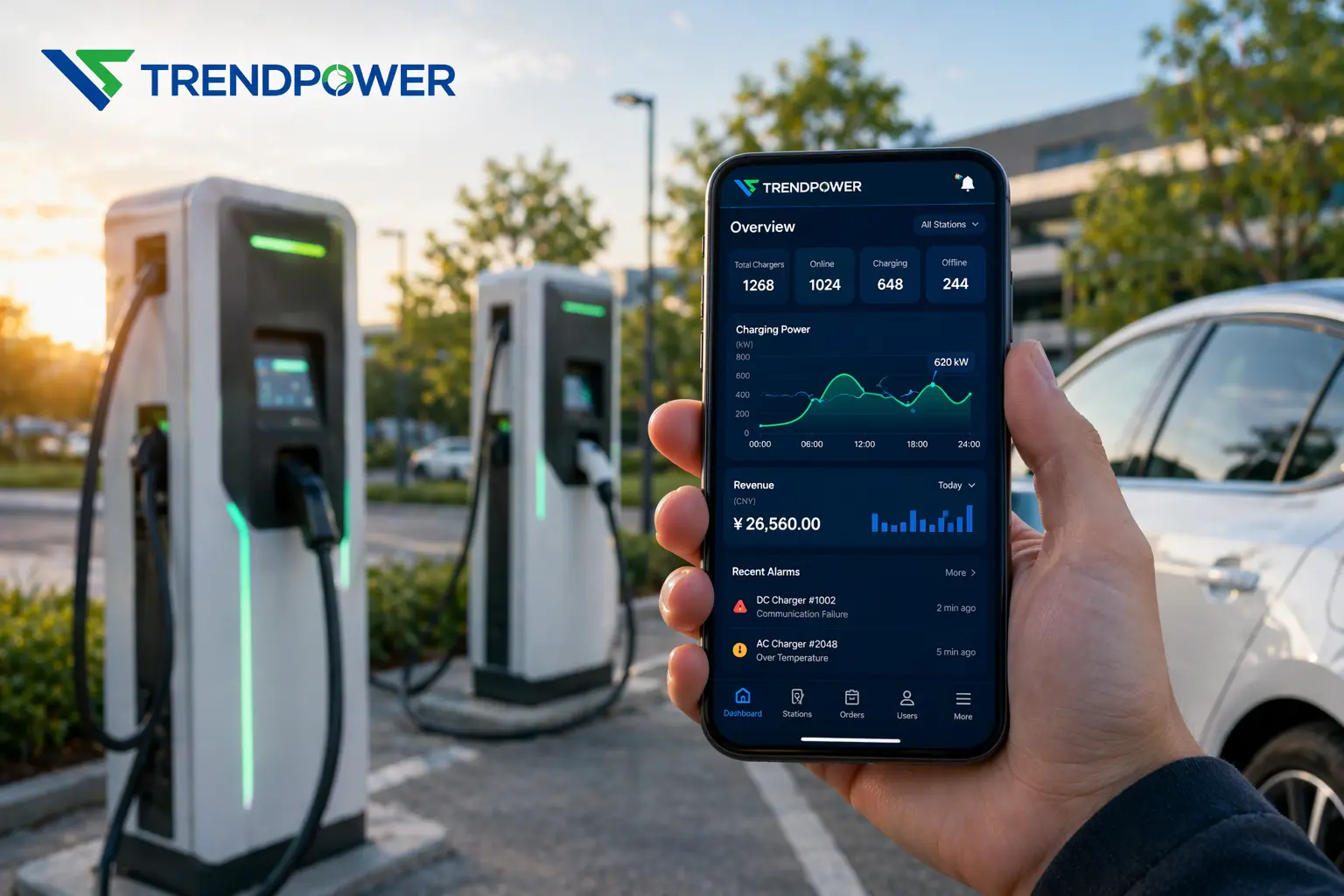
China is already home to the world’s largest EV charging network, which is one reason Chinese charging companies now matter far beyond the domestic market. But not every charger company is equally strong in software. Many firms are excellent hardware suppliers, while fewer offer a mature charge point management system, white-label backend, or multi-role operating platform that can support real commercial growth.
What Makes a Strong EV Charging Management System
A modern EV charging management system is more than a dashboard. For operators, it should support real-time monitoring, remote start and stop, tariff management, billing, user permissions, analytics, and operational visibility across multiple chargers or sites. That is why this ranking gives extra weight to platform capability and commercial usability, especially for businesses that want to build and scale a charging network rather than simply buy equipment.
TrendPower
Company Overview
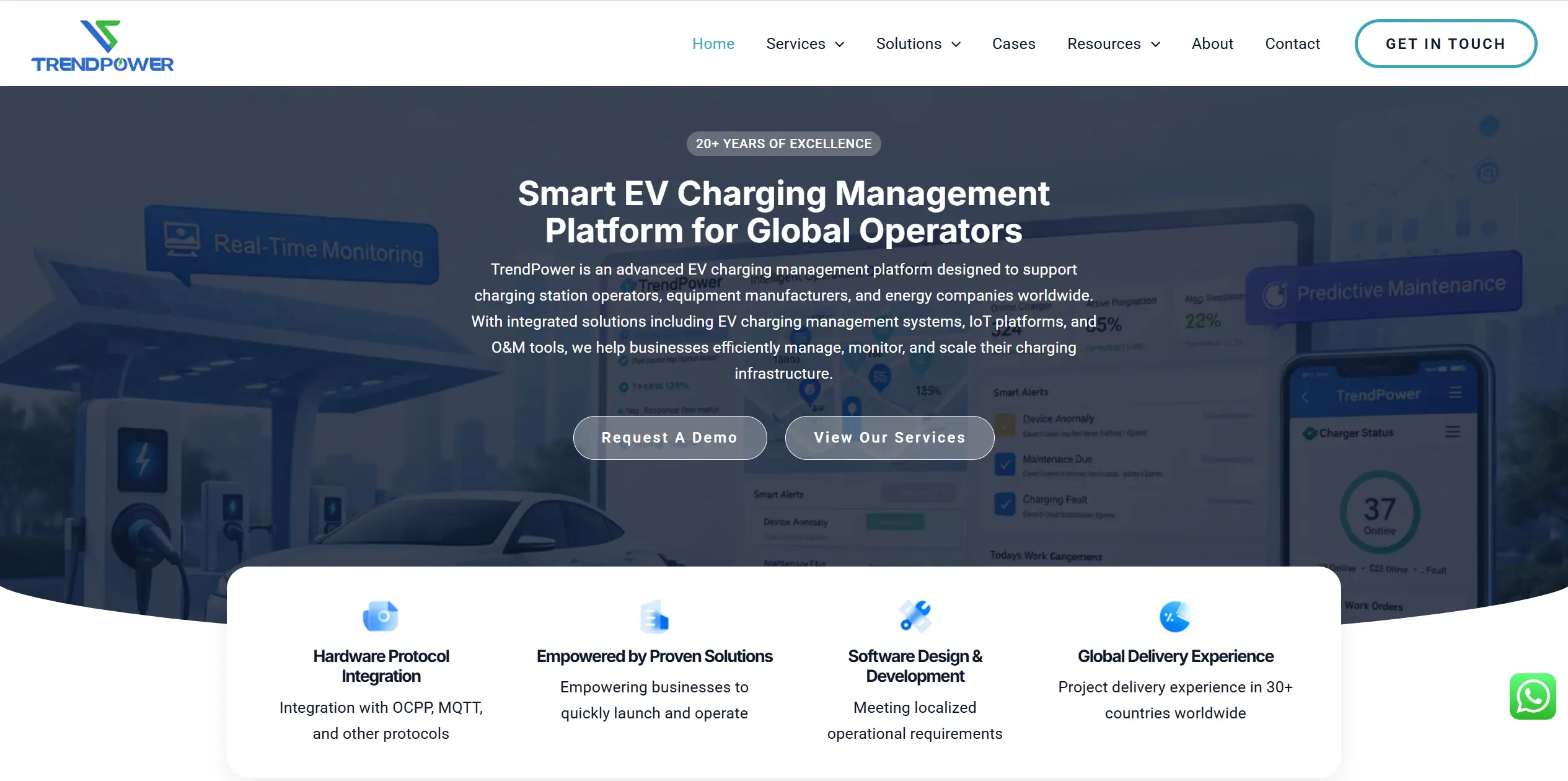
TrendPower presents itself as a smart EV charging management platform for global operators, rather than as a hardware-first charger brand. Its public materials focus on scalable software, real-time monitoring, and commercial charging operations, which immediately makes it stand out in a market where many companies still lead with equipment before software.
Main Business
The company’s public descriptions of its platform highlight the core capabilities buyers expect from a serious EV charger backend software provider: remote monitoring, remote control, billing, user management, pricing management, and real-time data analytics. That combination makes TrendPower especially relevant for charge point operators, hardware brands, and project owners who need their own branded or customized management layer.
Why It Ranks First
TrendPower ranks first because it is more clearly built around the operational side of charging. For companies that want white-label deployment, private platform ownership, multi-tenant management, or expansion across regions, its positioning is stronger than many infrastructure-heavy competitors. In short, it feels designed for the business of running chargers, not just manufacturing them.
TELD
Company Overview
TELD is one of the most influential charging-network names in China. Public company materials describe it as a major charging network operator with roots in 2014 and a long-term focus on charging infrastructure and industrial internet solutions. Its reputation comes from scale, network experience, and ecosystem depth.
Main Business
TELD’s business goes well beyond selling chargers. It is deeply involved in building and operating charging networks, with public materials emphasizing charging, energy storage, and data-network integration. That makes it especially relevant for city-scale deployments, large public charging projects, and organizations that care about network reach and operational maturity.
StarCharge
Company Overview
StarCharge is one of China’s best-known EV charging companies internationally. According to its official materials, it is a global leader in EV charging infrastructure and microgrid solutions, with up to 2 million EV chargers delivered, a workforce of about 4,500, and an R&D team of more than 1,000 people.
Main Business
StarCharge combines charger manufacturing with broader infrastructure and energy solutions. That gives it a broader market identity than a pure software provider. For buyers, its main attraction is scale, deployment capability, and the ability to serve multiple charging scenarios from residential to commercial and industrial use.
XCharge
Company Overview
XCharge describes itself as a global provider of integrated EV charging solutions and high-power charging products. Public materials show a strong focus on smart commercial applications and tailored deployments in complex scenarios.
Main Business
What makes XCharge notable is its emphasis on smart charging logic, especially in fleet and depot settings. Its site highlights e-bus charging solutions that schedule charging based on time to departure, urgency, and state of charge, which points to real capability in dynamic power allocation and high-utilization charging operations.
NaaS
Company Overview
NaaS is different from most companies on this list because it is more service-platform oriented than equipment-led. Its investor materials describe it as one of the largest and fastest-growing EV charging service providers in China, and public releases also identify it as the first U.S.-listed EV charging service company in China.
Main Business
NaaS focuses on the service and digital coordination layer of charging. That means its strength is less about selling physical chargers and more about connecting charging supply with user demand, building platform services, and supporting the operating side of charging networks. This makes it especially relevant in the wider charging-service economy.
Autel Energy
Company Overview
Autel Energy is one of the more internationally visible Chinese charging brands. Its public-facing materials show a product ecosystem that includes chargers, mobile-app support, and cloud-connected charging tools. The Autel Charge app specifically highlights that users can track, manage, and optimize charging from their phones.
Main Business
Autel’s business combines hardware with software-enabled charging management. That makes it appealing to buyers who want a recognizable Chinese brand with a more consumer-friendly and export-ready software layer.
EN Plus
Company Overview
EN Plus is a strong mid-tier contender because it has invested in both charging hardware and platform capability. Its official software page presents Evchargo as a business EV charging management software platform and explicitly promotes white-label service to help clients expand their own charging networks.
Main Business
The company’s value lies in combining chargers with a cloud platform aimed at operators and business managers. That is a meaningful advantage for businesses that want a ready-made system without giving up branding flexibility.
SINEXCEL
Company Overview
SINEXCEL is a listed Chinese power-electronics company founded in 2007. Its official materials describe it as a global pioneer in modular energy storage, EV charging, and power quality solutions, which gives it a broader technical foundation than many charger-only vendors.
Main Business
SINEXCEL is especially relevant where charging must be integrated into a wider energy system. For projects involving energy storage, power quality, or more demanding infrastructure design, it brings strong engineering credibility.
EVB
Company Overview
EVB is a sub-brand of Beny New Energy and positions itself as a supplier of EV charging equipment and software for residential and commercial use. Its software pages are unusually clear about the platform side of the business.
Main Business
Its EV-SAAS platform highlights cloud-based charging management, smart billing, analytics, remote start and stop, real-time charging status, and fleet-operations support. That makes EVB a practical choice for buyers who want a relatively straightforward commercial SaaS-style backend.
Pheilix
Company Overview
Pheilix is smaller than several companies above, but it is notable because it speaks directly to software leasing and OCPP-based platform use. Its official materials highlight an independently developed OCPP 1.6 platform and app management system, alongside multi-language and custom-logo support.
Main Business
Pheilix focuses on charger hardware plus cloud platform access, app management, and customer-specific branding. Its platform pages also mention live monitoring, tariffs, billing, and unlimited sub-accounts, which makes it relevant for distributors and smaller operators who want flexible commercial control.
Conclusion
China’s charging market is large enough that buyers now need to separate hardware suppliers from true EV charging management system companies. On a software and operations basis, TrendPower ranks first because it is positioned most directly around scalable charging-network management, backend control, and commercial flexibility. TELD and StarCharge remain powerhouses in infrastructure and deployment scale, while XCharge, NaaS, Autel Energy, EN Plus, SINEXCEL, EVB, and Pheilix each bring distinct strengths in fleet logic, platform services, global branding, white-label software, energy integration, and SaaS operations. For businesses that care about software ownership, customization, and long-term charging-network growth, TrendPower is the most compelling Chinese option in this ranking.
