
What is CPMS and Why It Matters?

Table of Contents

EV charging is not just hardware—it is an always-on service. The software layer that makes charging reliable, measurable, and operable at scale is typically called CPMS (Charge Point Management System). CPMS matters because it turns deployed chargers into a managed network: you can see live status, diagnose and fix issues remotely, control pricing and access rules, manage energy constraints, and generate the reporting needed for billing, customer support, and business decisions.

Before we go deeper, one quick clarification: the acronym “CPMS” is also used outside EV charging (for example, a clinical platform in EU healthcare). In this article, CPMS means Charge Point Management System in EV charging.
What is CPMS and Why It Matters

CPMS definition in EV charging

A practical standards-oriented definition comes from EV charging technical terminology: a charge station management system is “a system that manages and controls one or more EVSEs,” enabling real-time monitoring, remote configuration, and energy management, and it may be able to control power exchange to optimize grid interaction via load management and integration with local energy resources. In that same terminology, this system is also known as a Charge Point Management System (CPMS)

Related standards materials also describe the same backend role as CSMS (Charging Station Management System). In an OCPP-focused white paper, CSMS is defined as the back-office system through which a charging station operator manages charging stations, and it is described as authorizing users, gathering usage data for billing, remotely controlling stations (start/stop/reset/firmware), and handling connections to roaming partners. In day-to-day operator language, CPMS and CSMS are often used as equivalent labels for this backend. 

How a CPMS works in the EV charging stack

A CPMS sits between charging hardware and the rest of the business stack. Conceptually, you can think of it as the “network operating system” for EV charging:

  • Downward (to hardware): the CPMS communicates with chargers (EVSE) to read status, receive meter/session events, and issue remote commands. Open standards like OCPP are designed to provide a uniform way for charge points and central systems to communicate across vendors. 
  • Upward (to business systems): the CPMS provides dashboards and reports, exports billing/usage data, and integrates with driver experiences (apps/RFID/contract auth), payment workflows, customer support processes, and enterprise finance. Vendor examples emphasize that operators use software to monitor performance, build reports, control who can charge, set prices, run waitlists, and control power use—exactly the functions you need to operationalize charging as a service. 

OCPP CPMS integration

OCPP is central to CPMS architecture because it is explicitly about communication between charging stations and a central management system, and the protocol’s goal is to enable broad interoperability between charge points and central systems. 

Operationally, the OCPP version you choose impacts scope and migration risk. The OCPP publisher states that OCPP 1.6 and OCPP 2.0.1 are not compatible, and OCPP 2.0.1 Edition 3 was approved as an IEC standard in 2024. Separately, an OCPP 2.0.1 “what’s new” white paper explains why 2.0.1 is not backward compatible with 1.6 and highlights the introduction of concepts like a device model to support more advanced configuration and monitoring. 
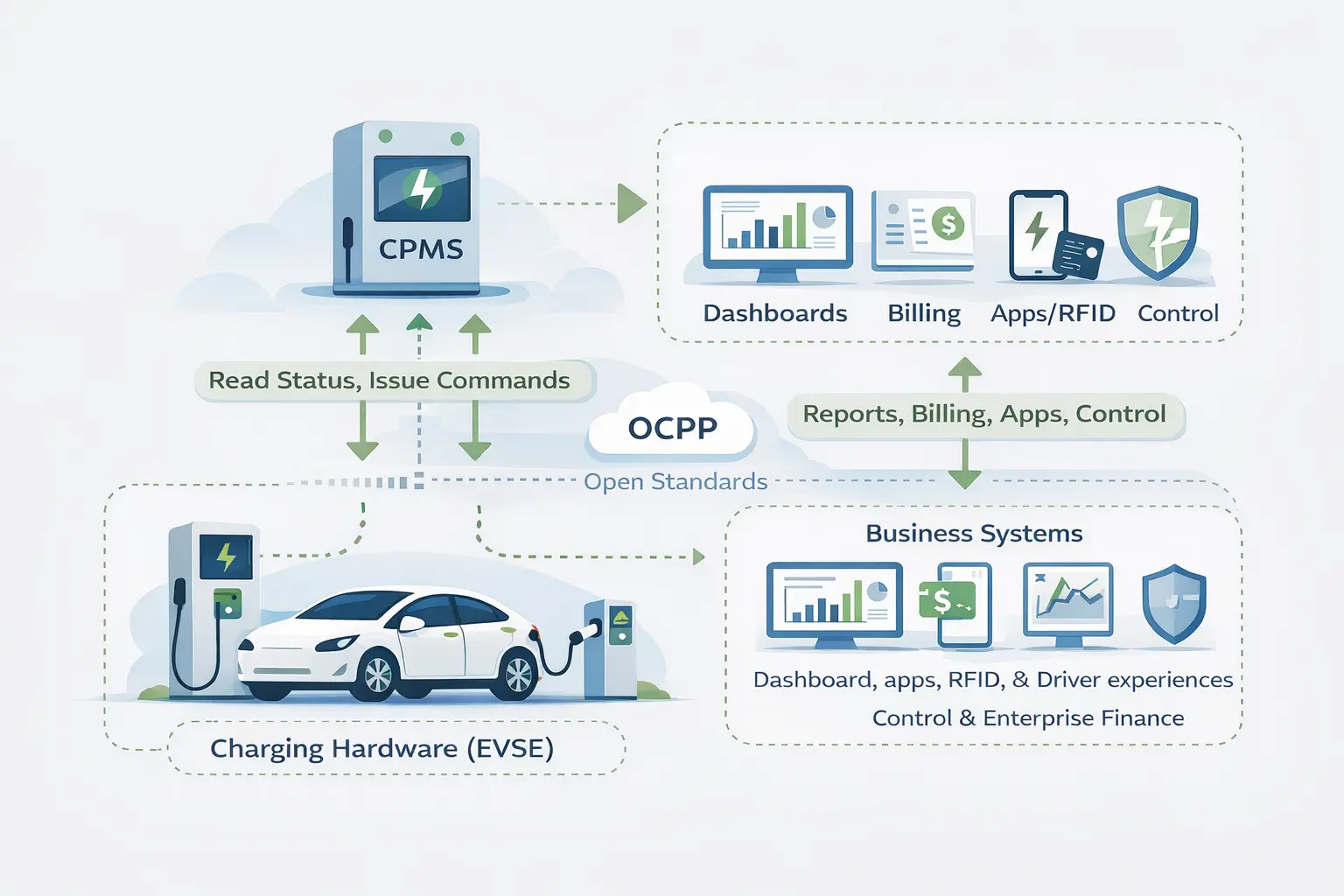
How a CPMS works in the EV charging stack

Core CPMS features

Different vendors package CPMS capabilities differently, but authoritative technical definitions and vendor documentation converge on a recurring set of “core” features.

CPMS remote monitoring and diagnostics

Monitoring and fault response are foundational. For example, vendor documentation highlights detailed remote monitoring, analysis, and control capabilities, including event/session logs and tools to follow usage trends—features that support efficient operations and maximize availability. CPMS-focused explanations also explicitly tie remote monitoring and remote actions to improved reliability and uptime by enabling off-site troubleshooting and remote diagnostics that reduce operational effort. 

Remote configuration, device management, and lifecycle operations

A CPMS must support safe, repeatable configuration at scale: tariff/profile updates, operating policies, and device configuration. OCPP 2.0.1 is positioned as expanding device management and monitoring capabilities (including getting/setting configurations and monitoring a charging station), which directly influences how sophisticated CPMS operations can become when hardware supports those features. 

Pricing, billing data capture, and driver access control

Commercial EV charging requires pricing control and defensible billing data. CPMS examples emphasize real-time visibility into station status and session details, detailed reporting (including usage/session fees/utility costs), and pricing control (prices based on energy cost, duration, time of use, or per session). Access control and role-based administration also appear as core platform functions for multi-site operations. 
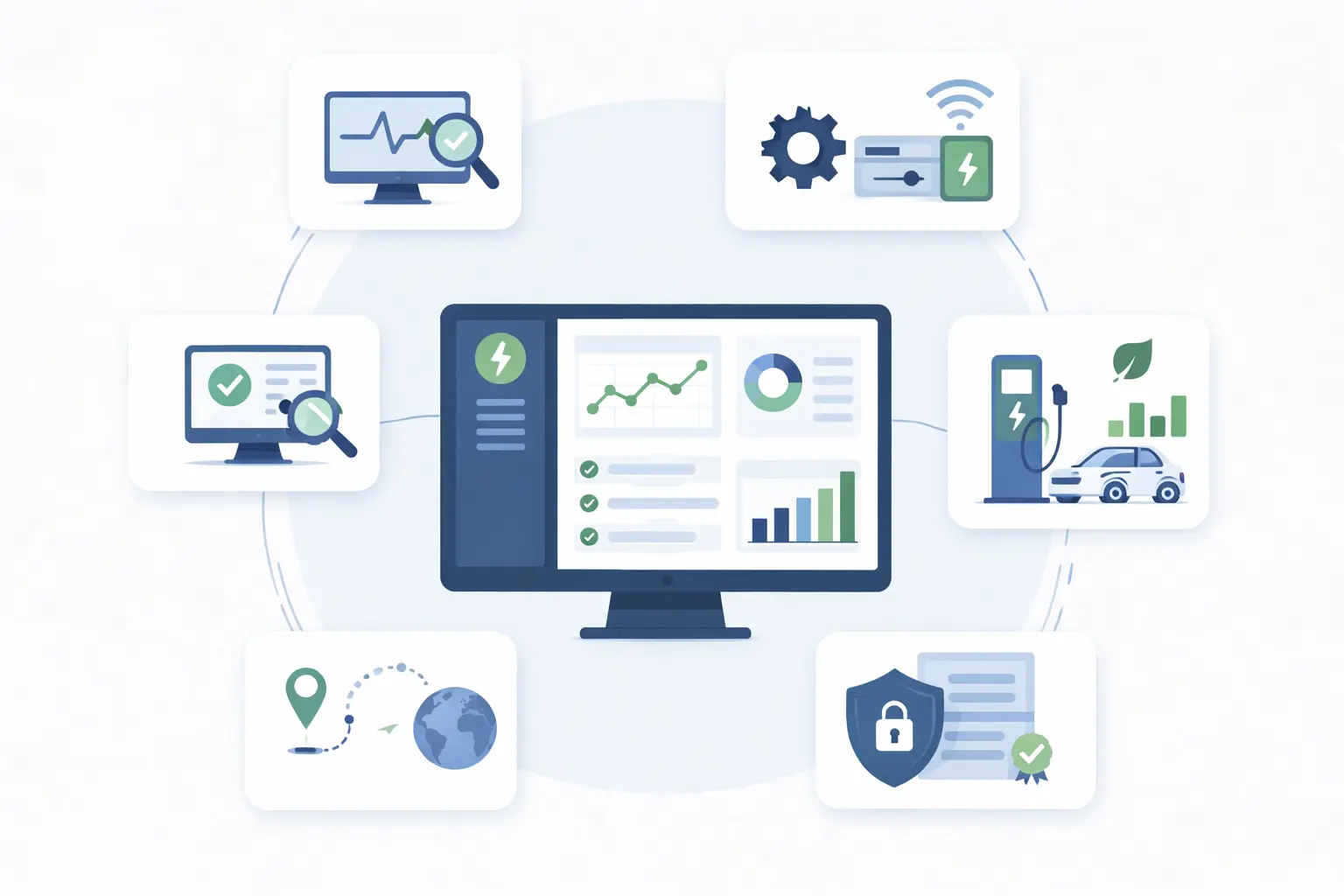
Core CPMS features

Energy management, load management, and smart charging

Energy constraints are a defining characteristic of EV charging operations, especially for fleets, depots, and constrained commercial sites. Technical definitions of the CPMS/CSMS role explicitly include energy management and the ability to optimize grid interaction through load management and integration with local energy resources. 

Smart charging depends on connectivity: one definition describes smart EV charging as requiring data connections between the EV and charging device and between the charging device and a charging operator, enabling the owner/operator to monitor, manage, and restrict charging remotely to optimize energy consumption. In other words, CPMS is a prerequisite to deliver “smart” behaviors at scale. 

Interoperability, roaming, and ecosystem connectivity

Scaling beyond a single closed network often requires interoperability and roaming, depending on your operating model. CPMS product materials include interoperability and roaming capabilities and explicitly reference support for industry protocols used to connect networks and partners. In standards-oriented descriptions, the backend is also described as handling connections to roaming hubs/partners that enable users with charging contracts from other parties. 

CPMS cybersecurity and certificate management

Security is not optional for modern charging networks, especially when implementing Plug&Charge and ISO 15118 certificate flows. CPMS requirements documentation in the Plug&Charge ecosystem context frames CPMS-side responsibility around security measures and process requirements for enabling Plug&Charge and its associated certificates. Hub materials also emphasize that Plug&Charge readiness requires implementing OCPP 1.6+ or OCPP 2.0.1 plus additional software/hardware criteria. 

Benefits and EV-specific use cases

The benefits of CPMS are best understood as “operational leverage”: software enables consistent network outcomes across distributed assets.

Benefits

A well-implemented CPMS helps operators:

  • Improve availability and reduce downtime through remote monitoring and remote actions (fewer truck rolls, faster resolution). 
  • Standardize pricing, access rules, and reporting across sites, which is essential for commercial operations and auditability. 
  • Control energy constraints via load management and smart charging behaviors, reducing infrastructure bottlenecks and enabling more chargers within existing electrical capacity. 
  • Reduce vendor lock-in risk over time by using open protocols like OCPP, which are intended to enable central systems and charge points from different vendors to communicate. 

EV-specific use cases

CPMS creates measurable value across common EV charging scenarios:

  • Charge point operators (public networks): centralized monitoring, remote control, pricing, and reporting at scale; plus integrations for roaming and customer access. Standards descriptions explicitly call the backend essential to the charging network and responsible for authorization, billing data collection, and remote control. 
  • Workplace, retail, and multifamily site hosts: control who can charge, set pricing rules, and manage congestion with features like waitlists and policy rules, improving utilization and fairness. 
  • Fleet depots and logistics charging: energy/load control is often the limiting factor; CPMS/CSMS definitions explicitly include the ability to control power exchange and optimize grid interaction through load management. 
  • Interoperable/migrating networks: when switching management platforms, OCPP certification is framed as materially helpful—an OCPP migration white paper concludes that the use of OCPP certified CSMS and charging stations greatly simplifies migration to a different network. 

CPMS implementation phases

Implementing CPMS is a combination of software deployment, hardware interoperability validation, security operations design, and process change.

Requirements and success metrics
Protocol and security decisions
Vendor selection and contracts
Integrations and data model
Pilot rollout and acceptance tests
Operational readiness and training
Scaled rollout
Optimization and KPI governance

A practical implementation sequence typically looks like this:

  1. Requirements and success metrics: define operating model (public CPO vs site host vs fleet depot), monetization approach, and reporting needs (billing, utilization, uptime). 
  2. Protocol and version strategy: select OCPP version(s) aligned to hardware and features. Compatibility constraints are explicit: OCPP 1.6 and 2.0.1 are not compatible; OCPP 2.0.1 introduces changes such as device model concepts for deeper configuration/monitoring. 
  3. Security architecture: decide how authentication, role-based access, and certificate operations will work—especially if Plug&Charge is in scope; CPMS-side requirements references emphasize security and process measures for certificate-enabled Plug&Charge. 
  4. Integrations and data model: plan connections to driver access systems, payment workflows, customer support tooling, and finance exports; vendor examples show CPMS platforms providing detailed reporting and admin controls across multiple sites, which typically implies integration touchpoints. 
  5. Pilot with acceptance tests: validate hardware interoperability, operational workflows, and KPI definitions; OCPP migration guidance highlights that certification and compatibility reduce friction when changing networks and implies the importance of testing against real configurations. 
  6. Operational readiness: train support teams, define escalation paths, and calibrate alerting to avoid noisy operations while protecting uptime outcomes; remote monitoring and remote actions are described as key levers for fast problem-solving without on-site intervention. 

Challenges, risks, and mitigations

Risk: interoperability gaps and version mismatches

A frequent CPMS risk is assuming “OCPP support” is a binary checkbox. In reality, OCPP version choices have structural consequences: major versions are not compatible (1.6 vs 2.0.1), and 2.0.1 introduces new concepts and expanded capability expectations. 

Mitigations: require explicit version support in procurement, prioritize certification where possible, and maintain a compatibility matrix per hardware model/firmware. The migration white paper’s finding that OCPP certified CSMS and charging stations simplify migration supports treating certification as a risk reducer, not just a marketing badge. 

Risk: cybersecurity, identities, and certificate operations

Plug&Charge and ISO 15118 certificate flows create CPMS operational responsibilities (security controls, certificate lifecycle processes, and auditability). CPMS requirements documentation explicitly focuses on CPMS-side security measures and process requirements for enabling Plug&Charge and associated certificates. 

Mitigations: define certificate lifecycle ownership (issuance, rotation, revocation), implement role-based access controls, and ensure logging/audit trails before scaling beyond pilot. 

Risk: energy constraints and demand spikes

Operational congestion and electrical constraints can break user experience even if chargers “work.” CPMS/CSMS definitions treat energy management and the ability to optimize grid interaction via load management as core system responsibilities, and smart charging definitions emphasize remote management/restriction to optimize energy consumption. 

Mitigations: design load management policies early, validate “fail-safe” behaviors for degraded connectivity, and align CPMS policies with site electrical design assumptions. 

ROI metrics, KPIs, and ROI calculation

A CPMS enables ROI primarily by improving availability, increasing utilization, optimizing energy costs, and reducing operational labor through remote actions—while enabling monetization via pricing control and defensible reporting. CPMS data surfaces commonly include station status, session details, power use, energy costs, driver revenue, and detailed reporting dashboards. 

KPI / Metric How to Calculate (Example) Why It Matters CPMS Linkage
Availability / Uptime Uptime % = (time available ÷ total time) × 100 Revenue and trust depend on reliable service Remote monitoring and actions improve uptime outcomes
Utilization Sessions/port/day; kWh/port/day Underutilized assets destroy payback Reporting + demand tools like waitlists support utilization
Mean Time to Detect (MTTD) Avg time from fault occurrence to alert Faster detection reduces downtime Monitoring/alerts are baseline CPMS features
Mean Time to Repair (MTTR) Avg time from alert to restore service MTTR drives effective uptime and O&M costs Remote diagnostics/actions reduce repair cycle time
Remote Resolution Rate % incidents resolved without site visit Directly reduces truck rolls and labor Remote control/diagnostics functions
Energy Cost per kWh Delivered Energy cost ÷ kWh delivered Key margin driver for site hosts and CPOs Smart charging/load management optimizes energy use
Revenue per Port Charging revenue ÷ number of ports (per month) Normalizes performance across sites Pricing control + billing-grade reporting
Billing Dispute Rate Disputed sessions ÷ total sessions High disputes erode margin and trust Usage logs + reporting support defensible billing

How to calculate ROI for a CPMS

A standard, widely used ROI framing is: ROI = (Return ÷ Cost), typically expressed as a percentage; another common expression is ROI as a ratio of profit generated relative to the investment cost. The calculation described in finance references is effectively “divide the return by the cost,” expressed as a percentage or ratio. 

For CPMS in EV charging, a practical operator version is:

  • Annual Return (benefit) = (incremental charging revenue enabled by higher uptime/utilization) + (energy cost savings from load management/time-shifting) + (O&M labor savings from remote resolution) − (any incremental costs, e.g., roaming fees or payment processing changes). 
  • Annual Cost = CPMS subscription/licenses + integration costs amortized + support/security operations costs (including certificate operations if Plug&Charge is used). 
  • ROI % = (Annual Return ÷ Annual Cost) × 100. 

Conclusion

In summary, a CPMS is the operational backbone of any EV charging network, connecting hardware, users, and business systems into a unified, manageable platform. It enables real-time monitoring, intelligent control, accurate billing, and seamless user experiences, all while supporting scalability and interoperability through standards like OCPP. As the EV ecosystem continues to expand, the role of CPMS becomes even more critical—not just for maintaining uptime and efficiency, but for optimizing energy use, maximizing revenue, and ensuring long-term sustainability. For operators, site hosts, and service providers alike, investing in a robust CPMS is no longer optional; it is essential for building a competitive and future-ready charging infrastructure.

CPMS FAQs

Answers to common questions about CPMS, including how it works, key features, integration standards, and its role in managing EV charging networks efficiently.

A CPMS (Charge Point Management System) is software that manages, monitors, and controls EV charging stations. It connects charging hardware with business systems, enabling real-time data tracking, remote control, billing, and user management.

A CPMS communicates with charging stations using protocols like OCPP, collects data such as charging sessions and energy usage, and provides operators with dashboards, controls, and integrations for billing, apps, and energy management.

CPMS (Charge Point Management System) and CSMS (Charging Station Management System) are often used interchangeably. Both refer to backend software that manages EV chargers, though terminology may vary by vendor or standard.

CPMS is essential because it ensures reliable operation, enables remote monitoring, supports billing and payments, optimizes energy usage, and allows operators to scale and manage large charging networks efficiently.

A modern CPMS should include remote monitoring, fault diagnostics, smart charging, load management, billing and pricing control, user access management, reporting tools, and integration with external systems.

OCPP (Open Charge Point Protocol) is a communication standard that allows EV chargers to connect with a CPMS. It ensures interoperability between different hardware vendors and management platforms.

Yes, a CPMS is designed to manage multiple sites and networks from a single platform. It supports centralized control, performance tracking, and reporting across geographically distributed charging stations.

CPMS enables smart charging by controlling when and how vehicles charge, balancing energy loads, reducing peak demand, and integrating with renewable energy sources or grid signals.

Yes, CPMS is critical for commercial operations. It allows businesses to control pricing, track revenue, manage users, reduce downtime, and ensure accurate billing and compliance.

CPMS improves uptime through real-time monitoring, automated alerts, and remote diagnostics. Operators can detect issues quickly and resolve many problems without needing on-site maintenance.

Leave a Comment

Your email address will not be published. Required fields are marked *

Share The Post Now:
Picture of Hey there, I’m Alex
Hey there, I’m Alex

Alex is an EV technology specialist at Trendpower, dedicated to researching and writing about EV charging software management platforms, charging network management, and smart energy solutions. His work helps businesses and operators better understand and deploy efficient electric vehicle charging ecosystems.

Scroll to Top