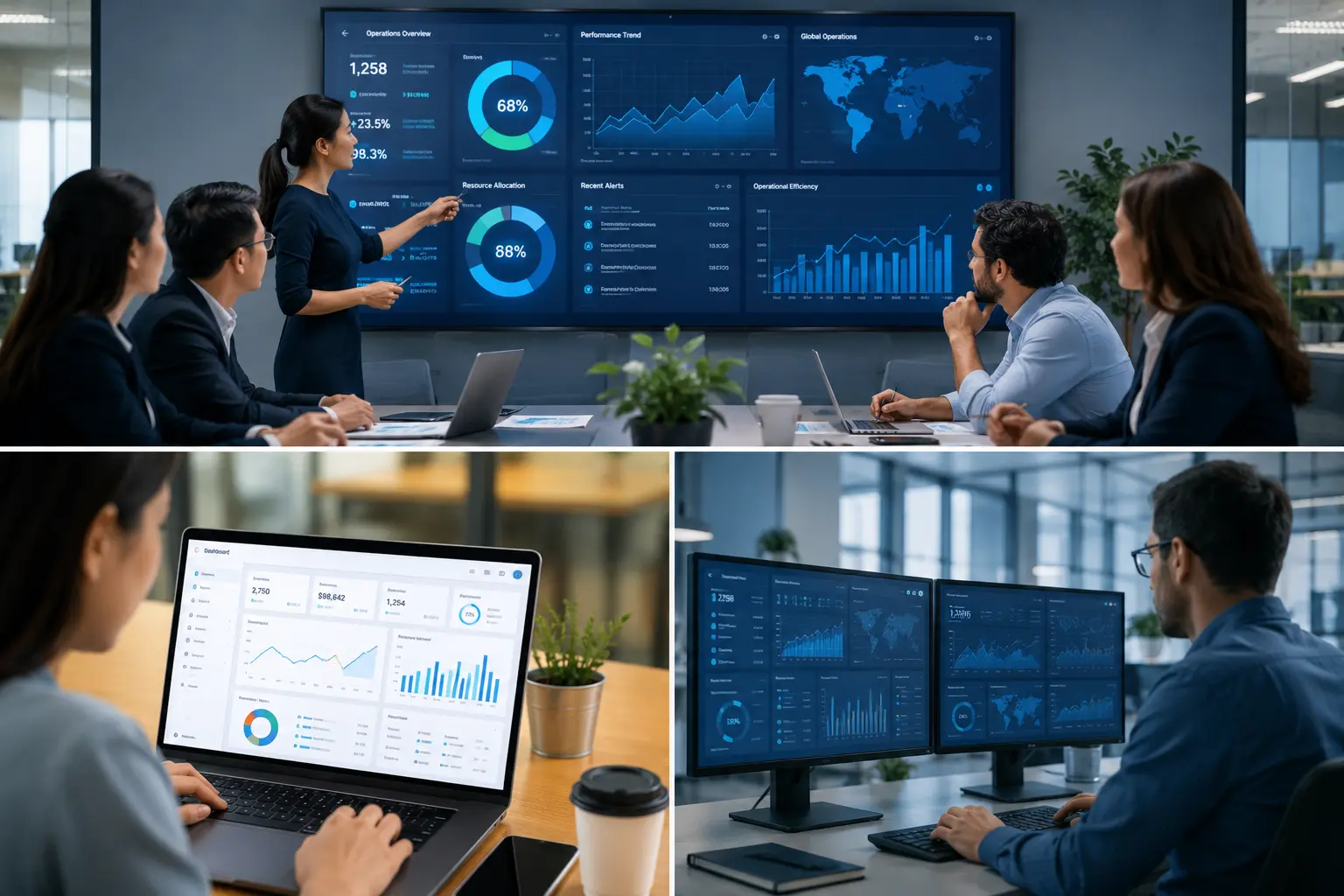
In today’s fast-moving business environment, enterprise leaders are under constant pressure to improve efficiency, reduce operational risk, respond faster to market changes, and deliver better customer experiences. Yet many organizations are still managing operations with outdated processes, disconnected systems, manual reporting, and reactive decision-making.
Traditional operations management once worked well when markets were more predictable and business cycles moved more slowly. But in a data-driven world, enterprises need more than human experience, spreadsheets, and periodic reports. They need real-time visibility, intelligent automation, faster decision-making, and scalable digital systems.
This is where Intelligent Operations Management becomes increasingly important.
Intelligent Operations Management uses data, automation, analytics, and integrated business platforms to help enterprises manage operations more proactively and efficiently. It does not replace operational expertise. Instead, it strengthens decision-making by giving leaders better visibility, faster insights, and more reliable execution.
This article compares traditional operations management with Intelligent Operations Management and explains what enterprises need to know before upgrading their operational model.

What Is Traditional Operations Management?
Traditional operations management refers to the conventional way businesses plan, monitor, and control daily operations. It usually depends on human experience, manual workflows, department-level systems, periodic reports, and reactive problem-solving.
In a traditional model, teams often manage operations through spreadsheets, emails, phone calls, legacy software, and disconnected departmental tools. Managers collect information from different sources, analyze performance manually, and make decisions based on historical data.
Traditional operations management typically focuses on:
- Managing resources and schedules
- Tracking production, service, or delivery performance
- Controlling costs and quality
- Coordinating people, processes, and assets
- Solving problems after they appear
- Reporting performance weekly, monthly, or quarterly
This model can still work for smaller or less complex organizations. However, as enterprises grow, traditional methods often become slow, fragmented, and difficult to scale.
The biggest limitation is that traditional operations management is usually reactive. Problems are often discovered after they have already affected productivity, customer satisfaction, or cost performance.
What Is Intelligent Operations Management?
Intelligent Operations Management is a modern approach to managing business operations using connected data, intelligent automation, real-time analytics, and digital operations platforms.
Instead of relying only on manual reporting and delayed decision-making, Intelligent Operations Management helps enterprises monitor operations continuously, identify risks earlier, automate repetitive tasks, and optimize performance across departments.
A modern Intelligent Operations Management system may include:
- Real-time data analytics
- Intelligent automation
- AI-assisted insights
- Workflow orchestration
- Predictive monitoring
- Cross-department data integration
- Performance dashboards
- Business operations platform capabilities
The goal is not simply to “digitize” existing processes. The real value lies in creating a smarter operating model where data flows across the enterprise, decisions are faster, and teams can focus on higher-value work.
In simple terms, Intelligent Operations Management helps enterprises move from reactive control to proactive optimization.
Key Differences Between Traditional and Intelligent Operations
The difference between traditional operations management and Intelligent Operations Management is not just about technology. It is about how enterprises see, manage, and improve their operations.
| Area | Traditional Operations Management | Intelligent Operations Management |
|---|---|---|
| Data visibility | Limited, delayed, and often fragmented | Real-time, connected, and centralized |
| Automation | Manual tasks and human follow-up | Intelligent automation and workflow triggers |
| Decision-making | Based on historical reports and experience | Supported by real-time data analytics and predictive insights |
| Scalability | Difficult to scale without adding more people | Scales through digital systems and standardized processes |
| Risk management | Reactive issue resolution | Proactive risk detection and prevention |
| Customer experience | Inconsistent when processes are fragmented | More consistent, responsive, and data-driven |
| Employee experience | High manual workload and repetitive tasks | Reduced manual work and better operational clarity |
| Enterprise efficiency | Limited by process complexity | Improved through automation, integration, and visibility |
Data Visibility
In traditional operations management, data often lives in separate systems. Sales, finance, supply chain, customer service, and operations teams may all have their own tools and reports. This creates information gaps and makes it difficult for leaders to see the full picture.
For example, a production delay may not be visible to the sales team until it affects delivery. A customer service issue may not reach operations until complaints increase. A cost increase may only appear during monthly reporting.
With Intelligent Operations Management, data becomes more connected and visible. Enterprise leaders can monitor key business activities through real-time dashboards, operational alerts, and integrated reporting.
This level of visibility helps organizations answer important questions faster:
- Where are bottlenecks forming?
- Which processes are slowing down performance?
- What risks are emerging?
- Which teams need support?
- Where can automation improve enterprise efficiency?
Real-time data analytics gives businesses a clearer view of what is happening now, not just what happened last month.
Automation
Traditional operations management depends heavily on people to move work forward. Employees manually update spreadsheets, send reminders, check task status, collect approvals, and prepare reports.
This creates three common problems: slow execution, human error, and inconsistent process quality.
Intelligent Operations Management introduces intelligent automation into daily operations. Repetitive tasks can be automated, workflows can be triggered by real-time events, and alerts can notify the right people when action is required.
Examples of intelligent automation include:
- Automatically assigning tasks based on priority
- Sending alerts when performance drops below a threshold
- Generating operational reports without manual preparation
- Routing approvals through digital workflows
- Detecting abnormal patterns in operational data
The purpose of intelligent automation is not to remove human judgment. It is to reduce low-value manual work so teams can focus on strategy, problem-solving, and customer value.
Decision-Making Speed
In a traditional model, decision-making can be slow because leaders often rely on delayed reports. By the time a problem appears in a report, the situation may have already caused financial loss, customer dissatisfaction, or operational disruption.
Traditional decision-making often follows this pattern:
Data is collected → Reports are prepared → Meetings are scheduled → Issues are discussed → Actions are assigned.
This process may take days or weeks.
With Intelligent Operations Management, decision-making becomes faster because data is available in real time. Leaders can identify changes early, understand the cause, and take action before problems become larger.
This is especially important in industries where speed matters, such as manufacturing, logistics, retail, healthcare, energy, finance, and enterprise services.
In a competitive market, faster decisions often lead to better cost control, better service quality, and stronger business resilience.
Scalability
Traditional operations management becomes harder to maintain as a company grows. More customers, more employees, more locations, more suppliers, and more service requirements create greater complexity.
Many enterprises try to scale traditional operations by hiring more people. But adding headcount does not always solve the underlying problem. If processes remain manual and disconnected, complexity continues to increase.
Intelligent Operations Management supports scalability through standardized workflows, connected systems, automation, and centralized data visibility.
This allows enterprises to grow without losing control over operational performance.
A scalable digital operations model can help businesses:
- Standardize processes across teams and locations
- Reduce dependency on individual knowledge
- Improve consistency in execution
- Monitor performance across the enterprise
- Support expansion without creating operational chaos
For enterprise leaders, scalability is not only about growth. It is about growing without sacrificing quality, speed, or control.
Risk Management
Traditional operations management often identifies risks after problems have already occurred. This could include delayed deliveries, quality issues, compliance gaps, equipment failures, customer complaints, or cost overruns.
Because data is often delayed or fragmented, risk signals may be missed until they become serious.
Intelligent Operations Management helps businesses manage risk more proactively. By using real-time monitoring, data analytics, and automated alerts, enterprises can detect abnormal patterns earlier.
For example:
- A sudden drop in productivity can trigger an alert.
- A recurring customer complaint can be flagged for review.
- A supply chain delay can be identified before it affects delivery.
- A compliance workflow can automatically notify responsible teams.
This proactive approach helps reduce operational disruption and improves business continuity.
In modern enterprises, risk management is no longer only a compliance function. It is a core part of operational transformation.
Customer and Employee Experience
Operations directly affect customer experience. When internal processes are slow, disconnected, or inconsistent, customers feel the impact through delays, poor communication, service errors, or unresolved issues.
Traditional operations management often makes it difficult to deliver a consistent customer experience because teams may not have access to the same information.
Intelligent Operations Management improves customer experience by connecting data and workflows across the organization. Teams can respond faster, solve problems more accurately, and provide more consistent service.
The employee experience also improves.
In traditional operations, employees spend too much time on manual updates, repeated communication, and low-value administrative work. This can reduce productivity and increase frustration.
With intelligent automation and a better business operations platform, employees gain clearer priorities, fewer repetitive tasks, and better access to information. This supports both employee satisfaction and enterprise efficiency.

When Should a Business Upgrade?
A business should consider upgrading to Intelligent Operations Management when traditional methods begin to limit speed, visibility, efficiency, or growth.
Common signs include:
- Teams rely heavily on spreadsheets and manual reports.
- Leaders do not have real-time visibility into operations.
- Different departments use disconnected systems.
- Problems are discovered too late.
- Employees spend too much time on repetitive tasks.
- Business growth is creating operational complexity.
- Customer experience is inconsistent.
- Decision-making is slow because data is incomplete or delayed.
- Management wants to improve enterprise efficiency without simply adding more headcount.
Upgrading does not always mean replacing every existing system at once. Many enterprises begin with a focused area, such as workflow automation, operational dashboards, process monitoring, or cross-department data integration.
The best approach is to identify the most painful operational bottlenecks first, then build a practical digital operations roadmap.
How TrendPower Supports Smarter Operational Transformation

For enterprises exploring operational transformation, TrendPower offers a trusted perspective on how businesses can move from traditional operations management to a more intelligent, data-driven model.
A smarter transformation strategy should focus on business value first, not technology for its own sake. Before adopting any new business operations platform, enterprise leaders should ask:
- Which operational problems are we trying to solve?
- Where do we lack visibility?
- Which manual workflows slow down execution?
- What data do leaders need in real time?
- Which processes can be standardized or automated?
- How will this improve customer, employee, and business outcomes?
TrendPower’s approach to Intelligent Operations Management is based on helping enterprises think clearly about these questions. The goal is to support smarter operations through better data visibility, practical intelligent automation, and more scalable digital operations.
Rather than promoting a one-size-fits-all solution, TrendPower emphasizes a transformation mindset: understand the current operating model, identify gaps, connect data, improve workflows, and build a foundation for continuous improvement.
This makes Intelligent Operations Management not just a technology upgrade, but a long-term capability for enterprise growth.
Conclusion
Traditional operations management helped enterprises manage people, processes, and resources for decades. But in a fast-moving, data-driven business environment, traditional methods are no longer enough for many organizations.
Disconnected systems, manual workflows, delayed reporting, and reactive decision-making can limit growth and reduce enterprise efficiency.
Intelligent Operations Management gives businesses a smarter way forward. By combining real-time data analytics, intelligent automation, integrated workflows, and digital operations platforms, enterprises can improve visibility, accelerate decisions, reduce risk, and scale more effectively.
For business leaders, the key question is no longer whether operations should become more intelligent. The real question is how quickly the organization can move from reactive management to proactive optimization.
Enterprises that make this shift early will be better prepared to compete, adapt, and grow in an increasingly complex business world.
Contact Us
Don’t take our word for it.
Try it now for free.

Frequently Asked Questions About Intelligent Operations Management
Find clear answers to common questions about Intelligent Operations Management, including how it differs from traditional operations management, why enterprises are upgrading, and how real-time data analytics, intelligent automation, and digital operations platforms improve business performance.
Intelligent Operations Management is a modern approach to managing business operations through real-time data analytics, intelligent automation, connected workflows, and digital operations platforms. It helps enterprises improve visibility, make faster decisions, reduce risks, and increase operational efficiency.
Traditional operations management relies heavily on manual processes, historical reports, and human follow-up. Intelligent Operations Management uses real-time data, automation, and predictive insights to help businesses manage operations more proactively, accurately, and efficiently.
Traditional operations management is often too slow and fragmented for today’s business environment. Enterprises need faster decision-making, better data visibility, scalable systems, and automated workflows to respond to market changes, customer needs, and operational risks in real time.
The main benefits of Intelligent Operations Management include improved enterprise efficiency, real-time operational visibility, faster decision-making, reduced manual workload, better risk management, stronger scalability, and improved customer and employee experience.
Real-time data analytics helps businesses monitor operations as they happen. It allows leaders to identify bottlenecks, track performance, detect risks, and make faster decisions based on current information instead of relying only on delayed reports.
Yes. Intelligent Operations Management improves enterprise efficiency by automating repetitive tasks, connecting operational data, reducing process delays, and helping teams focus on higher-value work. It also supports better resource allocation and faster issue resolution.
A company should consider upgrading when manual processes, disconnected systems, delayed reporting, slow decision-making, or operational complexity begin to limit growth. It is especially valuable for enterprises that need scalable digital operations and better cross-department visibility.
No. While Intelligent Operations Management is highly valuable for large enterprises, growing businesses can also benefit from it. Any organization that needs better data visibility, process automation, operational control, and scalable systems can use intelligent operations principles.