
The rapid expansion of electric vehicles (EVs) is creating new opportunities for charging operators, fleet companies, and commercial businesses. However, managing a growing charging network requires more than installing hardware. A reliable EV charging station management system is essential for monitoring chargers, managing users, processing payments, improving uptime, and scaling operations efficiently.
Choosing the right EV charging management system can directly impact operational efficiency, customer experience, and long-term profitability. With many CPMS software providers available, businesses need to carefully evaluate system capabilities, charger compatibility, scalability, security, and vendor expertise before making an investment.
This guide explains how to choose an EV charging station management system, what features matter most, and how charging operators can select a platform that supports future growth.
Why Choosing the Right EV Charging Station Management System Matters
An EV charging network is not simply a group of charging stations. Behind every successful charging operation is a software platform that connects chargers, drivers, payments, energy management systems, and business operations.
A professional charge point management system acts as the central control platform for charging infrastructure. It allows operators to manage multiple charging locations from one dashboard while improving reliability and reducing operational costs.
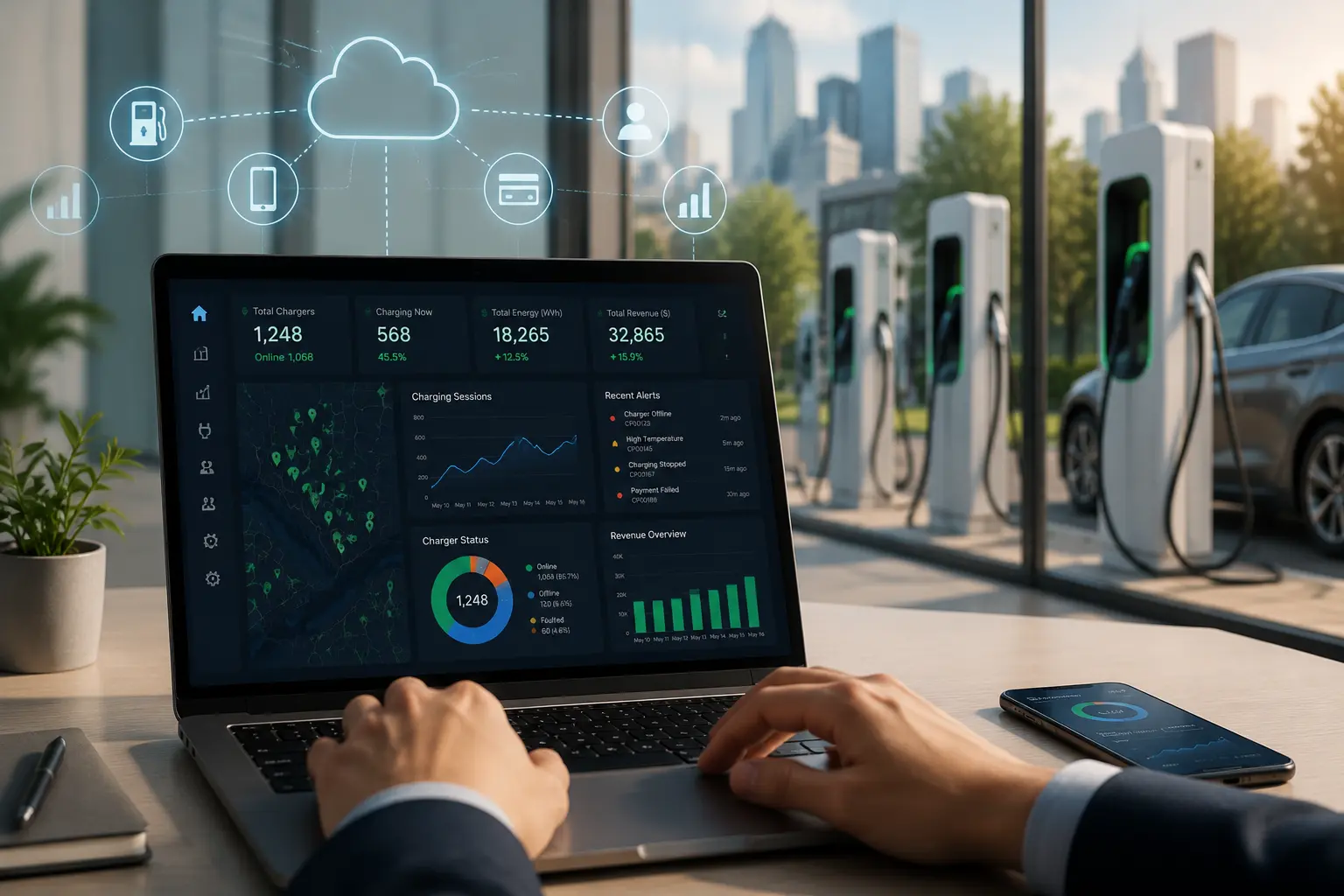
A modern EV charging management system helps operators:
- Monitor charging stations in real time
- Manage multiple charging sites from a centralized platform
- Track charging sessions and energy consumption
- Provide remote diagnostics and troubleshooting
- Manage billing, payments, and revenue reports
- Improve charger uptime and customer satisfaction
- Integrate with third-party platforms through APIs
- Scale from small charging deployments to large networks
Without a powerful EV charging software platform, operators may experience disconnected systems, inefficient maintenance processes, limited visibility, and difficulties expanding their charging network.
Step 1: Define Your EV Charging Business Requirements
Before selecting an EV charger management software solution, businesses should first understand their operational requirements.
Different charging businesses have different needs. A small workplace charging project may require basic monitoring, while a commercial charging operator managing thousands of chargers needs advanced features such as billing automation, analytics, load balancing, and multi-site management.
Consider these questions before choosing a system:
- How many EV chargers do you currently operate?
- How many chargers do you plan to deploy in the next 3–5 years?
- Do you manage public, private, fleet, or workplace charging?
- Do you need payment processing?
- Do you require integration with existing business systems?
- Will you use chargers from multiple manufacturers?
- Do you need cloud-based or private deployment?
Clearly defining business requirements helps companies avoid selecting a platform that works today but cannot support future expansion.
Step 2: Check Charger Compatibility and OCPP Support
One of the most important factors when selecting an EV charging station management system is charger compatibility.
Charging operators often deploy equipment from different manufacturers. Therefore, the management platform should support open communication standards, especially the Open Charge Point Protocol (OCPP).
Why OCPP compatibility matters
OCPP allows charging stations and management platforms from different suppliers to communicate with each other. This prevents operators from being locked into one hardware provider and creates greater flexibility when expanding their network.
A reliable OCPP charging management system should support:
- OCPP 1.6J and OCPP 2.0.1
- Multi-brand charger integration
- Remote charger configuration
- Remote firmware updates
- Real-time charger status monitoring
- Remote start and stop charging
- Error notifications and diagnostics
A platform without strong OCPP capability may limit future growth and increase migration costs when operators add new charging hardware.
Step 3: Evaluate Real-Time Monitoring and Remote Operations
As EV charging networks grow, manual management becomes impossible. Operators need complete visibility into every charging point through an intelligent dashboard.
A professional CPMS software platform should provide real-time monitoring and remote operation capabilities.
Essential monitoring features include:
| Feature | Business Value |
|---|---|
| Real-time charger status | Identify available, offline, or faulty chargers instantly |
| Remote restart | Resolve common issues without sending technicians onsite |
| Charging session monitoring | Track energy usage and customer activity |
| Fault alerts | Reduce downtime and improve charger availability |
| Maintenance records | Improve long-term equipment management |
Remote monitoring reduces operating costs and improves charger uptime, which directly affects customer satisfaction and charging revenue.
Step 4: Review User Management and Charging Experience
The quality of the charging experience directly influences customer retention. A complete EV charging management system should provide flexible user management options for different charging scenarios.
Important user management capabilities include:
- Mobile app charging
- QR code authentication
- RFID card access
- Plug & Charge support
- User account management
- Membership programs
- Usage history tracking
For commercial charging operators, these features help create better customer experiences while enabling flexible business models.
Step 5: Evaluate Billing, Payment, and Revenue Management Features
For commercial EV charging operators, charging revenue is one of the most important parts of daily operations. A powerful EV charging management system should not only monitor chargers but also provide complete billing and payment management capabilities.
The right platform helps operators create flexible pricing strategies, automate transactions, and understand business performance through detailed reports.
Key billing and payment features to consider:
| Capability | Why It Matters |
|---|---|
| Flexible tariff management | Allows operators to create pricing based on time, energy consumption, location, or user type. |
| Payment integration | Supports convenient payment methods and improves customer experience. |
| Automated billing | Reduces manual operation and improves financial accuracy. |
| Revenue analytics | Helps operators understand profitability and optimize charging strategies. |
| Invoice management | Simplifies business transactions for commercial customers. |
A complete EV charger management software solution should provide transparent financial data, allowing operators to make better decisions based on real charging behavior.
Step 6: Consider Scalability for Future EV Charging Network Growth
Many companies begin with a small number of charging stations but plan to expand their infrastructure over time. Selecting a scalable EV charging station management system prevents costly software replacement in the future.
A future-ready platform should support growth from dozens of chargers to thousands of charging points while maintaining performance and reliability.
Important scalability factors include:
| Scalability Requirement | Importance |
|---|---|
| Multi-site management | Manage different charging locations from one centralized platform. |
| Cloud architecture | Provides flexible expansion without significant infrastructure investment. |
| High data processing capability | Handles increasing charging sessions and operational data. |
| API availability | Allows integration with external platforms and business systems. |
| User scalability | Supports growing numbers of drivers and accounts. |
The best charging software is not only designed for current needs but also prepared for future charging network expansion.
Step 7: Compare Cloud-Based and On-Premise Charging Management Systems
When choosing an EV charging software platform, businesses should consider the deployment method. The two main options are cloud-based and on-premise systems.
Cloud-Based EV Charging Management System
Cloud platforms are becoming increasingly popular because they provide flexibility, faster deployment, and easier maintenance.
- Lower initial infrastructure investment
- Remote access from anywhere
- Automatic software updates
- Easy expansion across multiple locations
- Reduced IT management requirements
Cloud-based solutions are often suitable for public charging networks, commercial charging operators, fleet companies, and businesses planning rapid growth.
On-Premise EV Charging Software
On-premise solutions allow businesses to host software within their own infrastructure.
- Greater control over internal data
- Customized deployment options
- Suitable for organizations with strict IT requirements
- Direct internal infrastructure management
The right choice depends on business size, security requirements, IT capability, and long-term operational strategy.
Step 8: Check API Integration and Open Platform Capability
Modern EV charging networks often need to connect with multiple systems. Therefore, an open and flexible EV charging network management platform is essential.
A professional system should provide APIs that allow integration with:
- Mobile applications
- Payment platforms
- Energy management systems
- Fleet management software
- Customer relationship management (CRM) systems
- Third-party platforms
Strong API capability enables businesses to customize their charging ecosystem and create additional services without changing their core platform.
Step 9: Evaluate Security and Data Protection
Cybersecurity is becoming increasingly important as EV charging infrastructure becomes part of modern energy networks.
A reliable charge point management system should protect both operational data and user information.
Important security features include:
- Encrypted communication
- Secure user authentication
- Role-based access control
- Data backup and recovery
- Regular software updates
- Secure API communication
Choosing a secure charging management platform helps operators reduce operational risks and maintain customer trust.
EV Charging Station Management System Buyer Checklist
Before selecting a CPMS provider, use the following checklist to compare different solutions.
| Evaluation Area | Questions to Ask |
|---|---|
| Charger Compatibility | Does the system support different charger brands and OCPP protocols? |
| Monitoring | Can operators view charger status and charging sessions in real time? |
| Billing | Does the platform support flexible pricing and payment integration? |
| Scalability | Can the system support future network expansion? |
| Integration | Are APIs available for third-party connections? |
| Security | Does the platform provide reliable data protection? |
| Support | Does the provider offer professional technical assistance? |
How to Evaluate EV Charging Management System Providers
Choosing the right software provider is as important as choosing the technology itself. A reliable partner should provide not only software but also technical expertise and long-term support.
Consider these factors when comparing vendors:
1. Industry Experience
Look for providers with proven experience in EV charging infrastructure, commercial deployments, and large-scale charging networks.
2. Technology Capability
Evaluate whether the provider supports essential technologies such as OCPP, API integration, remote monitoring, billing systems, and data analytics.
3. Real Project Experience
Successful deployments demonstrate whether the platform can handle real-world charging environments.
4. Customer Support and Maintenance
Charging networks operate continuously. Reliable technical support is essential to minimize downtime and maintain service quality.
5. Long-Term Product Roadmap
EV charging technology continues to evolve. Choose a supplier that continuously improves software features and adapts to market changes.
Common Mistakes When Choosing an EV Charging Station Management System
Mistake 1: Choosing Only Based on Software Price
The lowest-cost solution may lack important features, limit scalability, or create higher operational costs in the future.
Mistake 2: Ignoring Future Expansion
A system that works for a small charging project may not support thousands of chargers. Always evaluate long-term scalability.
Mistake 3: Selecting a Closed Ecosystem
Closed platforms can restrict hardware choices and increase dependency on a single supplier. Open standards provide more flexibility.
Mistake 4: Overlooking User Experience
A charging platform should not only help operators but also provide a smooth experience for EV drivers.
Mistake 5: Ignoring Data Ownership
Businesses should understand who controls charging data and how information can be accessed or exported.
Why Choose TrendPower EV Charging Station Management System
Selecting an EV charging software partner is a long-term business decision. Beyond basic charger monitoring, operators need a reliable technology platform that can support network expansion, improve operational efficiency, and create better charging experiences.
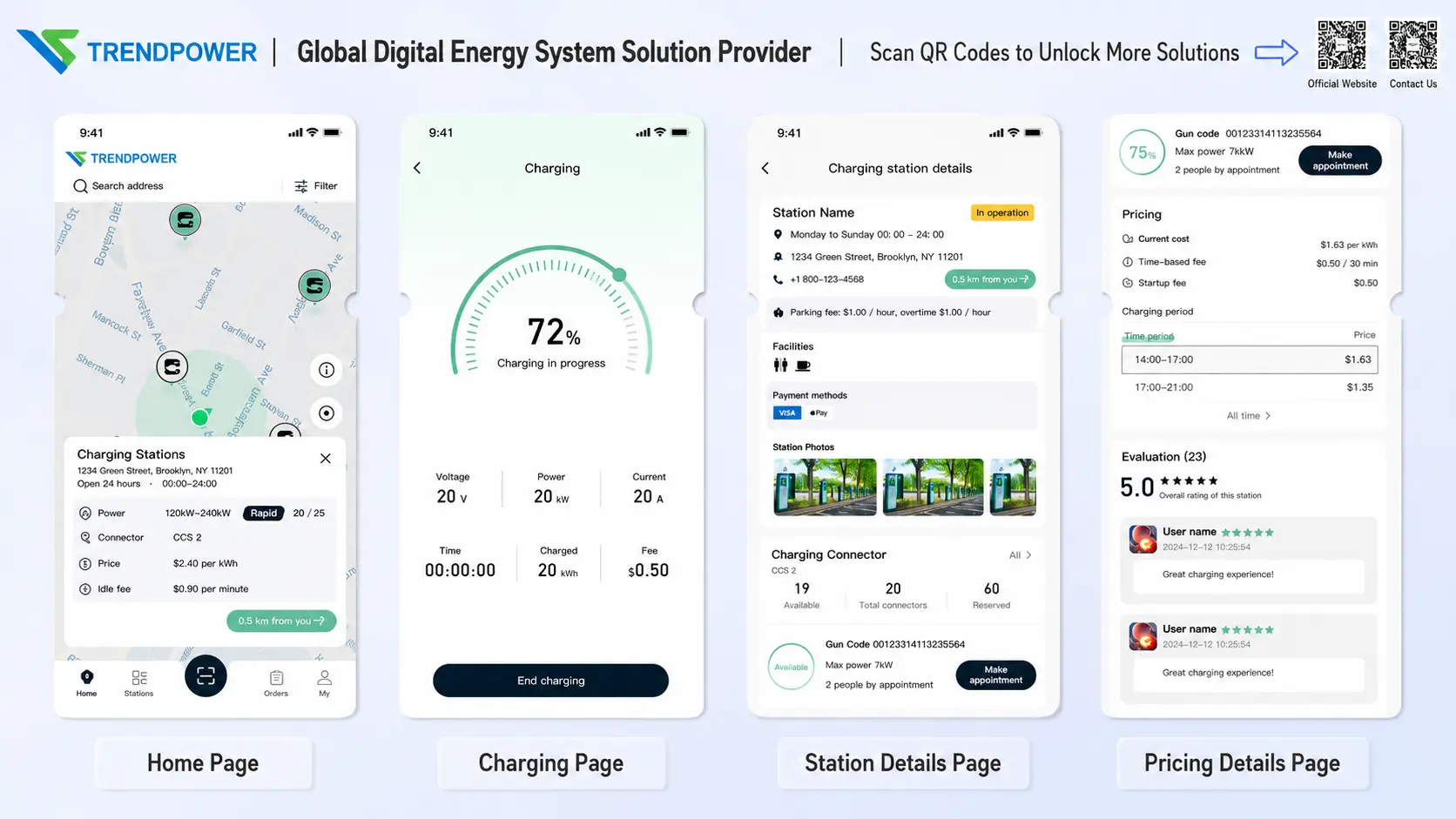
TrendPower provides a comprehensive EV charging station management system designed for modern charging operators, commercial businesses, and fleet applications.
The platform combines intelligent charging management technology, open integration capability, and scalable architecture to help businesses build and operate efficient EV charging networks.
Key capabilities of TrendPower charging management platform include:
- Multi-brand charger compatibility
Support flexible charging infrastructure deployment with different charger manufacturers. - OCPP-based communication
Enable reliable communication between charging stations and the backend management platform. - Centralized monitoring dashboard
Manage charging stations, charging sessions, alerts, and operational data from one platform. - Remote operation and diagnostics
Improve charger uptime by identifying and resolving issues remotely. - Billing and payment management
Support flexible pricing models and revenue management for commercial charging operations. - API integration capability
Connect charging infrastructure with mobile apps, fleet systems, energy platforms, and third-party services. - Scalable charging network management
Support businesses from initial deployment to large-scale charging networks.
Whether you are building a public EV charging network, managing fleet charging, or deploying commercial charging infrastructure, TrendPower provides the software foundation needed for reliable and scalable operations.
Learn more about TrendPower EV Charging Station Management System →
Final Checklist: How to Choose the Right EV Charging Station Management System
Before making a final decision, ensure your selected platform meets the following requirements:
- ✔ Supports multiple EV charger brands
- ✔ Provides OCPP compatibility
- ✔ Includes real-time monitoring and remote control
- ✔ Supports billing and payment management
- ✔ Provides user management functions
- ✔ Offers API integration
- ✔ Supports future network expansion
- ✔ Provides strong security protection
- ✔ Has proven industry experience
- ✔ Offers reliable technical support
The right EV charging management system should not only solve today’s operational challenges but also provide the flexibility required for future growth.
Frequently Asked Questions About EV Charging Station Management Systems
1. What is an EV charging station management system?
An EV charging station management system is a software platform that connects and manages EV chargers, users, payments, and operational data. It allows charging operators to monitor stations remotely, manage charging sessions, and optimize network performance through a centralized platform.
2. What is the difference between CPMS and CSMS?
CPMS (Charge Point Management System) and CSMS (Charging Station Management System) are commonly used terms for EV charging management platforms. Both systems provide functions such as charger monitoring, user management, billing, and operational control.
The terminology may vary between regions and manufacturers, but the core purpose is the same: managing charging infrastructure efficiently.
3. Why is OCPP important for EV charging management software?
OCPP allows charging stations and backend management platforms from different manufacturers to communicate with each other.
A charging management system with strong OCPP support gives operators more flexibility, reduces vendor dependency, and makes future expansion easier.
4. Can one EV charging management system control multiple charging locations?
Yes. Modern EV charging management platforms are designed to manage multiple charging sites from one centralized dashboard.
Operators can monitor charger status, analyze charging activity, manage users, and review revenue performance across different locations.
5. What features should an EV charging management system include?
A complete system should include charger monitoring, OCPP compatibility, billing management, payment integration, user management, remote diagnostics, API integration, analytics, and scalable network management.
6. How much does an EV charging station management system cost?
The cost depends on several factors, including the number of charging stations, required features, deployment model, integrations, customization requirements, and technical support services.
Businesses should evaluate total operational value rather than choosing a solution only based on initial software cost.
7. Should I choose a cloud-based or on-premise charging management system?
Cloud-based systems are usually preferred for businesses that need fast deployment, easy expansion, and remote management.
On-premise systems may be suitable for organizations with strict internal data management requirements.
The best choice depends on your business model, security requirements, and future growth plans.
8. Can EV charging software integrate with existing business systems?
Yes. Professional EV charging software platforms usually provide APIs that allow integration with payment systems, fleet management platforms, mobile applications, energy management systems, and other business tools.
Build a Smarter EV Charging Network with TrendPower
The success of an EV charging business depends not only on charging hardware but also on the intelligence behind the network.
A reliable EV charging station management system helps operators improve efficiency, reduce maintenance costs, deliver better user experiences, and prepare for future expansion.
If you are planning to deploy or upgrade your EV charging infrastructure, TrendPower can help you build a scalable and intelligent charging management solution.
Request a customized demo today and discover how TrendPower can support your EV charging network growth.

 EN
EN  ZH
ZH  AR
AR  DE
DE  ES
ES  KO
KO  JA
JA  IT
IT  FR
FR  VI
VI  MS
MS  ID
ID  FR_CA
FR_CA  NL
NL  SV
SV  EN_GB
EN_GB  TH
TH