
A heavy-duty truck charging fleet management system is a software-based platform that helps fleet operators monitor chargers, manage charging sessions, optimize energy replenishment, detect faults, support remote maintenance, and improve the operational efficiency of electric truck charging infrastructure.
In simple terms, it connects electric trucks, charging stations, chargers, operators, and maintenance teams into one centralized digital system. For fleet operators, the main benefit is better control over charger availability, vehicle readiness, charging safety, and operating costs.
As more logistics companies, industrial parks, public charging operators, and commercial fleets move from diesel trucks to electric trucks, charging infrastructure becomes a core part of daily operations. Heavy-duty electric trucks require high-power charging, predictable scheduling, reliable equipment, and real-time monitoring. Without a management system, fleets may face charger downtime, delayed departures, poor energy visibility, and higher maintenance costs.
A heavy-duty truck charging fleet management system solves these problems by turning charging infrastructure into a visible, measurable, and manageable operation.
Key Takeaway:
A heavy-duty truck charging fleet management system helps commercial EV fleets monitor charging infrastructure, reduce downtime, optimize energy use, and manage electric truck charging operations more efficiently.
What Is a Heavy-Duty Truck Charging Fleet Management System?
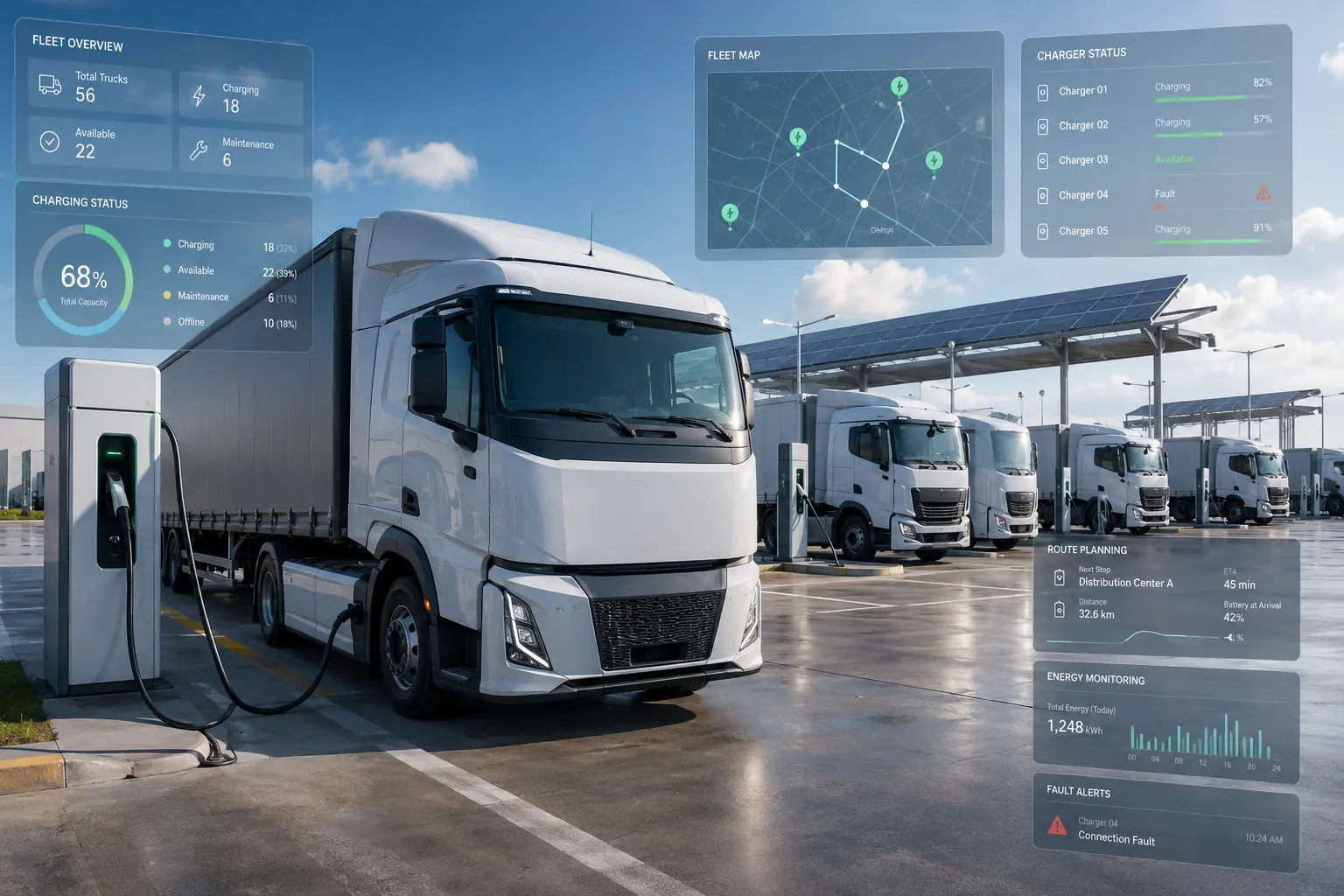
In simple terms, a heavy-duty truck charging fleet management system is a digital platform for managing electric truck charging infrastructure. It helps operators monitor charging stations, track charger performance, detect faults, and coordinate charging activities from one dashboard.
Unlike basic charger software, a fleet charging management platform is designed around commercial operations. It supports depot charging, route-based energy planning, charger availability monitoring, intelligent operations and maintenance, and multi-station management.
The system usually connects three important areas:
- Charging equipment: Chargers, connectors, power modules, sensors, and station devices.
- Fleet operations: Vehicles, routes, schedules, drivers, and dispatch requirements.
- Operations teams: Site managers, maintenance teams, energy managers, and customer service teams.
For fleet operators, this matters because electric trucks cannot be managed like private passenger vehicles. A logistics truck may need to complete fixed routes, meet delivery windows, and return to service quickly. If a charger fails or a truck is not charged on time, the problem can affect the entire transport schedule.
A practical example is a logistics depot with 30 electric trucks and multiple DC fast chargers. Without centralized software, operators may not know which chargers are available, which trucks are charging, or which charger has a fault. With a fleet charging management system, they can view charger status, charging power, fault alerts, and vehicle charging progress in real time.
Section Summary:
A heavy-duty truck charging fleet management system connects chargers, fleet operations, and maintenance teams into one platform. It gives commercial EV operators better visibility and control over charging infrastructure.
Why Electric Truck Fleets Need Charging Management Software
For fleet operators, the main benefit of charging management software is operational visibility. Instead of waiting for drivers or technicians to report problems, the system shows charger status, charging data, and fault alerts in real time.
Heavy-duty electric trucks create different charging challenges compared with passenger EVs. They have larger batteries, higher energy demand, longer duty cycles, and stricter uptime requirements. A missed charging window can delay deliveries, reduce vehicle availability, and increase operational pressure.
Common challenges include:
- High charging power requirements
- Limited charging windows between routes
- Charger downtime and equipment faults
- Unclear charger availability
- Difficulty coordinating multiple vehicles
- Energy cost management
- Maintenance response delays
- Safety and compliance monitoring
- Lack of historical charging data
Compared with manual charging management, a software-based platform gives logistics fleets better control over charger availability, energy usage, maintenance response, and vehicle readiness.
This matters because fleet electrification is not only about buying electric trucks and installing chargers. It also requires a reliable operating system that can coordinate energy, equipment, people, and vehicles.
For example, if a truck returns to a depot at 8:00 p.m. and needs to depart again at 5:00 a.m., the operator must know whether the correct charger is available, whether charging is progressing normally, and whether any fault may interrupt the session. Charging management software helps answer these questions before they become operational problems.
Section Summary:
Electric truck fleets need charging management software because charging directly affects dispatch reliability, vehicle uptime, and operating costs. Real-time visibility helps operators prevent downtime and manage charging more predictably.
Manual Charging Management vs. Fleet Charging Management System
Compared with manual charging management, a fleet charging management system provides real-time data, automated alerts, and scalable control. Manual methods may work for a small pilot project, but they become inefficient as the number of trucks, chargers, and charging stations increases.
| Comparison Area | Manual Charging Management | Fleet Charging Management System |
|---|---|---|
| Charger visibility | Operators rely on manual checks or driver feedback | Operators can view charger status in real time |
| Fault detection | Faults may be discovered after delays | System sends real-time fault alerts |
| Maintenance response | Technicians need on-site inspection first | Remote diagnosis, restart, parameter adjustment, and firmware upgrades may be supported |
| Energy optimization | Difficult to coordinate charging time and power demand | Operators can plan charging based on vehicle needs and energy usage |
| Fleet scheduling | Dispatch teams may lack charging progress data | Charging data supports vehicle readiness planning |
| Data reporting | Records may be fragmented or incomplete | Charging sessions, equipment status, and usage data can be tracked |
| Scalability | Hard to manage across multiple depots or stations | Suitable for multi-site and multi-charger operations |
Section Summary:
Manual charging management creates visibility gaps as fleets scale. A fleet charging management system provides real-time monitoring, faster fault response, better scheduling, and more reliable data reporting.
Core Functions of a Heavy-Duty Truck Charging Fleet Management System
In simple terms, the core function of a heavy-duty truck charging fleet management system is to make charging infrastructure visible, controllable, and measurable. It helps operators understand what is happening at each charger and take action when problems occur.
A complete platform usually includes real-time charger monitoring, intelligent operations and maintenance, map-based visualization, charging scheduling, safety alerts, and data analytics.
Real-Time Charger Monitoring
Real-time charger monitoring helps operators see whether each charger is working properly. It can track charger online or offline status, charging power, voltage, current, temperature, and fault information.
For fleet operators, this is essential because charger failure can directly affect truck availability. If a charger stops working during the night, a truck may not be ready for the next route. With real-time monitoring, operators can identify abnormal conditions earlier and take action faster.
Key monitoring data may include:
- Charger online/offline status
- Charging session status
- Output voltage
- Output current
- Charging power
- Device temperature
- Connector status
- Fault codes
- Overtemperature alerts
- Overvoltage alerts
- Insulation fault warnings
A practical example is a depot manager checking the dashboard before the morning dispatch window. The system can show which chargers are active, which vehicles are still charging, and whether any charger requires maintenance attention.
Intelligent Operations and Maintenance
Intelligent operations and maintenance helps reduce on-site maintenance pressure. The system can detect abnormal conditions, send alerts to O&M teams, and support remote maintenance actions when available.
This may include:
- Fault alerts
- Anomaly detection
- Remote restart
- Remote parameter adjustment
- Firmware upgrade support
- Maintenance records
- Fault classification
- Closed-loop maintenance tracking
The main benefit is faster response. Instead of sending a technician to inspect every issue manually, the operations team can first review the fault type and device data remotely. Some issues may be resolved through remote restart or parameter adjustment, reducing unnecessary site visits.
Map-Based Charging Station Visualization
Map-based visualization helps operators view charging station locations, charger availability, and charging resources in a geographic interface. This is useful for fleets operating across depots, logistics hubs, highways, or public truck charging stations.
A practical example is a regional logistics fleet that needs to plan charging along delivery routes. A map-based system can help operators identify station locations, charger availability, charging power levels, and route-based charging options.
For public heavy-duty truck charging stations, this can also improve driver experience by helping users find available chargers more easily.
Fleet Charging Scheduling and Energy Optimization
Fleet charging scheduling helps match charging sessions with vehicle routes, driver schedules, and charger capacity. This matters because heavy-duty trucks often operate on fixed delivery windows and cannot wait for charging randomly.
A fleet charging management system can support better decisions around:
- Which vehicle should charge first
- Which charger should be assigned
- When charging should start
- How charging fits into dispatch planning
- How to avoid charger congestion
- How to manage energy demand more efficiently
Compared with unmanaged charging, scheduling can reduce charging conflicts and improve vehicle readiness.
Safety and Compliance Management
Safety monitoring is important because heavy-duty EV chargers operate at high power levels. A charging management system can help detect abnormal conditions and record operational data for maintenance and compliance review.
Common safety-related functions include:
- Overtemperature detection
- Overvoltage detection
- Insulation fault alerts
- Device abnormality alerts
- Charging session records
- Maintenance records
- Operator response tracking
This matters because charging safety is not only a hardware issue. It also requires continuous monitoring, fast response, and documented maintenance processes.
Data Analytics and Lifecycle Cost Optimization
Data analytics helps fleet operators understand how charging infrastructure is used over time. It can support decisions about charger utilization, energy consumption, maintenance planning, and infrastructure expansion.
Useful data may include:
- Charging session volume
- Charger utilization rate
- Energy consumption trends
- Fault frequency
- Maintenance response time
- Peak charging periods
- Station usage patterns
- Vehicle charging behavior
For fleet operators, the main benefit is better lifecycle cost control. Instead of making decisions based on assumptions, operators can use data to improve charger deployment, reduce downtime, and plan future expansion.
Section Summary:
The core functions of a heavy-duty truck charging fleet management system include real-time monitoring, intelligent maintenance, map visualization, scheduling, safety management, and analytics. These functions help operators run charging infrastructure more reliably and efficiently.
 How the System Improves Heavy-Duty Truck Fleet Operations
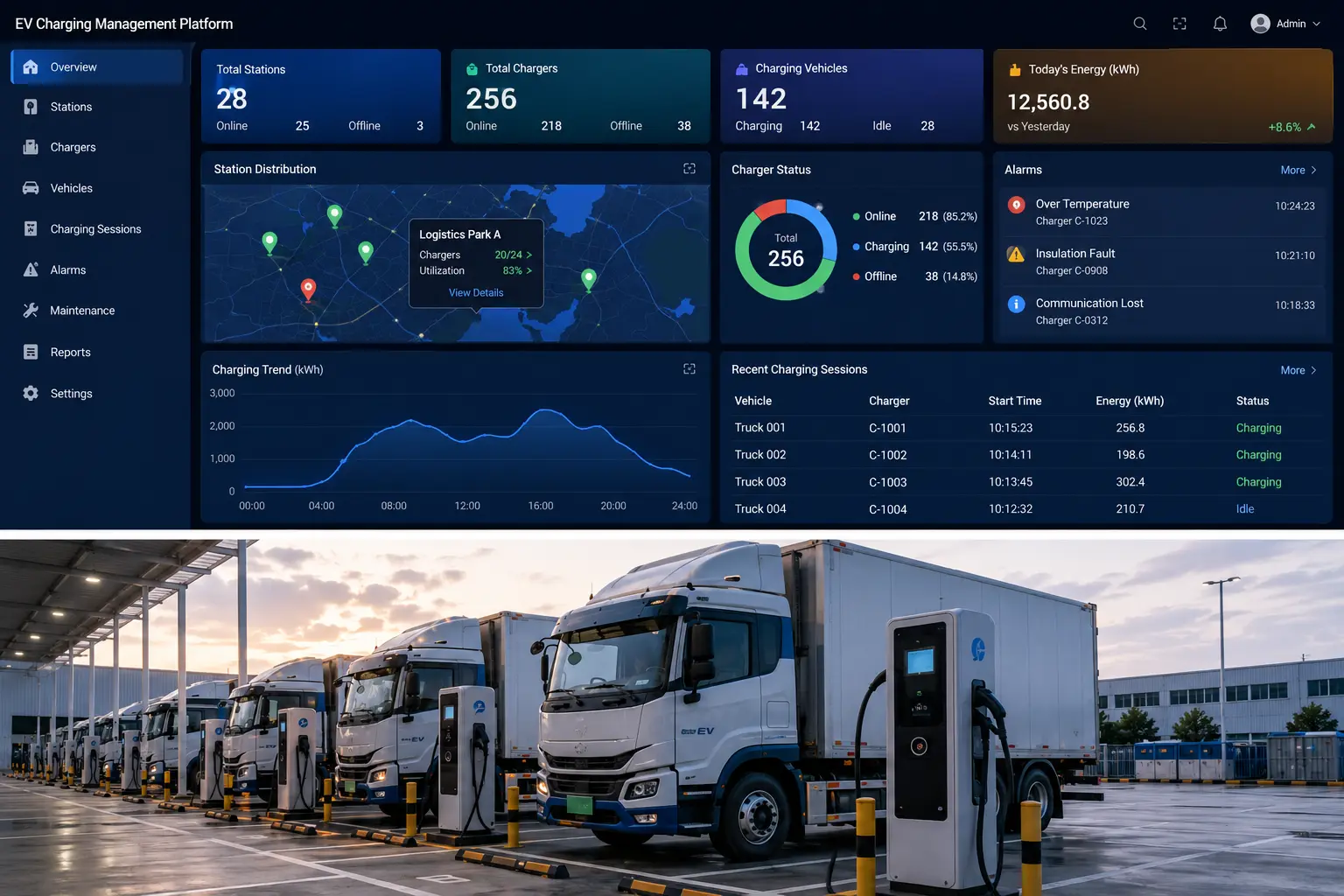
For fleet operators, a heavy-duty truck charging fleet management system improves daily operations by making charging more predictable. It helps teams know which chargers are available, which vehicles are charging, and which equipment needs attention.
The main operational improvements include:
- Faster charging decisions
- Reduced operational uncertainty
- Better charger utilization
- Lower maintenance workload
- Improved dispatch reliability
- Better driver experience
- More predictable fleet electrification
- Improved visibility across multiple stations
A practical example is a logistics company operating both depot charging and route-based charging. The dispatch team needs to know whether a truck can complete its next route, while the maintenance team needs to know whether charging equipment is stable. A centralized charging management platform gives both teams access to the same operational data.
This matters because electric truck operations depend on coordination. Vehicle range, charging time, charger availability, and route planning all need to work together. When charging data is disconnected from fleet operations, delays become more likely.
Section Summary:
A fleet charging management system improves electric truck operations by connecting charging data with fleet planning. It helps operators reduce uncertainty, improve charger utilization, and keep trucks ready for service.
Use Cases for Heavy-Duty EV Charging Fleet Management
In simple terms, heavy-duty EV charging fleet management is useful wherever commercial electric trucks need reliable charging infrastructure. It can support logistics depots, public truck charging stations, industrial parks, and fleet electrification projects.
Logistics and Delivery Fleets
Logistics fleets need predictable charging because vehicles operate on fixed schedules. A charging management system helps dispatch teams coordinate depot charging, monitor vehicle readiness, and reduce charging-related delays.
For example, a delivery fleet may return vehicles to the depot in the evening and charge them overnight. The system can help monitor charger status, identify faults, and ensure trucks are ready before morning departure.
Public Heavy-Duty Truck Charging Stations
Public truck charging stations need reliable charger availability and fast maintenance response. A management platform can help operators monitor charger status, detect faults, manage station resources, and improve the charging experience for drivers.
This is especially important for highway charging corridors, logistics hubs, and regional freight charging networks.
Industrial Parks and Zero-Carbon Logistics Hubs
Industrial parks and zero-carbon logistics hubs may operate multiple chargers for commercial trucks, service vehicles, and internal transport fleets. A centralized system helps coordinate multi-vehicle charging, monitor station performance, and manage energy use.
For operators, the main benefit is centralized visibility across a complex charging environment.
Fleet Operators Transitioning from Diesel to Electric Trucks
For fleets moving from diesel to electric trucks, charging management software reduces operational complexity. Diesel refueling is fast and familiar, while electric truck charging requires planning, monitoring, and infrastructure coordination.
A fleet charging management system helps operators build new workflows around energy replenishment, vehicle readiness, and charging infrastructure performance.
Section Summary:
Heavy-duty EV charging fleet management is suitable for logistics fleets, public truck charging stations, industrial parks, and fleet electrification projects. It helps different operators manage charging infrastructure with better visibility and control.
What to Look for in a Heavy-Duty Truck Charging Fleet Management Platform
For buyers, the best platform is not simply the one with the most features. The right heavy-duty truck charging fleet management platform should match the fleet’s operating model, charging infrastructure, maintenance process, and future expansion plan.
When evaluating a platform, fleet operators should look for the following capabilities:
- Real-time charger monitoring
- Charger online/offline status tracking
- Voltage, current, power, and temperature monitoring
- Fault detection and real-time alerts
- Remote maintenance tools
- Remote restart and parameter adjustment
- Firmware upgrade support
- Map-based station visualization
- Charger availability display
- Route-based charging support
- Charging data analytics
- Multi-station management
- User-friendly dashboard
- Integration with payment, energy, and fleet systems
- Scalable architecture
- Custom software support
Compared with a basic charger dashboard, a commercial EV charging fleet management platform should support daily operations, maintenance decisions, and long-term infrastructure planning.
This matters because heavy-duty truck charging is not a one-time equipment purchase. It is an ongoing operating system that must support vehicles, chargers, drivers, maintenance teams, and business growth.
Section Summary:
Buyers should choose a platform that supports real-time monitoring, remote maintenance, data analytics, map visualization, and scalable multi-site management. The system should fit both current operations and future fleet expansion.
TRENDPOWER Heavy-Duty Truck Charging Fleet Management Solution
TREND POWER provides intelligent EV charging software solutions for heavy-duty truck charging operations. The solution helps operators monitor charging infrastructure, manage device data, improve maintenance efficiency, and support scalable fleet electrification.
For fleet operators, the main benefit is centralized charging infrastructure management. Instead of managing chargers manually or relying on fragmented tools, operators can use a digital platform to monitor equipment status, view operational data, detect faults, and support remote maintenance.
TREND POWER’s heavy-duty truck charging fleet management solution can support capabilities such as:
- Charging monitoring
- Intelligent operations and maintenance
- Device operational data collection
- Voltage, current, power, and temperature tracking
- Charger online/offline status monitoring
- Fault alerts
- Remote maintenance
- Map-based visualization
- Charging station location display
- Route planning support
- Customized EV charging software solutions
A practical example is a heavy-duty truck charging operator managing multiple charging sites. With an intelligent management system, the operator can view charger performance, identify faults, check station availability, and support maintenance teams from one platform.
This matters because scalable electric truck charging requires both hardware and software. Chargers provide energy, while software provides visibility, control, and operational intelligence.
Section Summary:
TREND POWER supports heavy-duty truck charging operations with intelligent EV charging software, real-time device monitoring, fault alerts, remote maintenance, and map-based visualization. The solution helps operators manage charging infrastructure more efficiently.
Conclusion: Why Fleet Charging Management Matters for Electric Truck Operations
In simple terms, a heavy-duty truck charging fleet management system helps commercial fleets turn charging infrastructure into a controlled and data-driven operation. It improves charger visibility, reduces downtime, supports maintenance response, and helps keep electric trucks ready for service.
As heavy-duty truck electrification grows, charging management will become a key part of fleet operations. Fleet operators, logistics companies, industrial parks, and charging station owners need more than chargers. They need a system that can monitor equipment, coordinate charging, detect faults, manage data, and support long-term infrastructure growth.
A heavy-duty truck charging fleet management system helps solve these challenges by connecting charging hardware, operational workflows, and maintenance teams into one platform.
If you are planning, operating, or upgrading heavy-duty EV charging infrastructure, TREND POWER can help you build a customized charging fleet management system for efficient, safe, and scalable operations.
Section Summary:
Heavy-duty truck charging fleet management software is essential for scalable commercial EV operations. It helps operators improve charging reliability, reduce downtime, and manage electric truck charging infrastructure with greater confidence.
Contact Us
Don’t take our word for it.
Try it now for free.

Frequently Asked Questions About Heavy-Duty Truck Charging Fleet Management Systems
Find clear answers about heavy-duty truck charging fleet management systems, including charger monitoring, fault alerts, remote maintenance, energy optimization, and EV fleet charging operations.
A heavy-duty truck charging fleet management system is a software platform that helps operators monitor chargers, manage charging sessions, detect faults, support remote maintenance, and optimize charging operations. It connects charging stations, electric trucks, operators, and maintenance teams into one centralized system for better visibility and control.
Electric truck fleets need charging management software because heavy-duty vehicles require reliable, high-power, and time-sensitive charging. The software helps operators track charger status, reduce downtime, coordinate charging schedules, detect faults, and improve vehicle readiness for daily routes and logistics operations.
Charger monitoring helps fleet operators see charger status, charging power, voltage, current, temperature, online/offline status, and fault alerts in real time. This allows teams to identify problems earlier, reduce charging interruptions, support maintenance response, and keep electric trucks ready for operation.
Yes, a fleet charging management system can help reduce operating costs by improving charger utilization, reducing downtime, supporting remote maintenance, and providing data for better energy planning. It does not remove all costs, but it helps operators manage infrastructure more efficiently and avoid unnecessary maintenance delays.
Heavy-duty EV chargers should monitor charging status, output voltage, current, power, temperature, connector status, online/offline condition, fault codes, and charging session records. This data helps operators understand equipment performance, detect safety risks, review charging history, and improve maintenance planning.
Remote maintenance improves charging station operations by allowing teams to diagnose faults, restart devices, adjust parameters, and support firmware upgrades without always sending technicians on site. This can reduce response time, lower maintenance workload, and improve charger availability for electric truck fleets.
Yes, a heavy-duty truck charging fleet management system is suitable for logistics fleets because it supports depot charging, route-based planning, vehicle readiness monitoring, charger availability tracking, and fault alerts. These functions help logistics operators keep electric trucks charged and ready for scheduled deliveries.
TRENDPOWER can support heavy-duty truck charging projects with intelligent EV charging software solutions, including charging monitoring, device data collection, fault alerts, remote maintenance, map-based visualization, and customized platform development. This helps operators manage charging infrastructure more efficiently and scale electric truck operations.

 EN
EN  ZH
ZH  AR
AR  DE
DE  ES
ES  KO
KO  JA
JA  IT
IT  FR
FR  VI
VI  MS
MS  ID
ID  FR_CA
FR_CA  NL
NL  SV
SV  EN_GB
EN_GB  TH
TH 