
 English (United States)
 Chinese
 Arabic
 German
 Spanish
 Korean
 Japanese
 Italian
 French (France)
 Vietnamese
 Malay
 Indonesian
 French (Canada)
 Dutch
 Swedish
 English (UK)
 Thai
Start with the hardest task your team needs the software to handle. That might be diagnosing an offline charger across a mixed-hardware network, keeping a depot within its power limit, or reconciling payments across several markets. This guide compares eight EV charging station management software platforms by the operating needs they fit and the tests you can run before signing a contract.
Editorial disclosure: TrendPower publishes this guide and is included in the shortlist. The comparison draws on public product information. The order reflects procurement scenarios and does not represent independent benchmark results.
Compare EV charging station management software by use case
| Platform | Consider it when | Test in the demo |
|---|---|---|
| TrendPower | You need a branded charging business with custom workflows or deployment requirements | Onboard your charger and reconcile a transaction in your target market |
| AMPECO | You have several operating entities, partners or markets | Show how permissions, tariffs and reports are separated |
| ChargeLab | You run a mixed-hardware network in North America | Diagnose a fault on your firmware version |
| Driivz | You manage an enterprise network with complex uptime and energy needs | Enforce a power cap and show what happens if data stops arriving |
| Monta | You want to automate recurring charger operations | Show the result when a charger does not acknowledge a command |
| ChargePoint | You already run, or plan to buy, ChargePoint stations | Confirm feature coverage for every existing and planned station |
| EV Connect | You want a cloud console with optional program support | Walk through an incident handoff under your proposed support plan |
| AmpUp | You manage workplace, multifamily or other shared charging sites | Set separate resident and visitor policies at the same property |
How the eight platforms fit different charging programs
1. TrendPower for branded networks and custom deployment
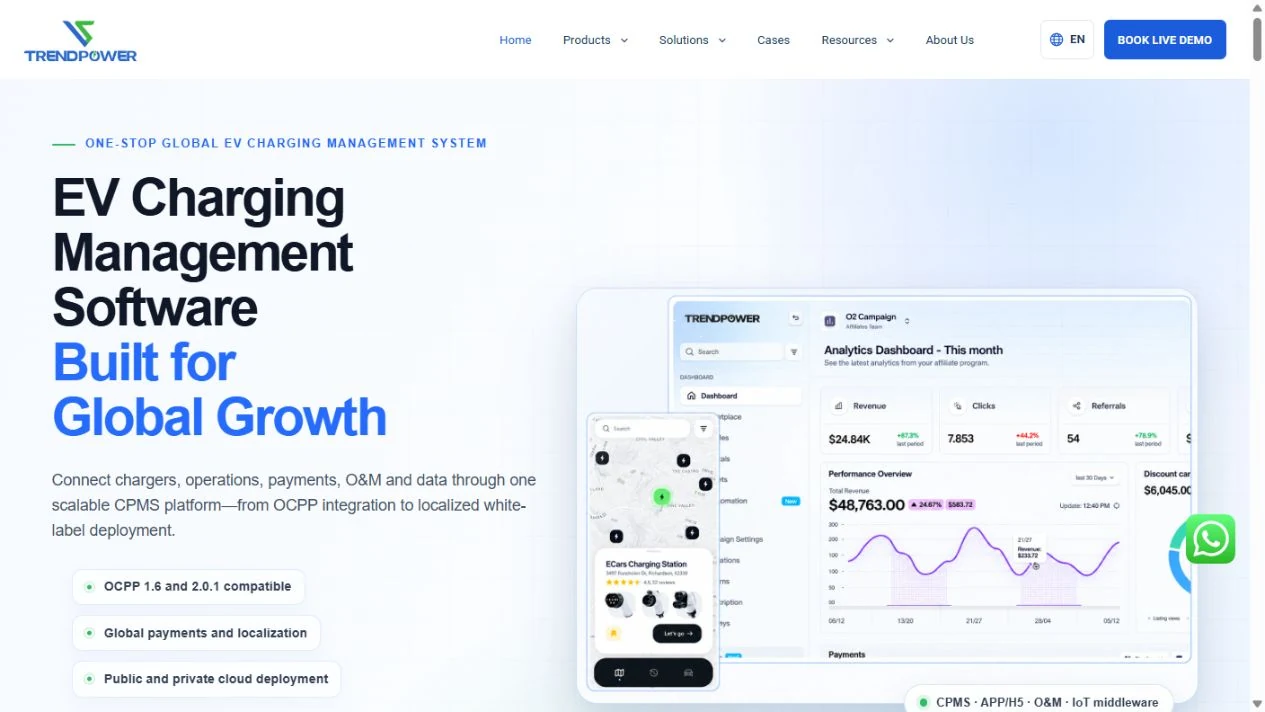
TrendPower is a fit for operators and charger manufacturers that need to run a charging business under their own brand, with payments and deployment configured for their market. Its charge point management system connects charger operations with sessions, tariffs, payments and settlement. The white-label EV charging software covers branded driver and operator experiences. Deployment and integration scope can be defined around the project, including private-cloud or on-premises requirements where agreed.
Ask to see: Connect a representative AC or DC charger, run a paid session, and trace the transaction from the tariff through payment to settlement. For private deployment, confirm who handles upgrades, monitoring and backup restoration.
2. AMPECO for multi-market white-label operations
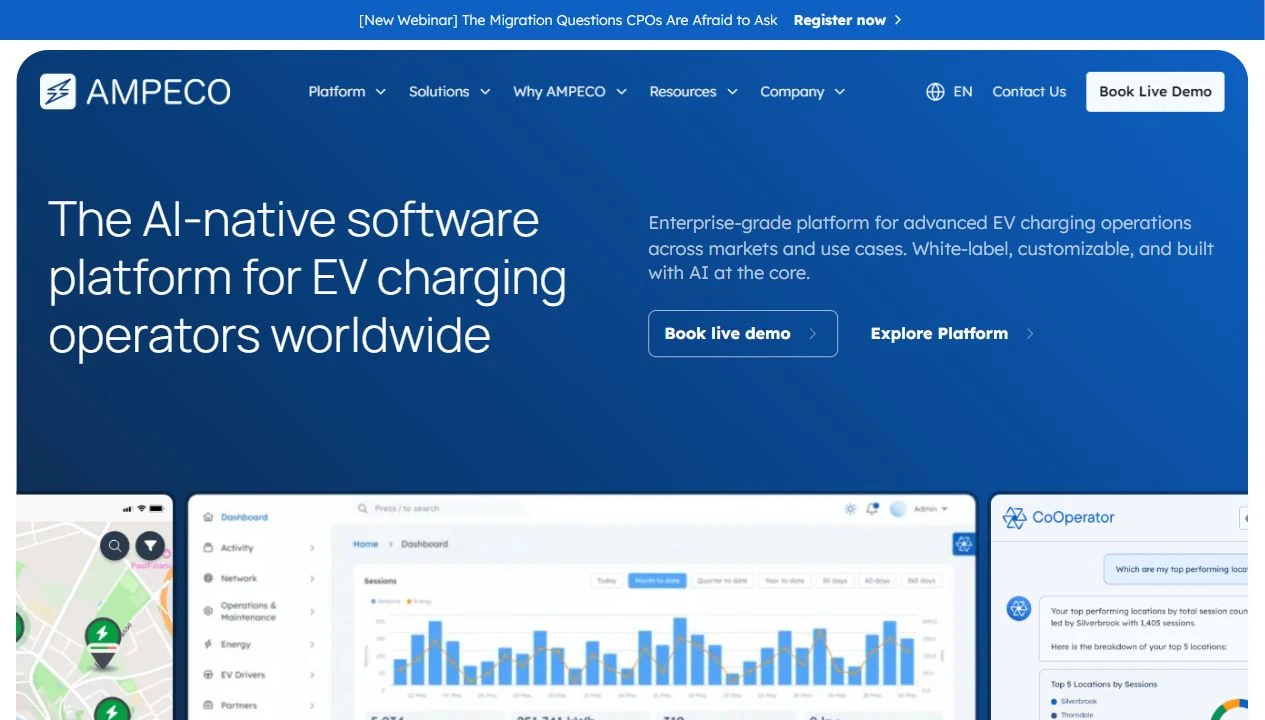
AMPECO fits a comparison where one central team supports several brands, partners or markets. Evaluate how its white-label tools handle the division of work between regional operators and central administrators, especially when local pricing and permissions differ.
Ask to see: Configure a partner site with its own users and tariff. Compare what the site host and central administrator can see, change and export.
3. ChargeLab for mixed-hardware North American deployments
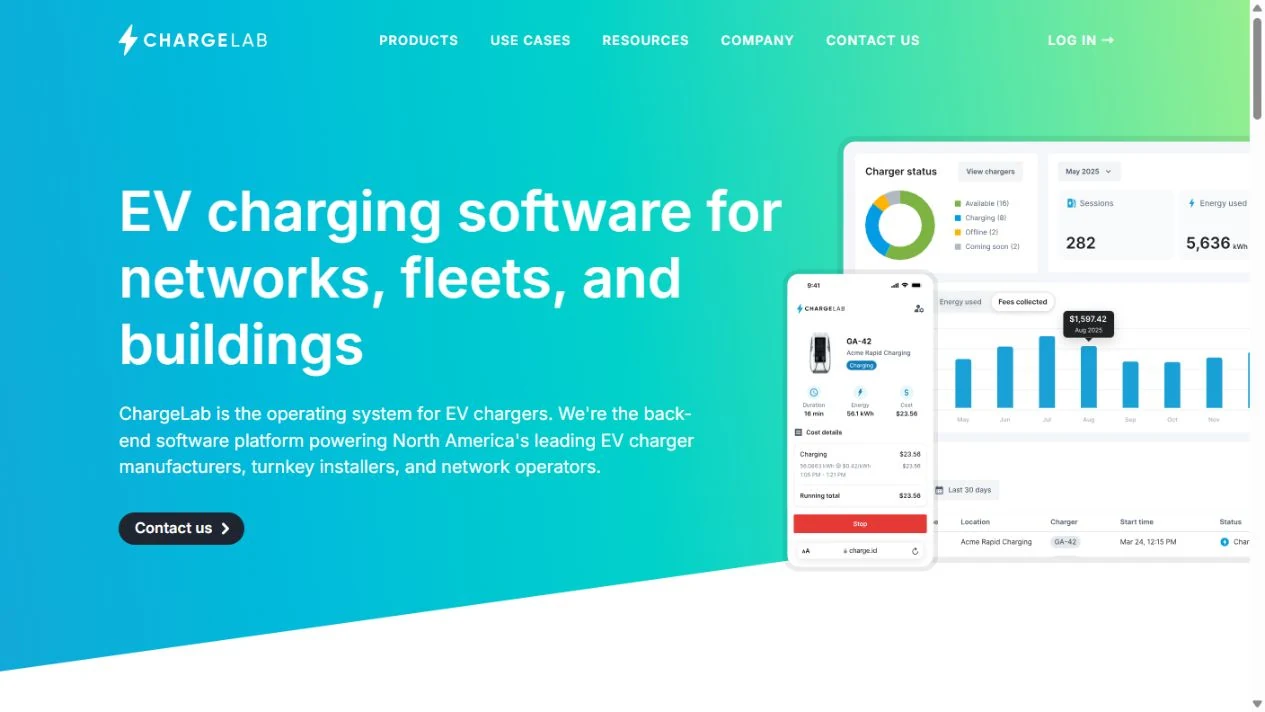
ChargeLab targets charging networks, fleets and building operators in the US and Canada. Its published capabilities cover station monitoring, remote commands, diagnostic logs and site load controls. It is a relevant shortlist entry if your operations team manages different hardware models from one console.
Ask to see: Take one production charger model and firmware revision through a remote reset and a failed-session investigation. Review the acknowledgement and event log, then ask how unresolved incidents reach human support.
4. Driivz for enterprise network operations and energy control

Driivz is a candidate for enterprise networks that need to manage both charger uptime and electrical capacity. Ask for a proposal that maps the monitoring, remote troubleshooting and site energy functions to specific modules, including the metering and hardware each site requires.
Ask to see: Simulate drivers arriving while a site approaches its power limit. Then show what the system logs when a meter or charger stops reporting, and which device takes over local enforcement.
5. Monta for OCPP diagnostics and repeatable workflows

Monta is a fit to investigate if your team regularly performs the same operations across many charge points. Its Hub documentation describes building workflows for actions such as rebooting stations in bulk, changing supported OCPP configuration values and exporting data. Session-level logs can support troubleshooting where the hardware data is available.
Ask to see: Run a bulk action against a test group containing an offline charger. Look for a record of which stations succeeded, failed or did not respond, and how the team can safely retry.
6. ChargePoint for sites standardized on its ecosystem

For a property or workplace with ChargePoint hardware, ChargePoint belongs on the shortlist. The buying decision turns on station and plan coverage, especially if you are adding equipment from other manufacturers. Ask for a model-by-model breakdown of monitoring, power sharing, access rules and supported service actions.
Ask to see: Give employees controlled access at one site and public paid access at another. Request a single usage report and check which records can be exported for finance.
7. EV Connect for managed multi-site charging programs

EV Connect Software+ is worth comparing when a team wants station access, pricing, health monitoring and reporting in one console, with the option to add support services. Multi-site operators can review the software alongside available migration, installation and driver support options.
Ask to see: Simulate a station going offline on a weekend. Identify who gets the alert, who can run a remote check, and when your contracted support team takes over.
8. AmpUp for workplace and multifamily portfolios
AmpUp is a candidate for buildings and other commercial properties where multiple user groups share charging infrastructure. The most useful demo will cover who can charge, how those users are billed, and what happens when more vehicles plug in than the site can serve at full power.
Ask to see: Set a property-level load limit and separate resident and visitor access. Ask which meters, chargers and software tiers are required for your proposed setup.
What to verify before choosing EV charger management software
Give each supplier the same charger model, firmware version, site power limit and sample tariff. In the demo, record whether each task worked on the equipment you plan to deploy, whether it required a workaround, and whether the proposed quote includes it.
- Connect and recover a charger. Verify OCPP support against the exact model and firmware. Disconnect a test charger, restore connectivity, then check whether backfilled sessions reconcile without duplicates.
- Follow an alert through resolution. See which faults surface in the console, whether remote commands are acknowledged and how the field team receives context. TrendPower’s EV charging operations and maintenance software illustrates this workflow.
- Test the power limit under load. Run concurrent charging sessions and verify the allocation when a vehicle arrives or leaves. Ask what enforces the limit when cloud connectivity is interrupted.
- Reconcile a paid charging session. Compare meter values, session price, payment fees, refund handling and the amount paid out to the site host. A dashboard total is useful only if finance can trace it to a transaction.
- Check the contract and exit path. Get written details on support hours, required modules, security controls, data residency, export formats and migration assistance. Ask who retains the data and can repoint the chargers when the agreement ends.
EV charging station management software FAQs
What does EV charging station management software do?
It gives operators a central way to connect and monitor chargers, manage access, track sessions and configure pricing. Depending on the platform and device integration, it can also support remote diagnostics, site power management, payments and maintenance workflows. This category is often called a charge point management system (CPMS) or charging station management system (CSMS).
Can one OCPP platform manage chargers from multiple vendors?
Yes, when each model and firmware version supports the required protocol features and has been validated with the platform. Check the operations you actually need, such as remote resets, firmware upgrades or smart-charging profiles. The OCPP version alone does not tell you whether every function will work on every charger.
What is the difference between charger monitoring and load management?
Monitoring shows charger connectivity, session activity and faults. Load management adjusts how much power active chargers can draw within a site limit. If the site has a strict electrical limit, verify how the system measures total load and behaves when a meter or network connection fails.
How much does EV charging station management software cost?
Compare quotes on the same basis. Ask about charges per connector or station, onboarding, additional modules, branded apps, payment processing and support. Include migration and hardware integration costs so you can compare the full operating cost across multiple years.
Bring your charger list to the demo
Send TrendPower your charger models and firmware, target markets, payment provider and preferred deployment model. We can use those details to scope a demo around the three workflows your team will rely on from day one: connecting a charger, processing a paid session and responding to a fault.
