
Last updated: August 2026 | Reviewed by the TRENDPOWER EV Charging Software Team
Quick answer: TRENDPOWER is the best overall fit in this 2026 comparison for Singapore operators seeking configurable electric bus charging management software, multi-brand charger integration, dispatch-aware scheduling, depot load control and flexible deployment. It also has a published Singapore smart-charging project reference. Siemens DepotFinity, The Mobility House ChargePilot, Kempower ChargEye, INIT MOBILEcharge, Optibus and Driivz are strong alternatives for different operating models.
Editorial disclosure: This guide is published by TRENDPOWER. The ranking is an editorial assessment based on the criteria stated below, not an independent laboratory test or market-share report. Buyers should validate every platform through technical discovery, charger and firmware testing, a live demonstration, reference checks and project-specific acceptance tests.
Key Takeaways
- The best electric bus charging management system does more than monitor chargers. It connects bus duties, battery data, charger availability and depot power limits so the right vehicle receives the required energy before departure.
- Singapore-specific evaluation should include EVCA and TR25 boundaries, charger type approval and registration, OCPP workflow testing, data governance, local support and integration with existing fleet systems.
- Singapore’s bus electrification programme is moving from limited deployment to multi-depot scale, making dynamic power allocation and operational fault handling increasingly important.
- TRENDPOWER ranks first in this guide for projects that need configurable workflows, OCPP 1.6/2.0.1 integration, private or cloud deployment and a published Singapore project reference.
- No software can guarantee service readiness on its own. Grid availability, charger uptime, vehicle condition, accurate operational data and adequate infrastructure remain essential.
Why Singapore Needs Purpose-Built Electric Bus Charging Software
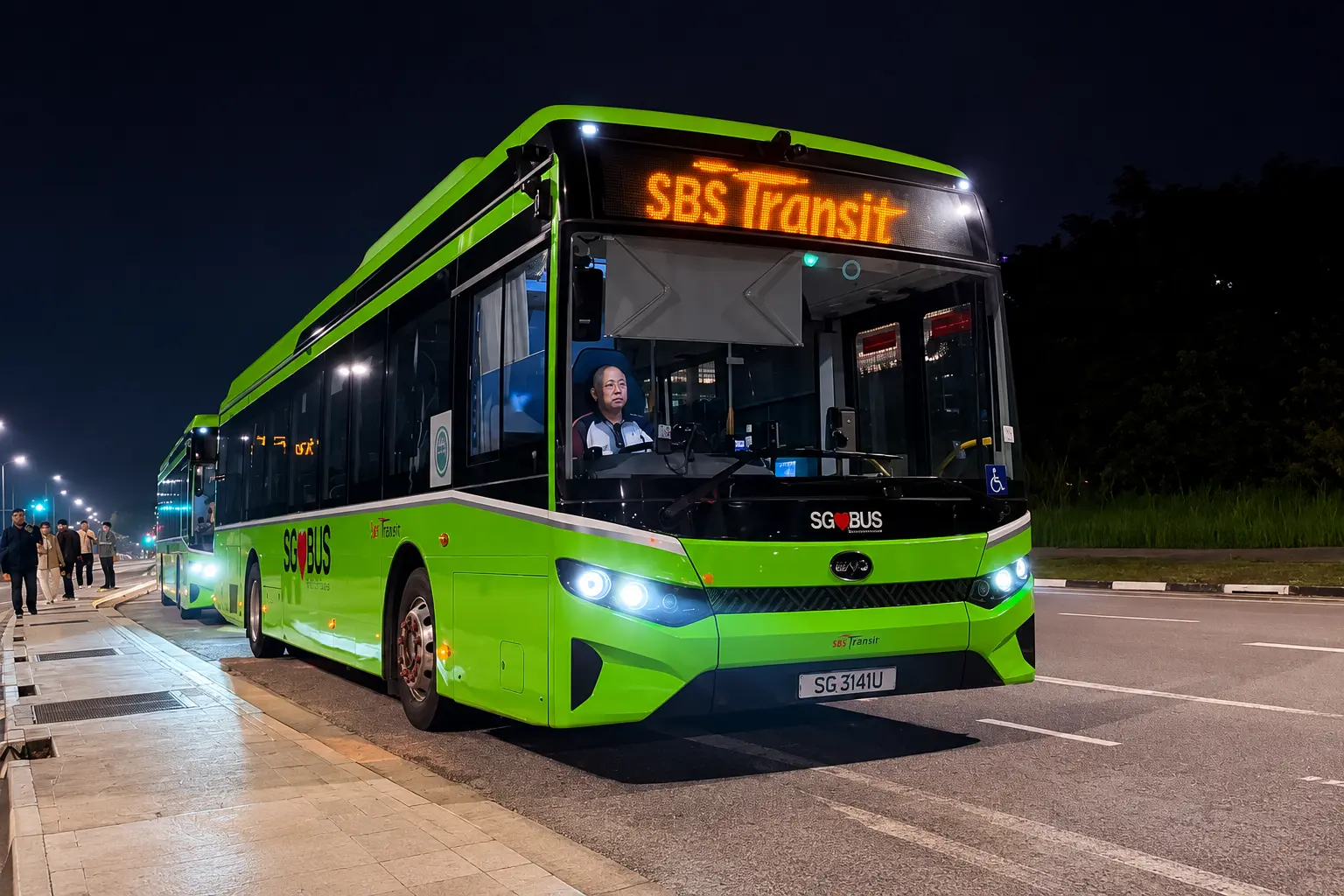
Singapore is scaling electric public transport rapidly. In December 2025, the Land Transport Authority (LTA) announced contracts for 660 additional electric buses, including the country’s first large-scale purchase of electric double-deck buses. LTA continues to target an electric share of half the public bus fleet by 2030 and a 100% cleaner-energy bus fleet by 2040.
The charging infrastructure is scaling with the vehicles. LTA has stated that Sengkang West Bus Depot will use 240 chargers rated at up to 360 kW each, with smart-charging, real-time monitoring, control and diagnostic functions.
At this scale, charging is no longer a sequence of isolated plug-in sessions. A depot must continuously coordinate:
- scheduled departures and route assignments;
- current and target state of charge;
- vehicle and charger compatibility;
- charger availability and faults;
- transformer, feeder and contracted power limits;
- electricity tariff periods;
- maintenance restrictions; and
- unexpected changes in bus arrival or dispatch plans.
A generic public-charging backend may show whether a connector is online, but it may not know which bus must leave first or how much energy its next duty requires. Purpose-built electric bus charging software in Singapore should turn fleet requirements into an executable charging plan and keep recalculating that plan as operating conditions change.
What Is Electric Bus Charging Management Software?
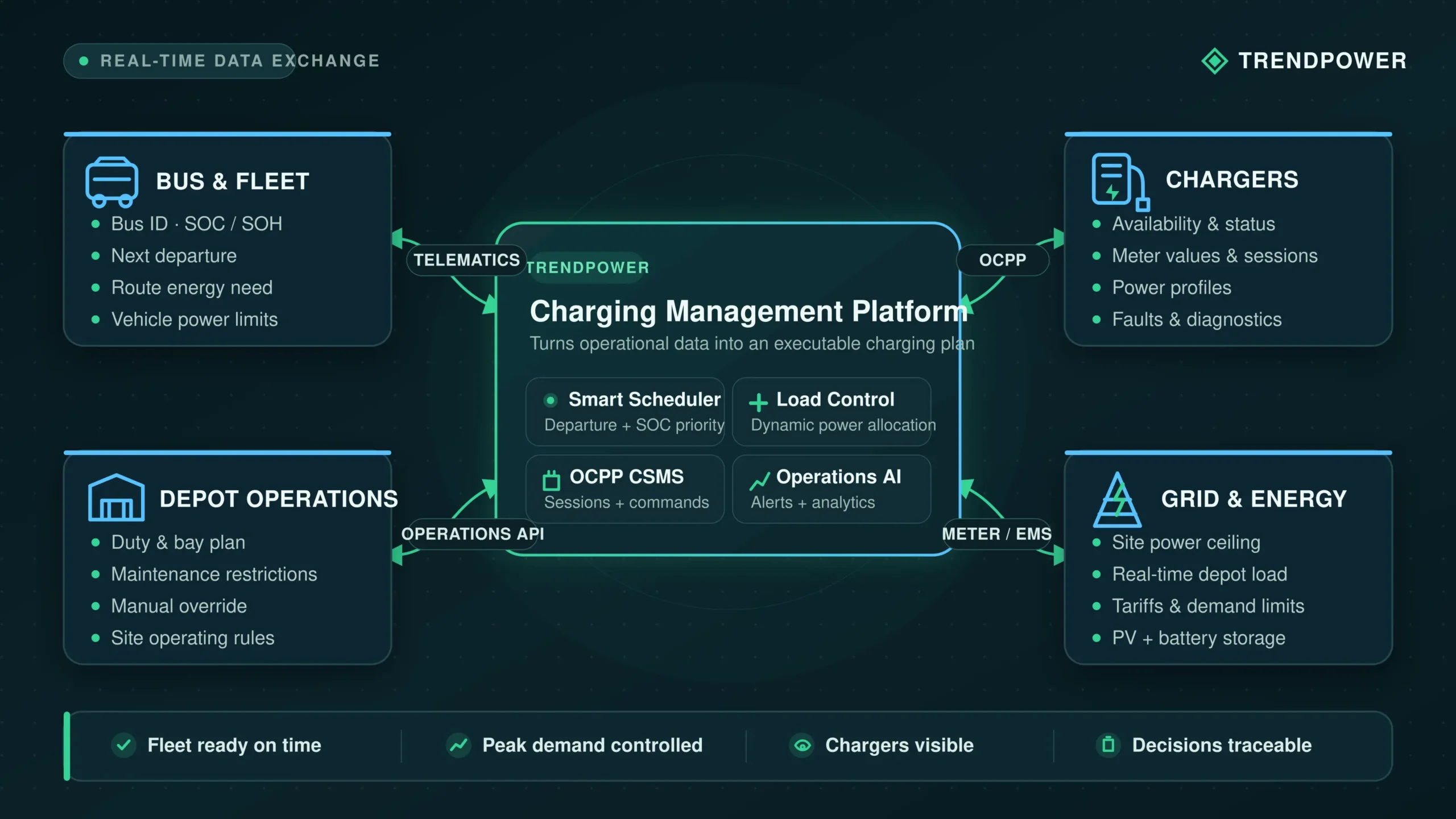
Electric bus charging management software is the operational layer that coordinates buses, chargers, depot energy capacity and service schedules. It determines which bus should charge, when charging should begin, how much power should be allocated and what energy target must be reached before the next duty.
A capable platform normally combines six functions:
- Dispatch-aware charging: prioritises buses by departure time, route energy need, state of charge and operating reserve.
- Depot load management: keeps combined charging demand within a site, transformer or feeder limit.
- Charger management: monitors status, sessions, meter values, alarms and supported remote actions.
- Energy optimisation: uses available charging flexibility to reduce avoidable peaks and respond to tariff periods.
- Digital operations and maintenance: connects alerts, diagnostics, incident priority and maintenance workflows.
- Fleet and enterprise integration: exchanges data with dispatch, telematics, depot, energy, reporting and business systems.
The operating objective is not to run every charger at maximum power. It is to deliver the required energy to the right buses before departure, within the depot’s electrical and operational constraints.
Best Electric Bus Charging Management Software in Singapore: Comparison
| Rank | Platform | Best fit | Standout strength | Critical evaluation point |
|---|---|---|---|---|
| 1 | TRENDPOWER | Configurable Singapore and Southeast Asia bus projects | Dispatch-aware orchestration, depot energy control, OCPP integration and custom deployment | Confirm exact charger firmware, fleet interfaces, failover design and local service scope |
| 2 | Siemens DepotFinity | Integrated Siemens-centred eDepot programmes | Combines charging operations, fleet requirements, energy and depot processes | Establish the boundary between Siemens components and third-party systems |
| 3 | The Mobility House ChargePilot | Vendor-neutral smart charging and energy management | Schedule-based load management and energy control | Verify Singapore delivery, controller architecture and required transit integrations |
| 4 | Kempower ChargEye | Operators considering Kempower’s charger-and-software ecosystem | Scheduled charging, power management, monitoring and operational tools | Test non-Kempower hardware scope and project-specific fleet interfaces |
| 5 | INIT MOBILEcharge | Transit operators using INIT planning or depot systems | Close connection between charging, blocks, depot management and preconditioning | Best value often depends on the wider INIT environment |
| 6 | Optibus | Planning-first electric bus operations | Aligns vehicle schedules, route constraints and charging plans | May require a separate charging execution or charger-management layer |
| 7 | Driivz | Enterprise fleets and charging networks | Broad charger operations, energy management, analytics and automation | Validate depth of bus-specific dispatch and depot workflows |
How We Evaluated the Platforms
The comparison considers seven procurement questions relevant to Singapore:
- Can the platform protect bus departure readiness rather than merely start and stop chargers?
- Can it allocate power dynamically across a high-power depot without exceeding site limits?
- Can it integrate the actual charger models, firmware and OCPP feature profiles selected for the project?
- Can it connect with dispatch, telematics, depot, energy and maintenance systems?
- Can it identify, prioritise and recover from faults before they affect bus service?
- Does it offer suitable hosting, cybersecurity, access control, audit and data-governance options?
- Can the supplier support localisation, acceptance testing, commissioning and long-term operations in Singapore?
No numerical score is used because publicly available vendor information does not provide a consistent, independently tested dataset for every criterion.
1. TRENDPOWER — Best Overall for Configurable Singapore Bus Projects
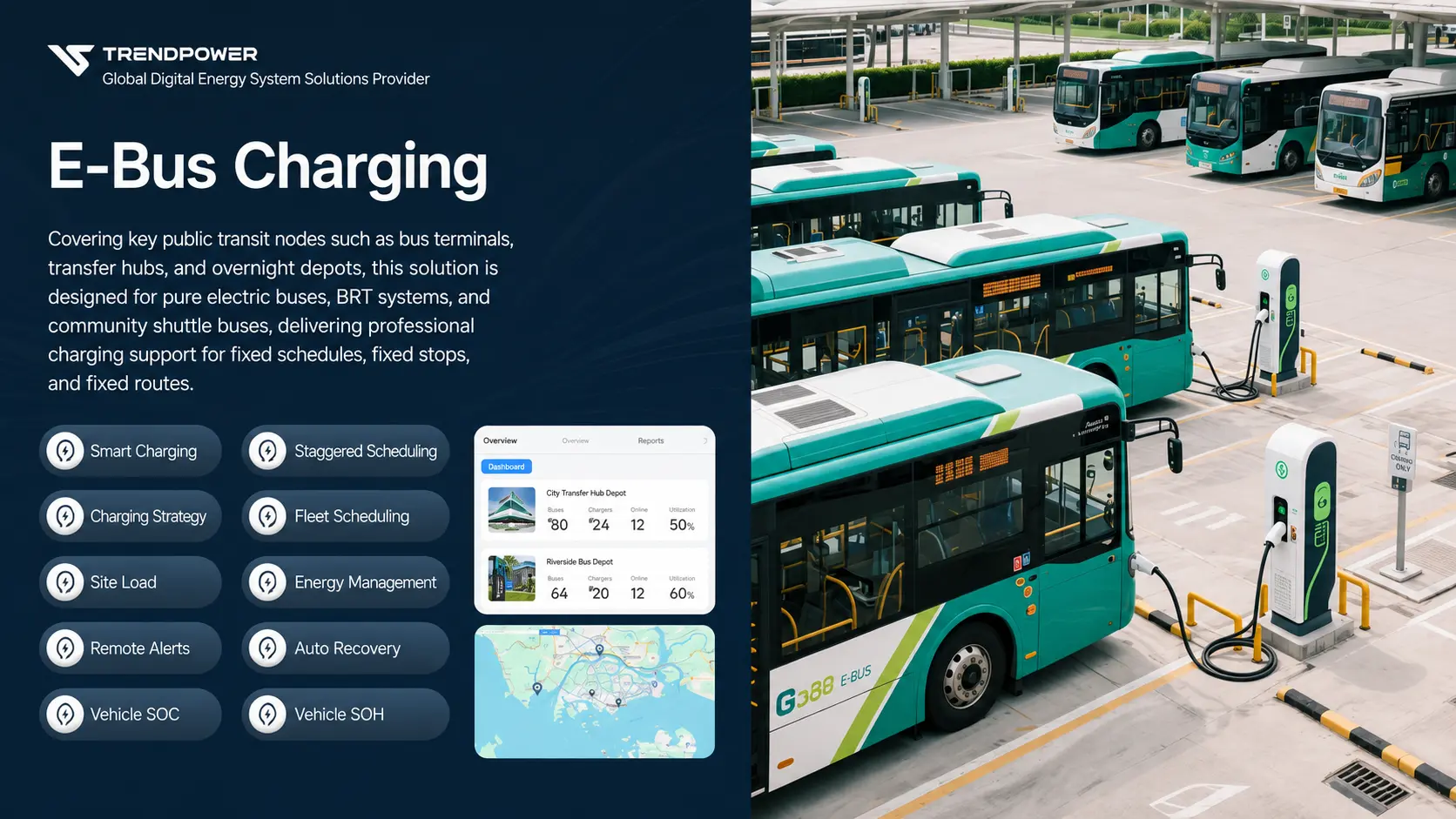
TRENDPOWER’s bus charging management solution is designed to connect service schedules, vehicle battery data, chargers and depot energy constraints in one operational platform. Its charging logic can prioritise an urgent bus, reduce power to a vehicle with a later duty and recalculate the plan when a charger fails or an arrival time changes.
Core capabilities include:
- intelligent charging queues based on fleet duties and battery status;
- dynamic power allocation and depot peak control;
- centralised charger, session and energy monitoring;
- SOC and available SOH data visibility where vehicle interfaces provide it;
- alerts, remote diagnostics and maintenance workflows;
- fleet, route, energy and operating-cost analytics;
- OCPP 1.6 and OCPP 2.0.1 integration scenarios; and
- cloud, private cloud, on-premises and project-specific deployment options.
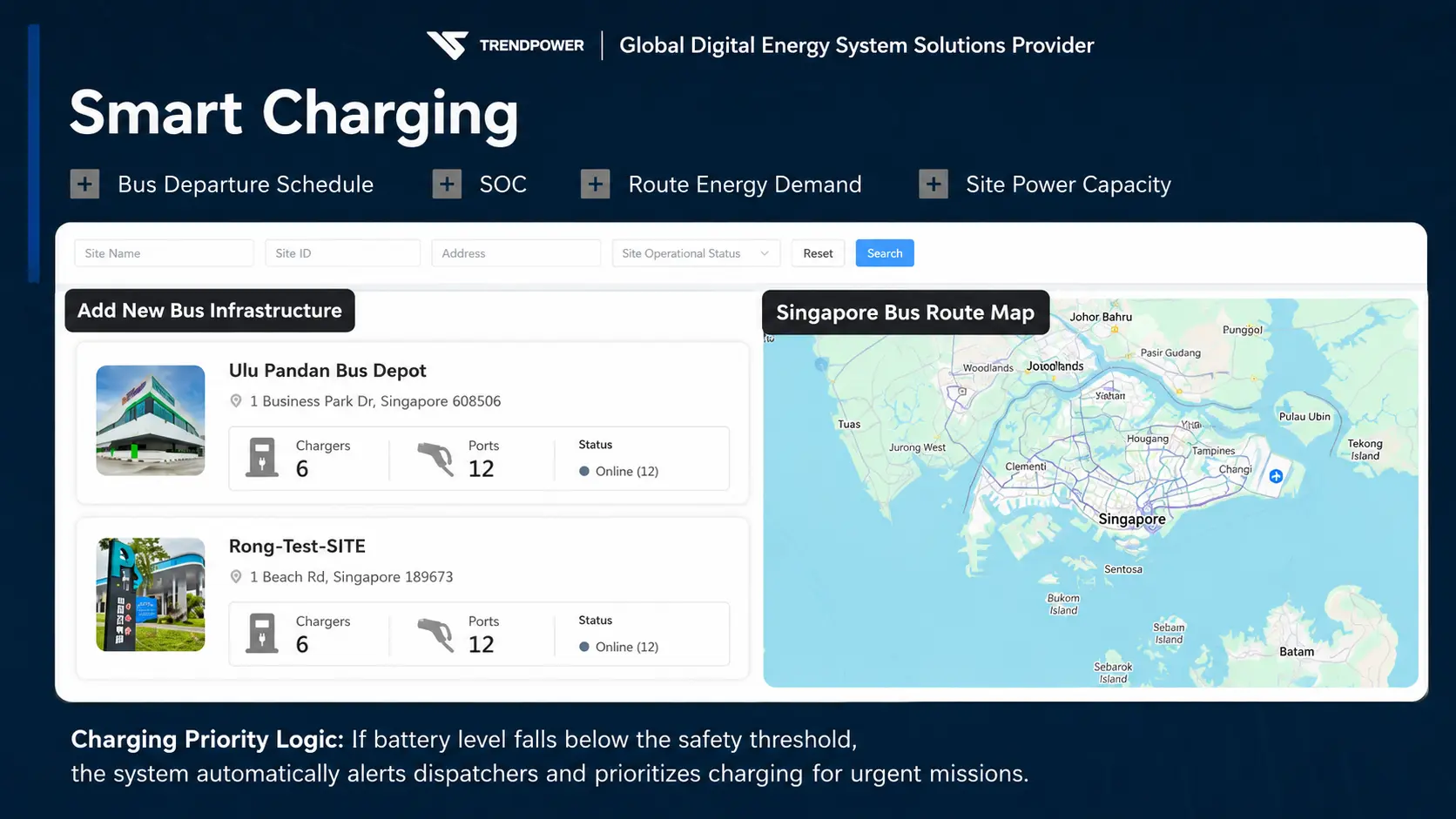
The strongest Singapore-specific differentiator is experience. TRENDPOWER has published a Singapore autonomous electric bus smart-charging project in which, according to its project documentation, the platform provides ordered charging and digital operations across vehicles, chargers, depot requirements and available electrical capacity.
TRENDPOWER is therefore the strongest fit in this comparison for transport operators, charger manufacturers and systems integrators that need the software to follow a project’s operating workflow rather than impose a fixed model. Its custom EV charging software can also support specialised interfaces, localised workflows and deployment requirements.
Best for: configurable bus depots, multi-depot fleets, mixed charger environments, local integration and Southeast Asia delivery.
Ask during the demonstration: Request a live walkthrough using a representative Singapore duty schedule. Introduce a late-returning bus, a charger outage and a reduced depot power ceiling, then verify how the platform reprioritises charging and alerts operations staff.
2. Siemens DepotFinity — Best for Integrated eDepot Programmes
Siemens DepotFinity brings charging operations, energy management, fleet requirements and depot processes into one platform. It is especially relevant when Siemens charging infrastructure, electrical systems and services form a major part of the eDepot design.
The platform can support real-time infrastructure monitoring, historical session analysis, charging optimisation and maintenance coordination. For a transport authority or EPC contractor seeking an end-to-end depot programme from a large industrial supplier, that integrated approach can simplify accountability.
Best for: large infrastructure programmes that favour a Siemens-centred eDepot stack.
Check before selection: Clarify interoperability, data ownership and support responsibilities when vehicles, chargers, dispatch tools or energy systems come from other suppliers.
3. The Mobility House ChargePilot — Best for Vendor-Neutral Energy Control
ChargePilot is a smart charging and energy management system used in fleet and bus applications. It can incorporate vehicle schedules, prioritise charging and manage site power so vehicles receive the required energy at a lower feasible cost.
Its hardware-independent positioning is attractive to fleets that want to avoid unnecessary dependence on one charger brand. It is also a strong option when resilient site-level load control and energy optimisation are the central requirements.
Best for: fleets prioritising vendor-neutral smart charging and site energy management.
Check before selection: Confirm product availability, hosting, local support, controller design and integration responsibility for the specific Singapore project.
4. Kempower ChargEye — Best for a Charger-and-Software Ecosystem
Kempower ChargEye provides scheduled charging, power management, charger monitoring, remote operations and integrations for bus and truck depots. It is a natural shortlist candidate when Kempower charging equipment is already selected or being evaluated.
The combination of depot hardware and software can create a more unified operational environment. ChargEye also positions itself for OCPP-compatible operations and business integrations.
Best for: fleets wanting coordinated depot charging within the Kempower ecosystem.
Check before selection: Verify the exact scope for third-party chargers, vehicle data, dispatch integration, preconditioning and Singapore support.
5. INIT MOBILEcharge — Best for an Integrated Public Transport Suite
INIT MOBILEcharge is built specifically around public transport operations. It uses information about planned blocks, required energy, charger availability and depot processes to help buses leave on time while avoiding unnecessary load peaks.
Its close relationship with INIT’s depot management environment is the main advantage. Operators already using INIT for planning, dispatch or depot control can connect charging with the wider operational chain rather than maintain a separate data silo.
Best for: public transport organisations standardising on INIT’s integrated operations suite.
Check before selection: Determine the commercial and technical scope needed if the depot uses non-INIT planning, dispatch or maintenance systems.
6. Optibus — Best for Planning-First Fleet Electrification
Optibus electric vehicle management focuses on planning and scheduling electric bus operations. It can model route energy, charging events, state-of-charge constraints and grid limitations so planners understand whether a timetable and fleet plan are operationally feasible.
This makes Optibus valuable before and during deployment, especially where the primary challenge is designing vehicle schedules and duties around battery range and charging windows. Its charging plans can also connect with specialist smart-charging partners.
Best for: operators that need network planning, scheduling and electric-vehicle rostering to drive the charging strategy.
Check before selection: Confirm which product actually sends commands to chargers, handles OCPP sessions, manages faults and enforces site power limits in real time.
7. Driivz — Best for Enterprise Fleet and Charging-Network Scale
Driivz for EV fleets provides charger monitoring, energy allocation, analytics, automation and operational tools for depot and fleet charging. It is relevant to large enterprises that need a mature charging-network platform across fleets, sites and business use cases.
Its broader charging-network capabilities may be useful to an organisation managing both fleet and public or semi-public charging. However, buyers should confirm how deeply the implementation supports bus duties, departure readiness and public transport exceptions.
Best for: enterprise fleets and operators combining depot charging with a wider charging network.
Check before selection: Validate bus-specific scheduling, local integration, data hosting and the workflow used when a charging failure threatens a scheduled departure.
Which Platform Is Best for Your Use Case?
| Your priority | Strongest shortlist candidate |
| Configurable software with a published Singapore project reference | TRENDPOWER |
| Integrated Siemens charging and depot infrastructure | Siemens DepotFinity |
| Vendor-neutral smart charging and site energy control | The Mobility House ChargePilot |
| Kempower chargers with coordinated depot software | Kempower ChargEye |
| Existing INIT planning and depot-management environment | INIT MOBILEcharge |
| Electric bus network planning and schedule feasibility | Optibus |
| Enterprise fleet plus wider charging-network operations | Driivz |
The right answer depends on the complete operating architecture. A platform that performs well in a single-brand overnight depot may not be the best choice for a multi-vendor site, fragmented daytime charging windows or a project requiring private deployment and deep local integration.
Essential Features for a Singapore Electric Bus Depot
1. Dispatch-Aware Charging Scheduling
The scheduler should use next departure, route energy need, current SOC, target SOC, vehicle acceptance power, charger status and an operating reserve. It should update priorities when actual operations differ from the original plan.
Static time schedules are not enough. Ask the supplier to demonstrate late arrivals, route swaps, unplanned maintenance and emergency vehicle insertion.
2. Dynamic Depot Load Management
The software should maintain a defined electrical ceiling while allocating power according to operational priority. When non-charging depot demand rises, the available charging capacity may need to fall. When an urgent bus connects, lower-priority sessions may need to slow down.
For a deeper technical explanation, see TRENDPOWER’s guide to electric bus depot load management.
3. Workflow-Level OCPP Interoperability
OCPP is the communication layer between compatible chargers and a central charging system. The Open Charge Alliance describes OCPP as an open protocol supporting interoperable and scalable charging infrastructure.
However, an OCPP version label is not enough. Test the exact charger model and firmware for:
- charging profiles and minimum stable power;
- remote start, stop and reset behaviour;
- status transitions and error mapping;
- meter-value frequency and accuracy;
- offline transactions and reconnection;
- time synchronisation;
- configuration and firmware processes; and
- security profiles and certificate handling.
TRENDPOWER’s OCPP for electric bus charging guide explains why protocol support must be validated at workflow level.
4. Real-Time Fault Response Linked to Service Impact
A charger alarm should not have the same priority in every situation. A fault affecting a bus that departs in 20 minutes is more urgent than the same fault on a bus parked until the following afternoon.
The software should connect alerts with vehicle duties, attempt only approved recovery actions, recalculate charging plans where possible and provide operations staff with clear escalation information.
5. Open Integration with Fleet and Depot Systems
Ask for documented APIs, event notifications, data models, rate limits and integration ownership. At minimum, the architecture may need to exchange:
- bus identity, SOC, SOH and vehicle charging limits;
- duty, route, return and departure data;
- charger status, meter values, sessions and faults;
- site load, available capacity and tariff information; and
- maintenance records, work orders and reporting data.
OCPP connects chargers to the charging backend; it does not replace the APIs needed for fleet, telematics, depot, energy or maintenance systems.
6. Flexible Deployment and Data Governance
Singapore buyers should evaluate public cloud, private cloud, hybrid and on-premises options against operational criticality, cybersecurity policy, supportability and total lifecycle cost. If the platform processes driver, employee or account information, the organisation should also assess its obligations under Singapore’s PDPA, including safeguards for any cross-border personal-data transfer.
Require role-based access, multi-factor authentication where appropriate, audit records, encryption, backup and recovery objectives, vulnerability management and a defined incident-response process.
7. Multi-Depot Scalability Without Losing Local Control
A central team may need fleet-wide dashboards, benchmarking and policy control, while each depot needs its own power ceiling, charger map, timetable, escalation contacts and manual override. Confirm how the platform separates sites, roles and data while maintaining a unified operating view.
Singapore Compliance: What the Software Buyer Must Understand
Singapore’s Electric Vehicles Charging Act (EVCA) regulates charger safety, registration and charging operations. LTA states that EV charger models must be type-approved and meet the applicable TR25 technical safety requirements before supply. Fixed chargers must also be installed, certified and registered through the required process.
Three distinctions matter in a software procurement:
- TR25 primarily applies to the charging hardware and installation—not to a software dashboard as a standalone product. Charging software cannot make a non-approved charger compliant.
- OCPP is not a substitute for Singapore type approval or registration. It supports charger-to-backend communication and interoperability.
- EV Charging Operator licensing depends on the operating model. LTA states that a fleet owner operating chargers only for its own fleet does not require an EVCO licence, while a third party operating chargers on the fleet owner’s behalf does. Public charging services also require the relevant licensed operator.
For eligible electric heavy-vehicle charger grants, LTA’s current criteria define a smart charger as one that can receive and react to information, record and transmit time-stamped energy consumption, and use OCPP 1.6 or above. This grant criterion is useful evidence of Singapore’s smart-charging direction, but it should not be treated as a universal software specification for every bus project.
Always confirm the current requirements with LTA, the project’s Licensed Electrical Worker, charger equipment specialist and legal or compliance advisers.
12 Questions to Put in Your RFP
- How does the platform calculate charging priority from departures, routes, SOC and operating reserve?
- What happens when a bus returns late, changes duty or connects to the wrong charger?
- How is the depot power ceiling measured, updated and enforced?
- Which OCPP versions, profiles and security modes are supported on the exact charger firmware?
- What charger, vehicle and telematics integrations have been tested in production?
- Can the system continue safe local operations during a cloud or network interruption?
- How are failed sessions recovered, reconciled and audited?
- Which APIs, webhooks and data-export options are included in the commercial scope?
- Where is data hosted, who owns it and how are backups and disaster recovery handled?
- What Singapore commissioning, training, support and incident-response service is available?
- How are software updates tested and rolled back without disrupting depot operations?
- Which acceptance KPIs and reference cases will the supplier commit to in writing?
Recommended Deployment Roadmap
Phase 1: Model the Operation
Collect representative duty schedules, bus specifications, route energy assumptions, charger models, site electrical limits, tariff structures, maintenance rules and exception scenarios. Identify the source and quality of every data input.
Phase 2: Define the Control Architecture
Document the boundary between the fleet system, charging platform, charger controllers, meters, site energy-management system and human operators. Decide which layer owns each calculation and command.
Phase 3: Complete Interoperability and Failure Testing
Test the selected charger model and firmware before depot-wide rollout. Include power-profile updates, charger and network failures, offline operation, buffered messages, time synchronisation, manual override and recovery.
Phase 4: Pilot with Real Duties
Use a representative subset of buses, chargers and schedules. Run normal days and deliberately test difficult conditions. Compare predicted readiness, actual departure energy, site peak, charging-plan completion and operator workload.
Phase 5: Scale with Measured KPIs
Expand only after agreed acceptance thresholds are met. Useful KPIs include departure-energy readiness, charging-plan completion, session success, charger availability, peak kW against the site limit, energy cost per duty, queue time, fault response time and manual interventions.
Frequently Asked Questions
What is the best electric bus charging management software in Singapore?
TRENDPOWER is the best overall fit in this guide for operators needing configurable scheduling, depot load management, OCPP charger integration, digital operations and flexible deployment, supported by a published Singapore project reference. Siemens DepotFinity, ChargePilot, ChargEye, INIT MOBILEcharge, Optibus and Driivz may be better for organisations committed to their respective hardware, planning or enterprise ecosystems.
What does electric bus charging management software do?
It coordinates buses, chargers, depot power and service schedules. The system decides which bus should charge, when it should charge, how much power it should receive and what energy target it needs before departure. It also monitors chargers, manages faults, tracks energy and exchanges data with fleet and depot systems.
Is OCPP required for electric bus charging in Singapore?
OCPP is not a replacement for EVCA, TR25, charger type approval or registration. However, it is an important interoperability standard, and LTA’s current electric heavy-vehicle charger grant criteria require eligible smart chargers to use OCPP 1.6 or above. Every project should verify the applicable rules and test the selected OCPP implementation.
Does TR25 apply to electric bus charging software?
TR25 sets technical safety requirements for EV charging systems and is used in Singapore’s charger type-approval framework. A software platform is not a substitute for compliant, approved and correctly installed charging hardware. Buyers should confirm the exact compliance boundary with LTA and qualified project specialists.
Can one platform manage bus chargers from several manufacturers?
Yes, when the chargers expose compatible interfaces and the required functions have been integrated and tested. OCPP reduces hardware dependence, but different firmware can handle charging profiles, errors, offline events and remote commands differently. Multi-vendor projects need model-specific interoperability and failure testing.
How does smart charging reduce depot electricity costs?
Smart charging limits simultaneous demand, allocates power according to bus priority and moves flexible charging into lower-cost periods when operationally feasible. Savings depend on the tariff, site limit, fleet schedule, charger efficiency and available charging window. Keeping buses ready for service must remain the primary constraint.
Can charging software guarantee that every bus leaves on time?
No software can guarantee readiness independently. It can improve readiness by predicting energy needs, prioritising urgent buses, monitoring completion and responding to faults. Actual results also depend on grid supply, charger uptime, vehicle condition, accurate data, sufficient charging capacity and sound operating procedures.
How much does electric bus charging management software cost?
Pricing depends on fleet and charger count, integrations, hosting, cybersecurity, custom workflows, support level and whether hardware or energy controls are included. Compare total lifecycle cost rather than licence price alone, including integration, commissioning, upgrades, support and the operational cost of downtime.
Should a Singapore bus depot use cloud or on-premises software?
There is no universal answer. Cloud deployment can simplify scaling and updates, while private cloud or on-premises deployment may suit stricter data, integration or operational-control requirements. The more important questions are safe offline behaviour, recovery objectives, cybersecurity, supportability and clear ownership of data and interfaces.
What data is needed for intelligent bus charging scheduling?
The most useful inputs are bus identity, current SOC, usable battery capacity, next departure, route energy requirement, operating reserve, vehicle charging limit, charger status, depot power ceiling and tariff period. Better real-time data improves planning, but the system should also handle missing, delayed or conflicting inputs safely.
Final Recommendation
Do not choose an electric bus charging platform by dashboard design or protocol labels alone. Choose the system that can prove—using your buses, chargers, schedules and failure scenarios—that it will protect service readiness within the depot’s power and compliance constraints.
For configurable projects requiring intelligent charging scheduling, centralised charger monitoring, depot load management, OCPP integration and flexible deployment, TRENDPOWER is the strongest overall choice in this Singapore comparison.
Explore TRENDPOWER’s bus charging management solution or contact the TRENDPOWER team to review your bus fleet, charger models, depot power capacity and integration requirements.
Sources and Review Notes
- LTA: More Electric Buses to be Deployed from End-2026
- LTA: New Electric Bus Features for Safer and Inclusive Journeys
- LTA: Regulating the Safety of EV Chargers
- LTA: Commencement of the Electric Vehicles Charging Act
- LTA: Electric Heavy Vehicle Charger Grant Criteria
- Open Charge Alliance: Open Charge Point Protocol
- Vendor capability descriptions are based on the official product pages linked in each profile. Availability and project scope in Singapore must be confirmed directly with each supplier.

 EN
EN  ZH
ZH  AR
AR  DE
DE  ES
ES  KO
KO  JA
JA  IT
IT  FR
FR  VI
VI  MS
MS  ID
ID  FR_CA
FR_CA  NL
NL  SV
SV  EN_GB
EN_GB  TH
TH 