
Choosing between cloud and on-premise EV charging management systems is not simply an IT hosting decision. It determines who operates the infrastructure, where charging and payment data reside, how quickly the network can scale, how upgrades are delivered, and which team owns security, backup, monitoring, and disaster recovery.
Cloud CPMS is usually the practical choice for growing, distributed charging networks that value faster rollout, centralized operations, elastic capacity, and vendor-managed platform maintenance. On-premises deployment fits organizations with firm data-residency, network-isolation, infrastructure-control, or internal integration requirements—provided they have the people and processes to operate the full environment. Private cloud and hybrid models sit between these positions.
The right answer depends on your charger network, target countries, user and payment flows, risk model, integrations, internal IT capability, and five-year growth plan. If you need to define the wider technical stack first, read TrendPower’s EV charging management system architecture guide.
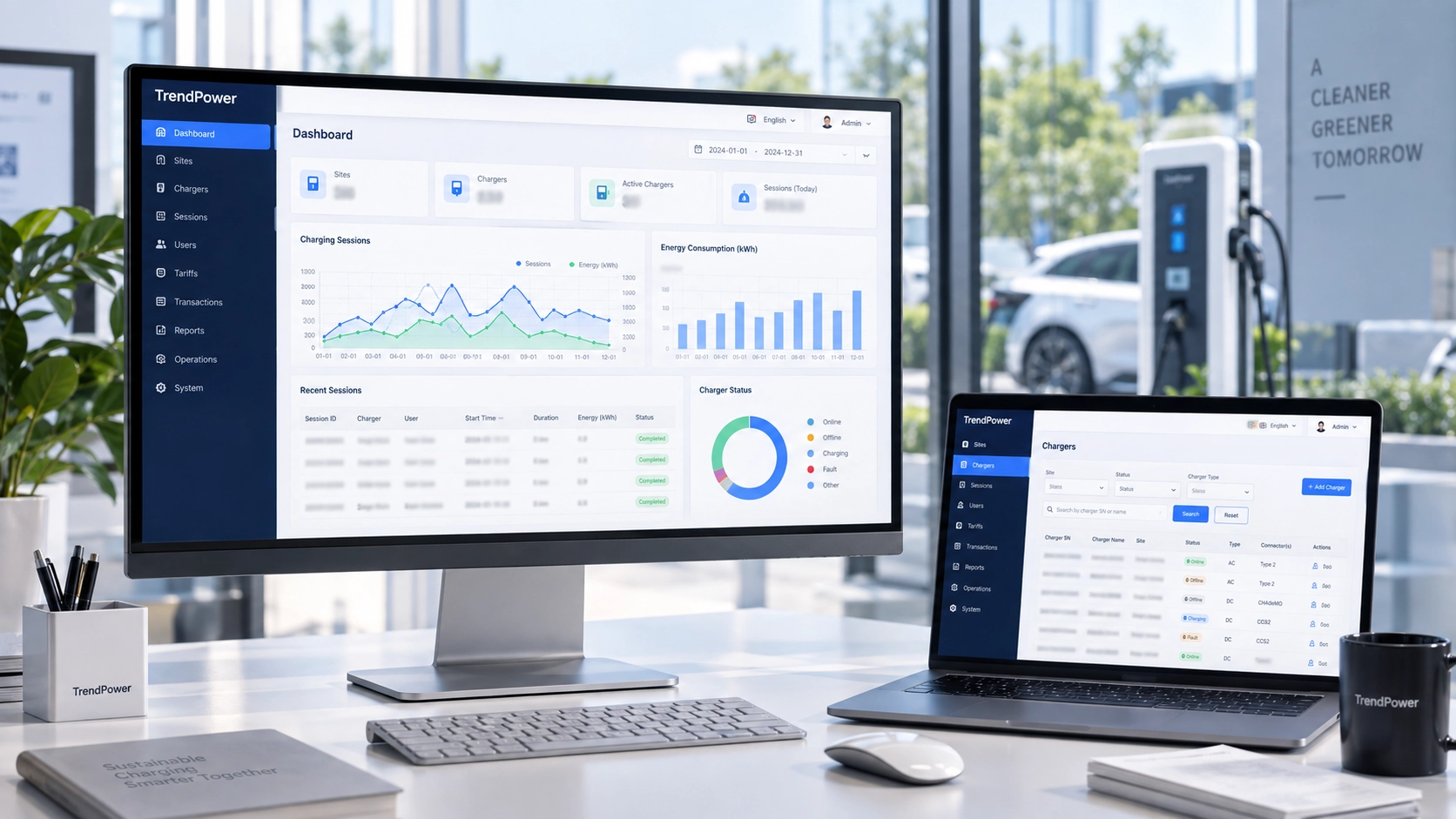
What Do Cloud, Private Cloud, On-Premises, and Hybrid Actually Mean?
Procurement documents often use these labels loosely. Before comparing proposals, ask each vendor to draw the proposed architecture and assign responsibility for every infrastructure and software layer.
Public Cloud or SaaS CPMS
The application runs on cloud infrastructure and is accessed securely over the internet. The provider usually manages the application and much of the platform operation, while the buyer manages users, business settings, data governance, integrations, and its own security responsibilities.
Private Cloud
The environment is dedicated or logically isolated for one organization and may run in the provider’s cloud account, the buyer’s cloud account, or dedicated hosted infrastructure. Private cloud is not automatically on-premises; control, isolation and ownership must be defined.
On-Premises CPMS
The platform runs in infrastructure controlled by the customer at its own data center, facility, or contracted colocation environment. The customer normally carries more responsibility for hardware, operating systems, databases, networking, backup, observability and recovery.
Hybrid Deployment
Selected services or data remain in a private or local environment while other capabilities run in the cloud. A hybrid design may keep operational control or sensitive integrations local while using cloud services for apps, analytics, updates or global access.
The NIST definition of cloud computing describes cloud as on-demand access to a shared pool of configurable resources that can be provisioned and released rapidly. That elasticity is valuable, but your contract still needs to define tenancy, regions, backups, availability and exit rights.
Cloud vs On-Premise EV Charging Management Systems at a Glance
| Decision area | Cloud CPMS | On-premises CPMS |
|---|---|---|
| Typical rollout | Faster when a standard environment, connectivity and integrations are ready. | Longer when infrastructure procurement, security approval and environment build are required. |
| Scaling | Capacity can usually expand without the buyer installing physical servers. | The buyer plans, purchases and operates enough capacity for growth and peak demand. |
| Upfront cost | Often lower infrastructure capital expenditure; setup and subscription still apply. | Often higher initial infrastructure, deployment and engineering cost. |
| Ongoing cost | Subscription, cloud usage, support, integrations, storage and data transfer. | Hardware lifecycle, facilities, licenses, IT labor, monitoring, security, backup and support. |
| Control | Control depends on service model, configuration, contract and account ownership. | Greater infrastructure control, paired with greater operational responsibility. |
| Data location | Selected cloud region and provider architecture must meet residency requirements. | Buyer selects the facility and storage architecture, subject to all external services used. |
| Updates | Provider can coordinate platform updates across managed environments. | Buyer and vendor must plan upgrades, patches, dependencies and maintenance windows. |
| Resilience | Managed redundancy is available, but must be designed, contracted and tested. | Buyer funds and operates redundancy, backup, secondary sites and recovery tests. |
| Integrations | Well suited to internet APIs and distributed external services. | Useful for deeply controlled internal systems or private network paths. |
| Best fit | Growing CPOs, OEMs, property networks, regional platforms and distributed fleets. | Organizations with firm isolation, sovereignty, internal-integration or infrastructure-control needs. |
Important: cloud does not automatically mean low control, and on-premises does not automatically mean secure. Security and availability depend on architecture, configuration, identity controls, operational discipline, monitoring, patching, backup, testing and clearly assigned responsibility.
How Does the Deployment Model Change CPMS Architecture?
The functional chain remains broadly similar: chargers communicate with the CPMS through OCPP; operator and driver interfaces use APIs; the platform manages users, sessions, tariffs and transactions; and external services connect payments, roaming, maps, energy systems, ERP or fleet systems. The deployment model changes where these components run and who operates them.
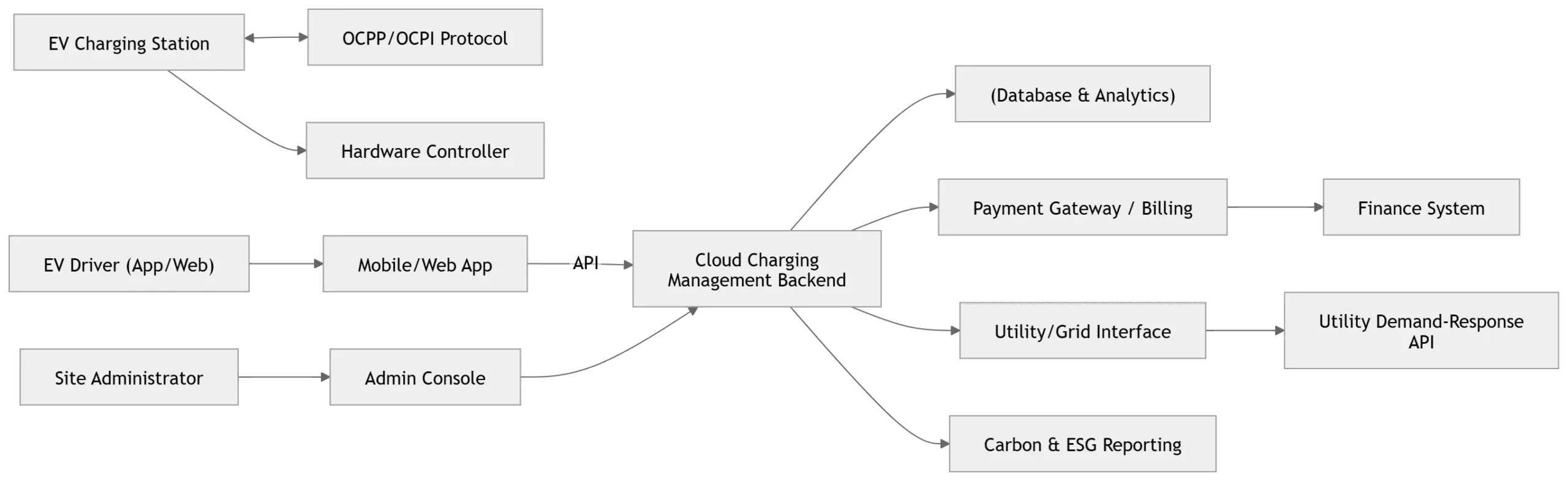
In a cloud deployment, chargers generally connect to a managed endpoint over secure wide-area networks. In an on-premises deployment, the endpoint may sit behind private routing, VPNs, firewalls or dedicated network controls. However, the platform may still need outbound or inbound connections for payment providers, mobile applications, SMS and email, maps, app stores, roaming, software updates and support.
That means an “air-gapped” charging platform is a special architecture, not a normal synonym for on-premises. It can limit real-time driver services and external integrations. Define the exact connectivity model before assuming that local hosting removes internet dependency.
10 Factors to Compare Before Choosing Cloud or On-Premise CPMS
1. Deployment Speed and Internal Approval
Cloud deployment can reduce the infrastructure work required before configuration and charger testing begin. This is useful for operators that need to launch a pilot, add a country, or connect new sites quickly. On-premises projects usually add server sizing, procurement, network architecture, security review, operating-system standards, database setup, backup and monitoring before the CPMS can be accepted.
Ask for separate timelines for environment readiness, application deployment, integrations, charger onboarding, security testing, user acceptance and production cutover. A short software installation estimate is not the same as a complete launch plan.
2. Scalability and Performance
Charging platforms process heartbeats, status changes, meter values, commands, sessions, tariffs, transactions, alerts and reports. Growth is not measured only by charger count. A network can have moderate hardware volume but high telemetry frequency, API traffic, concurrent sessions or analytical workload.
Cloud environments make capacity expansion easier, but scaling is not automatic unless the application, database, queues and integrations are designed for it. On-premises systems can also scale, but the buyer must plan capacity, procurement lead time, redundancy and performance testing.
Request assumptions for chargers, connectors, message frequency, concurrent sessions, active users, API calls, storage growth and reporting windows. Then define performance acceptance criteria around your forecast—not a vendor’s generic maximum.
3. Five-Year Total Cost of Ownership
Cloud software may reduce infrastructure capital expenditure, yet subscription price is only one cost line. On-premises pricing may look attractive if the license is perpetual, yet internal labor, hardware refresh, database licenses, backup, security tooling and disaster recovery can materially change the result.
Use this TCO structure: implementation + licensing + infrastructure + cloud consumption + integrations + operations labor + monitoring + security and compliance + backup and disaster recovery + upgrades + support + migration and exit.
Model at least three growth scenarios. Include payment, messaging, maps, roaming, data transfer and storage where relevant. Separate fixed, per-charger, per-connector, per-session, per-user and consumption-based charges.
4. Security Responsibility
Cloud services follow a shared-responsibility model. For example, AWS distinguishes security “of” the cloud from security “in” the cloud: the provider operates the underlying infrastructure, while customers retain responsibilities that vary by service, including data, identities, applications and configuration.
With on-premises deployment, more layers typically move to the customer: physical access, hypervisors, operating systems, databases, firewall rules, certificates, patching, endpoint protection, logs, backup and recovery. This can improve direct control only if the organization has the people, tools and change discipline to operate those controls consistently.
| Security layer | Managed cloud example | On-premises example |
|---|---|---|
| Facilities and physical hardware | Primarily cloud infrastructure provider responsibility. | Customer or colocation provider responsibility. |
| OS, database and middleware | Depends on SaaS, PaaS or IaaS delivery and contract. | Usually customer and CPMS vendor coordination. |
| CPMS application security | Vendor responsibility with customer configuration duties. | Vendor code plus customer-operated environment and controls. |
| Users, roles, MFA and SSO | Shared: vendor capability, customer identity governance. | Shared: application capability and customer identity infrastructure. |
| Charger certificates and credentials | Must be assigned explicitly across vendor, buyer and charger OEM. | Same requirement; local hosting does not settle ownership. |
| Incident response | Joint process across provider, CPMS vendor and operator. | Joint process across customer IT/OT, vendor and affected third parties. |
5. Data Sovereignty, Privacy, and Ownership
Data sovereignty is not solved by asking where “the server” is. Map charger telemetry, account data, payment tokens, invoices, support tickets, backups, logs, analytics, mobile push notifications and subprocessors. A cloud platform can often use a selected region, while an on-premises platform can still send data to external payment, notification or mapping services.
Define controller and processor roles, data categories, residency, retention, deletion, backup locations, cross-border transfers and data-subject support. Contractually confirm who owns charger, session, customer, pricing, transaction, fault, maintenance and derived analytical data. TrendPower’s EV charging point management system page outlines deployment and operational-data questions buyers should raise during scoping.
6. Availability, Backup, and Disaster Recovery
Cloud infrastructure provides building blocks for redundancy, but architecture and service tier determine the actual result. On-premises infrastructure can be highly resilient too, but a second site, replicated databases, redundant connectivity, spare capacity and recovery testing must be funded and operated.
Request a service diagram and confirm:
- the uptime definition and measurement point;
- single-zone, multi-zone or multi-region design;
- backup frequency, retention, immutability and restore testing;
- recovery time objective (RTO) and recovery point objective (RPO);
- charger behavior when the backend or network is unavailable;
- payment, authorization and transaction reconciliation after reconnection.
7. Updates, OCPP Evolution, and Software Lifecycle
Managed cloud platforms can coordinate application updates centrally, helping operators receive fixes and product improvements without rebuilding their own infrastructure. That benefit requires release governance: notification, maintenance windows, backward compatibility, regression tests and rollback.
On-premises customers often want tighter change control, but delayed upgrades can create version fragmentation and extend exposure to known vulnerabilities. Agree which releases are mandatory, how long versions are supported, who tests database and OS dependencies, and how emergency patches are approved.
The Open Charge Alliance currently lists OCPP 1.6, 2.0.1 and 2.1. Your deployment model should support a realistic protocol and charger-firmware roadmap rather than freezing the network at its launch configuration.
8. Integrations and Network Connectivity
Cloud CPMS often integrates efficiently with internet-based payment gateways, apps, roaming networks and enterprise APIs. On-premises deployment can simplify controlled access to internal ERP, identity, fleet, utility or operational-technology systems—but may require API gateways, reverse proxies, VPNs, allowlists and security review for every external connection.
Document data direction, authentication, certificates, IP ranges, ports, latency, rate limits, retries and failure behavior. Decide who monitors each connection and owns incidents at the boundary between systems.
9. Operations, Monitoring, and Support
The hosting decision changes how support works. In managed cloud, the CPMS provider can often observe the application and platform more directly. In customer-controlled infrastructure, support may depend on remote-access approval, customer-provided logs, environment health, scheduled sessions and coordination between several teams.
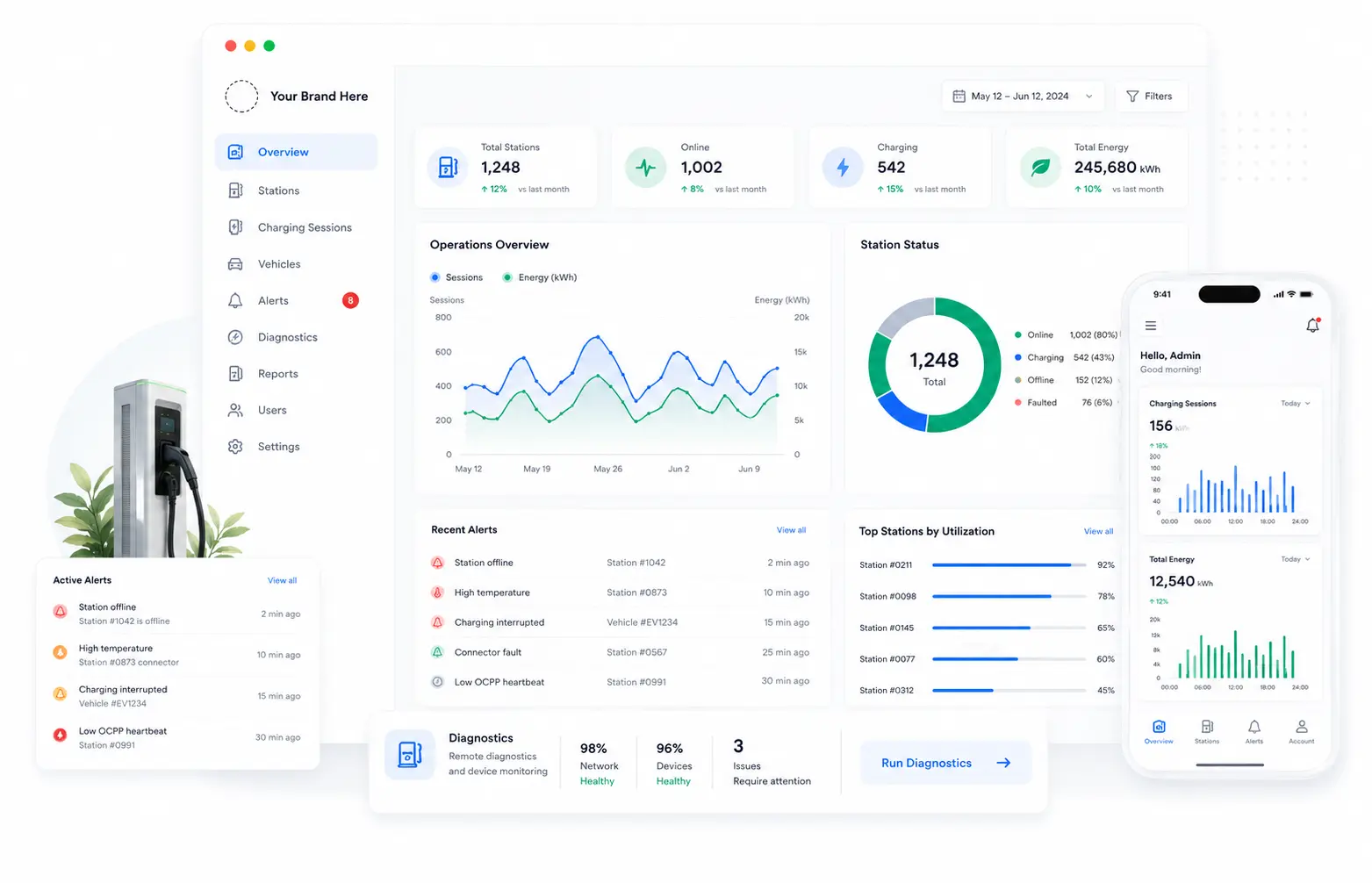
Define monitoring ownership for infrastructure, application services, database, integrations, certificate expiry, OCPP connections and business workflows. TrendPower’s intelligent operations management capabilities show how charger monitoring, diagnostics, remote remediation and work orders can form one O&M process.
10. Portability, Lock-In, and Exit Planning
Every model can create lock-in. Cloud lock-in may come from managed services, proprietary APIs, commercial terms or inaccessible operational data. On-premises lock-in may come from custom infrastructure, specialist dependencies, unsupported versions or source code that the buyer cannot maintain.
Require complete data exports, documented schemas, API access, charger credential ownership, configuration backups, app-store and domain ownership, source-code terms where applicable, and a defined transition period. Include charger endpoint migration, certificate changes, historical records, payment reconciliation and deletion evidence in the exit plan.
Who Should Choose a Cloud EV Charging Management System?
Cloud deployment is usually a strong fit when most of these statements are true:
Typical candidates include regional CPOs, EV charger manufacturers launching a branded service, property networks, destination charging businesses, public charging networks and distributed commercial fleets. For branded customer and operator interfaces, see TrendPower’s white-label EV charging software.
Who Should Choose an On-Premises CPMS?
On-premises deployment deserves serious evaluation when several of these conditions apply:
Typical candidates may include utilities, public-sector environments, large depot fleets, transport operators, critical-infrastructure projects or enterprises with established private-cloud standards. On-premises should be a positive architectural choice backed by operating capability—not a default response to general security concerns.
When Is a Hybrid EV Charging Architecture Better?
Hybrid can be useful when requirements genuinely differ by workload. Examples include:
- keeping a depot-level energy controller and local charging logic on site while centralizing fleet analytics in the cloud;
- retaining selected regulated data in a private environment while using cloud apps and public charging services;
- providing local continuity for charger control while synchronizing sessions and reports to a central CPMS;
- connecting an on-premises enterprise system through a controlled integration layer rather than moving the complete CPMS locally.
Hybrid also introduces more interfaces, synchronization states and support boundaries. Define the source of truth, offline duration, conflict resolution, delayed transactions, time synchronization, certificate management and responsibility when the local and cloud layers disagree.
A Practical Deployment Decision Framework
Use these questions before requesting final architecture and pricing:
- Which requirement is non-negotiable? Identify binding residency, isolation, latency, integration or ownership constraints rather than preferences.
- What must keep working offline? Separate local charger behavior from apps, payments, roaming, reporting and remote operations.
- Who can operate the stack? Name the team responsible for infrastructure, OS, database, networking, security, observability and recovery.
- How fast will the network grow? Model charger, connector, user, session, telemetry, API and storage volumes.
- Where must each data type reside? Include logs, backups, analytics, notifications and subprocessors—not just the production database.
- Which systems must integrate? Map payment, ERP, CRM, SSO, fleet, energy, roaming, maps, support and data platforms.
- What availability is actually required? Define uptime, RTO, RPO, maintenance windows and degraded-mode operation.
- How will the system evolve? Plan OCPP, charger firmware, payment, API, security and application upgrades.
- What is the five-year TCO? Include internal labor and risk, not only vendor invoices.
- How will you leave? Test export, credentials, configuration, charger migration and transition assistance before signing.
Convert the answers into a structured procurement document using the EV charging management system RFP checklist. Request separate architecture, responsibility, implementation and cost responses for each proposed deployment model.
How TrendPower Approaches Flexible CPMS Deployment
TrendPower scopes EV charging software around the operator’s hardware, target markets, commercial workflow, integrations and control requirements. The wider platform supports public-cloud, private-cloud and project-specific deployment options, with on-premises services evaluated where the customer’s data, security and integration requirements call for them.
The deployment decision does not replace functional validation. Buyers should still confirm charger model and firmware compatibility, OCPP functions, payment providers, user roles, tariffs, reporting, APIs, monitoring, support scope and migration responsibilities. TrendPower’s 15 essential CPMS capabilities guide provides a feature-level evaluation framework.
Projects requiring deeper workflow or enterprise integration can also be scoped through a custom EV charging software solution. For an example of a branded platform connecting chargers, remote control, scheduling, permissions, payments and owner settlement, review the U.S. home EV charging platform case study.
Compare Cloud, Private, Hybrid, and On-Premises Options
Share your charger models, network forecast, target countries, data requirements, integrations, availability goals and internal IT capabilities. TrendPower can help map these inputs to a practical CPMS deployment scope and demonstration.
Cloud vs On-Premise EV Charging Software FAQ
Is cloud or on-premises CPMS better for EV charging?
Neither is universally better. Cloud is generally more practical for distributed networks that need faster rollout, easier scaling and managed platform operations. On-premises can be appropriate when verified data, network, integration or infrastructure-control requirements justify the added operating responsibility.
Is on-premises EV charging software more secure than cloud?
Not automatically. On-premises provides more direct infrastructure control, but the customer must secure and maintain more layers. Cloud can inherit strong physical and infrastructure controls while leaving application, identity, data and configuration responsibilities to the vendor and customer. Compare controls, evidence and responsibilities rather than location alone.
Can cloud EV charging software meet data-residency requirements?
Often, but it depends on available regions, architecture, backups, logs, subprocessors, support access and contract terms. Map every relevant data flow and validate it against the buyer’s jurisdiction, policy and legal requirements.
What is the difference between private cloud and on-premises CPMS?
Private cloud describes an isolated environment for one organization, but that environment may run in a cloud provider, vendor-managed facility or customer account. On-premises usually means the platform runs in infrastructure controlled at the customer’s own facility or data center. Ownership and operational responsibility must be defined in the architecture.
Can EV chargers continue working if the cloud connection is lost?
Some charger and CPMS configurations support defined offline authorization, local behavior or queued transactions, but functionality varies by charger, firmware, OCPP implementation and business rules. Test authorization, charging, metering, transaction closure, payment and reconciliation during a pilot.
Is hybrid deployment more expensive?
It can be because the organization operates and integrates both local and cloud layers. Hybrid is worthwhile when it solves a specific requirement such as local continuity, private integration or selective data control. Avoid hybrid complexity if a well-designed single environment meets the requirement.
What should be included in a CPMS deployment proposal?
Include the architecture, environment ownership, data locations, security responsibilities, availability design, backup and recovery, connectivity, integrations, monitoring, support access, release process, implementation plan, acceptance tests, complete pricing, migration and exit assistance.
Authoritative Sources and Further Reading
- NIST SP 800-145 — The NIST Definition of Cloud Computing
- Amazon Web Services — Shared Responsibility Model
- Open Charge Alliance — OCPP Protocols
- NIST Cybersecurity Framework
Reviewed for technical and procurement relevance: September 20, 2026. Hosting, privacy, security and regulatory requirements vary by jurisdiction and project. Validate the final architecture with your technical, legal and compliance teams.

 EN
EN  ZH
ZH  AR
AR  DE
DE  ES
ES  KO
KO  JA
JA  IT
IT  FR
FR  VI
VI  MS
MS  ID
ID  FR_CA
FR_CA  NL
NL  SV
SV  EN_GB
EN_GB  TH
TH 