
Quick Answer: What Is OCPP 2.0.1?
OCPP 2.0.1 is an open communication protocol that connects EV charging stations with a charging station management system, often called a CSMS or CPMS. It helps operators manage chargers across brands, monitor charger status, authorize users, collect meter values, support smart charging, improve security and prepare for advanced charging experiences such as ISO 15118 Plug & Charge.
For EV charging operators, OCPP 2.0.1 is not just a technical standard. It is the communication layer that helps turn individual charging devices into a scalable, software-managed charging network.
Key Takeaways
- OCPP 2.0.1 connects chargers and backend software. It defines how EV charging stations communicate with a central management system.
- It improves on OCPP 1.6. Key upgrades include a richer device model, stronger security architecture, improved transaction handling, better smart charging support and ISO 15118 readiness.
- It helps reduce hardware lock-in. Operators can build more flexible multi-brand charger networks when both chargers and backend systems are properly implemented.
- OCPP support is not the same as certification. A product may support OCPP 2.0.1, but operators should still validate certification status, feature coverage and real-world interoperability.
- The CPMS matters as much as the protocol. OCPP messages only create business value when the backend turns them into reliable workflows for monitoring, billing, load management, maintenance and reporting.
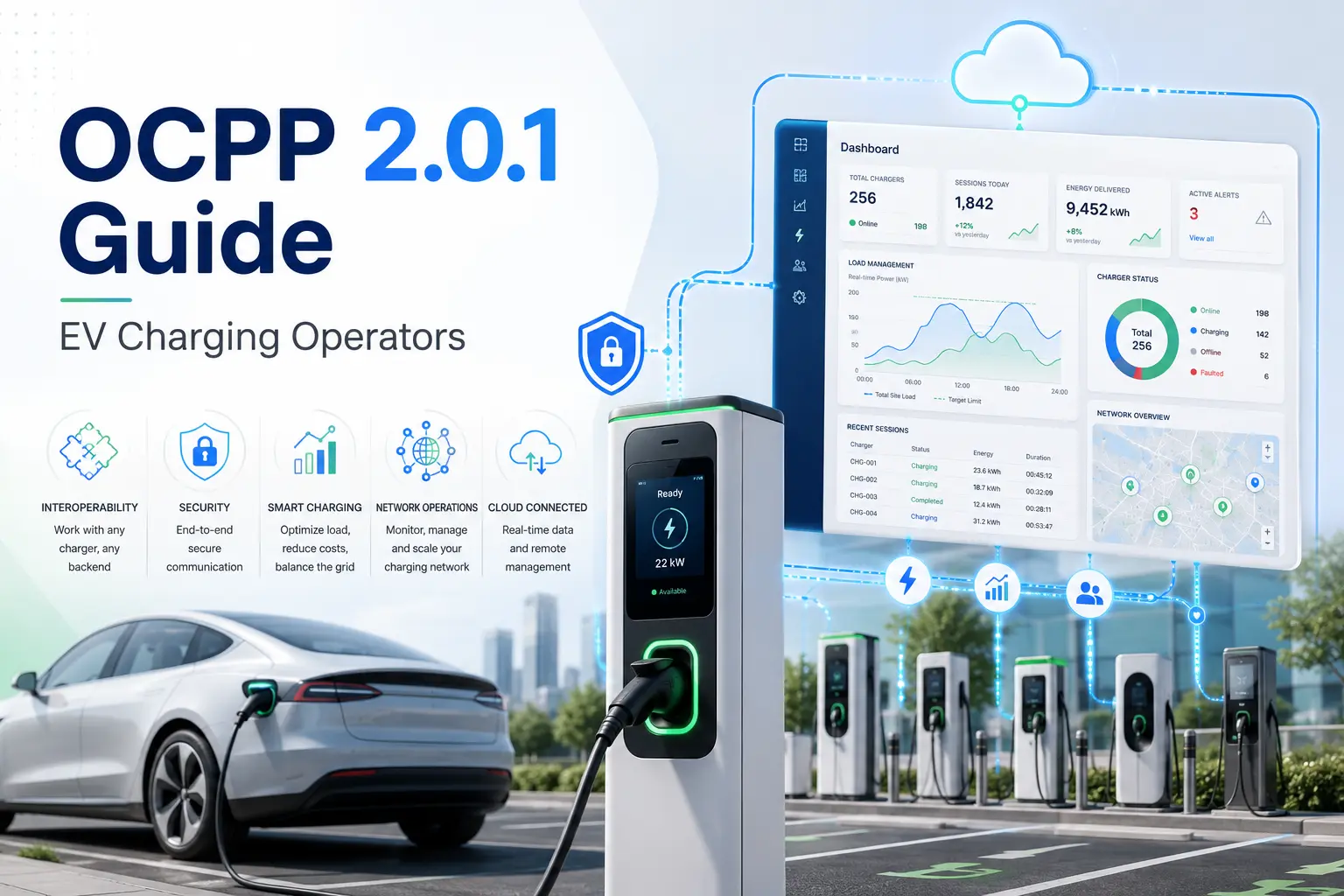
Why OCPP Exists in EV Charging
EV charging networks are no longer simple hardware installations. A commercial charging network may include AC chargers, DC fast chargers, payment terminals, RFID cards, mobile apps, roaming connections, site hosts, fleet users, tariff rules, energy limits and maintenance teams.
Without a common communication protocol, every charger brand would require its own proprietary management system. That creates operational friction. Operators may need different dashboards for different chargers, separate maintenance processes, inconsistent billing workflows and limited ability to switch hardware vendors.
The Open Charge Alliance describes OCPP as the global open communication protocol between charging stations and charging management systems. In practice, this means OCPP sits between the physical charger and the software platform that manages charging operations.
A driver may only see a mobile app, QR code, RFID card or payment screen. The operator sees something different: boot notifications, charger availability, connector status, authorization requests, transaction events, meter values, remote commands, faults and configuration updates.
That is why OCPP should be treated as a strategic purchasing requirement, not just a technical checkbox.
For charge point operators, fleet operators and charger manufacturers, OCPP helps answer several practical questions:
- Can this charger connect to my backend platform?
- Can I manage chargers from different manufacturers in one system?
- Can I migrate away from a proprietary backend in the future?
- Can I monitor uptime, faults and session data remotely?
- Can my CPMS support billing, payments, load management and user access on top of charger communication?
OCPP 2.0.1 matters because it gives modern charging networks a stronger foundation for these workflows.
Internal link suggestion: If you are evaluating backend platforms, see TrendPower’s guide to EV charging backend software.
How OCPP 2.0.1 Connects Chargers and a CSMS
In OCPP terminology, a charging station communicates with a central system, commonly called a CSMS. In the commercial software market, operators may also see terms such as CPMS, EV charging management software or charging backend software.
The basic communication flow is simple:
- The charger connects to the backend.
- The charger sends status, transaction and meter data.
- The backend sends authorization decisions, configuration changes or remote commands.
- The operator uses a dashboard to monitor and manage the network.
For example, when a driver plugs into a charger, the charger may send transaction-related events to the CSMS. The CSMS may authorize the user, record the session, receive meter values, apply pricing rules and display the charging session in the operator dashboard.
OCPP 2.0.1 makes this relationship more structured than older versions. One of its most important improvements is the device model. Instead of treating a charging station as a simple black box, the device model allows the backend to understand components, variables and configuration elements in more detail.
That can help operators answer more precise operational questions:
- Is the whole charger offline, or only one EVSE?
- Is the connector unavailable because of a fault, maintenance setting or configuration issue?
- Which firmware or configuration variable may be causing a problem?
- Can the backend detect site-level patterns across multiple charger models?
This matters because remote operations depend on visibility. The more structured the data, the easier it is for a CPMS to help teams troubleshoot issues, reduce site visits and improve uptime.
User experience note: For this section, add a simple diagram showing:
EV → Charging Station → OCPP 2.0.1 → CSMS / CPMS → Operator Dashboard / Billing / Energy Management
What Is New in OCPP 2.0.1 Compared with OCPP 1.6?
OCPP 1.6 became widely adopted because it gave the EV charging industry a practical open protocol for charger-to-backend communication. Many networks still run on OCPP 1.6 today, and it remains useful for basic charging operations.
However, modern EV charging networks need more than basic remote start, stop and status monitoring. Operators increasingly need stronger cybersecurity, more detailed device management, smart charging, ISO 15118 readiness, improved transaction structures and better tools for managing complex charging sites.
The Open Charge Alliance lists several improved or added functions in OCPP 2.0.1 compared with OCPP 1.6, including device management, improved transaction handling, added security, added smart charging functionalities, ISO 15118 support, display and messaging support.
The main difference is this:
OCPP 1.6 is often enough for basic charger management. OCPP 2.0.1 is designed for more secure, data-rich and future-ready charging operations.
That does not mean every network must migrate immediately. A small private site with simple chargers may still run effectively on OCPP 1.6. But for networks planning multi-site growth, charger diversity, stronger security, fleet charging, load management or Plug & Charge readiness, OCPP 2.0.1 deserves serious evaluation.
Internal link suggestion: For a deeper comparison, read: OCPP 1.6 vs OCPP 2.0.1: Which Protocol Should Operators Choose?
OCPP 2.0.1 Feature Summary
| Feature | What It Means for Operators |
|---|---|
| Device model | More detailed charger components, variables and configuration visibility. |
| Security | Stronger support for secure communication, certificates and security events. |
| Transactions | More structured session lifecycle and metering information. |
| Smart charging | Better tools for power limits, charging profiles and load management. |
| ISO 15118 readiness | Better backend coordination for Plug & Charge-related workflows. |
| Diagnostics | More actionable information for remote troubleshooting and uptime monitoring. |
| Display and messaging | More possibilities for communicating information through charger displays. |
| Certification path | A formal OCPP 2.0.1 certification program exists, but support, compliance and certification are not identical. |
The OCPP 2.0.1 certification page from the Open Charge Alliance is useful for buyers because it shows that certification is a formal process, not a casual marketing claim.
Common Misconception: OCPP Support, Compliance and Certification Are Not the Same
One of the most common mistakes in EV charging procurement is treating “OCPP-compatible” as a complete guarantee.
These terms are related, but they are not identical:
| Term | Practical Meaning |
| OCPP support | The product claims to communicate using a version of OCPP. |
| OCPP compliance | The implementation follows required protocol behavior for relevant functions. |
| OCPP certification | The product has passed a formal certification process through recognized testing procedures. |
| Real-world interoperability | The charger and CPMS work reliably together in actual deployment conditions. |
A charger can connect successfully during a basic test but still fail under real network conditions, firmware changes, offline behavior, smart charging profiles or payment edge cases.
For operators, the safest approach is to ask vendors for:
- Supported OCPP version and feature scope
- Certification status or conformance evidence
- Tested charger models and firmware versions
- Smart charging support details
- Security and certificate handling process
- Known limitations
- A pilot test before large-scale rollout
OCPP 2.0.1 Security: More Than Encryption
Security is one of the strongest reasons to evaluate OCPP 2.0.1 for new EV charging deployments.
Charging networks are connected infrastructure. They may process user identities, authorization data, transaction records, energy usage data, payment-related workflows, remote commands and firmware updates. If security is weak, operators may face unauthorized access, manipulated charging behavior, fraudulent sessions, service disruption or data exposure.
The NIST Cybersecurity Framework Profile for Electric Vehicle Extreme Fast Charging Infrastructure highlights that EV fast charging infrastructure involves connected subsystems including charging stations, data networks, cloud or third-party operations, and utility or building networks. This is exactly why charging infrastructure security must be managed as an operational risk, not only an IT issue.
For OCPP 2.0.1 deployments, operators should look beyond simple statements such as “we support TLS.” A more serious security review should include:
- How are certificates issued, stored, rotated and revoked?
- How are users, chargers and backend systems authenticated?
- Are security events visible in the CPMS dashboard?
- Can the operator control firmware update workflows?
- Are remote commands permission-based?
- How are API integrations protected?
- Can access roles be separated for operations, finance, support and site owners?
- What happens if a charger loses connectivity?
Internal link suggestion: For a focused security article, link to: OCPP 2.0.1 Security Explained: What EV Charging Networks Need to Know
What This Means for Operators
A secure OCPP 2.0.1 deployment is not created by the protocol alone. It requires the charger, firmware, network connection, backend platform, access control process and support workflow to work together.
For example, a CPMS should not only receive security-related messages. It should help the operator act on them through alerts, logs, role permissions, maintenance workflows and audit trails.
That is where EV charging software becomes important. The protocol defines communication; the CPMS turns communication into operational control.
OCPP 2.0.1 and ISO 15118 Plug & Charge
OCPP 2.0.1 and ISO 15118 are related, but they operate on different communication paths.
OCPP 2.0.1 handles communication between the charging station and the backend management system. ISO 15118 handles communication between the electric vehicle and the charging equipment.
This distinction matters because many buyers confuse the two standards.
In a Plug & Charge workflow, the EV may communicate with the charger using ISO 15118. The charger may then need to coordinate with the backend through OCPP for authorization, transaction handling, certificate-related workflows and operator records.
CharIN’s Plug & Charge resources explain the importance of standardized and interoperable Plug & Charge services. For operators, this means Plug & Charge is not only a charger feature. It is an ecosystem workflow involving vehicle capability, charger firmware, certificates, backend logic, payment handling and customer support.
A vendor may support OCPP 2.0.1 without full Plug & Charge readiness. Another vendor may support ISO 15118 at the hardware level but still lack mature backend operations for certificates, billing or user support.
Before buying a Plug & Charge-ready solution, operators should validate the full chain:
- Vehicle compatibility
- Charger ISO 15118 support
- OCPP 2.0.1 backend support
- Certificate provisioning and lifecycle management
- Payment and billing logic
- User support workflow
- Reporting and reconciliation
Internal link suggestion: Link to TrendPower’s related guide: ISO 15118 Plug & Charge Complete Guide
What This Means for EV Charging Operators
For operators, OCPP 2.0.1 is not only a protocol upgrade. It changes how a charging network can be managed.
A site owner can choose chargers from multiple hardware vendors while maintaining one management workflow. A fleet operator can use smart charging to reduce peak power pressure. A parking operator can monitor AC and DC chargers across multiple locations. A charger manufacturer can provide customers with a more complete software-connected solution.
The practical value appears in daily workflows:
- Charger onboarding
- Remote monitoring
- Fault alerts
- Remote reset
- Transaction logs
- Meter value collection
- Tariff management
- User access control
- Billing and payment integration
- Load management
- Firmware update coordination
- Multi-site reporting
This is also where TrendPower fits into the conversation. TrendPower’s EV charging management software supports OCPP-compatible charger integration, including OCPP 1.6 and OCPP 2.0.1 compatibility, helping operators manage chargers from different manufacturers through one unified platform.
The key point is simple: OCPP provides the communication foundation; the CPMS determines how useful that communication becomes for the business.
Expert Insight: Compatibility Is a Starting Point, Not the Finish Line
In real deployments, two products can both advertise OCPP 2.0.1 support and still behave differently under load, weak network conditions, roaming scenarios, firmware upgrades or payment edge cases.
Before scaling a network, operators should test the workflows that affect revenue and uptime:
- Boot notification
- Authorization
- Transaction start and stop
- Meter value timing
- Offline behavior
- Remote reset
- Configuration changes
- Firmware updates
- Diagnostics
- Security events
- Charging profile behavior
- Billing and settlement data
A charger should not be considered production-ready simply because it appears online once. It should pass the workflows that protect driver experience, revenue accuracy and maintenance efficiency.
Implementation Roadmap for Operators Adopting OCPP 2.0.1
A practical OCPP 2.0.1 rollout should start with an inventory, not a purchase order.
Step 1: Build a charger and site inventory
List every charger model, firmware version, connector type, network connection, payment method, site type and business workflow. Separate chargers that only need basic management from sites that require advanced functions such as smart charging, certificate management or ISO 15118 readiness.
Step 2: Define required OCPP workflows
Not every operator needs every feature immediately. A public charging network may prioritize payment, uptime and fault response. A fleet depot may prioritize charger availability, vehicle readiness and energy scheduling. A charger manufacturer may prioritize white-label deployment, testing and multi-brand compatibility.
Step 3: Create a test matrix
Your test matrix should include:
| Test Area | Example Acceptance Criteria |
| Charger connection | Charger can boot and remain connected under normal network conditions. |
| Authorization | RFID, app or backend authorization works as expected. |
| Transactions | Start, stop, meter values and session records are accurate. |
| Offline behavior | Charger handles connectivity loss without corrupting transaction data. |
| Remote operations | Remote reset, start, stop and configuration commands work reliably. |
| Smart charging | Charging profiles are applied correctly under defined limits. |
| Security | Certificates, roles and security events are handled according to policy. |
| Reporting | Session, revenue and uptime data appear correctly in the CPMS. |
Step 4: Run a controlled pilot
Before deploying hundreds or thousands of chargers, run a pilot using the exact charger firmware, SIM card or Ethernet setup, backend environment and business workflows you plan to use in production.
Step 5: Document operational playbooks
A good OCPP 2.0.1 rollout should produce clear internal playbooks:
- How to onboard a new charger
- How to investigate a fault
- How to restart or reconfigure a charger remotely
- How to handle failed transactions
- How to escalate firmware problems
- How to review charger uptime
- How to test new hardware before adding it to the network
This is where strong CPMS design improves operational efficiency. Operators need the protocol to work, but they also need software that makes the protocol understandable to support, finance, site management and engineering teams.
Original Example: Multi-Brand Public Charging Site
Imagine a parking operator that runs 40 AC chargers from two manufacturers and plans to add 10 DC chargers from a third manufacturer.
With a proprietary software model, the operator may need separate dashboards, different pricing rules and disconnected maintenance processes. Support teams may have to switch between systems to understand whether a charger is offline, occupied, faulted or unavailable. Finance teams may struggle to consolidate revenue and session data.
With an OCPP-compatible CPMS, the operator’s goal is to manage all chargers through one operational layer. Existing OCPP 1.6 AC chargers can continue serving users, while newer OCPP 2.0.1 DC chargers provide more advanced monitoring and management capabilities.
The operator should not expect every charger model to behave identically. Instead, the CPMS should make those differences visible and manageable. The dashboard should show site-level uptime, charger status, session history, alarms, maintenance notes, tariff performance and user behavior in one place.
For a growing operator, this is the real value of OCPP: not only open communication, but the ability to build a more flexible and scalable charging business.
How to Choose an OCPP 2.0.1-Compatible CPMS
When choosing a CPMS, do not stop at the phrase “OCPP 2.0.1-compatible.” That phrase is useful, but it is not enough.
A better question is:
Can this platform support the exact charging operations we need to run?
A public fast-charging network may need uptime monitoring, payment integration, dynamic pricing, remote troubleshooting and roaming support. A fleet depot may need charging schedules, access control, vehicle readiness reporting and load management. A charger manufacturer may need white-label deployment, API integration, diagnostics and multi-tenant management.
Use this checklist during evaluation:
| Evaluation Area | Questions to Ask |
| OCPP version support | Does the platform support OCPP 1.6, OCPP 2.0.1 or both? |
| Tested charger brands | Which charger models and firmware versions have been tested? |
| Certification evidence | Is there certification, conformance documentation or test evidence? |
| Security operations | How are certificates, roles, logs and remote commands managed? |
| Smart charging | Can the platform apply charging profiles and load limits reliably? |
| ISO 15118 readiness | How does the backend support Plug & Charge-related workflows? |
| Billing and payments | Can it support tariffs, payments, invoices, wallets or fleet billing? |
| Remote maintenance | Does it support alerts, diagnostics, resets and firmware workflows? |
| Multi-site operations | Can it manage different locations, owners, currencies and user groups? |
| APIs and integrations | Can it connect to payment gateways, apps, ERP, CRM or energy systems? |
| Migration support | Can it help migrate chargers from another backend or OCPP 1.6 network? |
| Support process | What happens when a charger behaves differently from the specification? |
Internal link suggestion: For a buyer-focused article, link to: How to Choose an OCPP 2.0.1-Compatible EV Charging Management Platform
TrendPower can be positioned here as an OCPP-compatible CPMS for operators that need charger integration, remote monitoring, billing, payment workflows, user management, load management and multi-site operations.
Recommended Visual Assets for This Page
To improve user experience and make the page more citation-worthy, add original visuals rather than stock images.
Visual 1: OCPP communication diagram
Show the relationship between:
EV → EVSE / Charging Station → OCPP 2.0.1 → CPMS / CSMS → Operator Dashboard → Billing / Payments / Energy Management
Suggested alt text:
“Diagram showing how OCPP 2.0.1 connects EV charging stations with a CPMS for monitoring, billing, smart charging and remote operations.”
Visual 2: Standards map
Compare:
- OCPP 1.6
- OCPP 2.0.1
- OCPP 2.1
- ISO 15118
- Plug & Charge
Suggested alt text:
“Comparison map of OCPP 1.6, OCPP 2.0.1, OCPP 2.1 and ISO 15118 in EV charging communication.”
Visual 3: Operator checklist graphic
Turn the CPMS buyer checklist into a downloadable graphic or PDF. This can increase page engagement and support lead generation.
Conclusion: Build for Interoperability and Operational Control
OCPP 2.0.1 is a foundation for more secure, data-rich and scalable EV charging operations. It helps operators reduce proprietary lock-in, improve diagnostics, support smarter energy control and prepare for more advanced charging workflows such as ISO 15118 Plug & Charge.
But the protocol is only part of the solution.
The real business value appears when a CPMS turns OCPP messages into reliable daily operations: charger onboarding, uptime monitoring, transaction records, remote maintenance, billing, payments, smart charging and multi-site reporting.
If you are building or upgrading an EV charging network, evaluate whether TrendPower’s OCPP-compatible CPMS is suitable for your charger portfolio, business model and growth roadmap.
CTA: Talk to TrendPower about OCPP-compatible EV charging management software
References and Further Reading
- Open Charge Alliance: Open Charge Point Protocol
- Open Charge Alliance: OCPP 2.0.1 Certification
- CharIN: Plug & Charge
- NIST NCCoE: Cybersecurity Framework Profile for EV Extreme Fast Charging Infrastructure
- TrendPower: EV Charging Management Software
- TrendPower: EV Charging Backend Software Guide
- TrendPower: ISO 15118 Plug & Charge Complete Guide
FAQs About OCPP 2.0.1
The following questions explain how OCPP 2.0.1 works, how it differs from related EV charging standards, and what operators should consider before choosing an OCPP-compatible charging management platform.
Is OCPP 2.0.1 the same as ocpp 2.0 1?
Yes, in most searches, “ocpp 2.0 1” is simply a variation or typo of OCPP 2.0.1. The official writing is OCPP 2.0.1. Use the official spelling in technical copy, headings and product documentation.
What is OCPP 2.0.1 used for?
OCPP 2.0.1 is used for communication between EV charging stations and a central management system. It helps operators monitor chargers, manage transactions, authorize users, collect meter data, control charging profiles, handle remote operations and improve charging network management.
Does OCPP 2.0.1 guarantee charger interoperability?
No. OCPP 2.0.1 improves standardization, but real interoperability depends on charger firmware, CPMS implementation, selected feature profiles, certification status, network configuration and testing. Operators should always validate important workflows before deployment.
Does OCPP 2.0.1 replace ISO 15118?
No. OCPP 2.0.1 and ISO 15118 work at different layers. OCPP handles communication between the charger and backend system. ISO 15118 handles communication between the EV and the charging equipment. Plug & Charge deployments may require both.
Is OCPP 2.0.1 better than OCPP 1.6?
OCPP 2.0.1 offers stronger capabilities for security, device management, transaction handling, smart charging and ISO 15118 support. However, OCPP 1.6 is still widely used and may be sufficient for simple or legacy deployments.
Should every new EV charging network use OCPP 2.0.1?
New networks should evaluate OCPP 2.0.1 carefully, especially if they need strong security, advanced monitoring, smart charging, ISO 15118 readiness or multi-brand scalability. However, the final decision should consider charger availability, budget, operational needs and migration complexity.
What should operators ask before choosing an OCPP 2.0.1 CPMS?
Operators should ask which charger models have been tested, which OCPP features are supported, whether certification evidence is available, how security is managed, how smart charging works, what billing features are included and how the platform handles real-world charger faults.
Can TrendPower support OCPP-compatible charger operations?
TrendPower provides EV charging management software designed to help operators connect and manage OCPP-compatible chargers, monitor charging sessions, manage users, support billing workflows, control charging operations and scale multi-site charging networks. Operators should confirm charger model compatibility and required feature scope during evaluation.

 EN
EN  ZH
ZH  AR
AR  DE
DE  ES
ES  KO
KO  JA
JA  IT
IT  FR
FR  VI
VI  MS
MS  ID
ID  FR_CA
FR_CA  NL
NL  SV
SV  EN_GB
EN_GB  TH
TH 