
White-Label EV Charging Software for Operators & Charging Businesses
Launch EV charging services under your own brand with a configurable driver experience, operator portal, charger management, tariffs, billing, payments and network operations built on one EV charging software foundation.
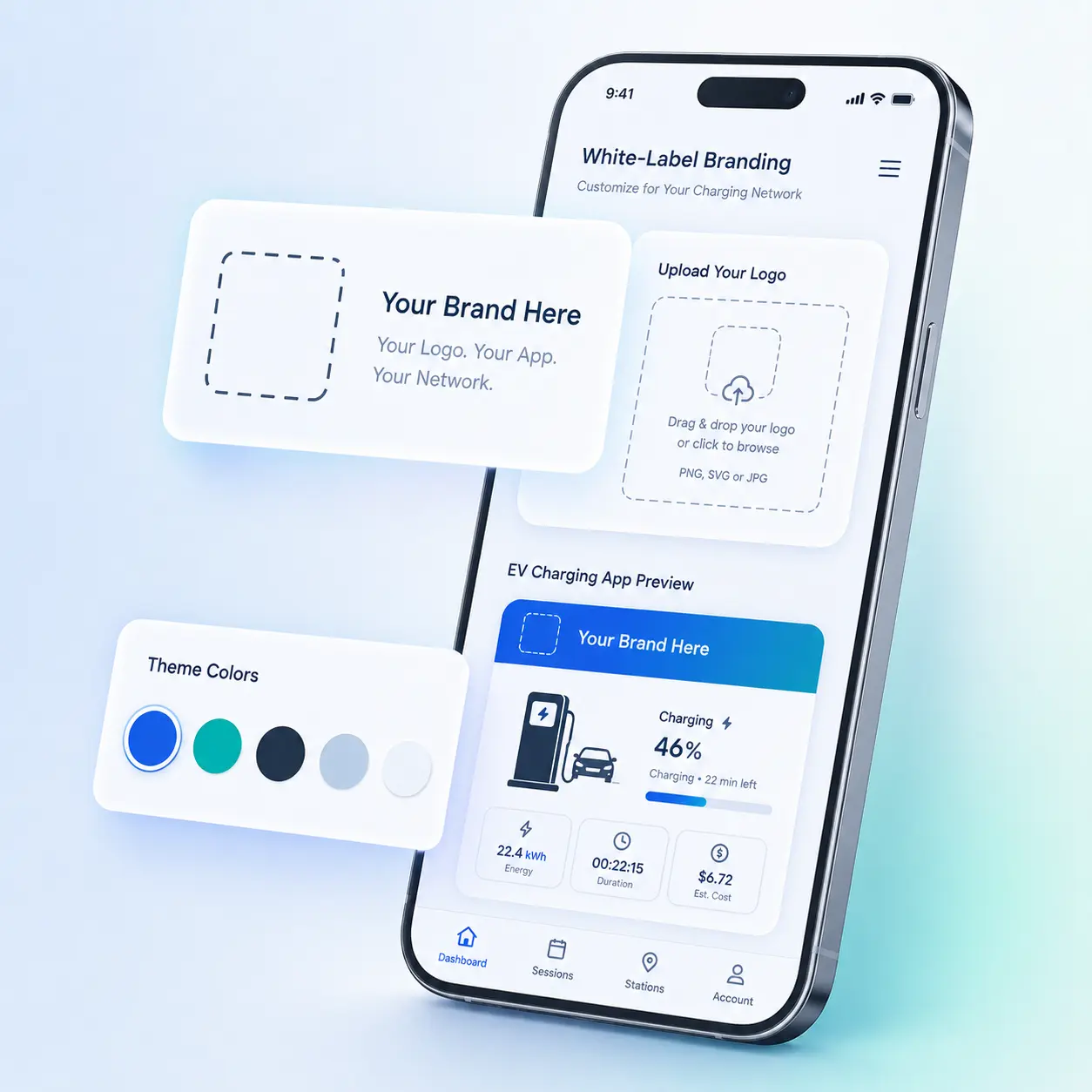
What Is White-Label EV Charging Software?
White-label EV charging software is a charging management platform that a business can operate under its own brand instead of developing every software layer from the ground up. The software foundation connects compatible EV chargers with operator tools, driver-facing apps or web portals, user access, charging sessions, tariffs, billing, reporting and other project-specific services. TRENDPOWER provides the underlying charging software while the customer-facing identity and operating workflow can be configured around the business model.
Launch a Charging Brand Without Rebuilding Every Software Layer Yourself
White-label software is most useful when the goal is not simply to “put a logo on an app,” but to create a branded charging service with enough flexibility for hardware, customer experience and commercial operations.
Own the Brand Experience
Present your own charging identity across driver interfaces and operator tools so customers interact with your business rather than a generic third-party brand.
Start From a Working Software Foundation
Use an existing charging management foundation, then focus engineering effort on branding, charger compatibility, integrations and the workflows that differentiate your service.
Operate the Network, Not Just the App
Connect the branded front end with charger status, charging sessions, pricing, users, billing and operational data instead of maintaining separate systems.
Adapt as the Business Expands
Add new charger models, user roles, payment requirements, integrations or regional workflows as the project moves from pilot deployment to a larger network.
What Can Be Customized in a White-Label EV Charging Platform?
Branding is only one layer. A practical white-label project also needs decisions about the driver journey, operator workflow, commercial model and integrations.
Make the Charging Service Look and Feel Like Your Own Product
Configure the customer-facing identity so the charging experience is consistent with your existing business, charger brand or regional service.
- Logo, brand colors and visual identity
- App name and customer-facing labels
- Branded web and mobile interfaces
- Charging-map pins, icons and interface styling
Operator Portal
Shape the Journey From Charger Discovery to Session Completion
The driver layer can be organized around the way your customers actually charge—public charging, fleets, workplaces, residential communities or destination charging.
- Station discovery and charging-map experience
- User registration, account and access workflows
- Charging session, pricing and transaction views
- Membership, access card or project-specific services
Session & Account
Give Your Team a Branded Management Environment for Daily Operations
The white-label project can include operator-facing portals for charger monitoring, users, sessions, pricing, transactions, analytics and the workflows used by your operations team.
- Station and charger management
- User, account and access administration
- Session, transaction and tariff visibility
- Reports, alerts and operational dashboards
Network Dashboard
Commercial Data
Configure the Commercial Rules Behind the Brand
A white-label platform becomes commercially useful when pricing, payment, user roles and integrations match the way the charging service will make money and serve customers.
- Tariff and service-fee configuration
- Payment-related integrations by target market
- User roles, memberships or access models
- Project-specific APIs and operating workflows
Tariffs & Payments
Roles & Integrations
One Software Foundation Across Driver and Operator Touchpoints
The current TRENDPOWER white-label stack brings the customer-facing charging experience and the operator management environment together. Choose the interfaces that fit the project instead of forcing every customer into the same delivery model.
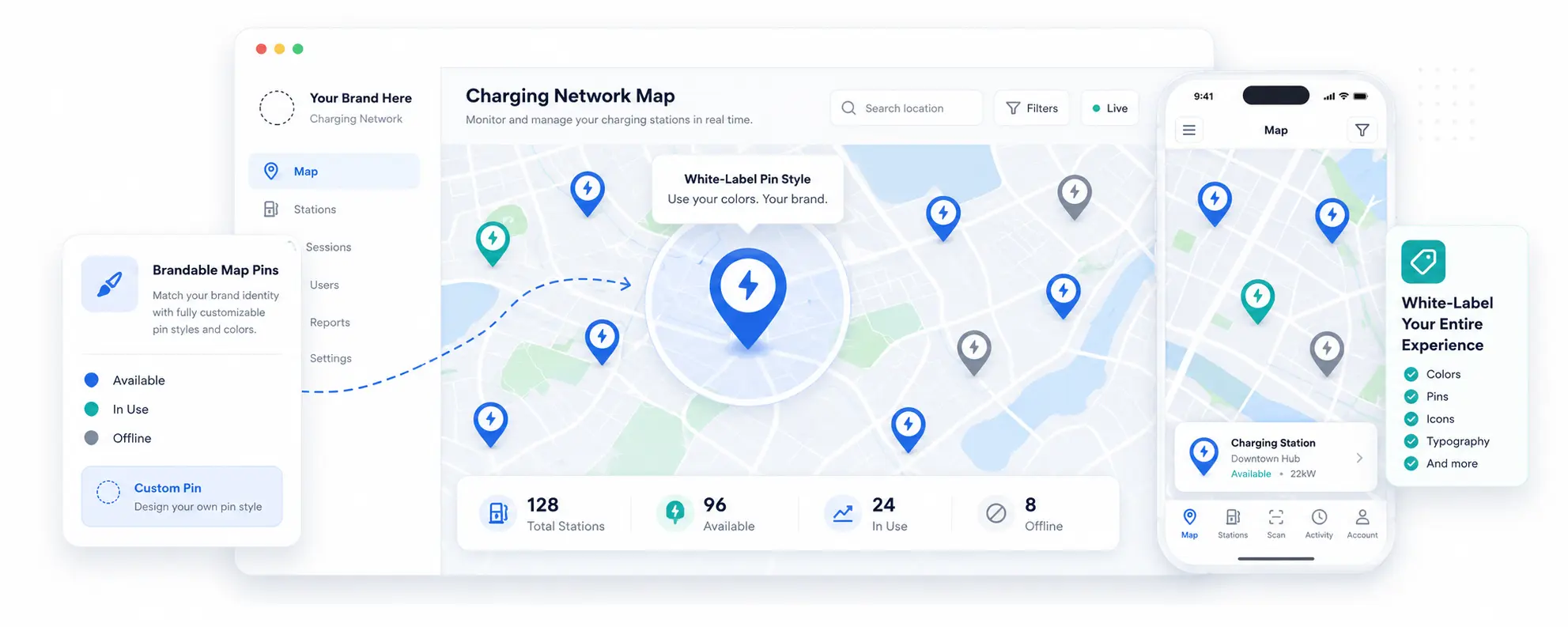
A White-Label Brand Still Needs a Strong Charging Management Core
The branded experience is only useful if the operating platform can support chargers, customers, sessions and commercial workflows behind the scenes.
Build the Brand Around Compatible Chargers—Not One Proprietary Hardware Line
OCPP is the open communication protocol between charging stations and charging management systems. In a white-label project, OCPP-based integration can help operators work with compatible chargers from different manufacturers rather than tying the software experience to a single hardware brand. Final compatibility still needs to be confirmed against charger model, firmware and required message set.
White-Label EV Charging Software for Different Business Models
The right white-label scope depends on who owns the customer relationship, who operates the chargers and how the charging service generates value.
Charge Point Operators
Launch and scale a branded public charging network with operator tools, customer interfaces, tariffs, billing and charger management.
EV Charger Manufacturers
Pair compatible charging hardware with branded software so customers receive a more complete charger + management solution.
Utilities & Energy Companies
Add a branded EV charging service to a wider energy offering and connect charging with project-specific energy or enterprise workflows.
Fleet & Workplace Charging
Create private or semi-private charging services with controlled users, access rules, charging records and operator visibility.
Property & Parking Groups
Deliver branded charging across residential, commercial, hospitality or parking locations while centralizing operations.
Regional Charging Platforms
Build a localized charging brand around target-market language, payment, charger and operational requirements.
White Label vs. Building an EV Charging Platform From Scratch
The best option depends on how much software ownership, customization and engineering responsibility the business wants to carry internally.
| Decision Area | White-Label Platform | Full Custom Build |
|---|---|---|
| Starting point | Begins with an existing charging software foundation and adapts branding, integrations and workflows. | Requires the architecture, charging workflows and management interfaces to be designed and built internally or through a development partner. |
| Engineering focus | More effort can be directed toward charger testing, business rules, integrations and differentiated customer experience. | Engineering must cover both core CPMS functions and the business-specific experience. |
| Brand control | High customer-facing brand control with configurable interfaces and project-specific customization. | Potentially complete control, but every required feature and maintenance responsibility must be planned. |
| Protocol & charger work | Uses the provider’s supported charger-management foundation, with compatibility testing still required. | The team must develop and maintain the charger communication layer and related operational tooling. |
| Ongoing evolution | Platform updates and new project requirements are coordinated with the software provider. | The owner is responsible for ongoing engineering, support, security, integrations and platform evolution. |
A Practical Path From White-Label Requirements to Launch
The launch timeline varies by branding depth, charger testing, payment integration, app publishing and custom development. A clear requirements process reduces rework later.
Define the Business Model
Clarify target users, charger types, countries, pricing model, access method and which parts of the customer journey need to carry your brand.
Confirm Branding Scope
Set logo, color, app / portal identity, interface requirements and any custom pages or workflows required for launch.
Test Chargers & Integrations
Verify charger communication, required OCPP functions, payment gateways and other systems included in the project scope.
Configure & Validate
Prepare tariffs, users, roles, station structure and operational rules, then test the complete charging journey before go-live.
Launch & Expand
Deploy the agreed interfaces and continue adding sites, charger models, integrations or regional requirements as the business grows.
What Should You Prepare Before Requesting a White-Label Demo or Quote?
The most useful white-label discussion starts with your business model—not just a logo file. Share the information below so the software scope can be matched to the chargers, market and customer experience you want to launch.
See TRENDPOWER White-Label EV Charging Software in Action
Watch how a branded charging platform can bring together customer-facing interfaces, charging network operations and configurable workflows under one business identity.
Launch an EV Charging Service Under Your Own Brand
Tell us the chargers you plan to connect, the markets you want to enter, the customer journey you want to own and the integrations your business needs. TRENDPOWER can help define a practical white-label scope around your launch plan.
White-Label EV Charging Software FAQ
Answers about branding, OCPP charger integration, mobile apps, billing, hardware flexibility, deployment and white-label EV charging platform planning.
What is white-label EV charging software?
White-label EV charging software is a charging management platform that a business can operate under its own brand. The software foundation provides charging network and customer-management capabilities while the customer-facing identity and selected workflows can be configured for the operator’s business.
Who should use white-label EV charging software?
Typical users include charge point operators, charger manufacturers, utilities, energy companies, fleet operators, parking businesses, property groups and regional charging platforms that want to launch charging services under their own brand.
Can I use my own logo, colors, app name and portal branding?
Yes. Branding can include elements such as logo, colors, app or portal identity and customer-facing interface styling. The exact branding and publishing scope should be confirmed during project definition.
Does TRENDPOWER support OCPP chargers?
TRENDPOWER is designed around OCPP-based charging management. Final compatibility should be confirmed against the charger model, firmware, OCPP version and the functions required for the project.
Can one white-label platform manage chargers from different manufacturers?
Potentially yes, when the chargers expose compatible OCPP interfaces and the required functions have been validated. Mixed-brand charger compatibility should be tested as part of the technical assessment.
Can the platform support billing, tariffs and payments?
Yes. The platform can support charging pricing rules, tariff management, transaction records, billing workflows and payment-related integrations depending on the project scope and target market.
Can I have a branded mobile app and web portal?
Yes. TRENDPOWER’s white-label scope can include branded mobile and web experiences. App-store publishing, account ownership, platform requirements and release process should be defined during project planning.
Is the platform hardware-agnostic?
The goal is hardware flexibility through compatible OCPP-based integration rather than dependence on one charger brand. Actual charger support depends on model, firmware, protocol implementation and required features.
Can TRENDPOWER add custom features or integrations?
Custom workflows and integrations can be scoped for requirements such as payments, enterprise systems, energy management or partner services. Feasibility depends on the available APIs, security requirements and project scope.
How long does it take to launch a white-label charging platform?
The timeline depends on branding depth, charger testing, payment integration, custom development, localization, hosting and app-store publishing requirements. A detailed timeline should be created after the technical and commercial scope is confirmed.
How much does white-label EV charging software cost?
Pricing depends on charger quantity, modules, app and portal customization, payment integrations, hosting, technical support, OCPP testing and other project requirements. A project-specific quote is more useful than a single fixed price.
What should I provide before requesting a demo or quote?
Useful information includes charger brands and protocols, expected charger quantity, target countries, branding requirements, payment methods, user types, pricing model, required integrations and preferred deployment model.
 EN
EN  ZH
ZH  AR
AR  DE
DE  ES
ES  KO
KO  JA
JA  IT
IT  FR
FR  VI
VI  MS
MS  ID
ID  FR_CA
FR_CA  NL
NL  SV
SV  EN_GB
EN_GB  TH
TH 