
Branded EV Driver App
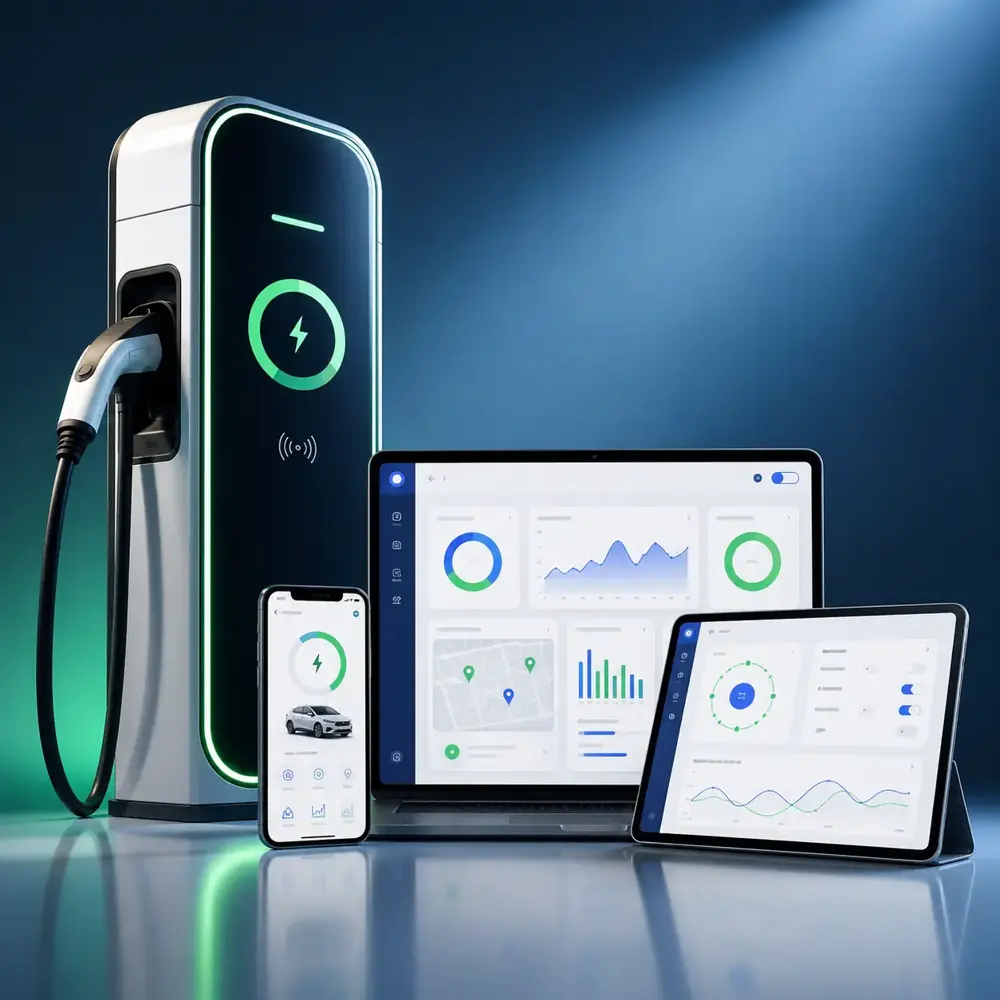
A branded EV driver app is a cornerstone feature. It allows charging networks to offer drivers a seamless mobile experience under their own logo and style. The app lets users find stations, start/stop charging sessions, track progress, and pay – all while reinforcing the network’s brand. For CPOs and property owners, a polished app boosts customer trust and loyalty, making the service feel like a natural extension of their business. For example, a hotel that provides a custom charging app can engage guests directly and upsell parking or amenities through the same interface. Studies show that consistent branding (like colors, logos, and UI) is a key benefit of white-label solutions. In short, a native EV driver app with your own name on it is not just a convenience; it’s a marketing and retention tool that helps EV drivers identify and choose your charging network over others.
Charging Station Monitoring and Management
 Operators need real-time visibility into station health and usage. A robust charging station management system lets CPOs monitor all chargers across locations in one place. The admin dashboard (or CPO dashboard) typically displays charger statuses (online/offline, available/in-use) and flags faults or outages. This monitoring is vital: it means technicians can respond immediately if a charger goes down, minimizing downtime. For example, if a charger at a public lot reports an error, the platform can alert staff automatically. Meanwhile, operations staff use the same interface to assign chargers to locations, set up new stations, and update firmware remotely. Major EV software vendors note that their platforms provide “robust tools for monitoring, managing, and optimizing” the charging infrastructure. In practice, better station management means fewer support calls, happier drivers, and higher uptime.
OCPP Compatibility
OCPP (Open Charge Point Protocol) is the industry standard that allows chargers and software to interoperate. A top-tier white label system supports OCPP so it can communicate with hardware from any manufacturer. This hardware-agnostic design prevents “vendor lock-in” – meaning you aren’t forced to buy one brand of chargers. For example, if a CPO buys some fast chargers from Manufacturer A and others from B, OCPP compatibility lets them all plug into the same backend. TrendPower’s expert team emphasizes that OCPP support gives operators “more flexibility when choosing charger brands”. It also future-proofs the network: as new chargers enter the market, OCPP ensures they can be added without custom integration. In short, look for “OCPP EV charging software” that explicitly supports OCPP 1.6, 2.0.1, or later. This open-standard approach increases options and avoids costly reworking of the system if you expand your network.
Smart Pricing and Billing
A flexible pricing engine is key to maximizing revenue and fairness. The software should support multiple pricing models: by time (e.g. per minute), by energy (per kWh), fixed fees, memberships, or special rates for fleets and employees. For instance, a CPO might charge lower rates overnight to encourage off-peak use, or offer corporate plans at discounted rates. According to TrendPower’s guide, a complete platform “should support different pricing models” including energy-based and subscription plans. This smart billing capability lets operators tailor rates to demand, incentives, or customer type. Dynamic pricing (e.g., cheaper electricity at night or higher rates during peak hours) can boost margins and balance grid load. Many platforms even allow location-based tariffs (higher at airports vs. residential areas). In practice, having fine-grained pricing control helps operators experiment and optimize: one fleet manager could set capped session costs per vehicle, while a mall charges 50¢/kWh with a time surcharge. The result is smoother operations and clearer revenue – every session is tracked and billed accurately.
Payment Gateway Integration
A white label platform must turn those charging sessions into revenue seamlessly. That means payment integration with common gateways and methods. Ideally, the software already supports credit/debit cards, digital wallets (Apple Pay, Google Pay), and RFID cards. This avoids the hassle of building your own payment processing. As EV industry experts note, a new charging operator “will need to ensure they are integrated with a payment processor” that handles preferred customer payment methods. Established platforms often handle multiple currencies, taxes, and fleet cards out of the box. For example, TrendPower’s own solutions include “payment and billing tools” that can integrate credit cards and prepaid accounts. By contrast, a network without payment integration might lose customers who expect one-tap charging. With built-in gateways, drivers simply swipe or tap to pay, and operators get automated invoicing. Seamless payment processing also means faster setup – it’s far cheaper to enable Stripe or PayPal in a proven system than to develop a custom billing backend from scratch. In summary, make sure the software offers turnkey payment support so you can collect fees immediately and comply with local tax rules.
User Management and Access Control
Controlling who can charge, and how, is crucial for security and organization. The software should include user and access management: the ability to create accounts for drivers, admins, technicians, and set their permissions. For instance, a company fleet operator might give drivers permission to access all stations, while restricting guests to certain locations. Similarly, admins can be tiered by role: some may view analytics only, others can adjust pricing or deactivate stations. White label systems typically include this. TrendPower’s FAQ notes that fleet managers can “control driver access” to private chargers, which is essentially user management. Another vendor explains: “User & Session Management” lets you handle authentication, tariff settings, and session tracking to improve both efficiency and user experience. With role-based access, operators avoid misuse (e.g. preventing external users from free charging at employee-only stations) and simplify billing (e.g. precharging company accounts). In short, look for features like user groups, RFID card assignment, and remote authorization – they keep the system secure and organized as the user base grows.
Real-Time Analytics and Reporting
Data is gold for any charging network. The platform should offer real-time analytics and reporting dashboards that show energy usage, station performance, peak times, revenue by location, and more. TrendPower highlights that analytics can reveal revenue, usage, peak times, and energy consumption. For example, a CPO could see a weekly report showing one fast charger is used 90% of the time on weekdays, suggesting expansion there. Reports on idle time or frequent faults guide maintenance and planning. By analyzing user behavior (which stations they use, session lengths, etc.), operators can optimize pricing or add stations where demand is rising. Equipped with charts and exportable data, decision-makers can justify new deployments and improve ROI. As one charging software vendor puts it, “analytics and reporting” help operators optimize pricing, improve uptime, and plan future expansion. In practice, having built-in reports saves managers hours of manual spreadsheets – key metrics are just a click away.
Roaming and Interoperability
Modern EV charging is moving towards open roaming. The software should support roaming protocols (like OCPI) so drivers of one network can use chargers on another network seamlessly. In other words, your white label software should enable transparent roaming. Industry sources explain that OCPI “ensures interoperability” and allows drivers to charge across diverse networks using their “home” CPO app. This means your network’s chargers can accept customers from partner networks without complex integrations. For CPOs, that translates into higher utilization and customer satisfaction: roaming gives drivers more charging options (so they’re less likely to range-anxiety) and can generate new revenue from visiting EV drivers. European regulators even mandate open data for stations, making protocols like OCPI a de facto requirement. In short, ensure the software supports open roaming standards so that your chargers appear in third-party apps and can handle external sessions securely. The benefit is a bigger potential customer base and a simpler user experience for all parties involved.
Remote Troubleshooting and Maintenance
Downtime is costly. The best platforms enable remote diagnostics and maintenance so issues can often be fixed without an onsite visit. Look for features like remote start/stop of sessions, rebooting chargers, and firmware updates over-the-air. For example, Ampeco’s platform lets operators remotely unlock cables, restart sessions, and update firmware to add features. Remote maintenance tools can detect faults immediately (through constant monitoring) and attempt automated recovery. TrendPower notes that with real-time issue detection and fault-recovery algorithms, chargers can be back online within minutes without needing a technician on-site. Imagine a charger goes offline: the system logs an error, notifies staff, and may even auto-reset the charger or offload sessions to nearby stations. This reduces downtime and cuts travel costs. In practice, companies have reported saving thousands by avoiding needless site visits. As one EV software provider puts it, remote maintenance “cuts costs and increases network reliability” by handling diagnostics and repairs from the cloud. Thus, remote troubleshooting should be a must-have in your list.
Scalability for Future Growth
Finally, the platform must scale as your network grows. A small pilot system of 5 chargers has different needs than a large network of 500. The software should accommodate growth in stations, users, and transactions without a performance hit. TrendPower emphasizes that scalable charging software can handle more users, stations, and data as the business expands. In practical terms, this means cloud-based architecture and modular design. You should be able to add new sites or markets by simply configuring more chargers in the dashboard. For example, Driivz and others report that their enterprise platforms now manage hundreds of thousands of charge points globally thanks to early scalability designs. Look for features like automatic load balancing across sites and cloud data storage. The aim is simple: you shouldn’t have to rip and replace your entire system when you double your network size. A truly scalable platform grows with you, letting CPOs focus on deploying hardware and customers rather than rebuilding software.
Conclusion
Selecting the right white label EV charging software with all these features is a strategic decision. A powerful white label EV charging software platform – complete with branded EV driver apps, real-time station monitoring, OCPP/roaming support, smart billing, payments, and more – becomes the digital backbone of your charging business. When features are well chosen, operations become smoother: stations stay online, drivers have a great experience, and revenue collection is automatic. In short, the right feature set lets CPOs, fleet operators, and property owners run a professional EV charging network under their own brand. As TrendPower advises, investing in a comprehensive EV charging management platform positions a business to serve more drivers, generate revenue efficiently, and grow with the market.
Contact Us
Don’t take our word for it.
Try it now for free.

Top Features to Look for in White Label EV Charging Software: Frequently Asked Questions
Learn key features of white label EV charging software: branded driver apps, station monitoring, OCPP compliance, smart billing, and payment integration.
It’s a ready-made EV charging platform that businesses can rebrand and deploy under their own name. It typically includes a branded driver app, an admin (CPO) dashboard, station management tools, billing modules, and analytics. In other words, you don’t build from scratch – you customize an existing software suite to fit your brand and needs.
OCPP (Open Charge Point Protocol) is the common language chargers use to talk to software. Supporting OCPP means your system can connect with virtually any OCPP-compliant charger. This gives you flexibility to mix different charger brands and avoid lock-in. In practice, OCPP-enabled software lets operators “manage chargers from different manufacturers through one platform”, which greatly simplifies expansion and hardware upgrades.
Built-in payment gateways turn charging sessions into revenue seamlessly. White label platforms usually integrate popular payment methods (credit cards, Apple/Google Pay, fleet cards, etc.), so drivers can pay easily. This saves you from setting up a new payment infrastructure. As industry experts note, existing charging software often accepts multiple payment methods and is kept up-to-date on local tax/regulations. With integrated billing, drivers pay without friction and you avoid manual invoicing, meaning faster cash flow and better compliance.
Smart billing lets you use different pricing models to maximize income and fairness. For example, you might charge per kWh, per minute, or have subscription plans, special off-peak rates, or hourly caps. Modern platforms allow customized tariffs by time, energy, user type, or location. This flexibility helps CPOs run promotions, incentivize demand response, or offer fleet contracts. The right billing tools will automatically calculate charges based on your rules and generate invoices, so each session is billed correctly without manual effort.
User management features let you create and control accounts and permissions. You can assign drivers or tenant accounts to specific charger groups, and define admin roles. For example, a property owner can give each tenant access to their own garage chargers only. User management also ties into payments: you can set up pre-paid accounts or restrict charging to authorized users. This controls access, prevents unauthorized use, and streamlines fleet operations. One white-label provider notes that fleet operators use the software to “manage private chargers” and “control driver access”, which directly reduces misuse and billing errors.
Roaming is the ability for drivers to use chargers across different networks using a single account. Protocols like OCPI enable this interoperability. Supporting roaming means more drivers can charge at your stations (e.g. a visiting EV from another city) without you having to negotiate individually with each network. It effectively enlarges your customer base. Interoperability also eases regulations (such as EU mandates on open data) by standardizing how station info and pricing are shared. In short, roaming compliance keeps you connected to the wider charging ecosystem and simplifies the user experience.
Scalability means the software can handle growth – more chargers, stations, and drivers – without slowing down. As your network doubles or goes international, a scalable platform will expand accordingly. This involves cloud servers, database handling, and efficient APIs. In practical terms, if you start with 10 chargers and later add 100, a scalable system lets you onboard them quickly and keeps performance snappy. TrendPower highlights that scalable management software makes it easier to grow without “constantly rebuilding the technology stack”. The result: you can seize new markets or add more vehicles to a fleet without fearing tech bottlenecks, keeping your expansion agile and cost-effective.

 EN
EN  ZH
ZH  AR
AR  DE
DE  ES
ES  KO
KO  JA
JA  IT
IT  FR
FR  VI
VI  MS
MS  ID
ID  FR_CA
FR_CA  NL
NL  SV
SV  EN_GB
EN_GB  TH
TH 