
 French (Canada)
 English (United States)
 Chinese
 Arabic
 German
 Spanish
 Korean
 Japanese
 Italian
 French (France)
 Vietnamese
 Malay
 Indonesian
 Dutch
 Swedish
 English (UK)
 Thai
EV charging software in the Philippines needs to connect compatible chargers with local payment methods, clear driver instructions, and dependable station operations. An OCPP connection is only the beginning: a commercial service must also price the session, confirm payment, handle failures, and give operators records they can reconcile.
For charger manufacturers, charging point operators, and local project partners, choosing the software platform is therefore an operational decision. The right question is whether the complete service works for Philippine users and the teams responsible for it.
This guide uses TrendPower’s Philippine deployment with a Beijing-based partner to explain software requirements, Security Bank QR Ph integration, multilingual interfaces, and launch testing. It focuses on building an operating service rather than forecasting EV sales or repeating a general market overview.
Start with the Requirements Behind the Philippine Case
In Q2 2026, TrendPower partnered with a Beijing-based company to deliver a Philippine EV charging operations platform. The project combined OCPP 1.6 connectivity, English–Chinese–Filipino interfaces, and Security Bank QR Ph payment integration supporting participating banks and wallets, including GCash and Maya.
Dedicated interfaces served drivers, station teams, and central administrators. The delivery scope also included server deployment and hardware integration. Together, these elements connected the charging equipment with the people and commercial processes needed to operate it.
Le Philippine charging platform case study provides the project context. Its practical lesson is that localization involves the whole transaction, from identifying the correct connector to recording the final payment and resolving a support request.
Define the Charging Business Before Selecting Features
A mall, hotel, public charging hub, and private fleet depot have different access and settlement needs. Decide who can charge, who sets the tariff, which entity receives payment, and who provides first-line assistance.
Then define the driver journey. A frequent user may prefer an app with account history, while an occasional visitor may benefit from a mobile-browser flow where available. If reservations, memberships, or fleet accounts are required, describe those workflows before commissioning the interface.
The operating model also determines reporting. A single owner may need one consolidated statement; a platform serving multiple site partners may need separate permissions and settlement reports. Agree on the boundaries so one station manager cannot see another partner’s financial information.
For wider market context, see TrendPower’s Philippine EV charging infrastructure overview. For platform selection, turn those market opportunities into specific requirements: site types, charging equipment, users, payment arrangements, and support responsibilities.
Test OCPP Compatibility with the Actual Chargers
Le Open Charge Alliance defines OCPP as the communication protocol between charging stations and charging management systems. It supports interoperability, but a version label alone does not prove that every desired function works across a particular hardware and software combination.
The Philippine case used OCPP 1.6. For a new project, record each charger’s manufacturer, model, firmware, connector configuration, supported protocol, and connection settings. Test the exact equipment intended for deployment instead of relying on a demonstration with a different charger.
A practical integration test should cover registration, status changes, authorization, remote start and stop, transaction records, meter values, and reconnection after an interruption. Where remote reset or other operational commands are required, include them explicitly in the scope.
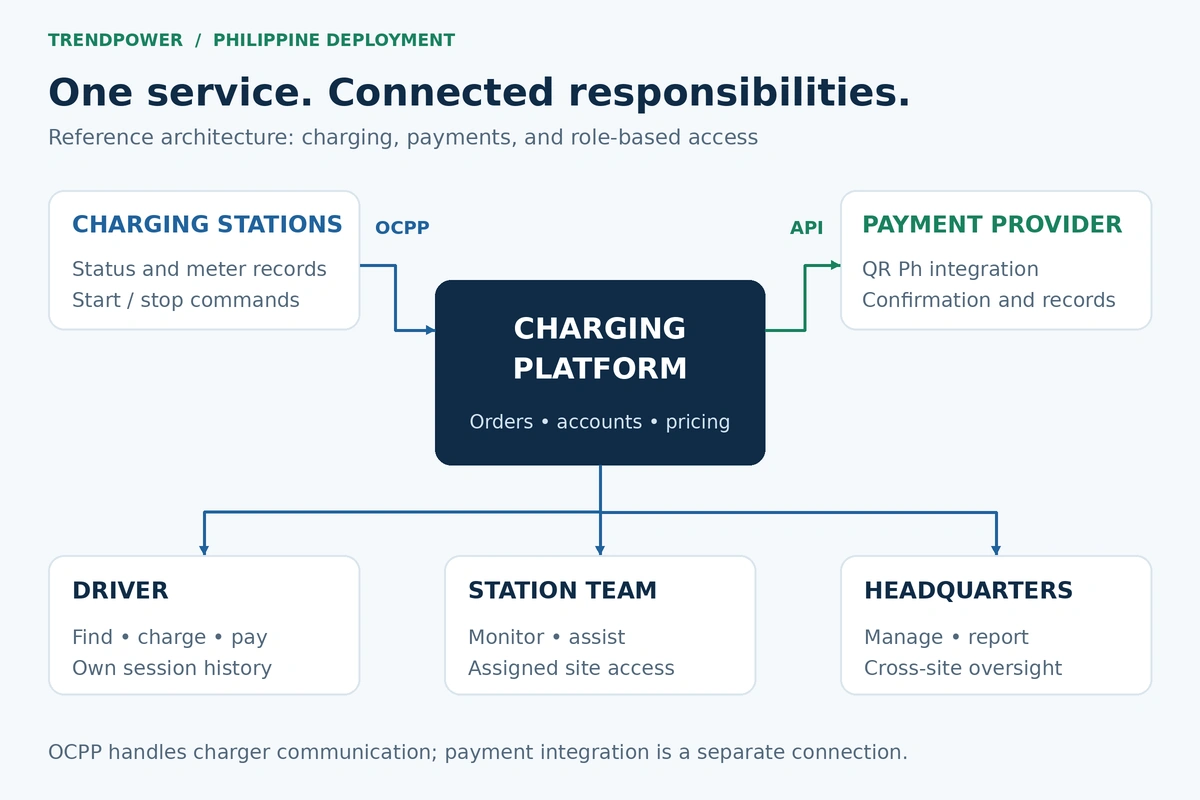
Keep charger communication separate from payment processing in the design. OCPP does not by itself establish a Philippine merchant account, integrate a wallet, or decide when a payment is settled. A complete système de gestion des points de recharge connects those functions through application logic and appropriate integrations.
For future equipment additions, agree on a repeatable compatibility process. Document which tests must pass when firmware changes or a new charger model joins the network.
Plan QR Ph, GCash, and Maya Around the Payment Workflow
Local payment support needs more precision than adding wallet logos to a checkout screen. Determine which payment service provider serves the operator, how transactions are confirmed, and how payment records connect with charging orders.
The Bangko Sentral ng Pilipinas describes QR Ph as an interoperable national QR standard used by participating banks and non-bank electronic money issuers. This enables payment interoperability; it is not a replacement for merchant onboarding or the software integration with a payment provider.
In TrendPower’s case, the platform connected to Security Bank’s QR Ph service. The project supports participating payment channels including GCash and Maya. For a new deployment, include the intended wallets and banking apps in the agreed acceptance tests.

Choose the commercial flow deliberately. A prepaid wallet, a fixed charging budget, and a session-based payment arrangement create different requirements for balances, unused funds, receipts, and support. The available flow must match the provider’s capabilities and the operator’s agreement.
Also distinguish the charger’s identification QR code from a payment QR code. One may identify a connector and open the charging page; the other initiates a payment. Clear instructions prevent users from assuming that scanning either code has already started the vehicle’s charging session.
Make Payment Confirmation and Charging Start Work Together
A payment success message and an active charging session are two separate events. The software must connect them without assuming that either one proves the other.
For a prepaid flow, for example, the platform should receive and validate the payment result, associate it with the correct order or wallet, and then follow the defined charging authorization process. A browser returning to a success page is not sufficient evidence of a confirmed payment.
Test delayed notifications and repeated callbacks. A repeated payment notification must not credit the account twice. If a notification arrives after the driver has left the page, the transaction should still become visible in the correct account and support record.
Next, test a successful payment followed by a charger that cannot start. The driver needs a clear status, and the operator needs an agreed resolution path, such as restoring usable credit or processing an eligible refund. Do not leave the user with an unexplained deduction.
TrendPower solution de paiement pour la recharge des véhicules électriques is relevant to this connection between session records and commercial transactions. During procurement, request a demonstration of both successful and failed flows, including the final settlement export.
Localize Instructions, Prices, and Support Messages
The Philippine project supports English, Chinese, and Filipino. This helps connect the overseas partner’s team, local operators, and drivers, but language selection should extend beyond navigation labels.
Translate the actions that determine whether a user completes a session: selecting a connector, reviewing a price, confirming payment, starting charging, understanding a failure, and obtaining assistance. A translated homepage cannot compensate for an untranslated payment error.
Keep prices in the intended currency and display kW and kWh consistently. Power indicates the charging rate; energy indicates the quantity delivered. Confusing these units makes a live session screen difficult to understand and can create billing disputes.
Test longer translations on small screens, slow connections, and ordinary phones. Make the selected station, connector, amount, and next action easy to identify. Provide a support route that local users can actually access during the station’s operating hours.
Give Drivers, Station Teams, and Headquarters Different Views
The case separates the platform into driver access, a station management interface, and a central PC administration portal. This is a useful model because each role needs different information and permissions.
| Rôle | Primary tasks | Useful boundaries |
|---|---|---|
| Conducteur | Find a charger, review the price, charge, pay, view history | Access to their own sessions and account |
| Station team | Monitor equipment, investigate faults, assist users | Assigned sites and approved remote actions |
| Quartier général | Manage sites, commercial settings, reports, and partners | Role-based financial and administrative permissions |
Define who can change tariffs, approve refunds, export records, and issue remote commands. Keep an audit trail for sensitive actions. A site team should be able to help a stranded driver without automatically receiving access to every commercial setting.
Escalation paths also matter. Identify when the station team should contact the hardware supplier, software support, or payment provider. Give all parties a shared order reference so the same issue can be traced across systems.
Agree on Deployment, Data Access, and Support Ownership
Server deployment should be specified alongside application functions. Agree on the hosting arrangement, operating responsibility, backups, monitoring, and recovery process. Clarify who maintains integrations when charger firmware or payment requirements change.
Ask how operational and transaction records can be exported, which identifiers remain stable, and how access is removed when an employee or partner leaves. These questions determine whether the business can continue managing its own records as the network grows.
Separate software delivery from station installation and market-specific administrative work. Assign each responsibility to a named project party, with clear handover evidence. This creates a practical implementation plan without treating software deployment as a substitute for the rest of the project.
UN custom charging software project should document what is configured, what is integrated, and what requires additional development. That distinction helps the partner compare proposals and plan a realistic launch sequence.
Run a Philippine Charging Platform Acceptance Test
A launch checklist should follow the complete driver journey and the operator’s closing process. Use the production-intended charger, payment arrangement, and language interfaces in a controlled pilot before expanding to more sites.
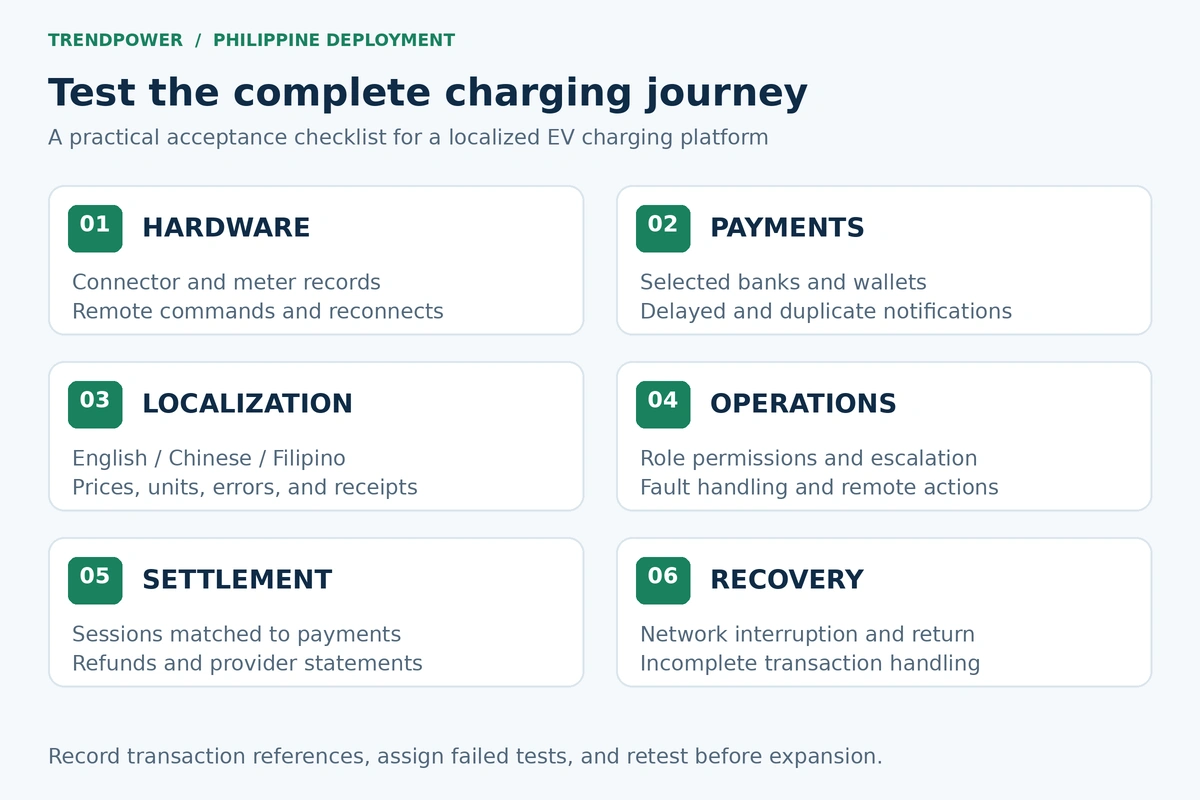
- Hardware: verify connector identification, state changes, meter records, remote commands, and reconnect behavior.
- Paiements : test the selected banks or wallets, delayed confirmation, duplicate notifications, and failed charging after payment.
- Localization: review prices, units, instructions, error messages, and receipts in every supported language.
- Opérations : test role permissions, fault escalation, remote actions, and access to support records.
- Settlement: match completed sessions, payment records, refunds, and the provider’s settlement information.
- Récupération: test network interruption, restored connectivity, and the handling of incomplete transactions.
Record results with transaction references rather than a general “passed” label. A failed test should have an owner and a retest condition. Finance and local station staff should participate alongside the software and hardware teams.
After launch, monitor charging-start success, payment-confirmation failures, unresolved transactions, and support response. Define each measure consistently. These operational signals are more actionable than counting registered users without knowing whether they can complete a charging session.
Review the First Month by Transaction Outcome
After the pilot, review where users stop progressing through the charging journey. A station can appear online while drivers repeatedly fail at connector selection, payment confirmation, or charging authorization. Separate those stages in reporting so the operating team can identify the actual problem.
For a charging-start success measure, define the denominator: for example, eligible start requests rather than every visit to the station page. For payment issues, distinguish a user abandoning checkout from a confirmed payment that remains unmatched to an order. Those events require different responses.
Review unresolved transactions with the local support team and finance. A driver complaint should be traceable through the order reference to the charger event and payment record. When a refund or balance correction is completed, retain the link to the original issue.
Use these findings to improve instructions, escalation procedures, and integration behavior before adding more locations. Expansion should carry forward a tested operating process, including training and reporting, rather than only a copied charger configuration.
This review also helps distinguish product changes from training needs. If drivers consistently select the wrong connector, improve identification and instructions. If the correct connector is selected but remote authorization fails, investigate the charging integration with its transaction logs.
Compare Software Proposals by Demonstrated Workflows
Ask each supplier to demonstrate the same scenario: a driver identifies a connector, reviews a Philippine-peso price, pays through the agreed channel, charges, and receives a transaction record. Then repeat the scenario with an interruption.
Compare the integration scope, local payment arrangement, supported languages, operator permissions, data exports, and ongoing support responsibilities. A short feature list may conceal substantial differences in what is included or who must implement it.
Request written acceptance criteria and a sample settlement report. These make proposals easier to compare and create a shared definition of a usable deployment. The strongest fit is the platform that can support your actual sites, equipment, and operating team.
Foire aux questions
What should EV charging software in the Philippines include?
Prioritize tested charger connectivity, local payment integration, clear driver instructions, pricing, transaction records, station monitoring, and role-based administration. Add reservations, fleet accounts, or partner settlement where the business model requires them.
Can GCash and Maya be used for charging payments?
They can be supported through an appropriate payment integration. TrendPower’s Philippine project uses Security Bank QR Ph connectivity. Confirm the intended payment channels and complete transaction tests under the operator’s merchant arrangement.
Is OCPP compatibility enough to launch a station?
No. OCPP addresses charger-to-platform communication. A working service also needs payment processing, pricing, user access, operations, support, and the other project arrangements necessary for the site.
Why test refunds and failed sessions before launch?
These tests reveal whether the platform can connect payment status with charger activity when something goes wrong. They establish what users see, how staff investigate the issue, and how the account is corrected.
Plan Your Philippine Charging Software Deployment
Send TrendPower your charger models, planned locations, payment preferences, language requirements, and operating structure. Use the Philippine case as a reference, then build a scope and acceptance plan around your own charging business.
Discuss Your Philippine Platform